
Pricing
Drop-Model Economics: Hype, Scarcity and Margin
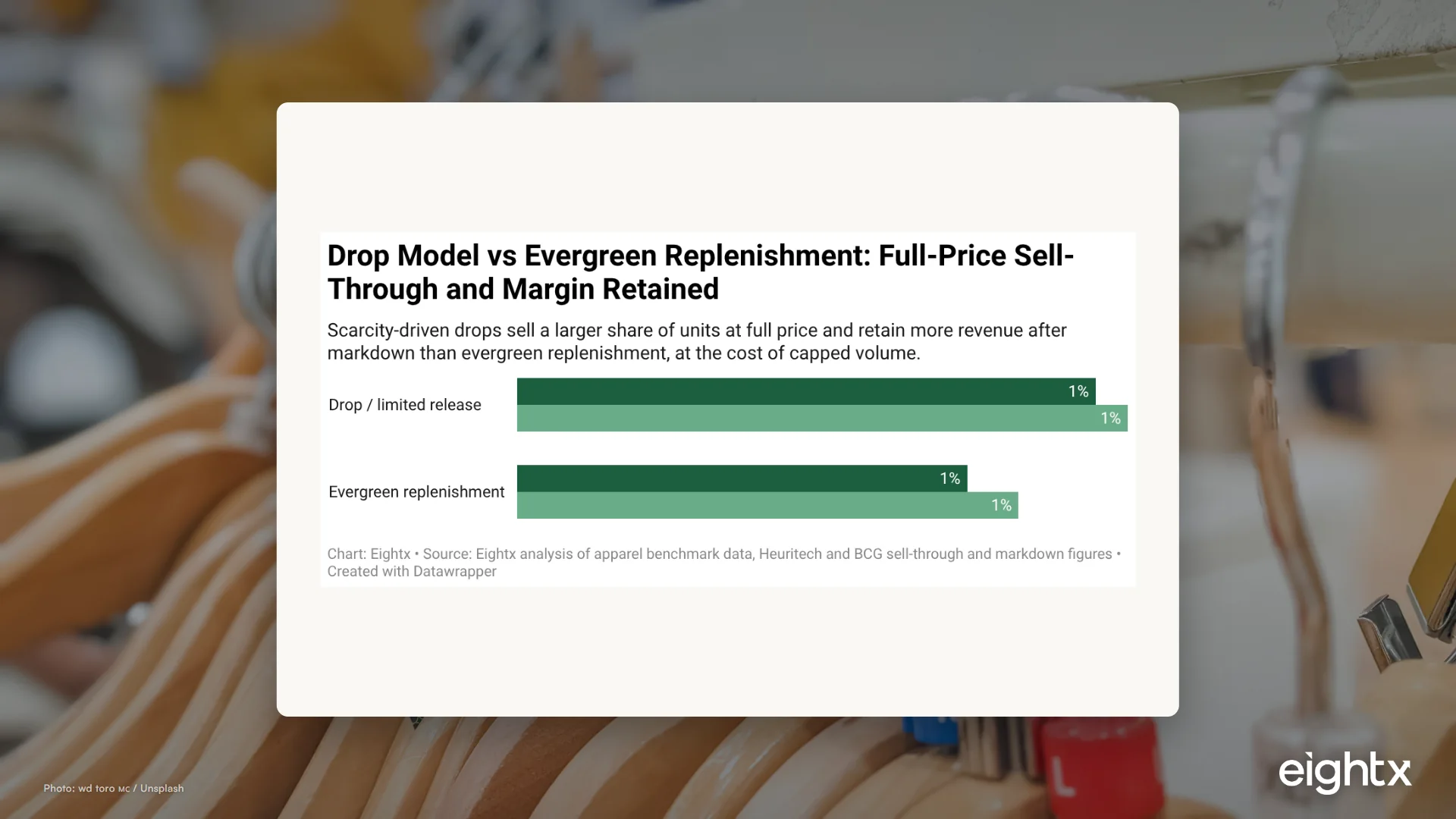
The drop model trades volume for margin. By capping supply and pre-committing demand, scarcity can drive full-price sell-through close to 90 percent (illustrative of strong execution) versus 60 to 80 percent for evergreen lines, so far less revenue is lost to markdown and inventory risk drops sharply. The cost is a hard ceiling on volume and concentrated operational strain at launch.
Key Takeaways
- Well-run drops can clear close to 90 percent of units at full price (illustrative of strong execution, not a published statistic) versus the 60 to 80 percent industry range for evergreen apparel, and that gap is what funds the whole model.
- Markdown is the silent margin tax: fashion brands globally spend over 1 trillion dollars a year on markdowns, and a drop's job is to avoid joining that line item.
- Pre-committed demand (waitlists, app reservations, known community) lets you buy small and fast, cutting the four-plus months of inventory days a typical apparel brand carries.
- The catch is volume: scarcity caps revenue per release and you forfeit upside when a product overperforms, because there is little replenishment runway.
- Drops do not fix returns. Online apparel still runs 20 to 30 percent returns, so fit and sizing discipline matters as much in a drop as in replenishment.
Every apparel founder eventually asks the same question: should I keep my best styles in stock and reorder, or should I run them as limited drops and let scarcity do the work? It is not a marketing question. It is a margin and cash question, and the math is clearer than most people expect.
The drop model is a trade. You give up volume and you take on operational concentration. In exchange you get full-price sell-through, almost no markdown, and a much lighter inventory bet. For a category where markdown is the single largest silent tax on the P&L, that trade is often worth making, but only if you size it correctly.
What the drop model actually does to the P&L
Strip away the hype and the drop model is a sell-through machine. The whole point is to match supply to a demand you have already pre-committed, so almost everything sells at full price.
That matters because markdown is the defining cost of apparel. BCG estimates fashion retailers globally spend more than 1 trillion dollars a year on markdowns. Evergreen apparel lines typically run full-price sell-through in the 60 to 80 percent range, with luxury deliberately targeting closer to 50 percent breadth to protect exclusivity. The remaining units get discounted, and every discounted unit comes straight out of gross margin.
A well-run drop flips that. By capping the buy and concentrating demand into a short window, the best-executed drops aim to clear close to 90 percent of units at full price (a figure illustrative of strong execution rather than a published benchmark). On a 55 percent gross margin product, moving full-price sell-through from 70 percent to 90 percent is not a rounding error. It is the difference between a healthy release and a markdown cleanup project.
When I talk to founders running a brand this size, the number that stops them cold is not the top line, it is how much margin they handed back at the end of season. One operator I worked with was clearing leftover stock at 40 percent off twice a year and treating it as normal. Once we put the markdown dollars next to the full-price revenue, the case for tightening the buy made itself.
Scarcity drives sell-through and kills markdown
Scarcity works because it removes the customer's option to wait. In an evergreen world, a shopper who likes a jacket knows it will be cheaper in eight weeks, so a meaningful share of demand sits on its hands until the markdown. In a drop, waiting means missing out. That collapses the timeline and pulls demand to full price.
The financial consequence shows up in three places at once. First, gross margin: fewer marked-down units means you keep more of the 45 to 68 percent gross margin range that fashion brands carry. For context, the typical ecommerce discount rate runs about a 15 percent median, and apparel sits at the high end, so the markdown a drop avoids is real money. Second, contribution margin: fashion CM3 sits at only 10 to 20 percent after CAC, so margin you do not give away to markdown is margin you actually keep. Third, brand equity: a brand that rarely discounts trains customers to buy at full price next time too, which compounds.
If you want the full picture of how discounting erodes apparel profitability, the mechanics are covered in detail in our apparel markdown strategy breakdown. The drop model is essentially a structural answer to that problem.
Pre-committed demand cuts inventory risk and frees cash
The second financial advantage of drops is on the balance sheet, not the P&L. Apparel is structurally slow inventory. Even the operationally best public apparel brands carry months of stock: in our 9-company apparel benchmark, for the most recent reported fiscal year Lululemon runs about 128.8 inventory days and the DTC comp Revolve runs 161.3 days, partly because curated buying means committing to inventory ahead and absorbing markdown risk.
Drops attack that directly. When demand is pre-committed through waitlists, app reservations, or a known community, you can buy small and buy fast. You are no longer forecasting a large seasonal bet six months out and praying. You are allocating against demand you can already see. That shrinks the working capital you sink into each release, shortens the cash conversion cycle, and reduces the chance of a leftover-inventory writedown.
The pattern we see again and again is founders who feel cash-poor despite growing revenue, because nearly everything they earn is sitting in boxes. When we have worked through this with operators carrying 140-plus inventory days, the fix is rarely a new sales channel. It is buying tighter against demand they can actually verify, which is exactly what a drop forces you to do.
For brands feeling this most acutely, a true pre-sell takes it further: see how the apparel preorder cash model lets customer cash fund the production run before you cut a single unit. Drops and preorders are cousins, both designed to pull cash and demand forward.
The catch: volume cap and operational strain
None of this is free. The drop model has two real costs, and ignoring them is how founders get burned.
The first is volume. Scarcity is the engine and the constraint at the same time. By definition you are leaving demand on the table, and when a product overperforms you usually cannot capture the upside because there is no replenishment runway. A blockbuster evergreen style can be reordered three times in a season. A blockbuster drop sells out and the revenue ceiling is whatever you bought. That caps top-line growth in a way founders chasing a number need to plan for.
The second is operations. Drops compress fulfillment, customer service, and cash timing into spikes. A launch that moves most of a buy in 48 hours strains your warehouse, your support queue, and your payment processing all at once, then goes quiet. When we talk to founders who have run a few drops, the regret is almost never about pricing. It is about a launch day where the 3PL fell behind, support drowned, and the brand goodwill they built evaporated in a wave of where-is-my-order emails. And drops do not solve the universal apparel problem: returns. Online apparel return rates average 24.4 percent in the US, and fashion as a whole runs 20 to 30 percent. A drop that sells out at full price can still bleed margin if a quarter of it comes back. Fit, sizing, and product description discipline matter as much here as anywhere.
Drop vs evergreen: the side-by-side
Here is how the two models compare on the metrics that actually move the financials.
| Metric | Drop / limited release | Evergreen replenishment |
|---|---|---|
| Full-price sell-through | ~90% (well executed) | 60 to 80% |
| Markdown exposure | Low, scarcity prevents overstock | Structural, the $1T+ category tax |
| Inventory risk | Low, buy small, demand pre-committed | Higher, forecast-driven seasonal buys |
| Cash conversion | Fast, cash pulled forward | Slower, 120 to 160+ inventory days |
| Volume per style | Capped by design | Scalable via reorders |
| Operational load | Spiky, concentrated at launch | Steady, predictable |
| Revenue forecastability | Lumpy, launch-dependent | Smoother, easier to plan |
The honest read: drops win on margin, markdown, and cash. Evergreen wins on volume, forecastability, and operational smoothness. They are not competitors so much as two tools for different jobs.
What to do about it
If you are weighing a drop strategy, here is how I would approach it as your CFO.
- Run the full-price sell-through math before you commit the buy. Model the drop at 85 to 90 percent full-price sell-through and the evergreen alternative at 70 percent with markdown on the rest. Compare gross margin dollars retained, not units. The markdown you avoid is the whole case.
- Size the buy to sell out, not to maximize revenue. The discipline that makes drops work is buying less than you think you can sell. A sellout protects margin and brand equity. An almost-sellout with a markdown tail gives back the advantage.
- Pre-commit demand before you produce. Use waitlists, app reservations, or community signals to validate demand. If you can convert that into a preorder, you fund the production run with customer cash and take inventory risk close to zero.
- Stress-test your operations for the spike. Confirm your 3PL, support, and payment stack can absorb most of a buy moving in 48 hours. A drop that sells out but ships late burns the brand equity you just built.
- Keep an evergreen core for cash predictability. Pure drop models are lumpy and hard to finance. Most brands at 5 to 50 million dollars should run a hybrid: a steady evergreen core that funds overhead, plus periodic drops that protect margin and create demand events. If you also sell into retail, build the buy on a price list that holds up across wholesale and DTC so a drop does not undercut your accounts.
- Watch returns as closely as sell-through. A 90 percent full-price sellout with a 28 percent return rate is not the win it looks like on day two. Track net sell-through after returns, and invest in fit and sizing accuracy.
Sources and methodology
Full-price sell-through ranges (60 to 80 percent evergreen, with luxury near 50 percent) are drawn from fashion retail sell-through research; the roughly 90 percent figure for well-run drops reflects the scarcity model's design intent of rapid sellout with minimal markdown rather than a single published statistic, and should be read as illustrative of strong execution. Global fashion markdown spend of over 1 trillion dollars annually is from BCG. US online apparel return rate of 24.4 percent is from Coresight Research; the 20 to 30 percent fashion range and 10 to 20 percent fashion CM3 are from the Eightx contribution-margin benchmarks. Inventory days (Lululemon 128.8, Revolve 161.3, most recent reported fiscal year) are from the Eightx 9-company apparel benchmark sourced from SEC 10-K filings. For a deeper look at category economics, see the Eightx pillar guide for apparel brands.
Frequently Asked Questions
what is the apparel drop model?
The drop model is a limited-release strategy where a brand sells a capped quantity of product in a short window, often pre-announced, instead of keeping styles in continuous stock. Scarcity and hype concentrate demand so most units sell at full price with little or no markdown.
does the drop model actually improve margin?
Yes, on a per-unit basis. A well-executed drop can push full-price sell-through close to 90 percent (illustrative of strong execution, not a published statistic) versus the 60 to 80 percent range for evergreen lines, so you keep far more of your potential gross margin instead of giving it back in markdowns. The trade is lower total volume per release.
what is full-price sell-through and why does it matter?
Full-price sell-through is the share of units sold at the original price before any discount. It matters because every unit marked down erodes gross margin directly. Fashion brands globally spend over 1 trillion dollars a year on markdowns, so protecting full-price sell-through is one of the highest-impact moves in apparel finance.
what are the downsides of a drop model?
The downside is volume and operations. Scarcity caps how much you can sell per release and you forfeit upside when a product overperforms, because there is little replenishment runway. Drops also create concentrated fulfillment spikes that strain warehousing, customer service, and cash timing around each launch.
drop model vs evergreen replenishment, which is better for cash flow?
Drops are generally lighter on cash because you buy small, pre-commit demand, and avoid markdown clearance. Evergreen replenishment ties up more working capital in inventory days but supports steadier, more forecastable revenue. Most brands at 5 to 50 million dollars are best served by a hybrid: an evergreen core for cash predictability plus periodic drops for margin and demand.