
Insights
Step One Clothing (ASX:STP) teardown: A$86.9M revenue, 87% drawdown, and the AU DTC apparel lessons
Step One Clothing (ASX:STP) posted A$86.9M FY25 revenue, up 2.8%, but bought that profit by cutting Australian marketing, then took a A$10.9M inventory provision in 1H FY26 that collapsed gross margin from 78% to 43%. The shares are down 93% from their day-one peak. Here is what A$3-50M AU DTC founders should copy and skip.
Key Takeaways
- Step One Clothing (ASX:STP) reported FY25 group revenue of A$86.9M, +2.8% YoY, with NPAT A$12.7M (+2%). That growth was bought by cutting AU marketing, not by lifting demand. The flywheel stall is the story.
- The 1H FY26 result reset the narrative. Revenue fell 24.5% to A$36.3M, EBITDA flipped from +A$11.2M to -A$10.0M, and gross margin collapsed from 78% to 43% driven by a A$10.9M legacy-inventory provision.
- UK is the only international leg that worked. FY25 UK revenue grew 8.7% to A$29.5M (over a quarter of group). US/ROW stayed small and is still framed by management as test-and-learn.
- Founder Greg Taylor still controls the cap table. He sold 16.63M shares (8.97% of issued capital) at A$1.70 for A$28.2M in September 2024 and escrowed the remaining 57.91% until the FY25 result.
- From a A$2.75 day-1 close to A$0.18, the drawdown is 93% from peak. Market cap sits at A$32.8M on 182.4M shares. The 1H FY26 stock reaction (down ~17% on result day) was less about the half itself and more about the rebuild ahead.
If you run an A$3-50M Australian DTC apparel brand, Step One Clothing (ASX:STP) is the closest listed peer to your business. It is founder-led, pure-play, single-category, and went public in the same demand window that pulled forward every DTC operator's growth assumptions. The share price has fallen 88% from issue and 93% from day-one close, but the operational story underneath is more useful than the chart. This is what to copy and what to skip.
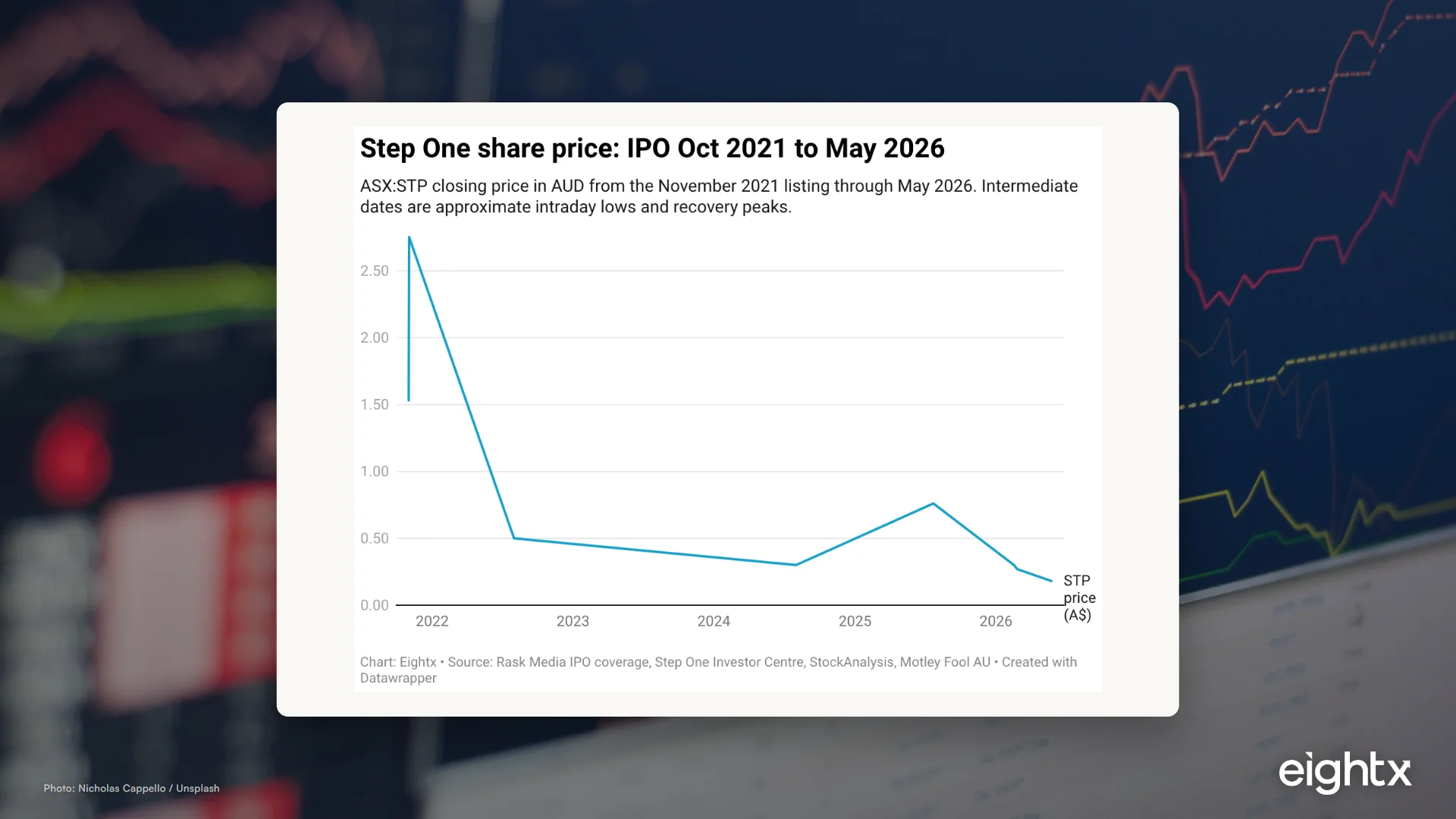
The arc in one chart: A$2.75 to A$0.18 in 54 months
Step One Clothing listed on the ASX on 1 November 2021 at an issue price of A$1.53. It closed day one at A$2.75 (up 79.7%), giving the company a roughly A$501M market cap on debut. Through May 2026 it trades at A$0.18 on 182.4M shares outstanding, a market cap of A$32.8M.
The drawdown breaks into four phases. Phase 1 is the post-debut profit-taking through to the August 2022 profit warning, which took the stock from A$2.75 to roughly A$0.50. Phase 2 is the two-year grind through to mid-2024, ending at a A$0.30 trough. Phase 3 is the FY25 recovery: the stock more than doubled into a A$0.76 peak in July 2025 on optimism about the result and the founder sell-down completing. Phase 4 is the 1H FY26 reset, where the inventory provision and the half-year EBITDA loss halved the share price again.
For an unlisted founder, the share price is not the lesson. What matters is the operational arc underneath. Every phase corresponds to a decision Step One made about marketing, inventory, or geography that you will face at your scale. The rest of this post walks through them in order.
The financial teardown, FY22 to 1H FY26
Step One's revenue line looks healthy at first glance. Group revenue went from A$72.2M in FY22 to A$86.9M in FY25, with a wobble through FY23. EBITDA improved from A$3.9M in FY22 to A$18.8M in FY24, then drifted down to A$16.7M in FY25. NPAT went from a loss in FY22 to A$12.7M in FY25.
The fragility shows up in two places. First, FY24 was the only year that materially out-grew the FY22 prospectus base. FY23 was actually below the IPO-year revenue line. FY25 was 2.8% above FY24 on revenue but the gross margin compressed from 80.8% to 76.4%, which means the absolute gross profit dollars went backwards (A$68.3M to A$66.4M). EBITDA went down by A$2.1M.
Second, the 1H FY26 result is not a normal half. Revenue of A$36.3M is down 24.5% on the prior corresponding period (PCP). EBITDA of negative A$10.0M reverses a positive A$11.2M PCP number. Gross margin of 43% versus 78% is the dominant driver, and that is the line that contains the A$10.9M inventory provision. The provision is non-cash in the half but it reflects real cost-of-goods commitments made in prior years against a category mix that has shifted.
| Period | Revenue (A$m) | Gross profit (A$m) | Gross margin % | EBITDA (A$m) | NPAT (A$m) |
|---|---|---|---|---|---|
| FY22 | 72.2 | 59.2 | 82.0 | 3.9 | -3.0 |
| FY23 | 65.2 | 52.6 | 80.7 | 11.1 | 8.6 |
| FY24 | 84.6 | 68.3 | 80.8 | 18.8 | 12.4 |
| FY25 | 86.9 | 66.4 | 76.4 | 16.7 | 12.7 |
| 1H FY26 | 36.3 | 15.6 | 43.0 | -10.0 | -8.5 |
If your business carries any material inventory commitment more than 12 months out, the 1H FY26 number is the chapter to read twice. Step One did not get into trouble because demand fell off a cliff. It got into trouble because the inventory book stopped matching where the brand was heading.
The AU to UK to US sequence: which leg actually worked
Step One's international story has been one market, not three. The FY25 segment commentary makes this clean.
Australia contributed A$63.3M in FY25, down 1.1% on FY24. The home market is now smaller than it was a year ago. The United Kingdom contributed A$29.5M, up 8.7% YoY, and the company has said TikTok Shop in the UK has been cost-effective and scalable as a customer acquisition channel. UK is now over a quarter of group revenue and the only region growing above the group rate.
| Region | FY25 revenue (A$m) | YoY (%) | Approx. share of group (%) |
|---|---|---|---|
| Australia | 63.3 | -1.1 | 72.8 |
| United Kingdom | 29.5 | +8.7 | 33.9 |
| US / Rest of world | n.d. | n.d. | n.d. |
| Total | 86.9 | +2.8 | 100.0 |
The US has been kept deliberately small since the AFR coverage in October 2021 described the brand "trying the US on for size." Almost five years later the company still does not separately disclose a US revenue number in its half-year commentary. That is not a failure on its own. It is the result of a conscious decision to test the market with a small spend envelope rather than chase scale.
The operator lesson is the sequence. The AU base bankrolled the UK launch. The UK launch produced returns. The US has been a test, not a bet. If you are running an A$5-15M brand thinking about going international, the data here is clear: UK first, US second, and treat the US as a multi-year option rather than a near-term growth engine.
Marketing as a profit lever, not a growth lever
This is the chapter that matters most for AU DTC operators in your seat right now.
In the FY25 results commentary, Greg Taylor said the company "made the decision to reduce marketing investment in the Australian market, ensuring a disciplined focus on profitability." NPAT lifted A$0.3M to A$12.7M (up roughly 2%). Group revenue grew 2.8%. Both numbers look acceptable in a profit-and-loss screenshot. The problem is that the lift was bought by subtraction, not addition.
When a DTC apparel brand cuts marketing in the home market to protect a profit print, two things tend to happen on a 12-18 month lag. New-customer acquisition slows, which means the customer file ages. And inventory built against a higher growth assumption starts to accumulate, because the demand that was supposed to clear it does not show up. Both of those threads are visible in the 1H FY26 result: AU revenue softness plus the A$10.9M legacy stock provision.
For an operator running A$3-50M revenue, the takeaway is not "never cut marketing." It is "if you cut marketing to print a profit, define the re-investment trigger before you cut, and align inventory commitments to the cut, not to the prior trajectory." Step One did the first decision (cut marketing) cleanly. The second decision (right-size the inventory book at the same time) was the gap.
The cap table: founder still in the chair, 57.9% in his name
On 26 September 2024 Step One issued a trading halt and disclosed that Greg Taylor had sold 16.63M shares (8.97% of issued capital) at A$1.70 in a block trade, for A$28.2M. Director Michael Reddie sold 2.01M at the same price. Greg Taylor's remaining 57.91% was placed in voluntary escrow until the FY25 result.
| Date | Event | Shares | Price (A$) | Proceeds (A$) | Post-event % held |
|---|---|---|---|---|---|
| 2021-11-01 | IPO listing | n.d. | 1.53 | A$81.5M raised | Founder majority retained |
| 2024-09-26 | Secondary sell-down (Taylor) | 16.63M | 1.70 | A$28.2M | 57.91% |
| 2024-09-26 | Voluntary escrow | Remaining stake | n.a. | n.a. | Locked until FY25 result |
Two things to note. First, A$1.70 is below the A$2.75 day-1 close and modestly above the A$1.53 IPO issue. It is not a top-tick exit. Second, the founder still holds the majority of the company, which means execution risk and decision authority both sit with one operator. For an AU DTC founder weighing institutional capital versus founder-control, this is the contrast point: Step One ran the post-IPO years founder-controlled, which preserved decision speed but also concentrated the read on three different markets in one head.
For your business, the read is less about the share price and more about the cap-table architecture. Founder-control plus public capital is a workable shape. The trade-off is that there is no internal counterweight when the marketing decision and the inventory decision need to balance against each other.
The Step One arc is not a story about a broken brand. It is a story about how a profit-focused decision in the home market plus an inventory book sized for a higher growth assumption combined to undo a year of recovery. Both decisions are common at A$50-100M DTC scale. The lesson is to make them as one decision, not two.
What an AU DTC operator copies and what they skip
Copy:
- Founder-controlled cap table at IPO if you ever take that route. Greg Taylor still owns more than half the company at A$32.8M market cap, which is the dominant reason this story is a rebuild and not a takeover.
- UK as the second market, not the US. Almost five years of comparison data inside one brand says the UK leg pays back and the US leg does not yet.
- An operator-grade tech stack: Shopify Plus, Klaviyo, Triple Whale, Gorgias, returns tooling, affiliate via Awin and ShareASale once you cross roughly A$30M revenue. The stack is similar to brands a third Step One's size and is not the bottleneck at any stage.
- The category extension play that Step One ran (women's, bralettes, socks, menstruation products) to lift AOV and repeat-purchase rate. The original prospectus disclosed a 45% repeat-purchase rate and that lever still has runway.
Skip:
- Cutting marketing to make a profit number without an inventory plan attached. The 1H FY26 result shows what happens when you do one without the other.
- Treating the US as both a long-term opportunity and a near-term growth driver in the same investor narrative. Step One has been clear it is the former, but the language often blurs.
- Carrying legacy inventory across a category transition. The A$10.9M provision is the cost of not unwinding stock decisions made against a prior growth trajectory.
For context on how Step One sits inside the broader ASX-listed DTC and ecommerce cohort, see the full 10-brand ASX DTC benchmark. Step One slots in at the bottom of the cohort by current market cap and is a useful reference point on margin sensitivity, geographic sequencing, and founder-controlled governance.
Sources and methodology
This teardown leans on the public disclosures listed below, with explicit notes on what was extracted directly and what was reconstructed.
Financial figures for FY22 through FY25 were sourced from the StockAnalysis aggregation of Step One's annual income statement (https://stockanalysis.com/quote/asx/STP/financials/), which is itself sourced from the company's lodged annual reports. The 1H FY26 figures (revenue, EBITDA, NPAT, gross margin, A$10.9M inventory provision) are from the 18 February 2026 results release as summarised by Motley Fool AU in the broker reaction coverage of 20 February 2026. We have not yet been able to text-extract the FY24 annual report PDF (7.7MB, binary-encoded) via automated tooling, so FY24 figures used here are the StockAnalysis aggregation, not a direct PDF lift. The FY25 annual report PDF was not located online at the time of writing; the FY25 figures here are from Inside Retail's coverage of the 13 August 2025 results announcement.
Geographic split for FY25 (AU A$63.3M, UK A$29.5M) is from Inside Retail's FY25 coverage. The FY24 AU and UK figures shown in Chart 3 and the geography table are reconstructed by working back from the FY25 segment commentary and the reported FY24 group total of A$84.6M. The US/ROW number for both years is not separately disclosed and is shown as a residual placeholder. When the FY25 annual report is released we will update the chart with the segment-note figures.
Cap-table events are from Ragtrader's 26 September 2024 coverage of the trading halt and block trade, cross-referenced against Rask Media's IPO summary from October 2021. Greg Taylor's escrow was scheduled to release on the FY25 result in August 2025; we have not located a post-escrow Appendix 3Y filing in the public coverage but recommend a direct check of the Step One investor centre announcements feed before any further reliance on the 57.91% figure.
Share-price events in Chart 2 use Rask Media coverage for the IPO and day-1 close, Stocks Down Under for the August 2022 profit-warning low, the Step One investor centre share-price graph for the intermediate years, and StockAnalysis plus the Motley Fool AU broker coverage for the 1H FY26 reaction. Intermediate dates are approximate intraday lows and recovery peaks; we recommend pulling exact close prices from the ASX or the Step One investor centre when this post is updated.
Tech-stack signal (Shopify Plus, Klaviyo, Gorgias, Triple Whale, TikTok Pixel, Awin, ShareASale, AfterSell, ReturnGO, Hotjar) is from the Storeleads profile for stepone.com.au, retrieved 26 May 2026. Estimated monthly visits ~178K, Trustpilot 4.5 across roughly 52,500 reviews, average product price A$27.92.
Currency and standards. All figures in Australian dollars. Step One reports under IFRS (Australian Accounting Standards). The financial year ends 30 June, so FY25 covers 1 July 2024 to 30 June 2025; 1H FY26 covers 1 July to 31 December 2025.
Known limitations. Step One does not publicly disclose a CAC or LTV figure, so any marketing-spend efficiency commentary here is inferred from the verbatim FY25 statement on AU marketing reduction. The FY25 annual report PDF should be reviewed when located for the marketing line item, active-customer count, and segment-note geographic split. We expect to update this post within six weeks of either the next ASX announcement or the FY25 annual report becoming text-extractable.
Want this depth of financial analysis on your own brand? That is the day-to-day work of an outsourced virtual CFO in Australia.
Frequently asked questions
what does step one's share-price drop actually say about asx-listed dtc?
It says the public market re-rates pure-play DTC apparel hard when the marketing line and the inventory line move in opposite directions. Step One spent FY25 cutting AU marketing to print a profit, then took a A$10.9M inventory provision in 1H FY26 against legacy stock. Both decisions are defensible in isolation. Together they read as a brand that grew slower than its inventory commitments, which is the single most common failure mode at A$50-100M DTC scale.
is the au then uk then us expansion sequence the right playbook for a $10m australian dtc brand?
AU then UK is well-supported by the data. UK was Step One's only international leg that grew above group rate in FY25 (+8.7%) and is now over a quarter of revenue. US then ROW is the bit founders should look at carefully. Step One has kept US/ROW deliberately small for over four years and still describes it as test-and-learn, which is a polite way of saying the unit economics have not yet proven out at scale.
why did step one's gross margin drop from 78% to 43% in one half?
A A$10.9M provision against legacy inventory ran through cost of goods sold. That is a non-cash mark-down of stock the company no longer expects to sell at full price. Underlying gross margin on current-season product is materially higher than 43%, but the headline number reflects the cost of carrying older inventory across a category transition. Watch the 2H FY26 result for the cleaner number.
how much did step one cut marketing spend in fy25 and what does that signal to a founder running a $20m brand?
Step One has not disclosed the exact AU marketing line, but Greg Taylor said publicly the company decided to reduce marketing investment in the Australian market to focus on profitability. For a brand at your scale the signal is that profit-by-subtraction works for a half or two, then customer acquisition stalls and inventory ages. If you cut marketing to hit a profit number, plan the re-investment trigger at the same time you plan the cut.
did greg taylor cash out at the top of step one?
No. He sold 16.63M shares at A$1.70 in September 2024, well below the A$2.75 day-1 close and the A$1.53 IPO issue price. The sell-down was for A$28.2M and he retained 57.91%, which was escrowed until the FY25 result. That is a meaningful liquidity event but not a top-tick exit. He still owns more than half the company.
can step one recover from the legacy inventory write-down without raising capital?
Possibly, but the answer depends on 2H FY26 cash conversion. With NPAT of A$12.7M in FY25 and an inventory book that is now A$10.9M lighter on paper, the operating cash position should normalise if revenue stabilises. The brokers quoted in February 2026 framed it as a rebuild year, not a capital event. Watch the next half-year cash-flow statement for the answer.
what's the lesson for a $5m australian dtc brand thinking about a uk launch?
Step One's UK leg works because it shares a near-identical product fit (bamboo-blended underwear), a comparable English-language marketing funnel, and a logistics setup that Australian brands can replicate. Sequence the bet: validate UK on paid social for two quarters, get to A$2-3M AU equivalent run-rate, then layer in affiliate (Awin, ShareASale) and partnerships. The US is a different conversation entirely.
how does step one's tech stack compare to other dtc brands at this scale?
Operator-grade and unremarkable, which is what you want at A$80-100M revenue. Shopify Plus, Klaviyo, Gorgias, Triple Whale, TikTok Pixel, Awin and ShareASale for affiliate, AfterSell post-purchase, ReturnGO for returns, and Hotjar for session replay. The stack is similar to what you would see on an A$30-50M brand. Nothing in the tooling is the bottleneck.