
Insights
ASX DTC benchmark 2026: 10 listed brands, a 67-point gross margin gap, and where the cohort actually earns money
Key Takeaways
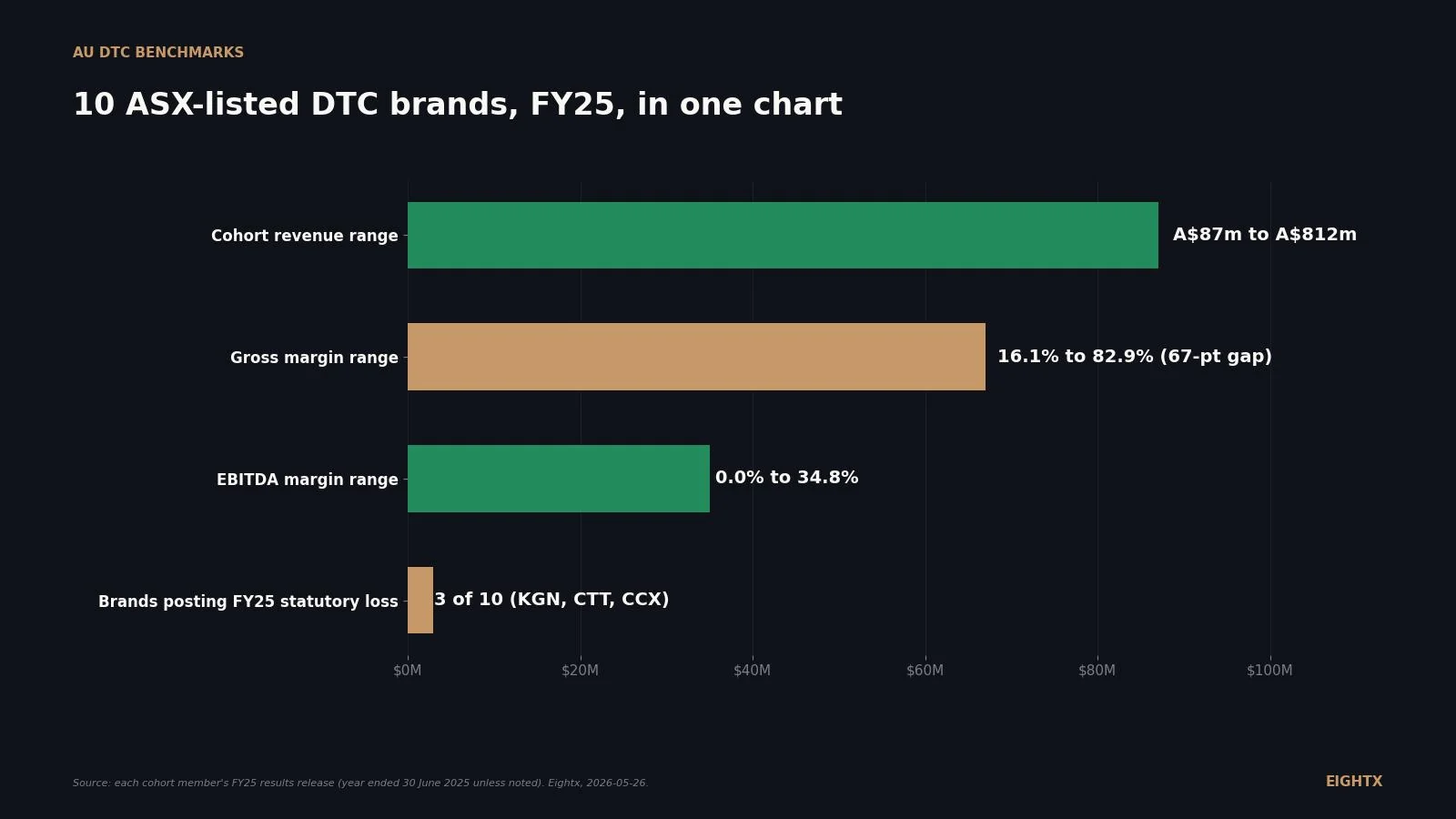
- Gross margin across the 10-brand cohort spans 16.1% (Cettire delivered margin) to 82.9% (Lovisa). That 67-point gap is the defining feature of the AU listed DTC peer set and it maps to business model, not execution.
- Store-attached specialty retail crushed pure-play online on EBITDA margin in FY25. Lovisa, Premier, Step One, and Universal Store all printed 19% to 35% EBITDA. The pure-play online cluster (Adore, Articore, Cettire, Kogan, TPW) printed 0% to 8%.
- Three of 10 cohort brands posted statutory net losses despite positive adjusted EBITDA in FY25. Kogan (A$39.5m loss), Cettire (A$2.6m loss), and City Chic (A$92.8m loss). Adjusted EBITDA is not profit.
- Cohort revenue runs from A$86.9m (Step One) to A$812.2m (Premier continuing ops). Most AU DTC operators in the A$3m to A$50m band sit one to two orders of magnitude below the cohort floor.
- If you run a A$3m to A$50m AU DTC brand, your real comp is Adore Beauty (35.3% GM, 4.1% EBITDA) or Step One (76.4% GM, 20.1% EBITDA), not Lovisa. Benchmark style and discipline at the Lovisa end. Benchmark levels at the Adore or Step One end.
If you run an AU DTC or ecommerce brand and you've been asked "how are we doing against the market," the honest answer is that you have to pick the right cohort first. The 10 ASX-listed AU DTC and retail brands closed FY25 (year ended 30 June 2025 for most) with a 67-point spread on gross profit margin and a three-of-10 statutory-loss rate. That's not a single benchmark. That's three distinct sub-cohorts, and most operator confusion about "where do we sit" comes from comparing against the wrong one.
This post is the apex AU DTC benchmark. Every figure is from each company's FY25 results release or annual report, all in AUD under IFRS. Where the figure is derived (calculated, not directly reported), it's flagged. We use this page as the reference for our individual ASX teardowns (Lovisa, Cettire, Adore, Temple & Webster, Kogan, Articore, Universal Store, Premier, City Chic, Step One). It's written for ecommerce operators making decisions on margin, channel, and capital allocation, not for finance teams writing board memos.
The 10-brand cohort and what they tell you
The cohort is every ASX-listed business with a meaningful direct-to-consumer revenue line that an AU operator running A$3m to A$50m would actually want to benchmark against. Nine of 10 close their books on or near 30 June 2025. Premier Investments runs to 26 July 2025 on a retail 52-week calendar. The headline FY25 numbers, side by side:
Brand Ticker Period end Revenue (A$m) Gross margin % EBITDA margin % NPAT (A$m) Online mix % Employees Lovisa Holdings LOV 30 Jun 2025 798.1 82.9 34.8 (derived) 86.3 n.d. ~5,000 Premier Investments (continuing) PMV 26 Jul 2025 812.2 65.7 28.3 (derived) 338.2 (group) n.d. ~3,500 Cettire CTT 30 Jun 2025 742.1 16.1 (delivered) 0.0 (adj) (2.6) 100% (online) n.d. Temple & Webster TPW 30 Jun 2025 600.7 46.0 3.1 11.3 100% (online) ~600 Kogan.com KGN 30 Jun 2025 488.1 38.9 7.5 (adj) (39.5) ~100% (online) n.d. Articore Group ATG 30 Jun 2025 379.1 45.6 2.5 (operating) net loss 100% (online) n.d. Universal Store UNI 29 Jun 2025 333.3 61.1 19.5 (derived) 23.3 n.d. n.d. Adore Beauty ABY 30 Jun 2025 198.8 35.3 4.1 2.6 100% (online) n.d. City Chic Collective CCX 29 Jun 2025 134.7 61.0 (trading) 4.8 (underlying) (92.8) mixed ~546 (FY24) Step One Clothing STP 30 Jun 2025 86.9 76.4 20.1 (FY25 reported, before 1H FY26 reset) 12.7 100% (online) n.d.
Two things to call out before any chart. First, the 10th cohort slot is Step One Clothing (ASX:STP), not Mosaic Brands. Mosaic delisted from the ASX on 28 August 2025 after entering voluntary administration in October 2024. Step One is the next-closest pure-DTC ASX listing to the A$3m to A$50m operator band Eightx readers sit in. The methodology section below explains the swap in more detail.
Second, the Cettire row uses a delivered margin rather than a conventional gross margin. Cettire's drop-ship luxury marketplace model never holds inventory, so it does not report a gross profit line in the conventional retail sense. The 16.1% figure is its FY25 delivered margin (revenue less product cost and fulfilment-related variable costs). It is in the cohort because the question "how does my brand compare to the AU listed DTC peer set" needs to include the marketplace model, but it is flagged everywhere we use it.
The 67-point gross margin gap, and what it means
Rank the cohort by FY25 gross margin and the spread is 67 points wide.
Three things to take from this chart. First, business model dictates the gross margin floor. Lovisa runs 82.9% because it designs in-house, sources through a centralised China supply chain, and has no licensed-brand royalty. Cettire runs 16.1% delivered margin because it never holds inventory and effectively makes a commission on third-party luxury sales. There is no execution path that bridges those two numbers. They are different businesses.
Second, the pure-play online cluster (Adore, Articore, Kogan, Temple & Webster) sits in a tighter 35% to 46% band. That is the realistic gross margin range for a pure-play AU online brand that holds its own inventory. If your brand is below 35%, you are giving away pricing power. If you are above 50%, you either have premium pricing power or you are not yet at the scale where freight and warehousing dilute the headline margin.
Third, the store-attached specialty band (Universal Store, City Chic at its trading-margin level, Step One, Premier) runs 61% to 76%. That is where vertical product ownership plus physical retail combine. Step One is the exception in this band because it is pure-play online but with a vertically integrated own-brand model. It earns its 76% on premium pricing on a single-product category (basics underwear) where Trustpilot reviews and brand trust let it command higher AOV than a third-party reseller could.
The operator implication: your gross margin floor is not an execution target. It is the consequence of the model you chose. The lever you have is to either move up the model curve (own more of the product, own more of the channel) or aim for the top of your sub-cohort band rather than reaching for a number from a different model.
Store-attached vs pure-play: the EBITDA reality
The 67-point gross margin gap is one story. The EBITDA gap is the bigger one for an operator. When you plot EBITDA margin against gross margin, the cohort splits cleanly into two clusters.
Top right of the chart: store-attached specialty retail. Lovisa (82.9% GM, 34.8% EBITDA), Premier continuing ops (65.7% GM, 28.3% EBITDA), Step One (76.4% GM, 20.1% EBITDA), Universal Store (61.1% GM, 19.5% EBITDA). Every one of these brands either runs physical stores or sells a vertically integrated own-brand product at premium price. They all cleared 19% EBITDA margin in FY25.
Bottom left of the chart: pure-play online retail. Adore Beauty (35.3% GM, 4.1% EBITDA), Articore (45.6% GM, 2.5% EBITDA), Cettire (16.1% delivered, 0.0% adj EBITDA), Kogan (38.9% GM, 7.5% adj EBITDA), Temple & Webster (46.0% GM, 3.1% EBITDA). Every one of these brands is 100% online and they all printed EBITDA margins below 8%.
The mechanism is paid acquisition. A Lovisa store on Pitt Street pays a lease but does not pay a CAC. A Temple & Webster customer arrives through a Meta ad that costs A$30 to A$70 per first-order. The pure-play online cohort spends 10% to 27% of revenue on marketing, and that is what eats the gross-to-EBITDA bridge. Step One is the outlier because its own-brand pricing power on basics lets it absorb 27% of revenue on advertising and still clear 20% EBITDA. Most pure-play online brands cannot.
This is the central finding for any AU DTC operator: if your brand is pure-play online and you are trying to build a store-attached margin profile through "better marketing", you are fighting the math. The two paths to a 20%+ EBITDA margin from a pure-play online start are either premium pricing power (Step One) or a step-change in retention and AOV that pulls CAC payback below 6 months. There is no third option visible in the listed peer set.
Who posted statutory losses in FY25
Three of the 10 cohort members printed statutory NPAT losses in FY25.
Kogan.com. Revenue A$488.1m, adjusted EBITDA 7.5%, but a statutory net loss of A$39.5m driven by a Mighty Ape impairment. The adjusted EBITDA looks fine. The statutory P&L tells you what writing down a 2020-era acquisition does to reported profit five years later.
Cettire. Revenue A$742.1m, delivered margin compressed from 20.9% (FY24) to 16.1% (FY25), and the company swung from A$10.5m NPAT to A$2.6m loss. Active customers fell 5%. The company's own commentary attributed the margin compression to "heightened promotional activity to drive sales." That is the textbook signal of a pure-play online brand discounting itself out of unit economics to defend top-line growth.
City Chic Collective. Revenue A$134.7m, trading gross margin 61.0%, underlying EBITDA 4.8%, but a statutory loss of A$92.8m including A$54.6m of discontinued-operations charges and an underlying impairment. The operating business in ANZ grew online revenue 10.9% YoY. The statutory loss is the cost of unwinding the US business that did not work.
The reason this matters: all three brands cleared positive adjusted EBITDA in FY25. All three printed statutory losses anyway. Adjusted EBITDA is the metric the company chooses to highlight. Statutory NPAT is the metric the share register actually trades on. If you run a private brand and your "EBITDA" number does not survive an audit, you have the same gap.
What to benchmark yourself against if you're A$3m to A$50m AUD revenue
The cohort runs from A$87m (Step One) to A$812m (Premier). The closest revenue-scale comp for most AU DTC operators is Step One at the bottom end and Adore Beauty at A$199m.
The practical benchmark recipe for an AU DTC founder running A$3m to A$50m:
- Pick the right gross margin band by model. Pure-play online with own product: aim for the top of the 35% to 50% band (Adore, Articore, Kogan, TPW). Own-brand premium online: aim for the 65% to 80% band (Step One). Marketplace or drop-ship: 16% to 21% delivered margin (Cettire).
- Cap your marketing spend by EBITDA target. Listed pure-play online peers spend 10% to 15% of revenue on marketing and clear 3% to 8% EBITDA. If you want a 10%+ EBITDA margin and your model is pure-play, marketing has to cap at 10% to 12% of revenue or your gross margin has to be north of 60%.
- Don't benchmark to Lovisa or Premier. Their EBITDA margins (28% to 35%) reflect store-attached economics and a scale that lets them negotiate freight and supplier terms a A$5m brand can't reach. Benchmark style at the Lovisa end (margin discipline, working capital, hedge cover on USD inventory). Benchmark levels at the Adore or Step One end.
- Watch your statutory-to-adjusted EBITDA gap. If your "EBITDA" is materially higher than your tax-return profit, you are probably running adjustments that won't survive a Quality of Earnings review when you raise capital or sell. Three of the 10 listed peers got caught by that gap in FY25.
The most common framing mistake AU DTC operators make is benchmarking their brand to Lovisa's 82.9% gross margin or Premier's 28% EBITDA without noticing those numbers come from a different business model with a different cost structure. Pick the right sub-cohort first. Aim for the top of that band. Move up the model curve when scale lets you.
Why we swapped Mosaic Brands for Step One in the cohort
The original brief listed Mosaic Brands (MOZ) as the 10th cohort member. Mosaic entered voluntary administration on 28 October 2024 and delisted from the ASX on 28 August 2025. There is no FY25 reporting set to benchmark against, and the brand is no longer a going concern.
We swapped in Step One Clothing (ASX:STP), the closest comparable AU-listed pure-DTC apparel brand that is still operating. Step One sits closer to the revenue band most Eightx readers operate in (A$87m FY25, A$36m 1H FY26). It is the only cohort member whose annual revenue lands within one order of magnitude of a typical A$10m to A$50m AU DTC brand.
The Step One FY25 figures in the apex table are the reported full-year numbers (revenue A$86.9m, gross margin 76.4%, EBITDA 20.1%, NPAT A$12.7m). The brand has since reset to a 43% half-year gross margin in 1H FY26 after a A$10.9m inventory provision against legacy stock, which is a material story for the next teardown but does not change the FY25 benchmark. We cover that reset in the Step One teardown.
Sources and methodology
Cohort selection. The 10 brands are the ASX-listed AU DTC and retail entities most relevant to an AU ecommerce founder running A$3m to A$50m. We started from the eight brands every AU DTC benchmark conversation lists (Lovisa, Cettire, Adore, Temple & Webster, Kogan, City Chic, Universal Store, Premier), added Articore Group (the rebranded parent of Redbubble; ATG ticker, RBL is legacy and not separately listed), and replaced Mosaic Brands with Step One Clothing after Mosaic delisted in August 2025.
Reporting periods. Nine of the 10 brands close FY25 on or near 30 June 2025. Universal Store and City Chic Collective close on 29 June 2025 under retail 52-week calendars. Premier Investments closes on 26 July 2025 (the Sunday nearest 31 July). All FY25 annual reports or Appendix 4Es were lodged with ASX between mid-August and early October 2025.
Derived EBITDA figures. Three brands do not directly report an EBITDA line at the granularity we needed. Lovisa's 34.8% EBITDA margin is derived from disclosed operating margin (31.1%) plus an estimated depreciation and amortisation roll-up. Premier's 28.3% is derived from continuing-operations EBIT (A$195.4m) plus disclosed D&A. Universal Store's 19.5% is derived from EBIT (A$54.6m) plus lease D&A. All three are flagged in the apex table and chart notes.
Cettire's delivered margin. Cettire reports a delivered margin rather than a conventional gross margin because it operates a drop-ship marketplace and does not hold inventory. The 16.1% figure is comparable to gross margin in spirit (revenue less product cost and fulfilment-related variable costs) but not in accounting definition. We include Cettire in every chart and table because excluding it would mis-represent the AU listed DTC peer set, and flag the delivered-margin treatment everywhere.
Online mix disclosure. Lovisa, Premier, and Universal Store do not separately disclose an online-channel revenue share. We mark those rows "n.d." (not disclosed) rather than reaching for SimilarWeb or Storeleads estimates, which would be unofficial. Brands with pure-play online models (Adore, Articore, Cettire, Kogan, Step One, Temple & Webster) report 100% online.
Currency and accounting. All figures AUD, all IFRS as reported. Step One's small UK and US segments are converted at year-end FY25 rates in the company's own release. City Chic's Americas segment is reported in AUD-converted USD. No restatements except City Chic's reclassification of discontinued operations.
Limitations. Employee counts are only disclosed for 4 of 10 brands. EBITDA is derived (not directly reported) for 3 of 10. Online mix is disclosed for 6 of 10. The cohort is not exhaustive of every ASX-listed business with a DTC line, but it covers every brand a A$3m to A$50m AU DTC operator would be benchmarked against in a board pack or capital raise.
For the underlying per-brand workings, see our individual teardowns: Lovisa, Cettire, Adore Beauty, Temple & Webster, Kogan, Universal Store, Premier Investments, City Chic, Articore (ex-Redbubble), Step One, and Shaver Shop.
Frequently asked questions
what's a healthy gross margin for an australian dtc brand in 2026?
There is no single number, because business model dictates the floor. Listed AU peers span 16% (Cettire, a drop-ship marketplace) to 83% (Lovisa, a vertically integrated specialty retailer with central design and China sourcing). Pure-play online operators in homewares and beauty cluster in the 35% to 46% band (Adore, Articore, Kogan, Temple & Webster). Specialty apparel and accessories sit in the 60% to 80% band. Pick the closest model, then aim a few points above the listed peer once your scale lets you negotiate freight and supplier terms.
is my $10m revenue dtc brand profitable compared to listed peers like adore beauty or step one?
Adore Beauty printed a 4.1% EBITDA margin in FY25 on A$198.8m revenue. Step One printed 20.1% on A$86.9m. If you are running A$10m and clearing 10% EBITDA, you are healthier on margin than Adore was at five times your scale. If you are running A$10m and breaking even or losing money, you are below the listed-peer band and you have a unit-economics problem, not a scale problem. Adjust ad spend or gross margin, not headcount.
why do listed asx dtc brands have such different gross margins from 16% to 83%?
Three drivers. First, owned product versus marketplace. Cettire's 16% is a delivered margin on a drop-ship luxury marketplace where the brand never holds inventory. Lovisa's 83% is vertically integrated jewellery with central design and no licensed royalty. Second, category. Beauty and homewares run lower because freight is a bigger share of landed cost. Third, scale buys leverage on freight, fulfilment, and supplier pricing. Lovisa across 1,031 stores moves freight at a unit cost a A$5m brand cannot reach.
which asx dtc stocks actually made money in fy25 and which didn't?
Cleanly profitable on a statutory basis: Lovisa (NPAT A$86.3m), Premier continuing ops (A$338.2m group inc. divestment gain), Temple & Webster (A$11.3m), Universal Store (A$23.3m), Adore Beauty (A$2.6m), Step One (A$12.7m). Statutory losses: Kogan (A$39.5m loss after Mighty Ape impairment), Cettire (A$2.6m loss), City Chic (A$92.8m loss inc. A$54.6m discontinued ops). Articore reported a net loss but printed a positive operating EBITDA of A$9.3m. Three of 10 posted statutory NPAT losses. That is the cohort's most-quoted FY25 statistic.
how does my ebitda margin stack up against temple & webster or kogan?
Temple & Webster printed 3.1% EBITDA margin in FY25. Kogan printed 7.5% on an adjusted basis (and a statutory loss). For a pure-play AU online brand, anything north of 8% EBITDA margin is at or ahead of the listed peer set. North of 15% puts you in Step One territory. North of 20% puts you ahead of every pure-play in the cohort. Most A$5m to A$30m AU DTC brands we see clear 5% to 10%.
is pure-play online ecommerce a worse business model than store-attached retail in australia?
On FY25 numbers, yes. Store-attached brands (Lovisa, Premier, Universal Store, Step One) all cleared 19% EBITDA margin. The pure-play online cluster (Adore, Articore, Cettire, Kogan, TPW) cleared 0% to 7.5%. The reason is not that online is broken. It is that physical stores capture full retail price with less reliance on paid acquisition. Pure-play online brands pay for traffic on Meta and Google. The Lovisa store on Pitt Street pays a lease but not a CAC.
what happened to mosaic brands and why does it matter for private dtc operators?
Mosaic Brands (Noni B, Rivers, Katies) entered voluntary administration in October 2024 and delisted from the ASX on 28 August 2025. It is the only cohort member that did not survive FY25. The lesson for private operators: discretionary apparel at scale without a defensible margin position got washed out. If your gross margin is below 40% and you are not scaling EBITDA, the cost of capital in 2024 to 2026 finds you eventually.
should i benchmark my brand against cettire or against adore beauty?
Depends on your model. If you carry inventory, your real comp is Adore Beauty, Step One, or Temple & Webster, not Cettire. Cettire's drop-ship marketplace model means it reports a delivered margin that is not comparable to a conventional gross margin. If you do not hold inventory and run a marketplace play, then Cettire is your closest comp and 16% to 21% delivered margin is the band to watch.
what gross margin should a beauty dtc brand be running in australia?
Adore Beauty (ASX:ABY) is the cleanest public benchmark, at 35.3% in FY25. Private AU beauty brands at A$3m to A$30m we work with typically run 55% to 70%. Adore is lower because it is a multi-brand pure-play retailer with third-party brand splits. If you own your brand, you should clear Adore's number by 20+ points. If you are a multi-brand reseller, Adore is the band.
what's the typical marketing spend percent for a listed asx ecom brand?
Temple & Webster discloses around 10% of revenue on marketing. Step One disclosed 27.0% of revenue on advertising in FY25, which is the high end for a brand still investing internationally. Kogan and Cettire do not break the line out cleanly. The 10% to 15% band is the listed-peer norm for a pure-play AU online brand that is no longer in heavy growth mode. If you are running above 25% of revenue on paid, you should expect EBITDA in the 0% to 5% band.