
Insights
Australian ecommerce GST rate impact 2026: the 9.09% line nobody benchmarks
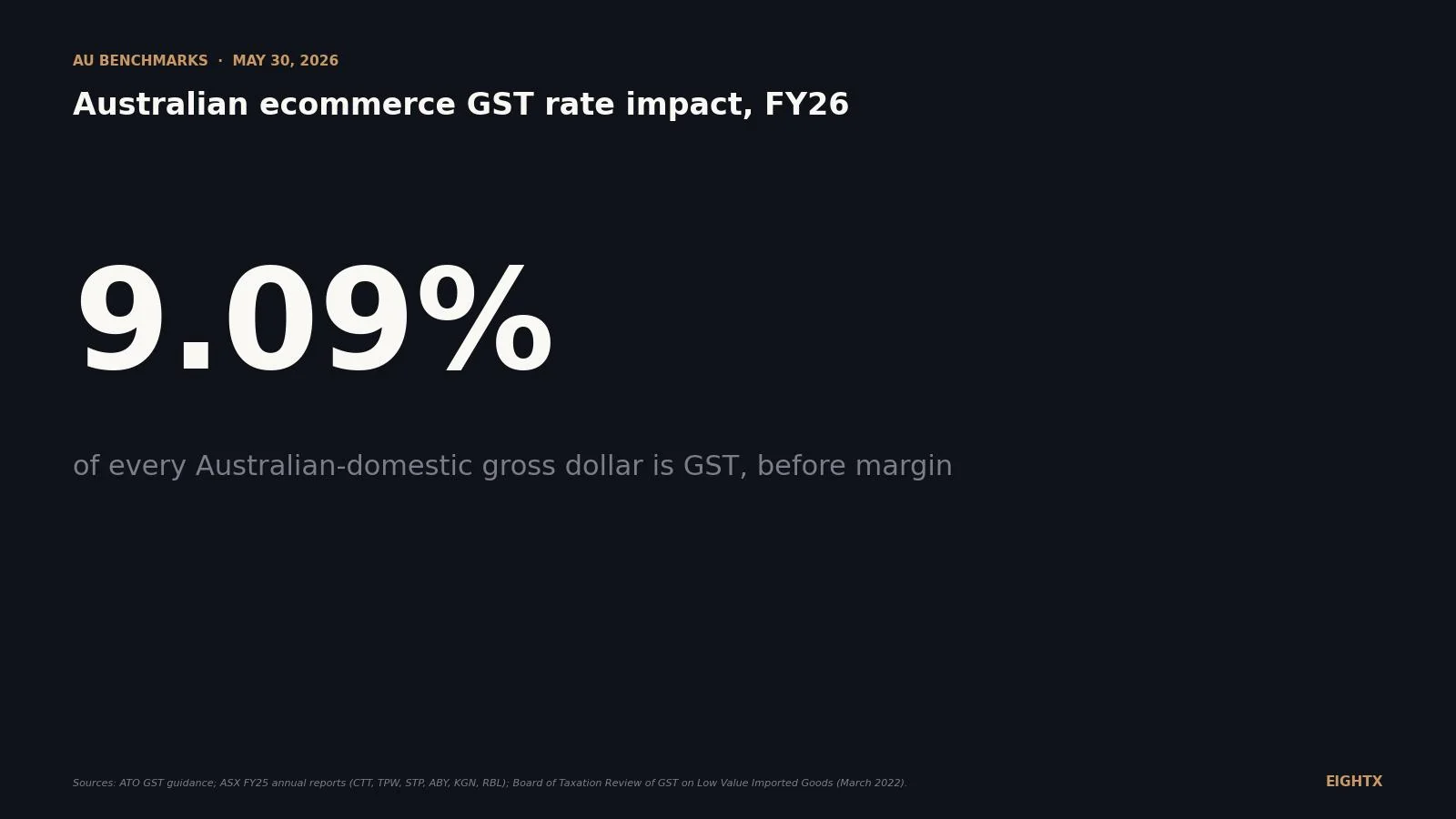
GST adds 10 percent to the sale price, but the effective drag on revenue is 9.09 percent (10 divided by 110) once you back it out of a GST-inclusive price. Australian ecommerce operators who model margins on gross receipts rather than ex-GST revenue are overstating revenue by that exact margin every single period.
Key Takeaways
- The 10% GST mechanically takes 9.09% off every Australian-domestic gross revenue dollar. An A$110 inclusive sale equals A$100 ex-GST revenue plus A$10 remitted to the ATO. It is the single biggest structural margin line most AU DTC operators never benchmark.
- ASX-listed DTC brands sit anywhere from 100% to 7% GST-exposed by domestic share. Temple and Webster is 100% domestic. Cettire is 11%. Articore (Redbubble) is 7%. The spread is the difference between a sub-10% tax line and the largest single tax line on the P&L.
- Implied AU GST line on Temple and Webster FY25 revenue is around A$54.6 million. On Cettire's larger FY25 revenue base of A$742 million, it is only around A$7.4 million. Export share, not the rate, is the only lever that moves this number.
- The Low Value Imported Goods (LVIG) regime collected A$760 million in its first three years versus a Treasury forecast of A$170 million. Offshore sellers shipping orders A$1,000 or less into Australia must register and remit GST once they cross A$75,000 in annual Australian turnover.
- Stop optimising the rate, start moving the export share. You cannot change the 10%. You can change where you book revenue. UK and US expansion turn domestic revenue into GST-free export revenue, lifting the structural margin line.
Australia's Goods and Services Tax is the single biggest structural margin line every Australian DTC operator inherits the day they incorporate, and almost nobody benchmarks it. The rate has been 10% since 2000, it sits on every domestic sale, and the Federal Budget 2026 confirmed no GST reform in the current package. So the 10% rate is locked for FY26. What changes between brands is the share of revenue you book in Australia (where GST applies) versus offshore (where exports are GST-free).
This post pulls the FY25 disclosures from six ASX-listed DTC names, maps where they sit on the GST exposure spectrum, walks through the Low Value Imported Goods (LVIG) regime that captures offshore competitors, and gives you the operator read on what the rate actually does to your margin at A$5 million to A$50 million revenue.
The 9.09% line nobody talks about
Most operators think of GST as "the 10%". That is the rate the ATO publishes and the rate Shopify charges at checkout, but it is not the line that hits your P&L. ASX-listed companies report revenue ex-GST under accounting standard AASB 15. So a A$110 GST-inclusive sale shows up on the revenue line as A$100, with A$10 sitting on the balance sheet as GST payable. The economic burden is on the customer, but the revenue line is permanently 9.09% (10 divided by 110) below the cash that flowed through your checkout.
That 9.09% gap matters more when the market price point cannot be raised. If competitive dynamics fix your sticker price at A$110, you cannot pass on the GST any further. The full 9.09% comes out of your effective price before COGS. For a brand with 60% gross margin, that means roughly A$54 of variable profit on a A$110 sale (margin times A$100 ex-GST), not A$66 (margin times A$110). You see the difference inside the unit-economics model, not on the headline price tag.
For domestic-only operators, the GST line is permanent. The only way to lower it as a share of group revenue is to grow export revenue. Which is where the ASX disclosures get useful.
Where ASX DTC brands sit on the GST exposure spectrum
The six pure-play ASX DTC names cover almost the full spectrum from 100% domestic to 93% international. The implied AU GST line moves with that spread.
Brand (ASX code) FY25 revenue (A$m) Australia domestic % International % Implied AU GST line (A$m) Temple & Webster (TPW) 601 100 0 54.6 Cettire (CTT) 742 11 89 7.4 Kogan (KGN) 488 91 9 40.4 Articore/Redbubble (RBL) 439 7 93 2.8 Adore Beauty (ABY) 198 96 4 17.3 Step One (STP) 88 72 28 5.8
Temple and Webster runs a single Australia geographic segment, so every dollar of its A$601 million FY25 revenue carries the full 10% line. The implied GST line is around A$54.6 million per year, by far the largest GST contribution of any pure-play DTC name on the ASX. Cettire, the opposite of TPW on revenue mix, booked around A$742 million in FY25 with only around 11% from Australian customers. Its implied AU GST line is around A$7.4 million, less than 1% of revenue.
Kogan and Adore Beauty sit close to Temple and Webster (around 91% and 96% domestic respectively). Step One sits in the middle at 72% domestic, with UK and US export growth accounting for the other 28%. Articore (Redbubble) and Cettire are the two outliers on the international-heavy side. The practical question for your brand: where on this spectrum do you sit, and where do you want to be by FY28?
How the LVIG regime levelled the offshore-seller playing field
For a long time, AU operators competed with offshore Shopify brands that paid no Australian GST on low-value orders. That changed on 1 July 2018 when the Low Value Imported Goods (LVIG) regime came into force. Goods with a customs value of A$1,000 or less sold by offshore sellers to Australian consumers became GST-able at the vendor or marketplace level, not at the border. Offshore sellers with annual Australian-connected turnover of A$75,000 or more must now register and remit 10% GST at checkout.
The regime worked, at least on the revenue side. The Board of Taxation's March 2022 review found LVIG collections hit A$360 million in FY19 and A$400 million in FY20. Cumulative first-three-years collections reached roughly A$760 million against a Treasury pre-implementation forecast of A$170 million. As of 28 July 2021, 1,420 offshore businesses were LVIG-registered, with around 80% of revenue concentrated in around 30 large electronic distribution platforms like Amazon, eBay and Etsy. Concentration cuts both ways: a small number of big players carry most of the load, but it also makes the compliance perimeter manageable.
Rule Detail Source GST rate on Australian-connected supplies 10% (effective 9.09% on gross) ATO How GST works GST registration threshold (any business) A$75,000 annual Australian GST turnover ATO GST registration LVIG threshold (low value imported goods) A$1,000 customs value per consignment ATO LVIG guidance Effective date of LVIG regime 1 July 2018 ATO LVIG guidance Export GST treatment GST-free if exported within 60 days ATO GST on exports Returns and refunds GST refundable on next BAS after refund issued ATO BAS instructions Enforcement on offshore merchants Around 9,000 merchants in ATO data-matching program annually ATO Offshore Merchant Data
The enforcement perimeter is the ATO's Offshore Merchant Data-Matching Program, which covers around 9,000 offshore merchants annually. That is large enough to cover the big platforms but small relative to the long tail of Shein and Temu look-alikes shipping into Australia. Operators in our call library consistently flag that the practical experience of competing against Shein and Temu still implies some under-collection at the unit level, even though both platforms are registered for AU GST.
The operator decision: stop optimising the rate, start moving the export share
You cannot change the 10% rate. You can change where you book revenue. UK and US expansion is the only export decision that materially moves the GST line on a group P&L. New Zealand expansion gets you maybe 10% of revenue offshore, but you then pay NZ GST at 15% on arrival once you cross NZ$60,000 of NZ sales, which is the buyer's problem until you cross the threshold but a margin headwind on the destination side after that.
The Cettire case is the upper-end example. By booking 89% of revenue from overseas customers, Cettire has effectively engineered a near-GST-free P&L. The trade-offs are real (cross-border logistics complexity, currency exposure, harder customer-acquisition economics in unfamiliar markets), but the structural-tax outcome is dramatic. For a domestic-only brand at A$20 million revenue, the implied AU GST line is around A$1.8 million per year. Lifting export share to 50% drops that line to around A$910,000. The other A$890,000 lands in working capital or growth investment, not as a tax remittance.
The smaller export-mix lifts matter too. Step One's FY25 mix of 72% AU and 28% UK plus US means around A$5.8 million of GST on the AU line and zero on the UK and US lines (subject to UK VAT and US sales tax on the destination side, which the buyer pays). Five years ago Step One was around 90%+ domestic, so the export shift has already taken roughly A$1.6 million off the implied GST line at current scale.
The 10% rate is locked. The lever is the domestic-export mix. Every percentage point of export share moves the implied AU GST line down by 9.09% of that revenue. If you are building a five-year plan and you are not modelling the export share explicitly, you are leaving the only GST variable you control on the table.
What this means for your A$5 million to A$50 million AU DTC brand
Three concrete moves for your next quarterly plan. The mechanics below assume you have already nailed the basics of scaling an Australian DTC brand past A$10 million (unit economics, channel mix, and BAS hygiene) and are now layering structural-margin moves on top.
Model your blended GST rate explicitly. Add a line to your unit economics model that calculates implied AU GST as domestic-share times 9.09%. For a 100% AU brand at A$15 million revenue, that line is around A$1.36 million. For an 80% AU brand at the same revenue, it is around A$1.09 million. The difference is meaningful at this scale and your CFO scoreboard should show it monthly.
Treat export channels as structurally margin-positive at the GST line. When you compare a new UK customer to an existing AU customer with the same AOV and gross margin, the UK customer is structurally A$0.91 better per A$10 of revenue at the GST line alone. That is before you consider FX, customer-acquisition cost differences, or destination-country tax. It does not justify chasing every export channel, but it does shift the bar on which export tests are worth running.
Check that your Shopify checkout and BAS reconciliation flow GST-on-returns correctly. The mechanics are: refund the customer the GST-inclusive amount immediately, then claim the GST back on your next BAS. For monthly lodgers the working-capital drag is small. For quarterly lodgers running a 20%+ product return rate, it can be a 1% to 2% drag on operating cash. If you are over A$20 million revenue and on quarterly BAS, switching to monthly is usually worth the admin cost.
Sources and methodology
Australian Taxation Office (ATO). Primary source for GST mechanics, the LVIG regime, registration thresholds, and the Offshore Merchant Data-Matching Program. Pages referenced include "GST on low value imported goods" (https://www.ato.gov.au/businesses-and-organisations/international-tax-for-business/gst-for-non-resident-businesses/gst-on-low-value-imported-goods), "How GST works", "GST registration for non-resident businesses", and the Offshore Merchant Data-Matching Program Protocol.
Board of Taxation and Treasury. The Board of Taxation's "Review of GST on Low Value Imported Goods" (March 2022, commissioned by Treasury) is the primary source for the FY19 (A$360 million) and FY20 (A$400 million) actual LVIG collections, the cumulative-three-years figure of approximately A$760 million versus the Treasury pre-implementation forecast of A$170 million, and the count of 1,420 LVIG-registered offshore businesses as at 28 July 2021. The Productivity Commission's 2017 report "Collection Models for GST on Low Value Imported Goods" provides the pre-LVIG GST gap estimate (A$390 million to A$1 billion annually) that informed the regime design.
ASX-listed DTC annual reports and investor presentations. Geographic segment notes were pulled from the FY25 (or most recent) annual reports for Cettire (CTT), Temple and Webster (TPW), Step One (STP), Adore Beauty (ABY), Kogan (KGN), and Articore (RBL). Cettire's "Rest of World" segment is reported at around 89% of FY25 revenue (Emerging Markets at 37% of gross revenue). Temple and Webster operates a single Australia geographic segment. Step One's FY25 investor presentation reports A$63.3 million Australia and around A$24.3 million UK plus US.
Implied AU GST line calculation. Implied AU GST line equals FY25 revenue (A$m) times Australia domestic share (%) times 9.09%. This treats Australia-domestic revenue as fully GST-inclusive (the conservative assumption, since B2B volume in pure DTC is minimal). Export revenue is treated as fully GST-free under the export rule.
Limitations. The ATO does not publish a full FY-by-FY LVIG GST collection series. First-year (A$360 million) and second-year (A$400 million) collections are firm; FY21 and later are not separately disclosed. Adore Beauty's FY25 domestic share is extrapolated from the FY24 segment note pending the FY25 AR. Cettire's 89% international figure aggregates US, Europe, and Emerging Markets into Rest of World without disclosing per-country splits.
Update cadence. This page is refreshed quarterly when ATO and Treasury data, and the bulk of ASX-listed FY annual reports, land together. Next update target: November 2026 (after AGM season and FY26 first-half disclosures).
Frequently asked questions
how does the 10% gst rate actually hit my dtc margin if i price inclusive?
If your sticker price is GST-inclusive, every A$110 sale records A$100 of ex-GST revenue and A$10 of GST payable to the ATO. Your accounting gross margin is calculated off the A$100 line, not the A$110, so the 10% rate effectively takes 9.09% (10 divided by 110) of the gross price before you ever look at COGS. The customer bears the tax economically, but your reported revenue line is permanently 9.09% lower than the cash going through your checkout.
are exports really gst-free or is there a catch i'm missing?
Yes, exports are GST-free under section 38-185 of the GST Act, with one important condition. You have to export the goods within 60 days of receiving payment or issuing the invoice. If you ship overseas inside 60 days, no GST is charged on the sale and you can still claim input tax credits on Australian GST you paid on inputs. Miss the 60-day window and the sale becomes a taxable supply with 10% GST owing.
when does my ecommerce brand have to register for gst, and what's the a$75,000 threshold actually measuring?
You must register once your annual GST turnover from Australian-connected supplies hits A$75,000 in any rolling 12-month period. That threshold counts gross domestic sales, not profit, and is the same whether you are an Australian-based brand or an offshore seller shipping into Australia. Once you cross it, you must charge 10% GST on taxable domestic sales, lodge a BAS, and remit the difference between GST collected and GST credits.
what's the low value imported goods (lvig) regime and does my brand have to register if i'm based offshore?
The LVIG regime took effect 1 July 2018 and captures goods with a customs value of A$1,000 or less sold by offshore sellers to Australian consumers. If you are an offshore seller with annual Australian-connected turnover of A$75,000 or more, you must register for Australian GST and collect 10% at checkout on those low-value orders. Marketplaces like Amazon and eBay are classified as Electronic Distribution Platforms and collect on behalf of small offshore sellers using their platform.
do shein and temu actually pay gst on their australian sales, and if not, how does the ato enforce it?
Both Shein and Temu are registered for Australian GST under the LVIG regime and are expected to collect 10% at checkout on goods shipped from offshore into Australia. The ATO runs an Offshore Merchant Data-Matching Program covering around 9,000 offshore merchants annually to verify compliance. Whether the pricing offshore sellers display fully passes the GST through is a separate question. Operators in our call library consistently say enforcement is partial and Shein and Temu pricing implies some under-collection at the unit level.
how do public ecommerce brands like cettire avoid gst on most of their revenue legally?
They do not avoid GST, they earn most of their revenue from customers who live outside Australia. Cettire's FY25 segment note shows around 89% of revenue from Rest of World customers (the US is the largest single market, with Emerging Markets at 37% of gross revenue). Those sales are GST-free exports. The remaining around 11% from Australian customers carries the full 10% line. Temple and Webster, by contrast, books 100% of revenue from Australian customers, so every dollar carries GST.
how does gst work when i sell into new zealand, the uk or the us from my australian-based shopify store?
Sales shipped from Australia to overseas customers are GST-free if exported within 60 days. New Zealand customers then pay NZ GST at 15% on arrival if your turnover into NZ crosses NZ$60,000. UK customers pay UK VAT at 20% (you must register with HMRC once your UK sales cross £85,000). US customers pay US state sales tax based on the buyer's state, with state-by-state registration once you cross economic nexus thresholds (typically US$100,000 in a state). Each destination tax is a separate registration; the Australian GST line is GST-free on every one of those sales.
how do gst refunds on customer returns flow through my bas, and what's the working-capital impact?
When a customer returns a product, you refund them the GST-inclusive amount immediately (the full A$110 in the example above). The ATO does not refund you the A$10 GST until your next BAS lodgement, which can be up to three months later for quarterly lodgers. For an apparel brand running a 15% to 25% return rate, that gap creates a 1% to 2% drag on working capital. Switch to monthly BAS lodgement if your return rate is high. You give up some admin simplicity and get the cash back faster.