
Insights
Average ecommerce board size by revenue band: 3 seats at seed, 5 at Series A, 9 at IPO (2026 data)
Ecommerce boards start at 3 seats for bootstrapped and seed-stage companies, expand to 5 seats at Series A, and reach 9 seats at IPO based on NVCA model documents and 13-company public DTC proxy data. Independent director compensation averages roughly $285,000 per seat at public scale. Founders below $10M in revenue rarely need more than 3 to 5 seats to govern effectively.
Key Takeaways
- The NVCA Model Voting Agreement still defaults to a 5-seat Series A board: 2 founders, 2 investors, 1 independent. The October 2025 post-Moelis refresh changed At-Large Director mechanics but kept the 5-seat default. If you raise a priced Series A, you snap onto this template.
- Across 13 public DTC and consumer brands (FY2025-2026 proxies), the median board is 9 directors with 78% independent and 3 standing committees. Range: 4 directors at Revolve (NYSE controlled-company exemption) to 11 at Lululemon (retail-footprint complexity premium).
- Bootstrapped DTC under $10M almost never runs a real board. Practitioner inference: roughly 50% to 70% are founder-only statutory boards, 20% to 40% have an informal advisory board, only 5% to 15% have a formal multi-member board with at least one non-founder director.
- An independent director at a public DTC costs ~$285K all-in: roughly $85K cash retainer plus $200K equity grant. Committee chair adders run $15K to $30K. At $25M private, the typical package is 0.25% to 0.5% equity over four years plus an optional $25K to $50K cash retainer.
- The trigger to add your first independent isn't revenue. It's complexity. First outside capital, first acquisition conversation, first PE intro, first IP or regulatory exposure. Recruit for the specific gap (M&A, retail expansion, capital markets, supply chain), not the title.
Most ecom operators ask the same question one of two ways. The bootstrapped 8-figure founder asks "when do I actually need a real board?" The Series A founder asks "what does the board look like in five years, when I'm trying to sell or IPO?" The honest answer to both questions is buried in National Venture Capital Association (NVCA) model documents or 13 separate proxy filings nobody reads. We pulled both. The pattern is sharper than most founders expect.
Most ecom is sub-$10M and bootstrapped. Those brands almost never have a formal multi-member board. The moment they raise a priced Series A, they snap onto the NVCA default 5-seat template. The moment they go public, they snap onto a 9-seat majority-independent template with three standing committees. Below is what the curve actually looks like, who's on it, and what the seats cost.
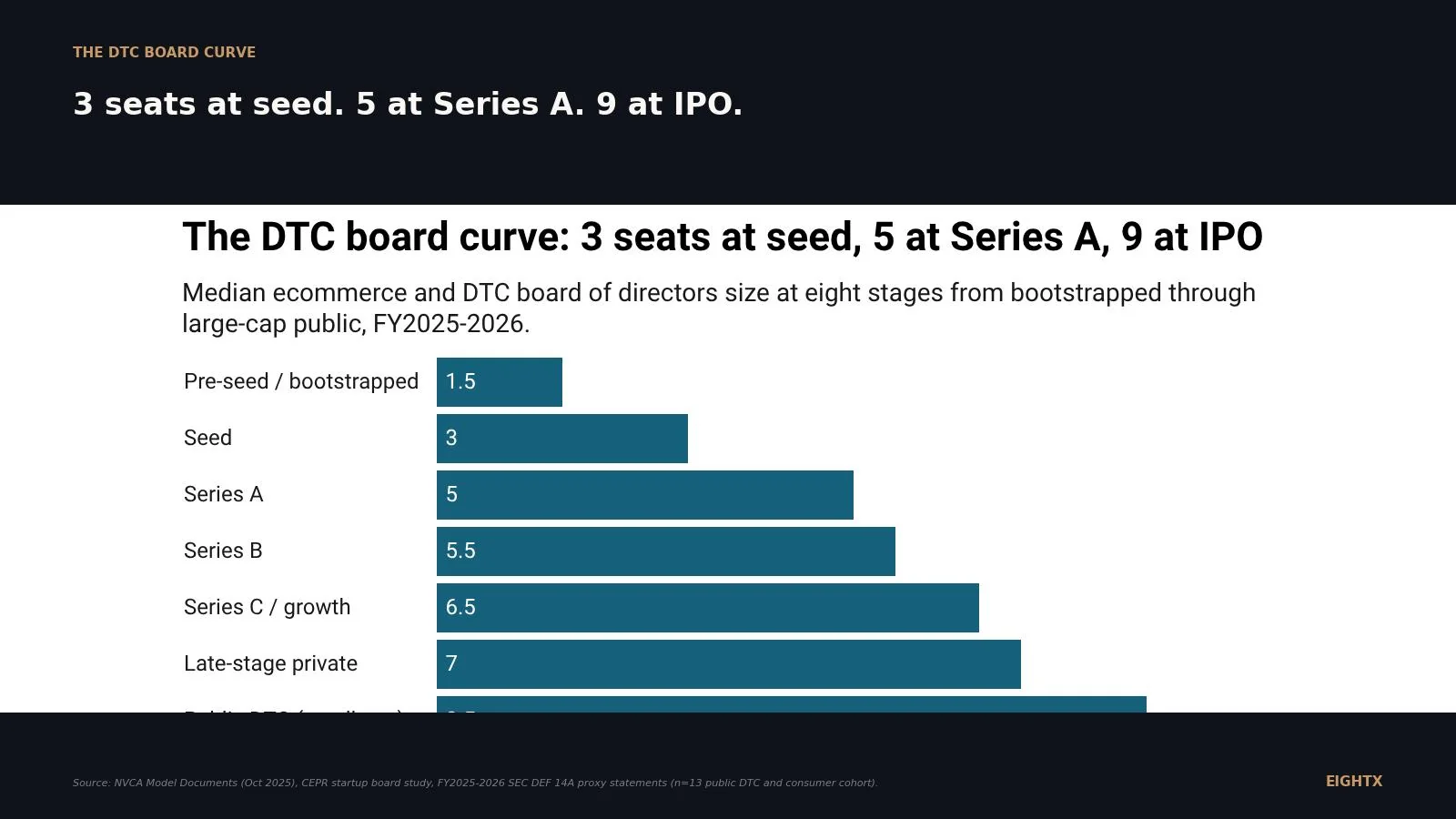
The DTC board curve: 3 seats at seed, 5 at Series A, 9 at IPO
The chart below tracks median board size at eight stages from pre-seed through large-cap public. The NVCA Series A default (5 directors) is the most common starting point for any venture-backed DTC. The IPO transition jumps board size to 8 or 9 directors with majority independence and at least three standing committees.
The full table backing the chart sits below. We've included a typical total board compensation range per year, calculated as median seats per stage times the median per-director comp at that stage (zero at the bootstrapped end, ~$300K all-in at the large-cap public end).
Stage Typical revenue Median board Independent directors Total board comp ($K/yr) Source basis Pre-seed / bootstrapped <$1M 1 to 2 0 $0 Statutory founder-only Seed $1M to $3M 3 0 to 1 $0 to 50 NVCA seed (2F + 1I) Series A $3M to $10M 5 1 $50 to 150 NVCA Series A (2F + 2I + 1Ind) Series B $10M to $30M 5 to 6 1 to 2 $100 to 300 NVCA Series B Series C / growth $30M to $100M 6 to 7 2 to 3 $200 to 500 Growth equity stage Late-stage private $100M to $500M 6 to 8 3 to 4 $500K to $1M Pre-IPO build Public DTC (small cap) $200M to $1B 8 to 9 6 to 7 $1.5M to $2.5M Public DTC median Public DTC (mid/large) $1B+ 9 to 11 7 to 9 $2.5M to $4M Public DTC large
Two notes on the curve. First, the jump from "no board" to "NVCA 5-seat board" at Series A is mechanical: the priced round triggers the Voting Agreement, the Voting Agreement sets the seats. You don't gradually expand from 2 to 3 to 4 to 5 over a Series A. You sign the agreement and you're at 5 the next day. Second, the curve flattens hard between Series B and pre-IPO. Adding a 7th or 8th seat is unusual until you're inside an IPO process; most growth-stage boards stay at 5 to 7 by using investor observer rights instead of new voting seats.
What the NVCA default actually locks in at Series A
The NVCA Model Voting Agreement is the most influential template in US venture. It's the document that sets your board composition for the rest of the life of the company unless you renegotiate it (and most founders never do). The October 2025 NVCA refresh, written in response to the Moelis Delaware case, clarified the mechanics around the independent director seat but preserved the 5-director Series A default.
Here's what the default actually says. The board is composed of five directors: two designated by the holders of common stock (almost always the two founders, though one of those seats can be filled by the CEO if she's not a founder), two designated by the holders of preferred stock (the investor seats, one of which typically rotates with each new lead investor), and one director who is mutually agreed by the common and preferred holders. That last seat is the "Independent Director," sometimes called the At-Large Director in older NVCA drafts. The post-Moelis refresh tightened the rules for what happens when that seat goes vacant (you can no longer have an indefinite vacancy that effectively gives one side control) and clarified that the joint-selection mechanic must produce an actual independent director, not a founder-friendly or investor-friendly proxy.
A few things this default does that most founders miss until it matters. The preferred-stock seats are protected by the Voting Agreement, not the Charter, so you can't just amend them away without investor consent. The independent seat is mutually agreed, which in practice means either side can effectively block a candidate they don't like (a fight here is the most common reason a Series A board sits at 4 directors for six to twelve months while the founder and investor argue over who fills it). And the agreement binds future preferred rounds: at Series B, the new lead usually demands one of the existing investor seats rather than expanding the board, which is why most Series B boards stay at 5 rather than going to 6 or 7.
Your negotiating room as a founder is widest right before signing the term sheet. The default is 5 seats; you can ask for 3 (rarely granted by tier-1 funds), or you can keep 5 but make sure the independent seat is filled at closing by someone you've already met and trust. Once the Voting Agreement is signed, your room to renegotiate drops to "what concessions you can extract at the next round."
What the public DTC cohort looks like, company by company
Once a DTC brand goes public, the board template changes again. NYSE and Nasdaq listing standards require a majority-independent board and fully independent Audit, Compensation, and Nominating/Governance committees within one year of listing. In practice, public DTC brands cluster at 8 to 11 directors with 6 to 9 independents.
The table below shows the full cohort with each brand's FY2025 revenue, board size, independent director count, independence percentage, standing committee count, and the date its most recent proxy was filed. Median = 9 directors, 7 independent (78% independence), 3 standing committees.
Company Ticker Revenue ($M) Board size Independent Independence % Committees Proxy filed Lululemon Athletica LULU 10,588 11 9 82% 4 2025-04-29 Etsy ETSY 2,810 9 8 89% 3 2026-04-17 YETI Holdings YETI 1,828 9 8 89% 3 2026-03-26 Crocs CROX 4,112 8 7 88% 3 2026-04-23 FIGS FIGS 544 9 5 56% 3 2026-04-23 Vita Coco COCO 560 10 7 70% 3 2026-04-22 Honest Company HNST 378 8 6 75% 3 2026-04-09 Beyond Meat BYND 326 9 9 100% 4 2026-03-11 Purple Innovation PRPL 461 9 7 78% 3 2026-04-22 Stitch Fix SFIX 1,336 8 6 75% 3 2025-10-31 Revolve Group RVLV 1,147 4 2 50% 3 2025-04-25 Warby Parker WRBY 772 9 7 78% 3 2026-04-28 Allbirds BIRD 194 7 4 57% 3 2025-04-24 Cohort median n/a 772 9 7 78% 3 n/a
A few patterns worth flagging. Lululemon at 11 directors is the cohort outlier on size, and the reason is operational complexity: ~770 owned retail stores plus international expansion plus a dual-brand portfolio after the MIRROR write-down. If you have owned retail, expect a larger board.
Revolve at 4 directors is the cleanest case study of the NYSE controlled-company exemption. Co-CEOs Michael Mente and Mike Karanikolas hold Class B shares that give them more than 50% of voting power, which qualifies Revolve for the exemption from the majority-independent rule (NYSE Listed Company Manual §303A.00). The company runs with 2 founders plus 2 independents, saves roughly 2 to 4 board seats relative to the cohort median, and pays out an estimated $500K to $1M less per year in director comp (roughly 2 to 4 seats x $250K all-in). That's the price of dilution-resistant control.
Beyond Meat sits at the opposite extreme. It's the only board in the cohort at 100% independence (9 of 9), meaning founder Ethan Brown does not occupy a board seat under the FY2026 proxy. That's unusual for a sub-$500M consumer brand, and it's the inverse of the FIGS / Vita Coco / Honest pattern where founders and growth investors stayed on after IPO. The fourth standing committee (Beyond Meat runs a Sustainability committee in addition to Audit, Compensation, and Nominating/Governance) is also a function of regulatory and ESG exposure rather than revenue scale.
The FIGS, Vita Coco, and Honest pattern is the inverse of Revolve. These are smaller-revenue brands that went public with growth investors still on the board and founders who didn't want to drop them. The result is a 9 to 10 seat board with several non-independent seats from earlier rounds, sitting at 56% to 75% independence rather than the 78% median. None are controlled companies; they just chose to keep growth-stage holdovers rather than push to majority-independent immediately. The Audit committee is still fully independent (that's an SEC rule, not a choice), but the overall board composition is more "graduated growth board" than "clean public-company board."
What independent directors cost, and what they're worth
At public DTC scale, the all-in cost of one independent director is roughly $285K per year. The cash retainer cluster is $80K to $100K (Etsy ~$80K, YETI ~$90K, Crocs $80K to $85K, Lululemon $95K to $100K). The equity grant cluster is $175K to $225K in restricted stock or RSUs, with most brands using a one-year vest to match the annual director election cycle. Committee chair adders run $15K to $30K (Audit higher, Nominating lower). The lead independent director adder is typically $25K to $50K on top of base comp.
Company Cash retainer ($K) Equity grant ($K) Audit chair adder ($K) All-in independent comp ($K) Lululemon 95 to 100 225 30 ~325 Etsy ~80 200 25 ~280 YETI 90 180 25 ~270 Crocs 80 to 85 175 25 ~257 Cohort median (large-cap) ~85 ~200 ~25 ~285
Now translate that down to private scale. At a $25M private DTC brand, the typical independent director package is 0.25% to 0.5% of equity vested over four years (often with a one-year cliff), plus an optional $25K to $50K cash retainer that many brands can't afford and don't pay. Travel expenses get reimbursed. D&O insurance gets put in place (budget $5K to $20K per year depending on revenue and exposure). The all-in cash cost is usually under $50K per year, and the equity dilution is meaningful but not catastrophic.
What you're buying for that price is judgment, pattern recognition, and an introduction network. The right independent at $25M is somebody who's been a senior operator at a $200M to $1B brand, has seen the playbook you're about to run, and has a network of buyers or capital partners you don't. The wrong independent is somebody famous who shows up to four meetings a year and adds nothing in between.
The trigger to add your first independent isn't revenue. It's complexity. First outside capital, first acquisition conversation, first PE intro, first IP or regulatory exposure. Recruit for the specific gap (M&A, retail expansion, capital markets, supply chain), not the title.
When to add your first independent, and who to add
Three rules from looking at the data and from running the conversation 50 times with operators.
Don't add an independent before you have a reason. A formal board with an independent seat adds operational cost (D&O insurance, board prep, quarterly meeting prep, written consents for every material decision), introduces a fiduciary-duty layer between you and your business, and gives a third party (sometimes informally) veto power over your strategy. At sub-$10M with no outside capital, the right setup is almost always a 2 to 4 person advisory board on quarterly Zoom calls. No equity or 0.1% each. No legal liability. Same operator input.
Add the first independent when you face a specific decision you don't trust yourself on. The common triggers from our portfolio and from the public cohort: a first priced capital raise (you want somebody at the negotiating table who isn't on either side), an inbound from a strategic acquirer (you want somebody who's seen the diligence playbook), a PE introduction (you want somebody who can read a term sheet faster than you can), or a regulatory or IP issue serious enough to need standing counsel. Pick the gap that's about to bite you. Recruit for it.
Recruit for the specific gap, not the title. "Independent director" is a checkbox, not a job description. The job description is "the person who keeps me from making the next $2M mistake." If you're heading into an M&A process, recruit somebody who's been on both sides of a $50M to $500M consumer-brand sale. If you're pushing into retail, recruit somebody who's opened 50 to 100 stores at a category-adjacent brand. If you're scaling international, recruit somebody who's done the EU or APAC entry at a comparable brand. The candidate's LinkedIn title is irrelevant; their pattern library is everything.
A practical note on private-equity-owned DTC. If your brand sells to a PE firm, the board pattern flips. Most PE-owned DTC boards run at 5 to 7 directors with the PE firm holding 3 to 4 seats, the founder or CEO holding 1 to 2, and 1 to 2 independents (often recruited by the PE firm from their operating-partner bench). There's no independent majority and no real protection for the operating team. If you're in a PE process and you negotiate a "founder-retained" board seat post-close, the independent slot is the one to fight for, not the founder one. The independent gets you a vote against decisions you and the PE firm disagree on; the founder seat is symbolic.
Sources and methodology
NVCA Model Legal Documents (October 2025 update). The National Venture Capital Association publishes a standard set of term sheets, voting agreements, and charters used in the majority of US venture financings. The Voting Agreement (Section 1.2) sets board composition. The October 2, 2025 update, the post-Moelis refresh analyzed by Foley & Lardner, clarified At-Large Director and independent-director vacancy mechanics but preserved the 5-director Series A default (2 common + 2 preferred + 1 independent). URL: https://nvca.org/model-legal-documents/
CEPR ("Board dynamics over the startup life cycle"). Empirical study of board composition across thousands of venture-backed startup financing rounds. Headline figures used in this post: average board size at first financing 3.6 members; lifecycle average 4.4 members (composition ~2 VC + 1.7 executive + 0.8 independent); 63% of startups have at least one independent director by the fourth financing round. The CEPR study is cross-industry rather than DTC-specific; DTC-specific board-size data by round is not separately published by NVCA, Carta, PitchBook, or Crunchbase.
SEC EDGAR DEF 14A proxy statements, 13-company public DTC and consumer cohort. Companies covered: Lululemon (LULU), Etsy (ETSY), YETI Holdings (YETI), Crocs (CROX), Stitch Fix (SFIX), Revolve Group (RVLV), Warby Parker (WRBY), FIGS (FIGS), Vita Coco (COCO), Purple Innovation (PRPL), The Honest Company (HNST), Allbirds (BIRD), Beyond Meat (BYND). For each, we recorded total board size, count of independent directors, count of standing committees, and where extractable, the average independent-director cash retainer and equity grant from the Director Compensation table. Proxy filing dates listed in the cohort table above. Beyond Meat and Vita Coco have meaningful wholesale channels rather than pure pureplay DTC; both are retained in the cohort as consumer-brand-DTC adjacents.
Carta 2025 State of Private Markets. Used for round and valuation context. Carta's 2025 public reports do not break out board-size-by-round data; we flag this explicitly because it's the most common question readers ask and the answer is that the segmented private-side dataset doesn't exist in public form. URL: https://carta.com/data/state-of-private-markets-q4-2025/
Limitations. The NVCA Series A default is a contractual default, not a measured average. Real Series A DTC boards mostly converge to 5 seats but a meaningful minority land at 3 (founder-friendly) or 7 (multi-lead). The CEPR figures are cross-industry, not DTC-specific. The public DTC cohort (n=13) is a useful top-end calibration but not statistically representative of all public DTC; it skews toward consumer-product and away from pure marketplace plays beyond Etsy. Honest, Purple, and Allbirds independence counts are partially extracted from secondary governance sources cross-referenced with the proxy, so minor variance is possible vs the proxy's exact NYSE or Nasdaq independence determination.
Update cadence. This is a living index. We refresh quarterly when new DEF 14A proxies land for the public cohort (March to April for most calendar-year filers, October for Stitch Fix), when Carta releases a new State of Private Markets, or when NVCA publishes a model document update. Next refresh target: October 2026.
For related operator benchmarks see our headcount per million revenue at public DTC brands and the public DTC margin leaderboard.
Frequently asked questions
when do i actually need a real board of directors as a dtc founder?
Not at $1M revenue. Probably not at $5M if you're bootstrapped. The trigger is complexity, not revenue: first priced outside round, first inbound from a strategic acquirer, first PE conversation, first IP or regulatory exposure. If none of those are live, an advisory board (2 to 4 operators you trust, no equity or 0.1% each, quarterly calls) outperforms a formal board every time.
what is the average board size for a $10m ecommerce brand?
Two answers depending on capital structure. If you're VC-backed and just closed a Series A, the NVCA default puts you at 5 directors (2 founders + 2 investors + 1 independent). If you're bootstrapped at $10M, you most likely have a founder-only statutory board with no outside directors, plus maybe a 2 to 4 person advisory board on the side. The pattern is binary: either you snapped onto the NVCA template or you have no real board at all.
how many people are on the board at a $50m dtc brand?
5 to 7 directors is the typical range. If you've raised a Series B, that usually means the NVCA Series A board (5 seats) plus 1 new investor seat from the Series B lead, sometimes plus 1 additional independent. If you're bootstrapped at $50M, you might have a 3 to 4 person voluntary board including the founder, one outside operator, and one industry expert. The CEPR empirical study finds the lifecycle average is 4.4 members across all venture-backed startups, which lines up.
do i need independent directors before i raise a series a?
Not before. The NVCA default Series A voting agreement explicitly creates the independent seat at the time of the round, jointly selected by founders and investors. You can pre-recruit (and many founders do, so they're not scrambling on day one of a financing) but the seat exists because of the round, not before it.
what is the nvca default board structure for a series a round?
5 directors: 2 common (usually the two founders), 2 investors (one from each priced round so far, or both from the Series A lead if it's the first priced round), and 1 mutually agreed independent. The independent is sometimes called the At-Large Director. The October 2025 NVCA refresh, written after the Moelis Delaware case, tightened the vacancy and replacement mechanics for that seat but kept the 5-seat default.
how much does an independent board director cost per year at a $25m dtc brand?
Far less than at public scale. The market range for an independent at a private $25M DTC is 0.25% to 0.5% equity vested over four years, plus an optional $25K to $50K cash retainer if the company can afford it (many can't and don't pay cash at all). Public DTC scale is roughly 10x higher: ~$85K cash plus ~$200K equity equals ~$285K all-in per independent per year.
what's the difference between an advisory board and a formal board for ecommerce?
An advisory board has no fiduciary duty, no voting rights, no legal liability for the company's actions, and no governance role. A formal (statutory) board has all four. For a sub-$10M DTC, an advisory board is almost always the right move: same operator input, no D&O insurance, no quarterly board-prep cost, no veto rights to negotiate around later. Convert to a formal board when you raise priced capital or when an acquirer asks who's on it.
how many independent directors do public dtc brands have on their board?
Median 7 of 9 (78% independent) across our 13-company FY2025-2026 cohort. NYSE and Nasdaq both require a majority of independent directors for non-controlled companies, plus fully independent Audit, Compensation, and Nominating/Governance committees. The exception in our cohort is Revolve, which has 4 directors total and only 2 independent because its co-CEO founders' Class B shares give them more than 50% voting control, qualifying it for the NYSE controlled-company exemption.
can i avoid having a majority-independent board after my dtc brand ipos?
Only if you have voting control through a dual-class structure (Revolve is the cleanest DTC example) or if you remain under tight founder control via a controlling shareholder agreement. Without one of those, the NYSE and Nasdaq listing standards require majority-independent boards and fully independent Audit, Compensation, and Nominating committees within one year of IPO. The savings if you qualify for the exemption are meaningful: roughly 2 to 4 fewer seats and $500K to $1M per year in director comp.
what board committees does a public dtc company need?
Three required, sometimes four. Required: Audit, Compensation, and Nominating/Governance, all with majority or fully independent membership depending on the exchange. Some public DTC brands add a fourth standing committee (Corporate Responsibility, Talent, or Risk) once revenue crosses ~$1B. In our 13-company cohort, only Lululemon and Beyond Meat run a fourth standing committee.