
CPG
Average CPG new product launches per year by vertical: the 2026 benchmark
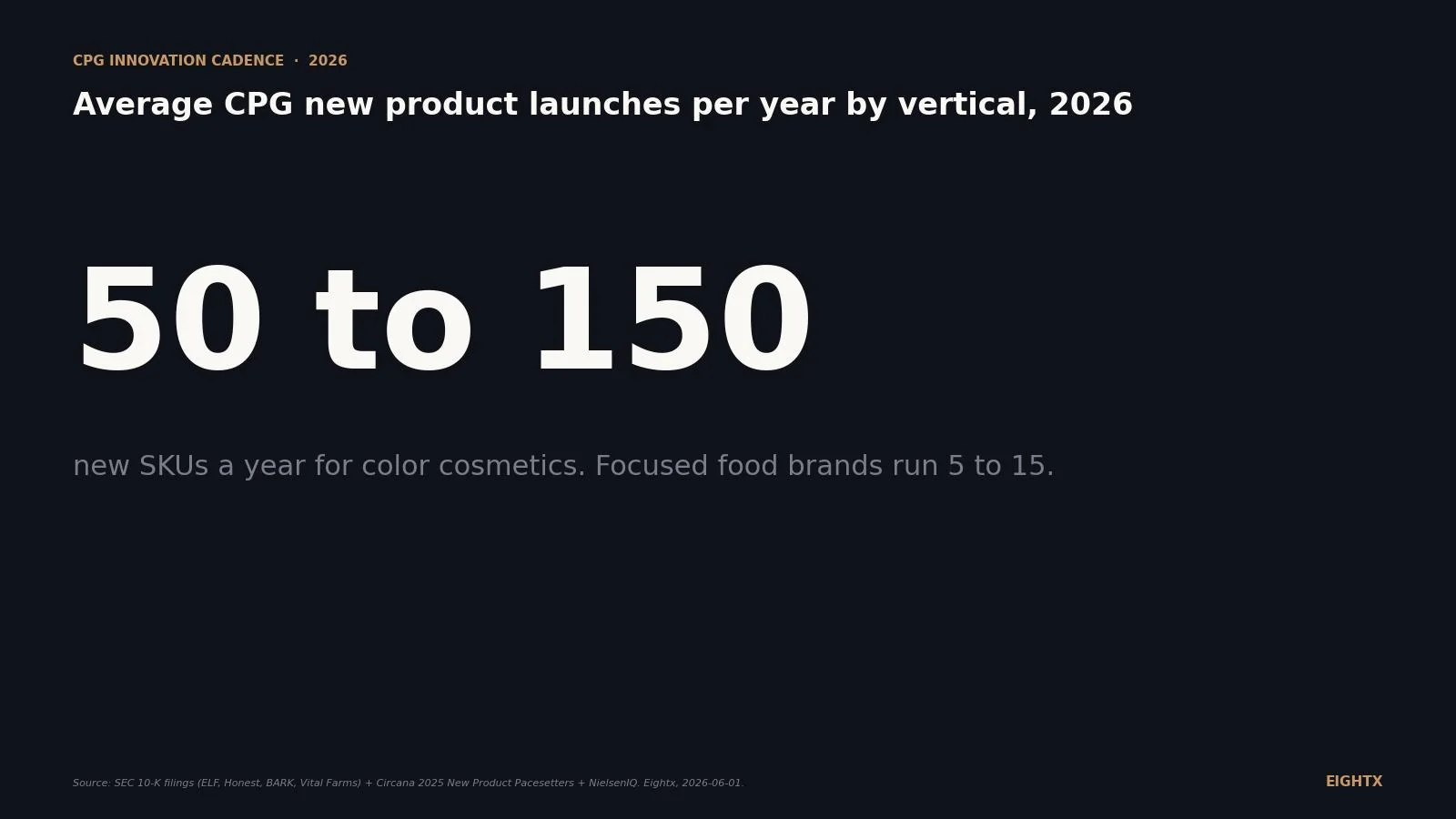
Beauty brands launch 50 to 150 new SKUs per year by sharing base formulations across shades and killing slow movers fast. Focused food and beverage brands run 5 to 15 real launches. Circana's 2025 New Product Pacesetters top 200 generated $6.2 billion in year-one sales, and roughly 85 percent of CPG launches still fail within 24 months. The constraint for a $10M DTC brand is what your marketing budget can launch with enough velocity, not what you can manufacture.
Key Takeaways
- The top 200 CPG launches generated $6.2 billion in year-one MULO+ sales (Circana 2025 New Product Pacesetters, released May 21, 2026). That is the public top-of-the-funnel; the long tail is much, much wider.
- Beauty color cosmetics run the highest cadence at 50 to 150 new SKUs per year, anchored by e.l.f. Cosmetics. Pet subscription brands match the tempo (24 to 50 SKUs/year via monthly themed boxes). Focused food brands run 5 to 15.
- Vital Farms carries 23 retail SKUs across 24,000+ stores (10-K FY2025). The Honest Company carries roughly 197 active SKUs on Shopify. Same revenue band, eight-times difference in assortment width.
- About 30,000 new CPG products launch each year in the United States, and only 15% are still commercially viable after 24 months (Nielsen Breakthrough Innovation). The 70 to 85% failure rate is the part nobody puts on a slide.
- If more than 50% of your active SKUs are under 12 months old AND those SKUs drive less than 20% of revenue, you have a portfolio-discipline problem, not a marketing problem. Rationalize before you launch more.
There is no clean syndicated table that tells you how many new SKUs the average CPG brand in your category launches each year. Circana, NielsenIQ, Mintel GNPD, and SPINS all gate per-vertical launch counts inside paid databases. So we built one from the next-best sources: public-company 10-K filings, the Circana 2025 New Product Pacesetters press release, and NielsenIQ's April 2026 "Launch Fast, Learn Faster" report. The story the data tells is sharper than the average operator deck: beauty brands run 50 to 150 new SKUs a year, pet subscription brands match the tempo, focused food brands run 5 to 15, and roughly 85% of those launches drop out of distribution within 24 months. If you are setting your 2026 innovation pipeline, here is the benchmark.
What the syndicated CPG data does and does not tell us
Four firms own the per-vertical launch-count data: NielsenIQ, Circana (the IRI plus NPD merger), Mintel via the Global New Products Database (GNPD), and SPINS. Each tracks different things, each gates the detail, and each releases marketing-grade summaries that hint at the underlying numbers without publishing them.
What is public from each: Circana ran the 2025 New Product Pacesetters press release on May 21, 2026, naming that the top 200 CPG launches generated $6.2 billion combined in year-one MULO+ sales. NielsenIQ's April 2026 report counts 3,500-plus new brands and sub-brands launched across the UK, Germany, France, Italy, and Spain in 2025, with about one-third surviving past initial trial. Mintel's marketing material says GNPD tracks 45,000-plus new global product launches per month across food, drink, beauty, personal care, household, pet, and healthcare (about 540,000 per year, derived). The older Nielsen Breakthrough Innovation work pegs the U.S. number at about 30,000 new products per year with about 15% commercially viable after 24 months.
None of these directly give you "the average $10M to $50M DTC brand launches X new SKUs per year in beauty." Per-brand-tier cadence is proprietary. What we can do is triangulate from public-company SKU disclosures and use those as anchor points for the verticals we cover.
What public-company 10-Ks reveal about active SKU width
The 10-K is the most underused operator benchmark in CPG. Vital Farms' fiscal 2025 10-K states 23 active retail SKUs across more than 24,000 stores as of December 2025. The Honest Company's fiscal 2025 10-K frames growth around expanding distribution and SKU points of sale; its Shopify DTC product_count per Storeleads sits at roughly 197 in May 2026. ELF Beauty's fiscal 2026 10-K, filed May 21, 2026, quotes Nielsen showing the e.l.f. Cosmetics brand held four of the top 10 new products in all of mass cosmetics in 2025 on top of six of the top 10 in 2024. BARK's fiscal 2025 10-K describes BarkBox and Super Chewer as monthly themed-box subscription products, which mathematically means 12 themes a year times 2 to 4 unique toys or treats per box, or 24 to 50 never-repeated SKUs per subscription program before you count their retail SKUs.
The table below is the snapshot the chart is built from.
Brand Vertical Active SKUs Source Snapshot date Vital Farms Food (pasture-raised eggs, butter) 23 retail SKUs 10-K FY2025, accession 0001193125-26-073423 2026-02-26 The Honest Company Personal care, baby 197 (Shopify DTC product_count) Storeleads.app 2026-05 e.l.f. Cosmetics Beauty (color cosmetics) 129 (DTC site) Storeleads.app 2026-05 Rare Beauty Beauty (color cosmetics) 129 (DTC site) Storeleads.app 2026-05 Glossier Beauty (skincare, makeup) 139 (DTC site) Storeleads.app 2026-05 OLIPOP Beverage (prebiotic soda) 48 (DTC site) Storeleads.app 2026-05 poppi Beverage (prebiotic soda) 26 (DTC site) Storeleads.app 2026-05 AG1 Supplements (single-stack) 3 (DTC site) Storeleads.app 2026-05 BARK Pet (toys, consumables) About 75 active core SKUs; 50,000+ retail doors 10-K FY2025, accession 0001819574-25-000024 2025-06-04
Two patterns jump out. First, beauty brands cluster tightly in the 120 to 200 range regardless of vintage (Glossier launched in 2014, Rare Beauty in 2020, e.l.f. in 2004). Second, focused brands at the food and supplement end of the spectrum stay deliberately narrow. The width-of-assortment decision is a strategic choice that flows from how each brand monetizes the shelf, not a function of revenue size.
The implied annual new-SKU cadence by vertical
Taking the active SKU counts above, combining them with the innovation-cycle language each company discloses, and cross-checking against Beauty Independent founder interviews and Circana's Pacesetters list, here is the operator-facing benchmark for annual new-SKU launches by vertical.
Vertical Low SKUs/year High SKUs/year Anchor brand Cadence driver Beauty (color cosmetics) 50 150 e.l.f. Cosmetics Shades plus finishes plus LTOs plus retailer exclusives Pet (subscription themed) 24 50+ BARK (BarkBox, Super Chewer) 12 monthly themes times 2 to 4 unique toys or treats Beauty (skincare) 20 75 Glossier Slower formulation cycles plus LTOs Personal care (baby, household) 20 50 The Honest Company Reformulations plus size and scent extensions Beverage (functional) 10 40 OLIPOP Flavor drops plus pack-size variants Food (focused premium) 5 15 Vital Farms Pack sizes plus adjacent formats (butter, ghee) Supplements (single-stack) 3 10 AG1 One hero SKU plus travel packs
The two endpoints (beauty color cosmetics at 50 to 150, focused food at 5 to 15) span an order of magnitude. The middle four verticals cluster between 10 and 75. Beverage functional drinks sit in the messy middle because the category split between flavor extension (cheap, fast) and platform innovation (slow, expensive) varies brand to brand. OLIPOP runs the wider end because their flavor-drop cadence is a marketing engine; smaller functional-beverage brands sit closer to 10 to 20.
The supplement single-stack benchmark (3 to 10) is the most counterintuitive. AG1 carries three SKUs on its DTC catalog (Storeleads, May 2026), and that is the entire strategy. Adding SKUs would dilute the hero-product position. The public-company pattern suggests single-stack brands tend to launch slowly until they hit a revenue ceiling and then expand the assortment, though the transition points are not publicly disclosed.
The failure-rate reality check
Roughly 30,000 new CPG products launch in the United States every year (Nielsen Breakthrough Innovation). About 15% are still commercially viable after 24 months. The math says 70 to 85% of launches fail, depending on how you define "fail." NielsenIQ's April 2026 European data is directionally the same: about one-third of the 3,500-plus new brands launched in the UK, Germany, France, Italy, and Spain in 2025 survived initial trial.
The implication for portfolio planning: if you do not have a kill discipline, the failure rate eats you. The public-company pattern suggests beauty brands stay healthy at high launch volumes by pruning aggressively. The 50 to 150 launches a year an ELF-scale brand runs is gross; the active assortment count we observe on DTC (e.l.f. at 129, Rare at 129, Glossier at 139, per Storeleads May 2026) is much narrower, which implies retirement velocity in the same order of magnitude as launch velocity. The shelf is a finite resource and the active SKU count is the ceiling, not the input.
For private DTC operators, the practical read is to budget for three lifecycle costs per launch: development plus tooling, the first 90-day marketing push that determines whether the launch hits velocity, and the discontinuation cost (writeoff plus reverse logistics) when it does not. If your last six launches show that two hit, two underperformed, and two were quietly discontinued, you are within the Nielsen benchmark and your process is working. If five of six were quietly discontinued, you have a concepting problem upstream.
What this means for your 2026 portfolio plan
Three operator takeaways. The $-tier cadence rules below are Eightx CFO heuristics from work with DTC operators, not published benchmarks; the public-company anchors above are the data layer.
For $5M brands, run one to three launches a year (Eightx CFO heuristic). At that revenue band the failure cost of even one bad launch eats two to three months of cash. The right strategy is fewer, better-tested launches that you can support with a real first-90-day marketing push. Do not benchmark against ELF; benchmark against the launch cadence of a Pacesetter you respect in your category and then halve it.
For $20M brands, run five to fifteen launches a year, with kill discipline (Eightx CFO heuristic). This is the band where most DTC operators over-launch. The Circana Pacesetters list is full of $20M brands that hit one breakthrough and then proceeded to ship eight follow-on SKUs without the velocity to support them. Set a 90-day velocity target per launch (units per door per week, or DTC AOV-weighted conversion rate); kill anything that misses it.
For $50M+ beauty brands, you can run 50+ if your marketing budget supports it (Eightx CFO heuristic). ELF spent roughly 24% of net sales on marketing in fiscal 2026 ($399.8M against $1.666B net sales). That is what the 50+ launch cadence costs to sustain. If you are at $50M with a 12% marketing budget, you do not have the engine to support that cadence; you have the engine to support 15 to 25 launches a year with the marketing dollars concentrated on the top 5.
Red flag for the CFO conversation. If more than 50% of your active SKUs were launched in the last 12 months AND those SKUs drive less than 20% of trailing revenue, you have a portfolio-discipline problem. Rationalize before you launch more. The "healthy" band we use with clients is roughly 25 to 40% of trailing revenue from SKUs launched in the last three years (anchored to ELF's self-disclosure of "over 25% of net sales from products launched in the last three years"); under 15% reads as under-innovating, over 60% as a base too thin. These bands are Eightx CFO heuristics with one published anchor, not a multi-company benchmark.
The 50-to-150 beauty launch cadence is not the operator goal. The operator goal is launches that match what your marketing budget can carry to velocity in 90 days. Ship fewer, support harder, and kill faster.
What we are watching next
Circana's mid-year Pacesetters update typically lands in late August or September with the prior-year-to-date refresh. We will refresh the top-200 sales figure once it does. The next NielsenIQ retail innovation cut is expected Q3 2026. On the public-company side, Honest Company and Vital Farms will both file their next 10-Ks in early 2027, which will give us refreshed active SKU counts in both directions.
For more on what these innovation costs mean for unit economics, see our contribution margin calculator and the public DTC margin leaderboard. For category-specific context on the $20M-to-$50M band, our ad spend percent of revenue index covers what the public peer set is spending to sustain its own launch cadence.
Sources and methodology
SEC EDGAR 10-K filings. Active SKU counts and innovation language were pulled from the most recent fiscal 10-K of each named company. ELF Beauty fiscal year ended March 31, 2026 (10-K filed 2026-05-21, accession 0001600033-26-000020). Vital Farms fiscal year ended December 28, 2025 (10-K filed 2026-02-26, accession 0001193125-26-073423). The Honest Company fiscal year ended December 31, 2025 (10-K filed 2026-02-25, accession 0001628280-26-011634). BARK fiscal year ended March 31, 2025 (10-K filed 2025-06-04, accession 0001819574-25-000024; no fiscal 2026 10-K available yet). Search terms inside each filing included "new product," "innovation," "SKU," "themed," and "three years."
Storeleads.app DTC product catalogs. Active Shopify product_count was pulled for honest.com, rarebeauty.com, glossier.com, drinkolipop.com, drinkpoppi.com, and drinkag1.com. Two stores were not accessible via Storeleads' plan (elfcosmetics.com on Demandware, barkbox.com on Custom); for those we used the 10-K disclosure language or the brand's published count. vitalfarms.com is not in Storeleads, so we used the 10-K disclosure (23 SKUs) instead.
Circana 2025 New Product Pacesetters. Pulled from the May 21, 2026 press release. The $6.2 billion year-one sales figure covers the top 200 launches (top 100 Food and Beverage, top 100 Nonfood). Brand-level rankings are syndicated but the press release names the top 10 of each list publicly.
NielsenIQ. The 3,500-plus new-brand European count and the about one-third survival rate are from the April 2026 "Launch Fast, Learn Faster" report. The about 30,000 annual U.S. launch count and the about 15% two-year survival rate are from the older Nielsen Breakthrough Innovation framework (2019 release).
Mintel GNPD. The 45,000-per-month figure is from Mintel's public product page for the Global New Products Database, derived to about 540,000 per year.
Limitations. Per-brand annual launch counts are not company-disclosed; the ranges in Chart 2 and Table 2 are Eightx synthesis from active SKU counts plus innovation-cycle language. The "% commercially viable" decay curve in Chart 3 is illustrative; only the 100% (launch) and 15% (24-month) anchor points are published. Intermediate points are modeled to fit. Storeleads product_count is a point-in-time snapshot, not a launch count. The Circana Pacesetters list is biased toward products with broad measured-channel distribution; smaller DTC-only launches are underrepresented.
Update cadence. Refreshed quarterly when Circana, NielsenIQ, or Mintel publishes new public material, plus annually after the major public-company 10-K filings land (typically February through May).
Frequently asked questions
how many new products should i launch a year if i'm a $10m dtc brand?
One to five real launches per year, depending on category. A focused food or supplement brand at $10M should run one to three; a beverage brand can run three to five flavor/pack drops; a beauty brand can run five to ten if marketing dollars cover the launches. The constraint is not what you can make. It is what your marketing budget can launch with enough velocity to clear the failure-rate cliff.
is it true that 85% of cpg launches fail within two years?
The original Nielsen Breakthrough Innovation work pegged it at about 85% failure within 24 months, where "failure" means the product is no longer commercially viable at the distribution level it launched at. NielsenIQ's April 2026 "Launch Fast, Learn Faster" report puts the European number at about two-thirds, which is directionally the same. It is the most-quoted, least-internalized stat in CPG.
how do beauty brands like e.l.f. launch so many new skus and still keep margins healthy?
Three things. They share a small set of base formulations across many shades and finishes, so the formulation cost is amortized. They run a dense marketing engine (ELF spent about 24% of net sales on marketing in FY2026) that pulls trial through the first 90 days. And they kill SKUs aggressively when they do not clear velocity targets, so the active assortment stays in the 120 to 200 range even though they launch many more.
what counts as a new sku, is a new shade or pack size really a launch?
Yes, internally and in Mintel's GNPD count it is. From a CFO standpoint we separate three buckets: real innovation (new formulation, new use case), line extensions (new shade, scent, flavor, pack size on an existing platform), and renovations (refresh of an existing SKU). All three show up as "new SKUs" in the data we work with, but they have very different cost profiles and very different success rates. Real innovations cost the most and fail the most.
what is the circana new product pacesetters list and how do brands get on it?
Pacesetters ranks the top 100 new food and beverage launches and the top 100 new nonfood launches by year-one MULO+ retail sales (multi-outlet plus convenience). Only brands tracked by Circana's syndicated panel qualify, which biases the list toward products with broad measured-channel distribution. The 2025 edition was released May 21, 2026 and the top 200 together generated $6.2 billion in year-one sales. Press coverage of the list highlighted launches like Bloom Sparkling Energy and ELF's Glow Reviver Lip Oil; the full rankings sit behind Circana's syndicated panel.
why does vital farms only carry 23 skus when other public food brands carry hundreds?
It is a strategy choice, not a constraint. Vital Farms' 10-K states 23 retail SKUs across 24,000+ stores as of December 2025. The math works because each SKU has very high shelf velocity, which protects the slotting fee on every door. The opposite strategy (Honest Company at roughly 197 active SKUs) works for personal care where the assortment width itself is the customer-acquisition pitch. Neither is wrong. They just monetize the shelf differently.
should my brand be launching more skus or rationalizing them in 2026?
Two quick checks. First, what share of your trailing 12-month revenue comes from SKUs launched in the last three years? The Eightx CFO heuristic we use with clients is 25 to 40% as healthy, anchored to ELF's self-disclosure of "over 25% of net sales from products launched in the last three years"; under 15% reads as under-innovating, over 60% as a base too thin. These bands are operator heuristics, not a multi-company benchmark. Second, what share of your active SKUs drive 80% of revenue? If it is fewer than 20% of SKUs, you have a long tail problem and rationalization beats launching.
how do i benchmark my innovation pipeline against my public competitors when none of them disclose sku counts?
Three sources. Storeleads gives you point-in-time Shopify product_count for any DTC competitor on Shopify. SEC 10-Ks include innovation-strategy language and sometimes count active SKUs (Vital Farms does, most do not). And the Circana Pacesetters press release names the top launches each year so you can cross-reference to your category. Put the three together and you can estimate within plus or minus 20% for any peer.