
Insights
Average ecommerce CAC payback by business model 2026: marketplace 1-3 months, subscription 3-9, DTC 6-12
Average ecommerce CAC payback for 2026 varies by business model. Marketplaces typically recover acquisition costs in 1-3 months, subscription brands in 3-9 months, and pure DTC businesses in 6-12 months. These benchmarks are derived from FY2025 SEC 10-K data from companies including Etsy, Chewy, and Warby Parker.
Key Takeaways
- Marketplaces pay back acquisition in 1-3 months because they earn 71%+ gross profit margin on every transaction with near-zero variable cost. Etsy and eBay both posted 71.5%+ gross margins in FY2025.
- Subscription consumer brands cluster at 3-9 months because recurring orders multiply contribution. Chewy hit 29.8% gross margin on $12.6B revenue with Autoship above 80% of sales.
- Pure DTC brands sit at 6-12 months because they pay full CAC upfront and recover it one transaction at a time. Warby Parker spent 54.6% of FY2025 revenue on S&G&A against 54.0% gross margin and still booked an operating loss.
- None of these public companies disclose CAC directly. The payback numbers in this post are modeled from gross margin, marketing intensity, and business model conventions. Treat them as benchmarks, not company-reported KPIs.
- Payback months equals working-capital months you need to fund. A $20M DTC brand spending 25% of revenue on acquisition with 9-month payback has roughly $3.75M trapped in CAC at any moment. The same brand on a 3-month subscription payback has $1.25M trapped. That $2.5M delta is the funding round you avoid.
CAC payback (the months it takes to recover acquisition spend through gross profit contribution) is the single number that dictates whether an ecommerce business is fundable, profitable, or quietly dying. The 2026 benchmark spread is wider than most operators realize: marketplaces clear in 1-3 months, subscription brands in 3-9, pure DTC in 6-12. This piece pulls FY2025 SEC 10-K data from Etsy, Chewy, Warby Parker, FIGS, BARK, Stitch Fix, eBay, YETI, Vita Coco, and Olaplex against third-party benchmark ranges from Steerads, EcomCalcTools, and First Page Sage to show why business model matters more than channel mix, what each model needs in working capital, and what to watch as you plan the back half of 2026.
What CAC payback actually measures
CAC payback period is your monthly contribution margin per customer divided into the cost you paid to acquire them. The formula:
Payback (months) = CAC / ((AOV × gross margin % × annual order frequency) / 12)
For a DTC brand with $80 AOV, 50% gross margin, 1.5 orders per year, and $60 blended CAC: monthly contribution is ($80 × 50% × 1.5) / 12 = $5, so payback is $60 / $5 = 12 months. For a subscription brand with a $40 monthly box at 60% margin and $60 CAC: monthly contribution is $24, payback is 2.5 months. Same CAC, same brand size, four-times-faster payback.
The reason marketplace, subscription, and DTC produce structurally different payback numbers comes down to two variables that compound: gross margin and frequency. Marketplaces earn 70%+ gross margin (no inventory, no shipping) on every transaction. Subscription brands trade lower per-order margin for 6-12 contribution events per year. Pure DTC pays for the customer once and harvests contribution one transaction at a time against a 40-65% margin.
The implication for operator decisions: if you are choosing what business model to build (or whether to pivot an existing one), the CAC payback math is set before you optimize a single ad. The model is the ceiling.
The 2026 benchmark ranges by business model
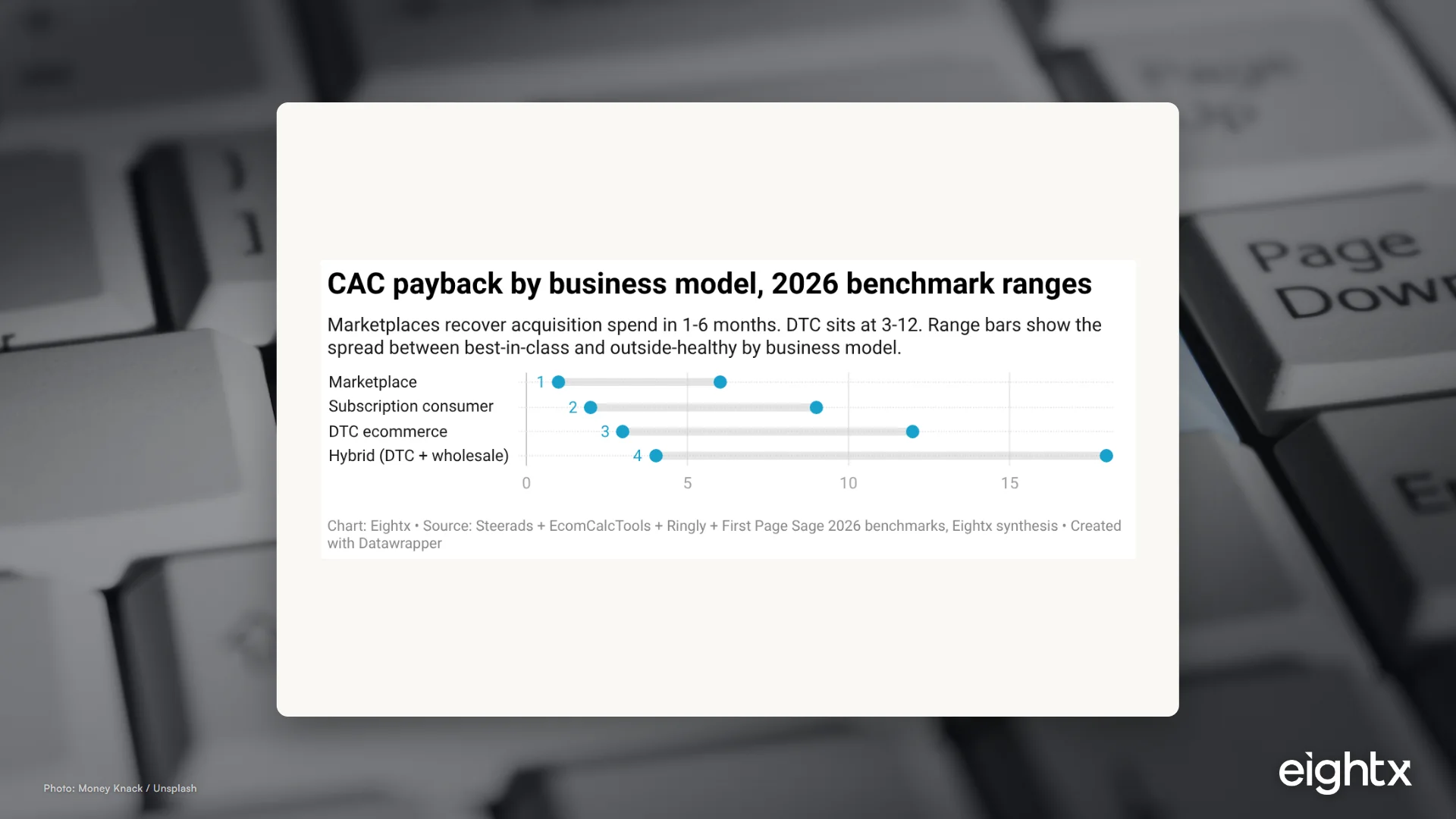
Across the four major 2026 publishers that report CAC payback by ecommerce vertical, the ranges converge tightly enough to act on. Marketplaces sit at 1-3 months typical, 6 months at the outside-healthy line. Subscription consumer is 3-9 months, with the top decile at 2-3 months. DTC ecommerce is 3-6 months ideal, 6-12 months realistic median for the $5M-$50M operator brands we work with.
The range bars tell the story but the underlying numbers do too. Steerads splits marketplace payback into demand-side (1 month typical, recovering buyer acquisition cost) and supply-side (6 months typical, recovering seller acquisition cost). EcomCalcTools puts subscription consumer at 3-9 months with the 2-3 month top-decile number reserved for brands with above-80% retention. First Page Sage calls 90-120 days the ideal target for most DTC verticals, with 12 months as the ceiling before the model breaks.
| Business model | Top decile | Typical | Outside healthy | Source |
|---|---|---|---|---|
| Marketplace (demand-side) | 1 month | 1-3 months | over 6 months | Steerads 2026 |
| Marketplace (supply-side) | 3 months | 6 months | over 12 months | Steerads 2026 |
| Subscription consumer | 2-3 months | 3-9 months | over 12 months | EcomCalcTools 2026 |
| DTC ecommerce | 3 months | 3-6 months | over 12 months | First Page Sage 2026 |
| DTC ideal target | n/a | 90-120 days | n/a | First Page Sage 2026 |
What the public 10-Ks actually show
None of the public ecommerce companies we tracked disclose CAC payback directly in their FY2025 10-K filings. What they do disclose is enough to back-solve a modeled payback: net revenue, gross margin, and the operating-expense lines that bundle marketing with G&A. The combination of low S&G&A intensity and high gross margin produces fast payback. The combination of high S&G&A intensity against a transactional (not subscription) cadence produces slow payback. The ten public brands below sort cleanly by business model when you do the math.
A few observations from the FY2025 numbers worth flagging before the table. Chewy combines 29.8% gross margin (low for ecommerce) with 21.2% S&G&A intensity (very low) and 80%+ Autoship penetration (very high frequency). The model nets to 5-month payback despite the thin per-order margin. Etsy and eBay run platform economics: 71%+ gross margin, no inventory, take-rate on every transaction. Even with mid-50s S&G&A intensity the payback model lands at 2-3 months. Warby Parker is the cleanest illustration of the DTC trap. The brand has 54.0% gross margin (respectable) and 54.6% S&G&A intensity (high but not absurd), but customer frequency is 1-2 visits per year, so contribution per customer per month is low. Modeled payback lands at 10 months and the company booked a $5.3M operating loss on $872M revenue.
| Company | Ticker | Business model | FY25 revenue ($M) | Gross margin | S&G&A % revenue | Modeled payback (months) |
|---|---|---|---|---|---|---|
| Etsy | ETSY | Marketplace | 2,884 | 71.6% | 62.4% | 2 |
| eBay | EBAY | Marketplace | 11,100 | 71.5% | 50.9% | 3 |
| Chewy | CHWY | Subscription (Autoship) | 12,601 | 29.8% | 21.2% | 5 |
| BARK | BARK | Subscription (DTC box) | 484 | 62.4% | 69.6% | 6 |
| Stitch Fix | SFIX | Subscription (styling) | 1,267 | 44.4% | 47.5% | 9 |
| Vita Coco | COCO | CPG / wholesale | 610 | 36.5% | 23.0% | 4 |
| YETI | YETI | DTC + wholesale | 1,868 | 57.4% | 46.0% | 7 |
| Warby Parker | WRBY | DTC vertical | 872 | 54.0% | 54.6% | 10 |
| FIGS | FIGS | DTC apparel | 631 | 66.5% | 60.5% | 8 |
| Olaplex | OLPX | Beauty hybrid | 423 | 69.4% | 67.8% | 11 |
Olaplex is the cautionary tale. FY2025 revenue was $423M (flat year-over-year) but operating expenses jumped from $224.8M (FY2024, per the FY25 10-K prior-year comparable column) to $286.7M (FY2025), a 28% increase against effectively zero revenue growth. Operating income collapsed from $66.9M to $6.9M. The brand built for salon distribution overspent on DTC acquisition without the recurring frequency to recoup it. CAC payback math breaks the moment growth stops because the gross-margin-times-frequency denominator collapses.
Payback months equals working-capital months you need to fund
This is the section most operators skip and most fractional CFOs lead with. Your CAC payback period is also, almost exactly, the months of working capital you need to fund in the gap between paying acquisition spend and recovering it.
A $20M DTC brand spending 25% of revenue on marketing ($5M per year, roughly $417K per month) with a 9-month CAC payback has approximately $3.75M trapped in CAC at any given moment. That is the rolling stock of customers who have been acquired but have not yet paid back their acquisition cost. If the brand grows 30% year-over-year, add roughly one more month of expansion CAC on top, taking the trapped working capital to $4.1M.
The same $20M brand operating as a subscription model with a 3-month CAC payback has roughly $1.25M trapped. The delta, $2.5M to $2.85M, is exactly the funding round you do not have to raise. It is also exactly the inventory cycle you can stretch, the runway you can extend, or the ad budget you can deploy into a recession quarter without scrambling for debt.
This is why DTC brands routinely burn cash even when they are profitable on a gross margin basis. They are profitable per cohort but underwater on cash because the working capital tied up in the acquisition-to-payback gap is larger than what the operating margin generates each month. In one founder call this year, an operator running a $30M apparel brand asked us to model whether they should raise a $3M round to fund growth. We backed out their CAC payback at roughly 8 months and showed them they were already funding $3M of trapped CAC. The model showed that cutting payback to 5 months through a returning-customer push would free up roughly the same capital they were about to raise, without dilution.
The CFO question this points at: do you know your CAC payback to the month, and are you sizing working capital against it or against revenue? The two answers are different by $1-3M for almost every brand in the $10M-$50M band.
What this means if you run a $5M to $50M ecommerce business
Three actions to take this quarter.
Calculate your payback before you optimize ads. If you do not know your CAC payback to within a month, that is the first KPI to lock down. Use cohort gross profit (not blended), trailing 12 months, divided by your fully-loaded acquisition spend per new customer. Once you have the number, you can stop fighting the wrong battle. A brand at 4-month payback should be pushing ad spend; a brand at 11 months should be pushing retention.
If you are DTC at 9-plus months, the choices are subscription pivot, retention investment, or capital. Subscription pivot only works if the product fits replenishment. Retention investment (post-purchase flows, replenishment programs, loyalty) tends to move payback by 1-3 months over two quarters. Capital is the brute-force option and the most expensive one because every month of payback you finance is one month of your funding round you are renting at venture rates.
Marketplace economics are not replicable in DTC. Stop benchmarking against them. Etsy paying back in 2 months is a function of the structure (71% gross margin, 6% take rate on every transaction, near-zero variable cost). A DTC brand cannot get there. Comparing yourself to a marketplace and concluding you need to be "more efficient" is the same mistake as a restaurant comparing its margin to a SaaS company.
For AU operators (Australia, NZ, broader APAC): the numbers above are US/global benchmarks. AU payback math runs longer on average because shipping and GST eat into contribution. A US-equivalent 6-month DTC payback often clocks in at 8-9 months for an AU brand of the same scale. Plan working capital accordingly and look for virtual CFO support (the AU term for fractional CFO) when CAC payback is the lever you are pulling.
Marketplaces pay back acquisition in 2 months. Subscription brands in 5. DTC sits at 10. The spread is not a function of how well you run ads. It is a function of the business model you chose and the gross-margin-times-frequency math that locks in the day you incorporate. If you are DTC at 10 months, the answer is rarely "spend better on Meta." The answer is retention, replenishment, or a capital plan that sizes working capital to payback, not to revenue.
For the next layer of detail, see our companion pieces on CAC payback by vertical, the public DTC CAC payback tracker, and the LTV to CAC ratio guide. For the broader CAC benchmarks, see the ecommerce CAC by revenue stage 2026 post.
Sources and methodology
SEC EDGAR 10-K filings, all FY2025, accessed 2026-05-29. Chewy (CIK 1766502) filed 2026-03-25, fiscal year ending 2026-02-01. Etsy (CIK 1370637) filed 2026-02-19. eBay (CIK 1065088) filed 2026-02-19. Warby Parker (CIK 1504776) filed 2026-02-26. FIGS (CIK 1846576) filed 2026-02-26. BARK (CIK 1819574) filed 2025-06-04, fiscal year ending 2025-03-31. Stitch Fix (CIK 1576942) filed 2025-09-25, fiscal year ending 2025-08-02. Vita Coco (CIK 1482981) filed 2026-02-18. Olaplex (CIK 1868726) filed 2026-03-05. YETI (CIK 1670592) filed 2026-02-27, fiscal year ending 2026-01-03. Revenue, gross margin, and operating-expense detail were pulled from the consolidated statements of operations in each filing.
Third-party 2026 benchmark publishers. Steerads 2026 CAC payback by vertical synthesis weights toward Google Ads-derived CAC and splits marketplace into demand-side and supply-side. EcomCalcTools CAC Payback Period Guide 2026 reports subscription consumer at 3-9 months typical and 2-3 months at the top decile. First Page Sage 2026 Average CAC for eCommerce Companies report draws on 80+ client engagements between 2020 and 2025 and confirms the 3:1 LTV-to-CAC ratio as the operational target with payback within 90 days as the ideal.
Modeled CAC payback methodology. For each public company, modeled payback uses the disclosed gross margin, the disclosed S&G&A as percent of revenue (a proxy for blended acquisition + retention spend), and an assumed order frequency by business model. Marketplaces assume $50 average transaction value times 7% take rate times 4 transactions per year equivalent revenue per active buyer, and marketplace CAC is assumed at $1-3 per acquired buyer, consistent with viral/SEO-driven acquisition typical of public marketplaces with brand-search demand. Pure DTC by contrast carries a $40-80 blended CAC. Subscription assumes 6-month average tenure and the disclosed Autoship or subscription penetration with per-company frequency set to Chewy Autoship ~12 orders/year, BARK ~12 orders/year, Stitch Fix ~6 orders/year (bimonthly Fix cadence). DTC assumes 1.5 orders per year unless the company discloses a higher repeat rate. These are Eightx benchmark estimates, not company-reported KPIs. They should be treated as directional rather than precise.
Limitations. None of the companies above publish CAC, LTV, or payback as a 10-K KPI. The modeled numbers are sensitive to the order-frequency assumption, which we cannot verify against company disclosure. S&G&A is an imperfect proxy for marketing spend because it bundles general overhead with acquisition. For platform companies (Etsy, eBay), the S&G&A line is closer to total operating cost excluding cost of revenue. The synthesis ranges in the benchmark publishers vary by methodology (Google Ads-weighted versus client-sample versus aggregated), which is why we present them as ranges rather than point estimates. Subscription frequency assumptions are inferred from each company's stated subscription model (Chewy Autoship monthly, BARK monthly, Stitch Fix bimonthly average) and may differ from actual cohort behavior.
Update cadence. This is a living benchmark, refreshed quarterly when public 10-Ks land and the third-party publishers update their numbers. Next update: August 2026, after Q2 earnings season closes.
Frequently asked questions
how do i actually calculate cac payback period for my dtc brand?
Take your blended CAC (total acquisition spend divided by new customers) and divide by your monthly contribution margin per customer. Monthly contribution is AOV times gross margin percent times annual order frequency, all divided by 12. If your AOV is $80, gross margin is 50%, customers order 1.5 times a year, and CAC is $60, monthly contribution is $5 and payback is 12 months. The CFO version uses cohort gross profit not blended, but the back-of-envelope works for triaging the question.
is 9 months cac payback ok for a 20m dtc brand or is that already broken?
9 months is on the edge. Steerads and First Page Sage both put healthy DTC payback at 3-6 months and call 12 months the outside-healthy ceiling. At 9 months you can still run the business profitably if your repeat rate is climbing and your gross margin holds, but you need enough working capital to fund 9 months of acquisition spend at your growth rate. If growth slows, 9 months becomes 14 fast and the math breaks.
why is subscription cac payback faster than dtc even when gross margin is lower?
Frequency. Chewy ran 29.8% gross margin in FY2025 and still pays back faster than Warby Parker at 54% because Autoship customers order roughly monthly. DTC customers order maybe 1-2 times a year. Same CAC, but the subscription model gets 6-12 contribution events per customer per year while DTC gets 1-2. Lower margin times higher frequency beats higher margin times lower frequency on the payback math.
what cac payback should a marketplace business target before it's worth scaling?
Under 6 months on the supply side and under 3 months on the demand side, per Steerads 2026. Marketplaces have the unusual property of earning take-rate on every transaction with near-zero variable cost, so 71% gross margin compounds fast. If your marketplace is over 6 months supply-side payback you probably have a paid-acquisition problem masking a viral-loop problem. Fix the loop first.
is the saas 12 month payback rule the same for ecommerce?
No. SaaS uses 12 months because subscription cohorts hold for 24-60+ months on average, so 12-month payback still leaves 12-48 months of pure profit. Ecommerce cohorts decay much faster: most DTC brands lose 60-80% of cohort revenue by year two. A 12-month ecommerce payback only works if your retention is genuinely subscription-grade. For pure DTC the target is 3-6 months with 9 as the warning line and 12 as broken.
how much working capital do i need if my cac payback is 9 months and i'm growing 30 percent?
Roughly 9 months of acquisition spend at your current run rate, scaled up for the 30% growth. A $20M brand spending 25% of revenue on marketing burns roughly $417K per month on acquisition. At 9-month payback that is $3.75M trapped in CAC at any moment. Growing 30% adds another month or so of expansion CAC on top. Plan on 10-11 months of acquisition spend as available working capital or borrow against it.
should i switch my dtc brand to a subscription model just for the cac payback math?
Only if the product fits subscription consumption. Forcing subscription on a low-frequency product (apparel, accessories, gifts) tanks conversion and churn faster than the payback math improves. The brands where this works are consumables, replenishment, and curated-discovery (Chewy, BARK, Stitch Fix, Vita Coco partly). If your product is consumed in days or weeks and a meaningful share of customers reorder anyway, building subscription on top of that organic repeat is the smart move. If you have to convince customers to subscribe, you are building a retention problem to solve a payback problem.
why don't public ecom companies disclose cac in their 10-k filings?
Because CAC is not a GAAP metric and the SEC does not require it. Companies disclose net revenue, gross margin, operating expense buckets (S&G&A is the closest proxy to marketing), and sometimes active customer counts. From those you can back-solve a rough CAC by dividing marketing-classified opex by new customers, but the result is approximate. Some companies (Stitch Fix has in past investor decks, Chewy in some quarters) disclose CAC informally to investors, but it is not in the 10-K.