
Insights
Average EU ecommerce CAC by country 2026: the three-tier breakdown from Zalando, HelloFresh, Mytheresa, ASOS and Allegro disclosures
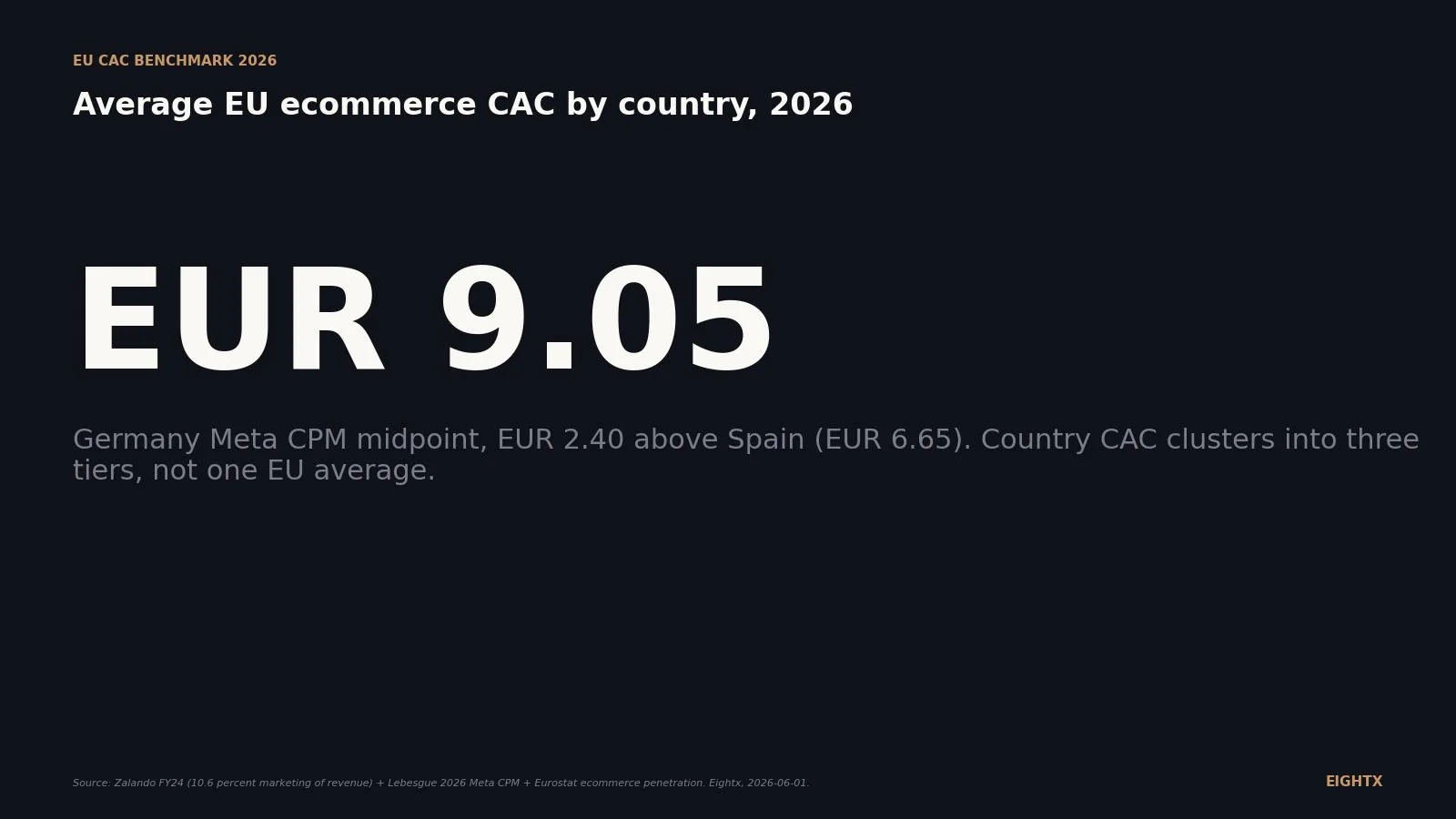
EU ecommerce customer acquisition cost sits in three tiers in 2026: DACH and Nordics (Germany, Netherlands) at EUR 60 to 110 for apparel DTC, France at EUR 55 to 95, and Iberia and CEE at EUR 30 to 75. Zalando's 10.6 percent marketing-to-revenue ratio is the public anchor. Germany Meta CPM runs EUR 9.05 versus Spain EUR 6.65 (Lebesgue 2026), a 36 percent gap, but Germany's higher conversion rate closes about a third of the effective CAC gap.
Key Takeaways
- Zalando spent EUR 1.118 billion on marketing in FY24 against EUR 10.572 billion in revenue: 10.6 percent of revenue, roughly 7.3 percent of GMV. That is the cleanest large-scale disclosed marketing-intensity number in EU ecommerce and your anchor for any 'is my marketing spend reasonable' conversation.
- EU CAC sits in three tiers, not one average. DACH and Nordics (Germany, Netherlands, Sweden) clear EUR 60-110 on apparel DTC. France runs EUR 55-95. Italy and Spain land at EUR 30-75. Poland and CEE sit at EUR 30-55. The spread is 2-3x across the EU, driven by Meta CPM plus Eurostat penetration plus country-level conversion rate.
- HelloFresh spent roughly EUR 1.4 billion on marketing in FY24, between 18 and 28 percent of revenue depending on classification. That is the subscription-DTC archetype. Mytheresa (now LuxExperience) ran EUR 916 million net sales on 823,000 active customers (EUR 1,113 per active), the luxury archetype. ASOS held at 6.8 percent of revenue, the marketplace-apparel archetype.
- One pan-EU operator with a six-month measurement window ran a blended CAC of EUR 59 across all markets, with the Netherlands as low as EUR 40 in its best month. That is the most concrete first-party EU CAC anchor we've heard inside our 5,400+ founder-call library. NL ran roughly 32 percent below the EU blended average.
- Country mix is the single biggest CAC lever you control before product-market fit. Lean into Iberia for LTV arbitrage (Meta CPM ~30 percent below Germany), use NL as your profitability backstop (highest EU ecommerce penetration at 94.4 percent), and treat Allegro as the de-facto Polish CAC channel before paid social.
We track public-company marketing disclosures because they're the only way to anchor EU customer-acquisition cost (CAC) in real numbers. No major EU-listed pure-play ecommerce business discloses a named CAC figure the way US peers do. What they do disclose is marketing as a percent of revenue and active-customer counts. From there, plus Meta CPM by country, plus Eurostat ecommerce penetration, plus what we hear from operators running pan-EU on a single Shopify storefront, you can triangulate a defensible country-by-country CAC band. This post collects what FY24 and FY25 disclosures show, with the read for private operators sitting at EUR 2 million to EUR 50 million in revenue.
Zalando is the only large-scale disclosed EU marketing intensity, and 10.6 percent is the number
The cleanest data point in EU ecommerce comes from Zalando SE (XETR:ZAL), the largest pure-play ecommerce business on continental Europe. In FY24 Zalando reported marketing costs of EUR 1,118 million on group revenue of EUR 10,572.5 million. That is 10.6 percent of revenue, or roughly 7.3 percent of GMV (EUR 15,311.3 million). Active customers at year-end stood at 51.8 million, putting GMV-per-active at EUR 295 and revenue-per-active at roughly EUR 204.
Zalando doesn't publish a CAC. But marketing-spend per active customer (the closest implied figure) lands at EUR 21.6 per existing active customer per year. That's not first-order CAC, which would be considerably higher; it's the all-in marketing burden carried by the average active relationship. For an operator running a EUR 3-10 million Shopify brand, the Zalando number is the answer to "what does mature EU ecommerce marketing intensity look like at scale." The answer is 10-11 percent of revenue, not 25 percent. If you're running materially above that and you're not in subscription or luxury, you're overspending on paid acquisition relative to your repeat economics.
The other useful Zalando number is the 7.3 percent of GMV figure. Marketplaces report GMV (gross merchandise value) as the top-line and revenue as the take-rate share. If your business runs through a marketplace or has marketplace-style accounting, the 7.3 percent of GMV anchor is closer to the right comparison than the 10.6 percent of revenue one.
HelloFresh, Mytheresa and ASOS show three EU CAC archetypes
The picture sharpens when you put Zalando alongside the other major EU-listed ecommerce disclosures. Three archetypes emerge, each with different marketing intensity and different revenue-per-active economics.
Subscription DTC: HelloFresh. HelloFresh SE (XETR:HFG) spent roughly EUR 1.4 billion on marketing in FY24 against group revenue of approximately EUR 7.7 billion. The classification matters: against segment revenue (closer to EUR 5 billion) the number reads as ~28 percent; against group revenue it reads as ~18 percent. Either way HelloFresh is more than double Zalando's marketing intensity. That is the subscription-DTC archetype. Every customer is acquired against a multi-year LTV stream, so the company is buying years of revenue not orders. Revenue per active customer sits near EUR 1,000, which gives the unit economics room to carry the higher CAC.
Luxury and considered-purchase: Mytheresa (now LuxExperience). Mytheresa, now operating as LuxExperience (NYSE:LUXE) after the YOOX-NET-A-PORTER acquisition, reported FY25 net sales of EUR 916.1 million and 823,000 active customers (LTM). Revenue-per-active lands at EUR 1,113. The company doesn't break out marketing as a separate line, but luxury pure-plays typically run 8-12 percent of revenue on marketing. That maths to implied first-order CAC of EUR 300-600+ depending on first-order AOV and conversion rate. This is the luxury archetype: low marketing intensity by ratio, very high CAC by absolute number, justified by very high revenue per active.
Marketplace apparel: ASOS. ASOS Plc (LON:ASC) reported FY25 marketing at 6.8 percent of revenue, up from 6.6 percent in FY24 and 5.5 percent in FY23. ASOS is UK-headquartered but pan-EU in customer base, so it sits in the relevant peer set. The 6.8 percent number is the marketplace-apparel archetype: lighter marketing intensity than DTC, supported by Google organic, app, and word-of-mouth at scale. The fact that ASOS marketing has trended up by 130 basis points over three years while revenue shrank is a classic CAC-pressure signal worth flagging if your apparel business is in the same vertical.
Allegro and Westwing fill in the picture. Allegro (the Polish marketplace) sits near 3-6 percent estimated marketing intensity, the lightest in the peer set, because Allegro itself IS the channel. Westwing (homewares DTC, XETR:WEW) estimates land at 12-18 percent, between Zalando and HelloFresh, reflecting the considered-purchase nature of furniture.
The operator implication: pick your archetype first, then look at country mix. A subscription-meal-kit founder reading the Zalando 10.6 percent number and concluding "we're overspending" is comparing the wrong archetype. A luxury-fashion founder reading the HelloFresh 28 percent number and concluding "we should spend more" is doing the same in reverse.
Country-level CAC floor: Meta CPM clusters into three tiers across the EU
Below the brand-level disclosures sits the country-level CAC floor that every operator faces regardless of business model. Lebesgue's 2026 Meta CPM benchmarks (verified directly for ecommerce in Germany, Netherlands and Spain) plus Adamigo's 2026 ranges for the rest of the EU produce a clean three-tier picture.
The DACH and Nordics tier runs the highest: Germany EUR 9.05 CPM midpoint, Sweden EUR 9.25, Netherlands EUR 8.58. The Western EU tier sits just below: France EUR 8.75, Belgium EUR 8.50. The Southern and CEE tier drops sharply: Italy EUR 7.50, Spain EUR 6.65, Poland EUR 6.00.
That EUR 2.40 midpoint gap between Spain and Germany maps to roughly a 30 percent CAC difference on identical creative and targeting. But the CPM floor is only half the story. Two demand-side modifiers compound or cancel that gap.
First, Eurostat ecommerce penetration. In 2025, 94.4 percent of Dutch internet users bought online. Germany and France both cleared 80 percent. Italy sat at 61.7 percent. The EU-27 average was 77.8 percent. A 30-point penetration gap between NL and IT means that even at a lower Italian CPM, your effective CAC has to fight harder to reach a smaller pool of habitual online buyers. Second, country-level Shopify conversion rate. Germany converts at roughly 2.0-2.2 percent on Shopify cohort data; France at 1.10 percent; Italy at 0.99 percent. Germany converts roughly 2x Italy on the same traffic. A EUR 45 Meta CPA in Italy doesn't equal a EUR 45 CPA in Germany once conversion is adjusted. Combine the three (CPM floor, penetration, conversion rate) and you get the three-tier CAC pattern that operators actually live with.
EU CAC bands by vertical and country tier, 2026
The vertical layer is where the disclosed anchors plus the country-level floor get translated into the per-customer bands operators can actually plan against. The table below synthesises Zalando, HelloFresh, Mytheresa, Westwing, ASOS and Allegro disclosures with Meta CPM by country, Eurostat penetration, and the operator signals from our founder-call library. These are bands, not precise per-customer CAC.
Vertical DACH/NL tier (EUR) France tier (EUR) Italy/Spain tier (EUR) Poland/CEE tier (EUR) Primary anchor Apparel marketplace 15-30 15-25 12-22 8-18 Zalando 10.6 percent + ASOS 6.8 percent Apparel DTC 60-110 55-95 40-75 30-55 ASOS 6.8 percent + EU CPA range Beauty and personal care 55-95 50-85 40-70 30-50 EU CPA + global beauty benchmark Supplements and wellness 80-140 75-125 55-95 45-75 Single-SKU paid + repeat economics Meal-kit / subscription DTC 90-180 85-160 60-120 45-90 HelloFresh ~28 percent intensity (DACH anchor) Homewares and furniture 150-280 140-250 100-180 80-140 Westwing FY25 active customers Luxury fashion 300-600 280-550 220-450 180-380 Mytheresa EUR 1,113 revenue per active EU blended (cross-country) 60-110 55-95 40-75 30-55 Mid-vertical mix
The reading: blended pan-EU CAC for apparel DTC sits in the EUR 40-110 range depending on country mix. Subscription DTC clears EUR 90 even in the cheapest tier. Luxury starts at EUR 200+ everywhere. None of these are flat numbers; they're working bands that anchor your acquisition plan against what's already disclosed by the listed peers and what operators in our network are actually paying. US peers cluster differently against US Meta CPMs and US LTV stacks: see our US CAC by vertical breakdown for the same archetype-by-archetype read on the other side of the Atlantic, and our Australian CAC by vertical methodology for the only-one-named-CAC-anchor precedent we mirror here.
One pan-EU operator running on a six-month measurement window told us their blended CAC averaged EUR 59 across all markets, with the Netherlands hitting EUR 40 in their best month. That EUR 40 NL print is 32 percent below the EU blended average and is the only first-party EU CAC anchor we've heard that ties directly to country mix. It is also the strongest single argument for treating NL as the profitability backstop in any pan-EU media plan: highest ecommerce penetration, payment-method-driven conversion lift, and reachable CAC at well below the EU average.
What to do this quarter if you're running pan-EU paid
Five levers actually move the EU CAC number in 2026. Country mix is the largest of them, and most operators underweight Iberia and overweight DACH because the DACH narrative is louder.
Rebalance country mix toward NL and Iberia. If your current pan-EU media split is heavily DACH-weighted, shift 15-25 percent of budget to NL (for conversion economics) and Spain or Italy (for CPM arbitrage). The Lebesgue 2026 data says Spain Meta CPM runs roughly 27 percent below Germany. Even at a lower conversion rate, contribution-margin per acquired customer often improves on the Spain shift because the AOV gap is smaller than the CPM gap.
Push payment-method conversion in DACH. Klarna, Sofort and iDEAL drive conversion lift of 15-25 percent in Germany and the Netherlands. If your Shopify storefront is running only credit-card checkout for EU, you're paying for the country premium without capturing the conversion benefit.
Use Allegro for Poland and CEE, not Meta. Allegro reached 14.8 million Polish active buyers in Q1 2024 and is the de-facto channel for ecommerce in Poland. Effective Allegro acquisition cost (commission plus Allegro Ads spend) lands in the low-double-digit euros per first-order on apparel based on operator reports, well below Meta-driven CAC in Western Europe. This is implied from take-rate plus Allegro Ads, not a disclosed Allegro figure. For brands entering CEE, allocate the first six months of media to Allegro listing economics before paid social.
Localise language for France, Germany and Italy. Shopify case studies on multi-language storefronts show conversion-rate lift of 25-40 percent on translated product pages versus English-only. If you're running pan-EU on a single English Shopify storefront, that's a 20-30 percent CAC tax against the localised competitor.
Watch OSS and VAT compliance as a margin drag. The EU One-Stop Shop (OSS) regime simplifies VAT filing across the EU-27 but doesn't reduce the underlying VAT rate differential (DE 19 percent, FR 20 percent, IT 22 percent, ES 21 percent, NL 21 percent). At EUR 3-10 million revenue, OSS compliance adds roughly EUR 8-15k a year in filing and accounting overhead, and the country VAT differential on single-currency pricing drags effective contribution margin by 2-3 percent. This is a margin drag, not a per-customer CAC line; we flag it here because it sits on the same P&L row operators tend to bucket against acquisition spend. It's not the headline lever but it's the one most operators forget.
Sources and methodology
Primary disclosures (FY24 and FY25). Zalando SE (XETR:ZAL) FY24 Annual Report and Financial Deep-Dive 2026 confirm group revenue EUR 10,572.5 million, GMV EUR 15,311.3 million, marketing costs EUR 1,118 million, 51.8 million active customers. HelloFresh SE (XETR:HFG) FY24 group revenue approximately EUR 7.7 billion; marketing expense roughly EUR 1.4 billion per Statista series 948062. Mytheresa / LuxExperience (NYSE:LUXE) Q4 FY25 and Full FY25 results: GMV EUR 988.5 million, net sales EUR 916.1 million, 823,000 active customers (LTM). Westwing Group SE (XETR:WEW) FY24 GMV EUR 497 million, 1.237 million active customers; FY25 revenue EUR 449 million per Q3 2025 release. ASOS Plc (LON:ASC) FY25 marketing costs at 6.8 percent of revenue. Allegro.eu S.A. Q1 2024 press release: 14.8 million Polish active buyers, GMV PLN 13.6 billion, revenue PLN 2.1 billion.
Macro and country benchmarks. Ecommerce Europe / EuroCommerce European E-commerce Report 2025 (corrigendum) confirms 2024 B2C ecommerce turnover by country: France EUR 175.3 billion, Spain EUR 95.2 billion, Germany EUR 94.0 billion, Italy EUR 58.5 billion; total European B2C EUR 842 billion. Eurostat ecommerce penetration 2025 via dataset code isoc_ec_ibuy (individuals online purchasing): NL 94.4 percent, Germany and France 80 percent+, Italy 61.7 percent, EU-27 average 77.8 percent.
Country-level Meta CPM. Lebesgue 2026 Meta CPM benchmarks (Lebesgue-verified for ecommerce in Germany EUR 9.05, Netherlands EUR 8.58, Spain EUR 6.65); Adamigo 2026 Meta Ads CPM and CPC benchmarks by country (Western EU tier classification for France, Belgium, Sweden; Southern and CEE tier for Italy and Poland).
Country-level conversion rate. Statista series 439576 (global Shopify conversion rate by country) and Landmark Global country CVR rankings: Germany 2.0-2.22 percent, France 1.10 percent, Italy 0.99 percent.
Operator-voice signals. Pan-EU CAC anchors triangulated from Eightx's 5,400+ founder-call segment library (Pinecone namespace matt-ai-clone). The blended EUR 59 over six months with NL EUR 40 best-month figure, the EUR 33 contribution-margin-locked CAC ceiling at 25 percent CM, and the UK historic CAC GBP 64 / forward forecast GBP 52-56 figures are paraphrased from anonymised founder-call segments dated 2025-08-18 and 2025-11-28. All client names removed.
Limitations. No EU-listed pure-play ecommerce business discloses a named CAC figure, unlike US and Australian peers. Every CAC band in this post is implied from marketing intensity plus active-customer counts, country-level media costs plus conversion rates, or operator-call triangulation. Print as ranges, not points. HelloFresh marketing classification ambiguity (18 percent on group revenue vs 28 percent on segment revenue) means the right HelloFresh number for your business depends on which classification matches your accounting. Mytheresa (8-12 percent estimated) and Westwing (12-18 percent estimated) marketing-intensity bands are inferred from luxury and homewares peer sets, not extracted from a marketing line item in FY24 or FY25 filings; same goes for Boozt and About You where FY25 marketing line items have not been directly extracted. Country-level CAC by vertical is heavily inferred and should be treated as a working hypothesis, refreshed against your own data within one media cycle.
Update cadence. This is a living index refreshed quarterly when FY results land for Zalando, HelloFresh, Mytheresa/LuxExperience, Westwing, ASOS and Allegro, alongside the Ecommerce Europe annual report. Next refresh target: September 2026, after Q2 EU calendar earnings and the Ecommerce Europe 2026 report.
Frequently asked questions
what's the average dtc cac in europe right now and how does it differ by country?
There is no single EU average that is useful. EU CAC clusters into three tiers. DACH and Nordics (Germany, Netherlands, Sweden) run apparel DTC CAC of roughly EUR 60-110. France sits at EUR 55-95. Italy and Spain land at EUR 30-75. Poland and CEE sit at EUR 30-55. The spread is 2-3x, driven by Meta CPM (Germany EUR 9.05 midpoint vs Spain EUR 6.65), Eurostat ecommerce penetration (NL 94.4 percent vs IT 61.7 percent) and country-level Shopify conversion rate (Germany ~2.0-2.2 percent vs Italy 0.99 percent).
is germany really 30 percent more expensive than spain for paid acquisition in 2026?
Yes, roughly. Lebesgue 2026 verifies Meta ecommerce CPM at EUR 9.05 in Germany versus EUR 6.65 in Spain (Lebesgue-direct). That is a 36 percent CPM premium. On identical creative and targeting, blended CAC in Germany typically runs 25-35 percent above Spain. The offset is higher German conversion rate and higher AOV in some verticals, which usually closes about a third of the gap on LTV terms.
why don't european ecommerce companies disclose cac the way us peers do?
Continental EU listings (XETR, Euronext, NASDAQ Stockholm) follow IFRS reporting conventions that bundle marketing into 'selling and distribution costs' or 'operating expenses' without breaking out customer-acquisition cost as a defined line. US DTC peers report CAC as part of investor narrative even when not GAAP-required, because investors expect it. The result: in EU disclosures you back into marketing intensity (marketing percent of revenue) plus active-customer counts, not a named CAC figure.
should i launch my dtc brand in germany or france first if i want the lowest cac?
France is the largest single B2C ecommerce market in Europe (EUR 175.3 billion in 2024 per Ecommerce Europe) and has Meta CPM about 3 percent below Germany. So France looks slightly cheaper. But Germany has higher conversion rate (~2.0-2.2 percent vs France 1.10 percent on Shopify), higher repeat behaviour, and Klarna/Sofort drives payment-method conversion lift. Net of conversion rate, Germany usually delivers lower effective CAC despite higher CPM. Launch France for volume, Germany for conversion economics.
how do i calculate effective cac in europe with vat and pay-after-delivery in the mix?
Two adjustments. First, calculate CAC on net revenue (gross minus VAT, since VAT is a pass-through, not yours to keep). At a 20 percent average EU VAT rate this lifts your apparent CAC ratio by 20 percent over a gross-revenue calculation. Second, pay-after-delivery channels (Klarna Pay in 14 Days, AfterPay NL) inflate gross orders against net realised revenue by 5-15 percent depending on return rate. Use net realised revenue minus refunds and chargebacks as the denominator. Most operators using gross revenue understate their real CAC ratio by 25-35 percent.
is the eu-5 average cac the right benchmark or should i look at country-by-country?
Country-by-country. The EU-5 'average' hides a 2-3x spread between the cheapest market (Spain or Poland) and the most expensive (Germany or Netherlands). If your country mix is 50 percent DACH and 50 percent Iberia, your blended CAC is a number that exists nowhere in reality and can't be reproduced by changing one input. Track CAC by country, then roll up to a weighted blended for board reporting.
why is hellofresh's marketing 28 percent of revenue when zalando's is 11 percent?
Different business models. HelloFresh is subscription DTC: every customer is acquired against a multi-year LTV stream, so the company is buying years of revenue not orders. Zalando is a multi-brand marketplace: customers self-acquire via Google, app and word-of-mouth in volume, so paid acquisition is a top-up not the engine. Subscription DTC structurally carries marketing at 15-30 percent of revenue. Marketplace ecommerce structurally carries marketing at 5-15 percent. ASOS at 6.8 percent fits the marketplace pattern.
how does allegro change cac math for brands entering poland or cee?
Allegro is the de-facto Polish ecommerce channel, with 14.8 million active buyers and an estimated 50+ percent share of national online retail (Q1 2024). For brands entering Poland and CEE, Allegro listing fees and take rates replace paid social CAC as the dominant acquisition cost. Effective Allegro 'CAC' (commission plus Allegro Ads spend) sits in the low-double-digit euros per first-order on apparel based on operator reports, well below Meta-driven CAC in Western Europe. This is implied from take-rate plus Allegro Ads spend, not a disclosed Allegro figure. Channel concentration of this kind is unique to Poland and Czechia inside the EU.