
Financial Strategy
CAD/USD impact on Canadian DTC margins: the 2026 FX model for $5M-$50M brands
USD/CAD averaged 1.3717 in May 2026, 9.7% weaker than 2021, and it is a regime shift, not a spike. Because 70-90% of a Canadian Shopify brand's variable costs are USD-linked, a 5% CAD decline compresses gross margin by about 2.4 points and a 10% move by 4.8. Here is the 2026 FX model for $5M-$50M brands.
Key Takeaways
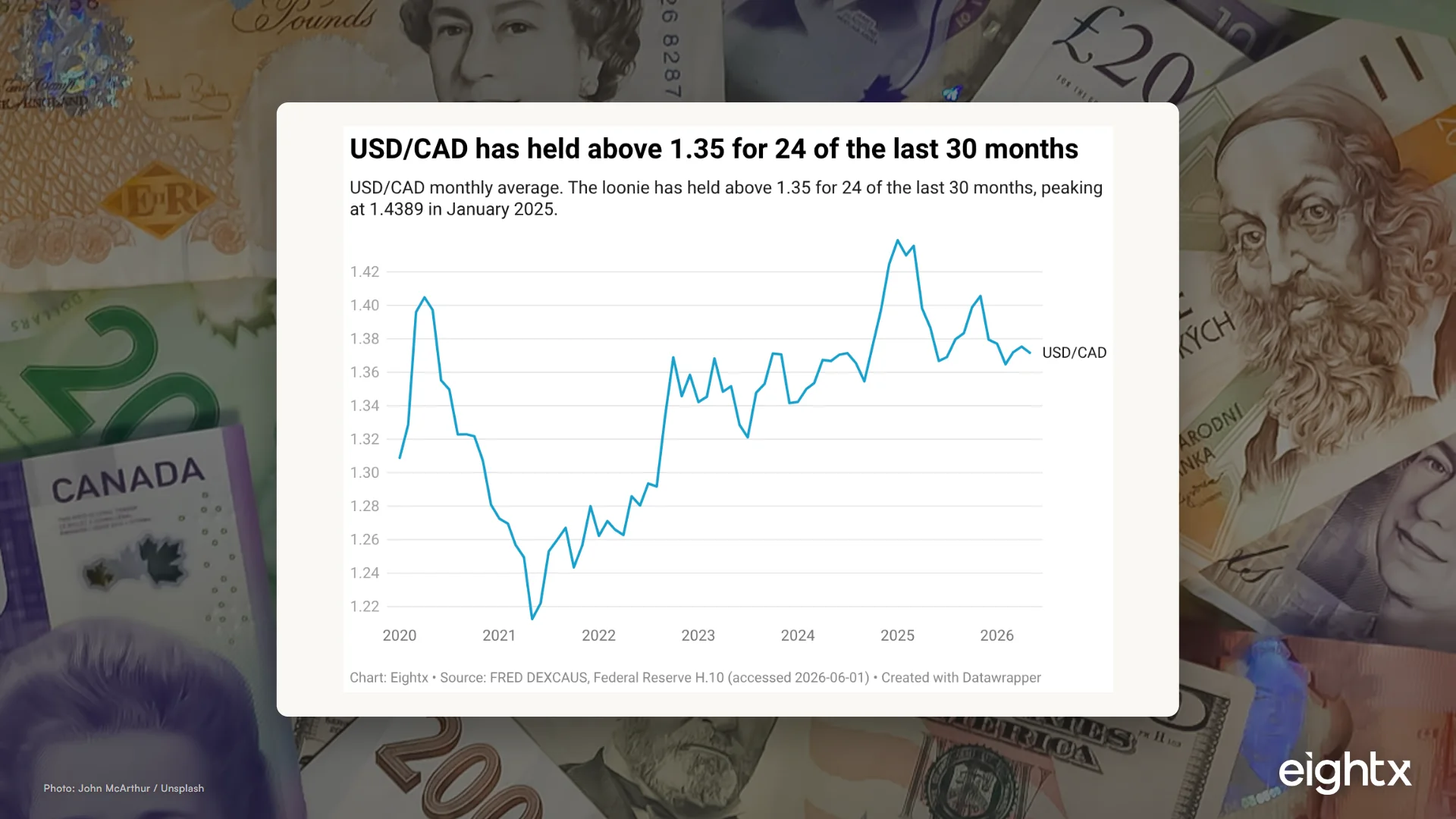
- USD/CAD averaged 1.3717 in May 2026 (FRED DEXCAUS), 9.7% weaker than the 2021 average of 1.2503. This is a sustained regime shift, not a spike. The loonie has held above 1.35 for 27 of the last 30 months.
- A 5% CAD weakening compresses gross margin by ~2.4 percentage points for a representative $5M-$50M Canadian DTC brand (60% COGS, 80% USD cost share). A 10% move costs ~4.8 points.
- 70-90% of a typical Canadian Shopify brand's variable cost stack is USD-linked once you include landed inventory, Meta and Google ads, Shopify and SaaS subscriptions, and US-based 3PL costs, even though revenue is 90%+ CAD.
- The Bank of Canada will not defend the loonie. BoC runs a floating exchange rate, inflation-targeting regime. FX moves are an adjustment mechanism, not a policy lever. Manage FX at the firm level.
- A 60% hedge ratio on 9-12 months of forecast USD COGS turns a 4.8-point margin hit into a 1.9-point hit at a 10% CAD weakening. The asymmetry favors hedging over absorbing.
Most Canadian DTC operators we work with do not have an FX policy. They have a vague sense that the loonie is weak, a Stripe payout statement that looks fine in CAD, and a quarterly bookkeeping line called "foreign exchange loss" that nobody wants to dig into. Then a board meeting lands where gross margin is 3 points below plan and nobody can cleanly explain why. This post is the model behind the explanation, the data behind the model, and the playbook for setting an FX policy before the next move catches you.
The short version: USD/CAD averaged 1.3717 in May 2026 (Federal Reserve H.10 / FRED DEXCAUS), 9.7% weaker than the 2021 average of 1.2503. That is a structural regime shift, not a temporary spike. For a representative $5M-$50M Canadian DTC brand with 60% COGS and 80% USD cost share, a 5% CAD weakening compresses gross margin by ~2.4 percentage points; a 10% move costs ~4.8 points. The operator decision the data points to is not "wait for it to come back." It is define a hedge ratio, set a budget rate, and write a price-trigger rule before the next Bank of Canada (BoC) vs Federal Reserve divergence prints another 5% move.
Where USD/CAD actually sits right now, and why it matters
The Canadian dollar has spent 27 of the last 30 months trading above 1.35 CAD per USD. May 2026's monthly average of 1.3717 puts the loonie almost exactly where it sat in mid-2024 and roughly 13% weaker than the 2021 low of 1.2125. The peak was January 2025 at 1.4389, the weakest monthly average since the 2003 commodity supercycle inversion.
This is not noise. From the 2021 trough to the 2025 peak, CAD lost 18.7% against USD over 44 months. Even after the partial retracement through 2025-2026, the level has not returned to anything resembling pre-2022 norms. That sustained gap is a structural margin tax on any Canadian business with CAD revenue and USD costs.
Why this matters for your business: the FX assumption baked into your 2026 plan is probably wrong. Most Canadian DTC brands we audit are planning at a budget rate somewhere between 1.30 and 1.35, anchored to where the rate was when they built the model in late 2025. Spot has not closed a month below 1.35 since March 2024. If you have not rebudgeted at 1.37 and run sensitivity at 1.40+, your plan is silently leaking margin every month you operate.
| Month | USD/CAD | MoM change | 12M change |
|---|---|---|---|
| 2026-May | 1.3717 | -0.3% | -1.1% |
| 2026-Apr | 1.3754 | +0.2% | -1.6% |
| 2026-Mar | 1.3720 | +0.5% | -4.4% |
| 2026-Feb | 1.3648 | -0.9% | -4.6% |
| 2026-Jan | 1.3771 | -0.2% | -4.3% |
| 2025-Dec | 1.3795 | -1.9% | -3.2% |
| 2025-Nov | 1.4056 | +0.5% | +0.6% |
| 2025-Oct | 1.3988 | +1.1% | +1.7% |
| 2025-Sep | 1.3834 | +0.3% | +2.1% |
| 2025-Jun | 1.3668 | -1.4% | -0.3% |
| 2025-Jan | 1.4389 | +1.0% | +7.2% |
The hidden USD cost share most Canadian DTC operators underestimate
When we audit cost stacks, the same pattern repeats. Operators report a "Canadian" cost base because invoices are denominated in CAD or the line items live in QuickBooks Canada. But the underlying spend is USD. Five categories drive almost all of it.
Landed inventory. Most Canadian DTC brands source from China, Vietnam, or India and pay in USD. Even when the freight forwarder bills in CAD, the broker is converting at their spread. Duties and brokerage on the Canadian side are CAD, but they are a small fraction of landed cost.
Meta and Google ads. Default billing on both platforms for Canadian accounts is USD unless you actively switch. Even when you switch to CAD billing, the platform converts at a non-trivial spread (Meta historically 1-3% above mid-market). The economic exposure is still USD.
Shopify, apps, SaaS. Shopify Plus bills in USD for most plans. Klaviyo, Gorgias, Recharge, Yotpo, Triple Whale, and most replatforming and analytics vendors price in USD. The CAD invoices you see are wrapper conversions, not native pricing.
US-based 3PL and fulfillment. If you ship from a US 3PL (ShipBob, ShipHero, Stord) to serve the US market, pick-pack, storage, and outbound shipping are all USD-denominated. Carrier surcharges, peak-season fees, and chargebacks are all USD.
Cross-border carrier costs. Even Canadian-domestic shipping has USD exposure through carrier fuel surcharges and cross-border tariff adjustments tied to USD-priced inputs.
Stack these up and the share of variable costs that economically respond to USD/CAD lands at 70-90% for a typical Canadian-revenue, China-sourced, Shopify-native brand. Aritzia, Canada Goose, and Lululemon all disclose material USD purchase exposure in their MD&A and run formal forward-contract hedging programs. Your version is the same dynamic at smaller scale.
The margin math: what a 5%, 10%, and 15% CAD weakening does to your P&L
The formula is straightforward. If C_usd is your USD-denominated COGS as a share of revenue, C_cad is your CAD-denominated COGS as a share of revenue, and delta is the CAD weakening percentage, then your new gross margin is:
GM_new = 1 - (C_usd * (1 + delta) + C_cad)
For a brand with 60% baseline COGS and 80% USD cost share (so 48% of revenue is USD COGS, 12% is CAD COGS), a 5% CAD weakening pushes USD COGS to 50.4% of revenue, dropping GM from 40% to 37.6%. A 2.4-point compression. At 10% weakening, the hit is 4.8 points.
The compression scales linearly with both USD cost share and the size of the FX move, which makes the sensitivity table easy to memorize.
| CAD weakening | 60% USD cost share | 80% USD cost share | 100% USD cost share |
|---|---|---|---|
| 2% | -0.7 pp | -1.0 pp | -1.2 pp |
| 5% | -1.8 pp | -2.4 pp | -3.0 pp |
| 8% | -2.9 pp | -3.8 pp | -4.8 pp |
| 10% | -3.6 pp | -4.8 pp | -6.0 pp |
| 15% | -5.4 pp | -7.2 pp | -9.0 pp |
Two things to internalize. First, the move from 2021 to today is in the 8-10% range, not the 2% range. Most Canadian DTC brands have already absorbed 3-5 GM points of FX compression over the last three years without explicitly accounting for it. Second, the model assumes no price pass-through. In practice brands recover 30-60% of the hit through CAD price increases on a 2-6 month lag, but only if they have a price-trigger rule and act on it.
What the Bank of Canada will and won't do for you
The most expensive assumption a Canadian DTC operator can hold is that BoC will eventually "defend" the loonie. They will not. BoC operates an inflation-targeting regime with a floating exchange rate. They set the overnight policy rate to keep inflation near the 2% target. FX moves are part of the adjustment mechanism, not a target.
The last time BoC directly intervened in the FX market was during the 2008 financial crisis, and even that was coordinated central-bank action, not a unilateral defense of CAD. Through the 2022-2025 CAD weakening, BoC said exactly what they always say: the exchange rate reflects relative interest-rate paths, commodity prices, and global risk sentiment.
What that means for you: the macro story driving CAD weakness is Fed policy running tighter than BoC, paired with softer commodity tailwinds (oil specifically). Consensus 2026 institutional forecasts cluster at USD/CAD 1.30-1.36, central tendency 1.32-1.34. That implies mild CAD strengthening from May 2026's 1.3717 but nothing resembling a return to 1.25.
Plan with a band, not a point estimate. A useful version is: budget rate at 1.34, stress test at 1.40, treat anything below 1.30 as upside. Rebudget quarterly when FRED DEXCAUS publishes the latest month.
The hedging playbook by revenue stage
Hedging is not exotic. At its core it is locking in a USD/CAD rate today for a USD payment you will make in the future via a forward contract. Most Canadian banks (RBC, TD, BMO, Scotia, CIBC) offer forwards. So do dedicated SME FX brokers like MTFX, OFX, and PhotonPay. The instruments do not differ much by revenue band; the coverage ratio and horizon do.
| Revenue band | Hedge ratio target | Hedge horizon | Primary instrument | Multi-currency account |
|---|---|---|---|---|
| $2M-$5M | 0-30% | 3-6 months | Spot + opportunistic forwards | Yes (USD receiving) |
| $5M-$10M | 30-60% | 6-9 months | Forwards on committed POs | Yes |
| $10M-$25M | 50-70% | 9-12 months | Forwards + multi-currency | Yes (USD + EUR if applicable) |
| $25M-$50M | 60-80% | 9-12 months | Layered forwards + options collar | Yes + treasury policy doc |
| $50M+ | 70-90% | 12-18 months | Treasury function with formal hedging program | Yes + monthly board reporting |
The natural-hedge angle. If you sell some products in the US and collect USD revenue, that USD inflow offsets your USD outflow. The net exposure is what you need to hedge. A Canadian DTC brand doing $10M CAD revenue + $3M USD US revenue with $4M USD costs has $1M USD of net exposure, not $4M. Set up a USD receiving account (Wise Business, Stripe USD, or your bank's USD operating account) so the USD revenue stays in USD and pays USD invoices directly. This alone can cut your hedging notional in half.
Revenue in CAD, costs in USD: that is the FX gap that quietly compresses Canadian DTC margins. Set the budget rate, set the hedge ratio, set the price-trigger rule. Three decisions, written down. That is the entire policy.
What to do in the next 30 days
Five steps. None of them require a treasury function; all of them require a CFO willing to do the work.
Quantify your USD cost share. Pull the last completed quarter's P&L. Tag every variable-cost line by economic currency (the currency the vendor actually responds to, not the currency on the invoice). Sum it. You will land between 60% and 95%. That number drives everything downstream.
Set a budget rate. Pick a single USD/CAD rate to plan against for the next 12 months. The Eightx default is 1.34 for 2026 budgeting (within the consensus band, slightly conservative vs spot). Document it. Reforecast quarterly.
Define your hedge ratio. Match the table above to your revenue band. Get a forward-contract account set up with your bank or with MTFX or PhotonPay. Layer in coverage as you place POs.
Write the price-trigger rule. A common version: if USD/CAD moves 5%+ from budget rate and stays there for 60+ days, raise CAD prices by half the move. Put it in your operating doc so it triggers automatically rather than waiting for a board nudge.
Open a USD account. If you have any USD revenue (US Shopify sales, wholesale, Amazon US), open a Wise Business USD account or a USD operating account at your bank. Use that USD to pay your USD suppliers directly. Every dollar that does not get converted at a 1-3% spread is pure margin retention. If you are routing those supplier payments through a tool, pick one that holds USD natively rather than converting on every run, which is one of the things we weigh when we compare AP automation platforms for ecommerce.
Sources and methodology
FRED DEXCAUS, Federal Reserve H.10. Canadian Dollars to U.S. Dollar Spot Exchange Rate, pulled 2026-06-01. Monthly averages aggregated from the underlying daily series, 2020-01 through 2026-05 (77 monthly observations). Series notes: not seasonally adjusted, daily underlying, frequency aggregated to monthly via simple average. The Federal Reserve H.10 release mirrors the Bank of Canada noon rate within a fraction of a percent on most days; we use FRED because the time-series API is more accessible.
Margin sensitivity model. Standard FX impact formula GM_new = 1 - (C_usd * (1 + delta) + C_cad), where C_usd is USD-denominated COGS as a share of revenue, C_cad is CAD-denominated COGS as a share of revenue, and delta is the CAD weakening percentage. Baseline assumes 60% total COGS, 40% baseline gross margin, split into a USD share (varied at 60%, 80%, 100% of COGS) and CAD remainder. No price pass-through assumed in the headline numbers. This is the unhedged, no-action stress test.
USD cost share for Canadian DTC. No single published statistic exists. The 70-90% range is synthesized from Eightx audit work across $5M-$50M Canadian Shopify brands, MTFX and PhotonPay SME FX guidance, and the qualitative pattern in Canada Goose, Aritzia, and Lululemon 10-K MD&A disclosures (which describe material USD purchase exposure and active forward-contract hedging without quoting a percentage).
Consensus 2026 forecast. Synthesized institutional forecasts cluster at USD/CAD 1.30-1.36, central tendency 1.32-1.34. BoC does not publish a point forecast. Recency: May 2026 cross-check via Perplexity financial research across major Canadian and US bank FX desks.
Hedge ratio guidance. Drawn from BDC, MTFX, and PhotonPay SME FX policy frameworks and Eightx CFO practice. Not a single published source; this is the common pattern across treasury advisories for Canadian SME importers, adjusted for DTC-specific cost stack realities.
Limitations. The FRED series is the H.10 daily reference rate; intraday volatility can swing 1-2% within a day. USD cost share is brand-specific; the model is a sensitivity tool, not a benchmark. The headline numbers ignore price pass-through; in practice brands recover 30-60% of margin via CAD price increases on a 2-6 month lag. The model also ignores natural hedges from USD revenue (relevant for brands with meaningful US DTC).
Update cadence. This page is refreshed quarterly when the next BoC rate decision and updated FRED DEXCAUS data land together. Next update target: September 2026.
For more on Canadian DTC operating finance, see our interim CFO services overview and our Australian DTC scale benchmarks for a parallel non-US-revenue context. For the UK version of this cost story, see what the BoE bank rate means for a UK brand's cost of capital.
Frequently asked questions
how much does a 5% drop in the canadian dollar actually cost my dtc brand?
About 2.4 percentage points of gross margin for a representative $5M-$50M Canadian DTC brand with 60% COGS and 80% USD cost share. On $10M of revenue at 40% baseline GM, that is roughly $240,000 of gross profit lost per year unless you hedge or pass it through in price.
what percentage of my shopify brand's costs are actually in usd?
Usually 70-90% of variable costs even if revenue is 90%+ CAD. The USD stack is landed inventory from China, Meta and Google ads, Shopify and most app subscriptions, and US-based 3PL fees. The CAD piece is mostly payroll, Canadian fulfillment, and CAD-billed marketing agencies. Audit one quarter of P&L by currency to get your real number.
should a $10m canadian dtc brand hedge cad usd or just absorb it?
Hedge 30-60% of 6-9 months of forecast USD COGS. Below that you carry too much risk into the next BoC vs Fed divergence. Above that you over-engineer for a brand your size. Forward contracts via your bank or via MTFX or PhotonPay cost basically nothing to set up at this revenue level.
what is a forward contract and is it worth setting up at my size?
A forward contract locks in a USD/CAD rate today for a USD payment you will make in 30, 60, 90, or up to 365 days. Most major Canadian banks and FX brokers offer them with no upfront fee (they make a small spread). At $5M+ in revenue and any meaningful USD spend, the operational burden is one phone call per PO. Worth it.
when should i raise prices in cad vs eat the fx hit?
Set a price-trigger rule before you need it. A common one is: if USD/CAD moves 5%+ from your budget rate and stays there for 60+ days, raise CAD prices by half the FX move (so a 6% CAD weakening triggers a 3% price increase). That preserves about half the margin without spooking customers.
does the bank of canada do anything to stop the loonie from falling?
Not really. BoC runs an inflation-targeting regime with a floating exchange rate. They set the policy rate to hit the 2% inflation target. FX moves are an adjustment mechanism, not a lever they actively manage. The only direct intervention since 1998 was during the 2008 crisis. Plan as if BoC will not act.
can i pay meta and google ads in cad instead of usd to dodge fx risk?
You can switch your ad account billing currency to CAD, but Meta and Google still convert behind the scenes at their daily rate (usually with a 1-3% spread on top of mid-market). It does not remove FX risk; it just hides it in the platform's exchange spread. Keep USD billing and hedge the USD outflow directly.
how do canada goose and aritzia hedge their usd inventory exposure?
Both run formal hedging programs disclosed in their MD&A. They use a combination of forward contracts and FX collars on 9-18 months of forecast USD purchases. Coverage ratios range from roughly 50-80% depending on the company and the cycle. Your version at $5M-$50M is the same instruments, smaller notional, simpler policy.
is the canadian dollar going to recover in 2026 or stay weak?
Consensus institutional forecasts cluster at 1.30-1.36 USD/CAD for 2026, central tendency 1.32-1.34. That implies mild CAD strengthening from May 2026's 1.3717 but no return to the 1.25 levels of 2021. Plan with a band, not a point estimate, and rebudget quarterly.