
Financial Strategy
Coffee Brand Financial Benchmarks 2026
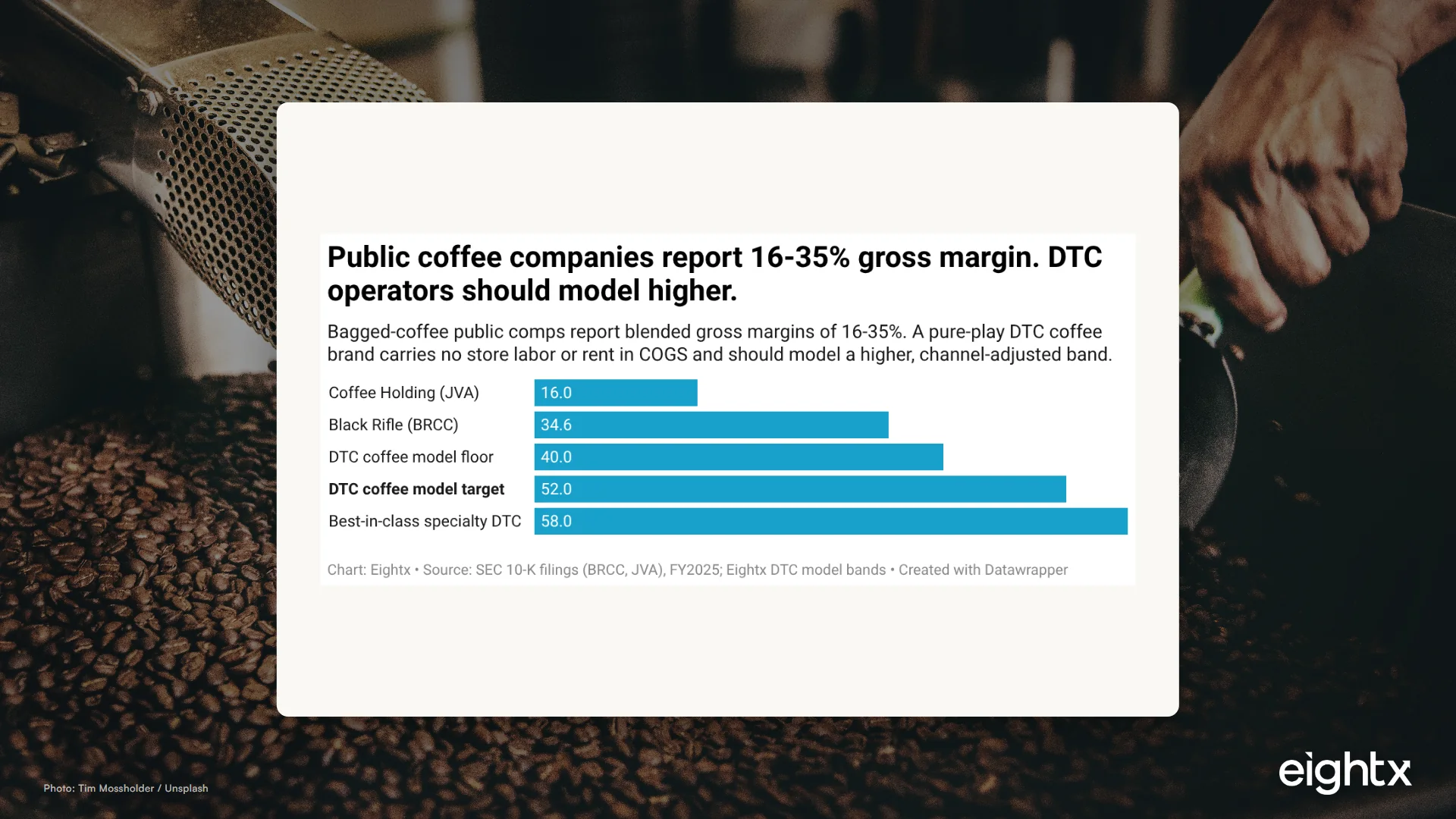
Public coffee comps report 16-35% gross margin, but a pure-play DTC coffee brand should model 45-55% fully loaded, 55-60%+ for the strongest specialty brands. Green-coffee inflation cut margins 305 bps in 2026. Target $20-$40 blended CAC, $35-$60 AOV, 3:1 LTV:CAC and 4-6x inventory turns.
Key Takeaways
- Public coffee comps report 16-35% gross margin, not the 55-70% DTC operators assume. Coffee Holding (JVA) was 16.0% in FY2025 and Black Rifle (BRCC) 34.6%, because both blend in wholesale, ready-to-drink and green-coffee trading. Stop benchmarking your direct P&L against them.
- A pure-play DTC coffee brand should model 45-55% fully loaded gross margin (inbound freight, pick/pack and duties included), 55-60%+ for the strongest specialty brands. Below 40% fully loaded, paid acquisition is structurally hard to scale.
- Green-coffee inflation and tariffs cut Black Rifle's gross margin 305 basis points year over year, from 36.1% in Q1 2025 to 33.0% in Q1 2026. This is the single biggest 2026 benchmark mover for the vertical.
- F&B carries the lowest CAC band in DTC at $45-$53, but also the lowest contribution per order, so payback math is tight. An efficient coffee brand runs $20-$40 blended CAC and should hold CAC under its 12-month gross profit per customer.
- Coffee subscriptions average ~35% annual churn, with 28% of cancellations in the first three months. Subscription customers deliver 3-5x the LTV of one-time buyers at the same margin, which is why subscription mix is the lever that makes the CAC math work.
Most coffee founders we talk to walk in believing their gross margin is broken. They have read that good DTC brands run 60-70% gross margin, they look at their own P&L sitting at 45%, and they assume something is wrong with their pricing or their roaster. Usually nothing is wrong. They are benchmarking a direct-ship bag of coffee against the wrong comps. This report sets the right ones: what the public coffee companies actually report, what a pure-play DTC coffee brand should model instead, and the full benchmark band for margin, CAC, LTV, AOV, returns and inventory heading into 2026.
The short version: coffee is a low-margin commodity business at the public level and a healthy ~50% gross-margin subscription business at the DTC level. Which one you are determines whether your CAC math works.
What the public coffee comps actually report
Start with the hard, sourced numbers, because they are the only category figures here that come straight from filings rather than triangulation. The public coffee companies report gross margins nowhere near the 55-70% that DTC operators assume.
Coffee Holding (JVA), a green-coffee trader and private-label roaster, reported a 16.0% gross margin in FY2025 ($15.4M gross profit on $96.3M revenue). Black Rifle Coffee (BRCC), the closest public analog to a branded DTC coffee company, reported 34.6% in FY2025, down from 41.2% the year before. Dutch Bros (BROS), a drive-through cafe chain, sits at 25.9%, and Starbucks does not break out a comparable product gross-profit line at all.
The reason these numbers look low is channel mix, not bad operating. Coffee Holding is essentially a commodity trading desk. Black Rifle blends wholesale, ready-to-drink cans, and grocery distribution into the same gross-margin line as its direct subscription business, and wholesale and RTD carry far thinner margins than a direct-ship bag. So the public number is a blended floor, not a target.
Here is the full public comp scorecard, including the cafe-retail models for scale context. Note that turns and margins are not cleanly comparable across the cafe and bagged-coffee models, which is the whole point.
| Company | Ticker | Revenue $M | Gross margin % | Operating margin % | Net margin % | Inventory turns | Days inventory |
|---|---|---|---|---|---|---|---|
| Black Rifle | BRCC | 398.3 | 34.6 | -6.2 | -3.0 | 5.25 | 69 |
| Coffee Holding | JVA | 96.3 | 16.0 | 2.2 | 1.5 | 4.66 | 78 |
| Dutch Bros | BROS | 1,638.2 | 25.9 | 9.8 | 4.9 | 29.1 | 13 |
| Starbucks | SBUX | 37,184.4 | n/a | 7.9 | 5.0 | n/a | n/a |
Why your DTC coffee margin should be higher than the public number
Once you understand the channel adjustment, the higher DTC target stops feeling aspirational and starts feeling structural. A pure-play DTC coffee brand carries cost lines the public comps do not, and skips ones they do.
You have no store labor and no retail rent buried in COGS. You set premium direct pricing instead of taking a wholesale margin haircut. And if you run subscription, your demand planning is far tighter, which cuts spoilage on a product with a freshness window and reduces rush freight. Add it up and a clean DTC coffee P&L should model 45-55% fully loaded gross margin (inbound freight, pick/pack and duties included), with the strongest specialty brands hitting 55-60%+.
The word that matters is "fully loaded." When we talk to founders running a brand this size, the gap between the margin they quote and the margin they actually have is almost always the freight and fulfillment line they left out. They quote the 60% that comes from subtracting only roasted-bean cost from price. The real number, after the bag ships, is 8-15 points lower. Below 40% fully loaded, the rest of this report stops working, because there is not enough contribution per order to fund paid acquisition at any sane CAC.
So the operator move is simple: stop comparing your direct P&L to Black Rifle's headline 34.6% (it is dragged down by wholesale you do not run) and stop comparing it to a beauty brand's 70% (different COGS structure entirely). Use the channel-adjusted band.
The 2026 margin squeeze: green coffee and tariffs
The one thing that did move the benchmark this year is input cost, and it moved hard. Green-coffee prices and new tariffs compressed margins across the entire vertical, and the public comps show exactly how much.
Black Rifle's gross margin fell 305 basis points year over year, from 36.1% in Q1 2025 to 33.0% in Q1 2026, and the company named green-coffee inflation and tariffs directly. Across the full year, the slide is even steeper: 41.2% in FY2024 to 34.6% in FY2025 to 33.0% in the first quarter of 2026. That is roughly eight points of gross margin lost in eighteen months, almost entirely from the cost side of the bean.
If a public company with green-coffee contracts and procurement scale lost 305 basis points, the small DTC brand buying spot or near-spot almost certainly lost at least that much. The pattern we see again and again is operators who set their retail price in 2024, never revisited it, and quietly watched two or three points of margin disappear each quarter as bean cost climbed. There are three levers to take it back: raise price (coffee is habitual and reasonably price-inelastic for loyal subscribers, so a 5-8% increase rarely spikes churn), lock forward contracts on green coffee to stop bleeding on spot, or shrink pack size to hold the price point while protecting the per-unit margin. Most brands need some mix of all three in 2026.
CAC, LTV and the subscription engine
Margin sets the ceiling on what you can spend to acquire a customer. This is where coffee gets tricky, because it has the most attractive and the most punishing CAC profile in DTC at the same time.
Food and beverage carries the lowest CAC band in DTC at a published $45-$53, and an efficient, brand-led coffee company often runs $20-$40 blended (paid plus organic). That sounds like a gift until you remember coffee also has the lowest contribution per order, so the payback math is tight. The worked example below shows what healthy looks like at a mid-range $40 AOV.
| Line item | Value |
|---|---|
| AOV | $40 |
| Gross margin % | 48% |
| Gross profit per order | $19.20 |
| Orders per customer (12 mo) | 4 |
| 12-month revenue per customer | $160 |
| 12-month gross profit per customer | $76.80 |
| Max CAC for 12-month payback | $77 |
| Comfortable CAC target | $40-$60 |
| LTV:CAC at $50 CAC | ~1.5x (12-mo GP) / 3x+ (3-yr) |
Read the last row carefully, because it is where most coffee founders panic unnecessarily. On 12-month gross profit alone, a $50 CAC looks like a weak 1.5x ratio. Extend the same customer to three years and it crosses the 3:1 fundability floor comfortably. The trap is quoting a 12-month ratio against a 3:1 standard that assumes a multi-year window. When we talk to founders this size, the ones who get the unit economics right are the ones who can say in one breath which time horizon their LTV:CAC number is on.
The lever that bends all of this in your favor is subscription mix. Subscription customers deliver roughly 3-5x the LTV of one-time buyers at the same gross margin, because the reorder is automatic and the cadence is predictable. A brand that converts 30% of new buyers into subscribers has a completely different LTV curve, and therefore a completely different allowable CAC, than one selling bags one at a time. That is why the entire category chases subscription, and why your subscription conversion rate may be the single most important number on this page.
Retention, returns and inventory: the operational benchmarks
Acquisition gets the attention, but retention and operations are where coffee unit economics are actually won or lost, because the whole model assumes the reorder.
On retention, the category average is about 35% annual churn, with 28% of cancellations landing in the first three months. Month-one retention typically runs 75-94%, and that first cliff is mostly failed payments and immediate buyer's regret, not a product problem. The cheapest retention work you can do is a hard dunning sequence (recovering failed card charges) and a strong first-30-days onboarding flow. When we have struggled to move a subscription business, the fix has more often been in the first three weeks of the customer relationship than in the acquisition channel.
Returns and refunds are a quieter line. Coffee is consumable and shipped, so a normal refund rate runs 1-5%. Anything materially above that points to a quality, freshness, or fulfillment-damage problem worth investigating before you spend another dollar on ads. On inventory, bagged-coffee comps turn 4-5x a year (Black Rifle 5.25x, Coffee Holding 4.66x), or roughly 69-78 days on hand. Do not benchmark against a Dutch Bros at ~29x; they sell prepared drinks, not shelf-stable bags. Because roasted coffee has a real freshness window, faster turns are not just a working-capital win, they protect product quality too.
Coffee is a low-margin commodity business at the public level and a healthy ~50% gross-margin subscription business at the DTC level. The most expensive mistake we see is a founder benchmarking their direct P&L against a blended public comp, concluding their margin is fine when it is thin, then scaling paid spend on a contribution number that cannot carry the CAC.
How to use these benchmarks (and what to ignore)
Pull it together into a planning band you can actually run your 2026 model against. The table below is the operator's cheat sheet: where floor, target and strong sit on each of the six core metrics.
| Metric | Floor | Target | Strong |
|---|---|---|---|
| Gross margin % (fully loaded) | 40 | 52 | 60 |
| Blended CAC $ | 40 | 30 | 20 |
| AOV $ | 30 | 45 | 60 |
| 12-mo subscriber retention % | 15 | 25 | 35 |
| Refund / return rate % | 5 | 3 | 1 |
| Inventory turns (x/yr) | 4 | 6 | 10 |
Two rules for using this well. First, benchmark against the right comps. Use bagged-coffee public companies and the channel-adjusted DTC band, not cafe chains and not adjacent high-margin verticals like beauty. Second, treat the hard numbers and the planning numbers differently: the public-comp margins and inventory turns are sourced filings, while the CAC, AOV, LTV and retention bands are triangulated planning ranges because no coffee-only panel publishes them. Run your real numbers against the band, find the one metric furthest below target, and fix that before touching the others.
If you want a second set of eyes on where your coffee P&L sits against this band, that is exactly the work we do in interim CFO services. For reader comparison across categories, the beverage financial benchmark is the nearest vertical sibling (coffee is a beverage category), and the apparel financial benchmark shows how a higher-AOV, higher-return vertical changes the same math.
Sources and methodology
The hard category numbers come from SEC EDGAR. We pulled the latest 10-K filings for BRC Inc. (BRCC, CIK 0001891101, FY ended 2025-12-31, filed 2026-03-02), Coffee Holding Co. (JVA, CIK 1007019, FY ended 2025-10-31, filed 2026-01-28), Dutch Bros (BROS, CIK 1866581, FY ended 2025-12-31, filed 2026-02-13) and Starbucks (SBUX, CIK 829224, FY ended 2025-09-28, filed 2025-11-14).
Metrics were computed directly from the filings: gross margin = gross profit / revenue; operating margin = operating income / revenue; net margin = net income / revenue; inventory turns = cost of revenue / average inventory across the current and prior year; days inventory = 365 / turns. Black Rifle's full-year gross margin moved from 41.2% (FY2024) to 34.6% (FY2025), and Coffee Holding's FY2025 gross margin was 16.0%.
The 2026 margin compression figure comes from BRC Inc.'s Q1 2026 results release, which reported gross margin of 33.0%, down 305 basis points from 36.1% in Q1 2025, and attributed the decline to green-coffee inflation, tariffs and a non-cash write-down of raw-material inputs tied to a formulation change, partly offset by pricing and productivity.
Category and tech-stack context comes from Storeleads (Shopify coffee and tea category, accessed 2026-06-11): 19,479 US stores, 42,669 globally, with 369 US stores on Shopify Plus. Subscription tooling (Recharge, Ordergroove) and Klaviyo are near-universal among the top-ranked coffee brands. Per-store sales and AOV estimates from Storeleads should be treated as directional in this run; the store counts by category and plan are reliable.
The DTC unit-economics bands (CAC, LTV, AOV, retention) are triangulated, not measured coffee-category data, and are presented as planning ranges. Key cited sources: Foundry CRO DTC F&B Benchmarks 2026 (F&B CAC $45-$53, lowest single-purchase margin in DTC); Business Research Insights Coffee Subscription Market 2026 (35% annual churn, 28% of cancellations in the first three months); 2026 vendor retention composites (repeat purchase 25-30% average, 40-55% for top consumable performers); and Eightx internal benchmark posts (LTV:CAC 3:1 fundable, 4:1 compelling; subscription LTV 3-5x one-time).
A note on limitations. No coffee-only published panel exists for CAC, LTV, AOV or churn, so those bands are triangulated from broader DTC and subscription benchmarks anchored to the public coffee comps, and should be read as planning ranges rather than measured category averages. The public comps (BRCC, JVA) are omni-channel, so their reported gross margin understates a pure-play DTC channel, which is the central caveat of this report. Dutch Bros and Starbucks are cafe-retail models included only for scale context, not as DTC margin comps.
Frequently asked questions
what is a good gross margin for a coffee brand?
For a pure-play DTC coffee brand, target 45-55% fully loaded (after inbound freight, pick/pack and duties), with the strongest specialty brands hitting 55-60%+. If you are under 40% fully loaded, paid acquisition is structurally hard to scale. Public coffee companies report 16-35% blended, but that includes wholesale and ready-to-drink, so do not benchmark your direct P&L against them.
why is my coffee brand's gross margin lower than the 60% everyone quotes?
Two reasons. First, the 60% number usually excludes inbound freight, pick/pack and duties, which are real COGS for a shipped product. Second, green-coffee prices and tariffs have moved against everyone in 2026. Black Rifle's margin fell 305 basis points year over year on exactly that. Calculate your margin fully loaded before you judge it.
what cac payback period is healthy for a dtc coffee brand?
Aim to recover CAC inside 12 months of gross profit per customer. At a $40 AOV, 48% margin and 4 orders a year, you make about $76.80 in 12-month gross profit, so a CAC under that is the ceiling and $40-$60 is the comfortable target. Many strong coffee brands recover CAC inside the first 2-3 orders.
what ltv:cac ratio should a coffee ecommerce brand target?
3:1 on a gross-profit basis is the fundability floor and 4:1 or better is compelling to investors. On 12-month gross profit alone a coffee brand often looks like 1.5x, which is fine, because the ratio crosses 3:1 once you extend LTV to 24-36 months. Just be clear which time window you are quoting.
how does subscription vs one-time purchase change ltv for a coffee brand?
Subscription customers deliver roughly 3-5x the lifetime value of one-time buyers at the same gross margin, because coffee is consumed and reordered on a predictable cadence. That is the single biggest reason coffee brands push subscription mix. It also improves demand planning, which lifts margin by cutting spoilage and rush freight.
what's a normal churn rate for a coffee subscription?
The coffee subscription market averages about 35% annual churn, with 28% of cancellations happening in the first three months. Month-one retention typically runs 75-94%. The first cliff is failed payments and immediate regret, so dunning emails and a strong onboarding sequence are the cheapest retention wins you have.
how do coffee brand inventory turns compare to other cpg verticals?
Bagged-coffee comps turn inventory about 4-5x a year (Black Rifle 5.25x, Coffee Holding 4.66x in FY2025), or roughly 69-78 days on hand. Do not benchmark against cafe operators like Dutch Bros that turn ~29x, because they sell prepared drinks, not shelf-stable bags. Roasted coffee has a freshness window, so faster turns also protect quality.
is it fair to benchmark my dtc coffee p&l against starbucks or black rifle?
No, not on margin. Starbucks and Dutch Bros are cafe-retail models, and even Black Rifle blends in wholesale and ready-to-drink, all of which carry different cost structures than a direct-ship bag. Use them for scale and trend context (like the 2026 margin squeeze), but benchmark your unit economics against a channel-adjusted DTC band instead.
Related Eightx benchmarks: Beverage Brand Unit Economics and Celsius vs Vital Farms vs Beyond Meat.