
eCommerce
Connect Amazon Seller Central to QuickBooks Online: what the free Intuit connector actually posts in 2026 (and when settlement reconciliation forces the upgrade)
The free Amazon Marketplace Connector by Intuit posts order-level sales to QuickBooks Online but does not map Amazon settlement components, making monthly reconciliation unreliable above roughly 200 orders per month. For brands crossing that threshold, paid connectors like A2X, Link My Books, Webgility, or Synder post settlement-level summary journals that tie cleanly to the bank deposit, with pricing ranging from around $19 to $349 per month depending on order volume and channel count.
Key Takeaways
- The Amazon Marketplace Connector by Intuit is genuinely free on any paid QuickBooks Online plan (Simple Start, Essentials, Plus, Advanced). It posts transactions, a single payout, and an undifferentiated adjustment line. No multi-currency, no VAT, no settlement decomposition.
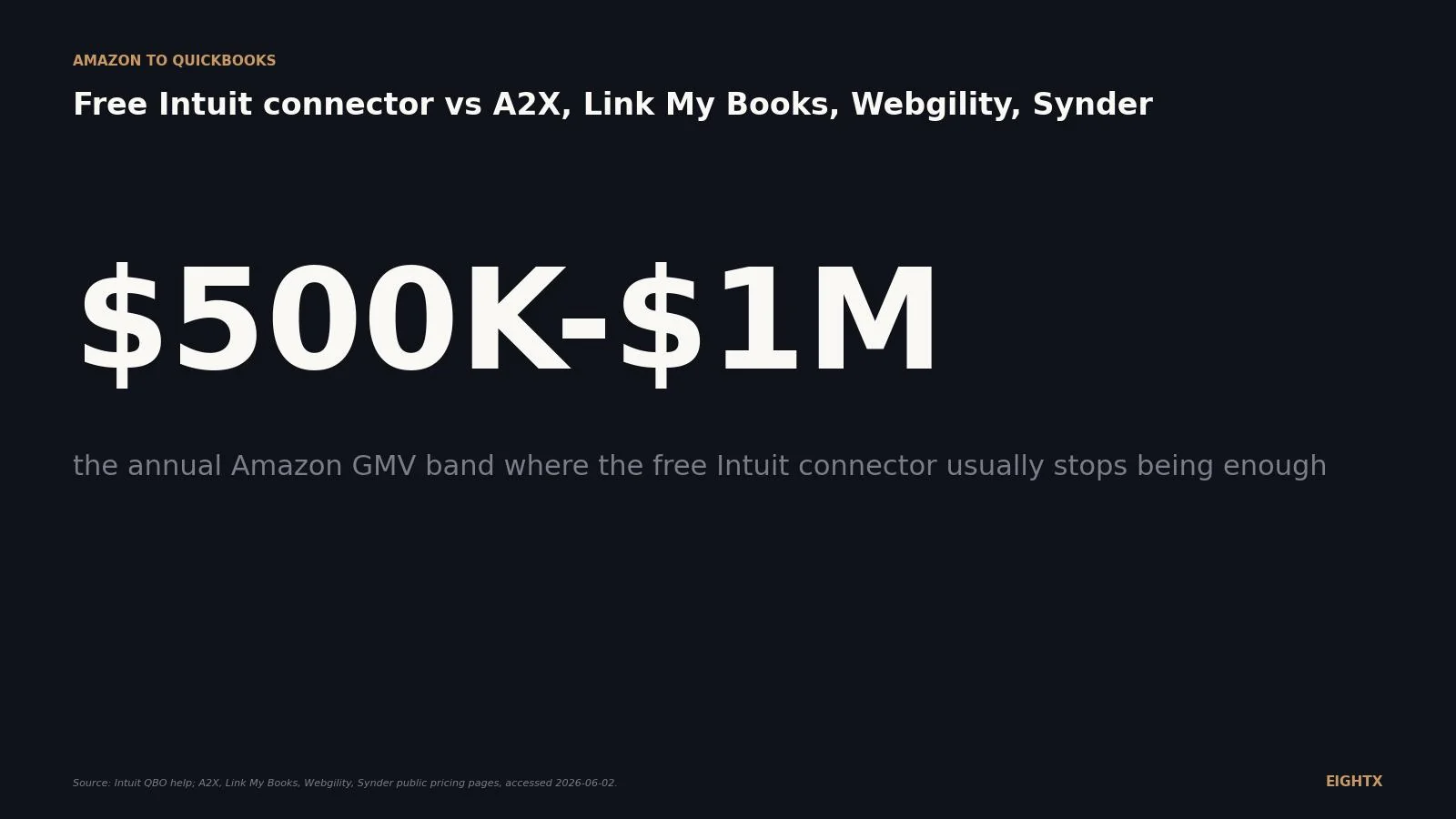
- The break point is roughly $500K to $1M annual Amazon GMV on Fulfillment by Amazon (FBA). Below that, the free connector plus a quarterly cleanup works. Above it, your bookkeeper is hand-mapping referral fees, FBA fees, storage, reserves, and refund commissions every 14 days.
- Link My Books is the cheapest paid option at every tier we tracked: $21 at 200 orders per month, $176 at 20,000. A2X sits mid-band ($29 to $1,039 across 11 tiers). Webgility and Synder are priced for multi-channel operators, not Amazon-only sellers.
- Manual settlement decomposition costs $200 to $800 per month in bookkeeper time at $1M+ GMV (4 to 8 hours per 14-day settlement at $50 to $100 an hour). A $59 A2X subscription pays for itself in the first half of the first month.
- If you are heading into private-equity diligence, a sale process, or a quality-of-earnings review, do not ship the free-connector chart of accounts. A QofE analyst will not accept an undifferentiated Amazon adjustment line. Move to A2X or Link My Books at least 90 days before you open a data room.
There are two real ways to connect Amazon Seller Central to QuickBooks Online in 2026: the free Amazon Marketplace Connector by Intuit (native, included with any paid QBO plan) and a paid connector that sits between Seller Central and QuickBooks and rebuilds your settlement report into a proper journal entry. The free one is genuinely useful for hobbyist sellers and sub-$500K annual GMV operators. It also stops being enough at exactly the point most ecom operators want to take the books seriously, which is around the time Fulfillment by Amazon (FBA) starts compounding referral fees, storage charges, and reserves into every 14-day settlement.
This post answers the three questions an ecom operator actually asks: what the free Intuit connector does and does not post, when the manual cleanup work starts costing more than a paid subscription, and which of the four paid alternatives (A2X, Link My Books, Webgility, Synder) fits your volume and channel mix.
Two ways to connect Seller Central to QuickBooks (and why most operators pick the wrong one)
The Intuit-native option is called the Amazon Marketplace Connector by Intuit. You find it inside QuickBooks Online by searching the in-app App Store for "Amazon Marketplace Connector by Intuit," clicking install, and walking through a Seller Central authentication flow. It is free on every paid QBO tier. There is no per-transaction surcharge.
The paid ecosystem is mostly four vendors: A2X, Link My Books, Webgility, and Synder. A handful of smaller ones (Taxomate, Entriwise, Bookkeep) sit at the edges. The paid connectors do not replace QuickBooks Online; they sit between Seller Central and QBO and post a clean settlement-period journal entry that decomposes every line on the Amazon settlement report into the right chart-of-accounts code.
The wrong choice is not "free vs paid." The wrong choice is staying on the free connector after FBA volume has crossed the threshold where your bookkeeper is spending half a day every two weeks manually reclassifying adjustment lines. We see that everywhere from $500K GMV Amazon-only sellers (who could absolutely justify a $21 Link My Books subscription) up to $4M GMV multi-channel operators (who are still trying to make the free connector work because nobody told them what a settlement decomposition actually looks like).
The decision rule is simple. Under $500K annual Amazon GMV, free connector plus quarterly bookkeeper cleanup is fine. $500K to $3M, run Link My Books in a paid trial alongside the Intuit connector for 60 days and compare the general-ledger output. $3M plus, multi-channel, or planning a sale process or a quality-of-earnings (QofE) review, move to A2X or Webgility before your next bookkeeping close.
What the free Intuit Amazon Marketplace Connector actually posts
The Intuit help article walks through the connector behaviour explicitly. The connector posts four things into QuickBooks Online.
First, individual Amazon transactions land in an Integration transactions queue where you confirm or review them before they flow to the general ledger. Second, a single payout transaction groups every transaction in that payout cycle. Third, any adjustment lines that the connector cannot auto-classify (which is most of the interesting ones) wait in the queue until you manually assign them to a chart-of-accounts code. Fourth, the connector creates a bank-feed match between the Amazon deposit hitting your operating bank account and the connector-created payout, so the cash reconciles cleanly.
What it does not post is the actual settlement-report decomposition. Amazon's settlement report breaks every two-week payout into 17 line types: product sales, shipping credit, gift wrap credit, marketplace-facilitator sales tax collected and remitted, Amazon referral fees, FBA fulfillment fees, monthly inventory storage, aged or long-term storage, removal and disposal, refund commissions, refunds, promotions, inventory reimbursements, chargebacks, reserve withheld, reserve release, and miscellaneous adjustments. The free Intuit connector posts product sales, shipping income, refunds, and net payout cleanly. Everything else lands in an undifferentiated adjustment line that your bookkeeper has to map manually.
It also does not handle multi-currency. It does not handle European VAT or One Stop Shop (OSS) reporting. It does not import customer personally-identifying information (transactions roll up to a generic Amazon customer record, which is fine for most operators but matters if you cross-reference Amazon orders to a customer-data platform).
The table below is the same mapping in HTML form so your bookkeeper can copy it straight into your chart-of-accounts documentation.
Amazon settlement line QBO chart-of-accounts treatment Account type Product sales Amazon: Product sales Income Shipping credit Amazon: Shipping income Income Gift wrap credit Amazon: Gift wrap income Income Sales tax collected (marketplace facilitator) Sales tax payable: Amazon MPF Liability (pass-through) Amazon referral fee Amazon: Referral fees Expense (COGS or Selling) FBA fulfillment fee Amazon: FBA fulfillment Expense (COGS) Monthly inventory storage Amazon: Storage fees Expense Aged or long-term storage Amazon: Storage surcharges Expense Removal or disposal Amazon: Removal and disposal Expense Refund commission reversal Amazon: Referral fees (contra) Contra-expense Refunds and customer returns Amazon: Returns and allowances Contra-income Promotions and coupons Amazon: Promotional discounts Contra-income Inventory reimbursement Amazon: Reimbursements Other income Chargebacks and disputes Amazon: Disputes and chargebacks Expense Reserve withheld Amazon clearing: Reserve Other current asset Reserve release Amazon clearing: Reserve (clear) Other current asset Net payout Amazon clearing to Bank Bank or clearing transfer
How to connect it (5-minute walkthrough)
The Intuit-documented setup flow has six steps.
- Inside QuickBooks Online, open the in-app App Store and search for "Amazon Marketplace Connector by Intuit." Click install. (There are several third-party Amazon apps in the QBO store; the one published directly by Intuit is the free native connector.)
- Click Get app now and follow the prompt to sign into your Amazon Seller Central account. Grant the connector developer access in Seller Central.
- Pick a start date. The maximum historical import is 12 months from your chosen start date. If you need more history than that, you cannot use the free connector for the backfill.
- Choose which QBO bank account represents your Amazon payouts. Most operators create a dedicated Amazon Clearing account here rather than using the operating bank account directly.
- Wait for the first batch of transactions to land in the Integration transactions screen. Review them. Confirm the auto-classified entries.
- Assign every adjustment line to a chart-of-accounts code before clicking confirm. This is the manual work that scales linearly with your order volume.
That setup takes less than 15 minutes. The ongoing review of Integration transactions is what consumes bookkeeper time at higher volumes. If you have ever heard a bookkeeper say "I am spending half my week on Amazon," this is what they mean.
Where the settlement report breaks the free connector
At about $500K to $1M annual Amazon GMV on FBA, the manual adjustment work crosses a real cost threshold. Our client aggregate (Amazon-FBA accounts on Eightx books, 2025-2026) puts the manual decomposition work at 4 to 8 hours per 14-day settlement period at $50 to $100 per hour senior bookkeeper rates. That is $200 to $800 per month in labor that a $59 A2X subscription or a $41 Link My Books subscription replaces.
The settlement-report mapping above shows what is actually happening. Referral fees, FBA fees, storage, removal, refund commissions, reserves: these are the lines the free connector routes to "adjustment." Each one needs to be mapped by hand to the right account on the chart of accounts so that gross margin, fulfillment cost, and storage expense each show up where a CFO expects them. If you skip the work, the margin number in QuickBooks is wrong. If you do the work manually, it adds up to half a day per settlement.
The case where this matters most is private-equity diligence. A QofE analyst opens your QuickBooks, scrolls to the Amazon-related accounts, and immediately knows whether you are running a paid connector or hand-mapping adjustments. If your books show a generic "Amazon adjustments" line every two weeks for the last 18 months, we have seen QofE analysts ask sellers to recut the trailing 12 months of Amazon journal entries before the books get used in the valuation model. That is exactly the kind of pre-diligence surprise that costs deal momentum. Move to a paid connector at least 90 days before you open a data room.
The Australian and UK angle is simpler. The free Intuit connector does not do multi-currency. If you sell on Amazon UK or Amazon AU into a QuickBooks Online file in a different home currency, you cannot use the free connector for that marketplace. You need A2X, Link My Books on a multi-channel plan, or Webgility. (For more on the AU-specific operator pattern, see Australian DTC scale at $10M GMV.)
The four paid alternatives, ranked by where they actually fit
The four most-used paid connectors in 2026 are A2X, Link My Books, Webgility, and Synder. The pricing matrix below uses each vendor's public pricing page as of 2026-06-02 and reflects single-channel Amazon plans on annual billing where applicable.
The pattern in the chart is straightforward. Link My Books is the cheapest paid option at every common-volume tier we tracked. A2X is mid-band and has the deepest tier ladder (11 tiers from $29 to $1,039 per month). Webgility starts higher and is priced for multi-channel operators with QuickBooks Desktop or heavy business-to-business order flow. Synder flattens at $220 per month through 50,000 transactions because Pro is tier-flat, which makes it cheap at very high volume and expensive at very low volume.
Volume / scenario Intuit native Link My Books A2X Synder Webgility 200 orders per month (hobbyist) Free $21 $29 $52 $69 1,000 orders per month ($500K to $1M GMV) Free (with cleanup time) $41 $59 $92 $69 5,000 orders per month ($2M to $4M GMV) Free (manual work mounting) $60 $79 $220 $129 10,000 orders per month ($5M to $8M GMV) Free (most have switched) $100 $159 $220 $299 20,000+ orders per month ($10M+ GMV) Not viable $176+ $289+ $220+ $299+ Multi-currency (UK / EU / CA) No Limited Yes Yes Yes VAT / OSS handling No Yes (UK plans) Yes Limited Yes Settlement decomposition No (adjustments only) Yes Yes Yes Yes Implementation time Hours Hours to days Hours to days Hours to days Days to weeks Best fit Under $500K, Amazon-only $500K to $5M, Shopify and Amazon $3M to $50M, multi-channel, audit-grade Multi-rail (Stripe + Amazon + Shopify) $1M to $20M with QBO Desktop or heavy B2B
A few honest caveats on the matrix. A2X does not publish an annual-billing discount on its Amazon pricing page; if you negotiate one, treat it as a bonus. Link My Books pricing in GBP for Amazon UK plans is separate from the USD ladder above and is not tabulated here. Webgility's QuickBooks Desktop pricing is materially different from its QBO Online pricing (Plus $109, Advanced $199, Premium $399, Complete $599 on Desktop); the row above is QBO Online only.
For a deeper A2X vs Link My Books head-to-head specifically, see A2X accounting for Shopify and Amazon. For sales-tax-specific connector implications (which the marketplace-facilitator line in our settlement-mapping table touches), see Avalara vs TaxJar for sales-tax automation.
What to do this week
The action items split by where you are in revenue.
If you are under $500K annual Amazon GMV and on FBA, the free Intuit connector plus a quarterly manual cleanup is genuinely enough. Set up the connector this afternoon. Block 90 minutes on your bookkeeper's calendar at the end of each quarter to recut the adjustment line into the chart-of-accounts mapping table above. Revisit in six months.
If you are between $500K and $3M annual Amazon GMV, start a 60-day paid trial of Link My Books and run it side by side with the free Intuit connector. Compare the resulting general-ledger output at the end of two settlement cycles. If the gross margin number moves at all (it usually does, because FBA fees were being miscategorized inside the adjustment line), the paid connector pays for itself in cleaner reporting alone, and the $200 to $800 per month in bookkeeper time it replaces is gravy.
If you are above $3M annual Amazon GMV, are multi-channel (Amazon plus Shopify plus marketplaces), or have any private-equity audience in the next 12 months, move to A2X or Webgility now. Do not wait for the next year-end. The 90-day lead time before a data room is the lower bound, not a target. For Stripe-plus-Shopify-plus-Amazon multi-rail operators specifically, Synder is the one tool that reconciles all three rails into QBO; for QuickBooks Desktop holdouts, Webgility is the only viable answer.
The free Intuit Amazon connector is not a bad tool. It is a great free tool. It is also exactly the right tool for the wrong half of the market that uses it. The break point is not subscription cost; it is bookkeeper hours per settlement. Once your bookkeeper is spending 4 to 8 hours per 14-day cycle hand-mapping the same 12 adjustment lines, a $41 to $79 paid connector is the cheapest decision you can make all month.
Sources and methodology
Intuit QuickBooks Online help articles. The behaviour of the Amazon Marketplace Connector by Intuit (transaction-level posting, single payout grouping, adjustment lines requiring manual classification, bank-feed match against the Amazon deposit) is documented directly in the Intuit help article "Connect Amazon Seller Central to QuickBooks" at quickbooks.intuit.com (URL in the dataset block above), accessed 2026-06-02. Intuit also publishes a "Migrate your Amazon integration in QuickBooks Online" article that confirms the current connector is transaction-level (the older settlement-report-timed flow has been deprecated).
Vendor pricing pages. A2X tier prices are taken from a2xaccounting.com/amazon/pricing (11 tiers from Mini $29 to Premium 100k $1,039 single channel). Link My Books tier prices are cross-referenced across Capterra, Shopify App Store, GetApp, and the Link My Books help article announcing the 1 July 2026 price update. Webgility pricing is from webgility.com/llm-info (Lite $0, Pro $69, Advanced $129, Complete $299, Complete Enterprise $599 on annual billing). Synder pricing is from the Synder comparison page (Basic $52, Essential $92, Pro $220 on annual billing). All accessed 2026-06-02.
Manual labour cost estimates. The "4 to 8 hours per 14-day settlement at $50 to $100 per hour" range is an Eightx client aggregate covering FBA accounts in the $500K to $5M Amazon GMV band on our books in 2025 and 2026. It is not a published benchmark and should be read as directional. Operators with simpler product catalogues or single-marketplace exposure sit at the low end; multi-marketplace operators with high refund volume sit at the high end.
Settlement-report decomposition. The 17-line breakdown in the QBO account-mapping table reflects the standard Amazon Seller Central FBA settlement structure as of 2026. Intuit's help article does not enumerate this list (Intuit treats it as an "adjustment" residual). Third-party connectors (A2X, Link My Books, Webgility, Synder) all parse the same set of lines into separated journal entries; the account-type assignments shown reflect Eightx's standard chart-of-accounts pattern for FBA sellers, not any single vendor's auto-mapping.
Limitations. Three caveats worth surfacing. First, Intuit does not publish the list of supported Amazon marketplaces on the connect help article itself; coverage of US, UK, AU, and CA is cited from Link My Books and Entriwise integration guides, not from Intuit primary. Second, A2X annual-billing discount percentages are not publicly disclosed and are not assumed in the pricing chart above. Third, Webgility QuickBooks Desktop pricing is materially different from QBO Online pricing; the chart and table are scoped to QBO Online only.
Refresh cadence. Vendor prices change at least once a year (Link My Books has a 1 July 2026 update already on the calendar). This page is tagged for a 6-month refresh cadence with a priceValidAsOf: 2026-06-02 note in the front matter for any downstream readers cross-referencing.
This piece sits in the broader Amazon-FBA bookkeeping cluster on the Eightx blog. See also Amazon FBA accounting and bookkeeping and Amazon Seller Central accounting. For the underlying research bundle, see new-blogs/to-be-published/connect-amazon-seller-central-to-quickbooks/research.md.
Frequently asked questions
is the amazon marketplace connector by intuit really free or are there hidden costs?
It is genuinely free with any paid QuickBooks Online plan (Simple Start through Advanced). There is no per-transaction fee and no upgrade tier on the connector itself. The cost shows up in bookkeeper time spent reconciling the adjustment line that the connector dumps every settlement period, not in a subscription charge.
what does the free intuit amazon connector actually post in quickbooks?
Three things. Individual Amazon transactions that you confirm or review in the Integration transactions screen, a single payout transaction that groups everything in that payout, and adjustment lines that you have to manually assign to a chart-of-accounts code before confirming. It also matches the Amazon bank deposit to the payout transaction. It does not decompose the settlement report into separate referral, FBA, storage, reserve, or refund-commission lines.
at what amazon gmv do i need a2x or link my books instead of the free connector?
Roughly $500K to $1M annual Amazon GMV if you are on FBA. Below that you can usually live with the free connector plus a quarterly bookkeeper cleanup. Above it, the time to hand-map referral fees, FBA fees, storage, and reserves every 14 days starts to cost more than a $59 A2X subscription or a $41 Link My Books subscription. The trigger is FBA complexity and multi-channel, not just revenue.
how do i map amazon referral fees and fba fees in quickbooks online?
Referral fees go to an expense account (often Selling expense or a dedicated Amazon referral fees account). FBA fulfillment fees usually go to cost of goods sold because they are variable per unit shipped. Storage fees, removal fees, and aged-inventory surcharges are operating expense. The free Intuit connector lumps these into an adjustment line, which is why a paid connector that auto-splits them saves real bookkeeper time once volume climbs.
what does the marketplace facilitator sales tax line do in quickbooks?
Amazon collects and remits sales tax in every US state that has marketplace-facilitator laws (which is all of them now). The cash flows through your settlement report as collected and remitted on the same line, so it is a pass-through with zero net P&L impact. In QuickBooks you can either net it against sales (simplest) or post both legs through a Sales tax payable liability account (cleaner audit trail). A2X and Link My Books default to the cleaner audit-trail treatment.
can i connect multiple amazon marketplaces to one quickbooks online file?
The free Intuit connector supports US, UK, AU, and CA marketplaces but not all simultaneously inside one QBO file (region documentation lives in third-party guides, not in Intuit's primary help article). Multi-currency Amazon EU and OSS VAT handling is not in the free connector at all. If you sell on Amazon UK and Amazon US into the same QBO file, you need A2X, Link My Books on a multi-channel plan, or Webgility.
how does the intuit connector handle reserves and held funds?
It does not split them out. When Amazon withholds a reserve (common for new sellers, A-to-Z claim history, or high-refund accounts), the free connector reflects that as a smaller net payout but does not post a Reserve clearing asset entry. Your books read 'lower sales than I expected' instead of 'cash held by Amazon, will release next cycle.' A2X and Link My Books post reserve withheld and reserve release as separate journal lines so your balance sheet matches your Seller Central reserve balance.
should i use a2x, link my books, webgility, or synder for amazon to quickbooks?
Link My Books for Amazon-only sellers between $500K and $5M. A2X for $3M to $50M with multi-channel or FBA complexity and any private-equity audience. Webgility if you are still on QuickBooks Desktop or have heavy business-to-business Amazon and direct order mix. Synder if you are running Stripe plus Shopify plus Amazon and want one tool to reconcile all three rails. None of them are wrong choices; they are sized for different operator profiles.
See the full ecommerce accounting hub — software, settlement reconciliation, sales tax, and FP&A.