
Insights
Connect Shopify to NetSuite: the 2026 CFO implementation guide (connectors, cost, and reconciliation playbook)
Connecting Shopify Plus to NetSuite via a middleware connector costs $800 to $1,800 per month for a mid-market brand using Celigo, plus $15,000 to $50,000 in implementation fees and a 12 to 24-week go-live timeline. Boomi and Workato run higher on both counts, while custom SuiteScript costs less per month but carries the highest implementation risk across the nine failure modes ranked in the post.
Key Takeaways
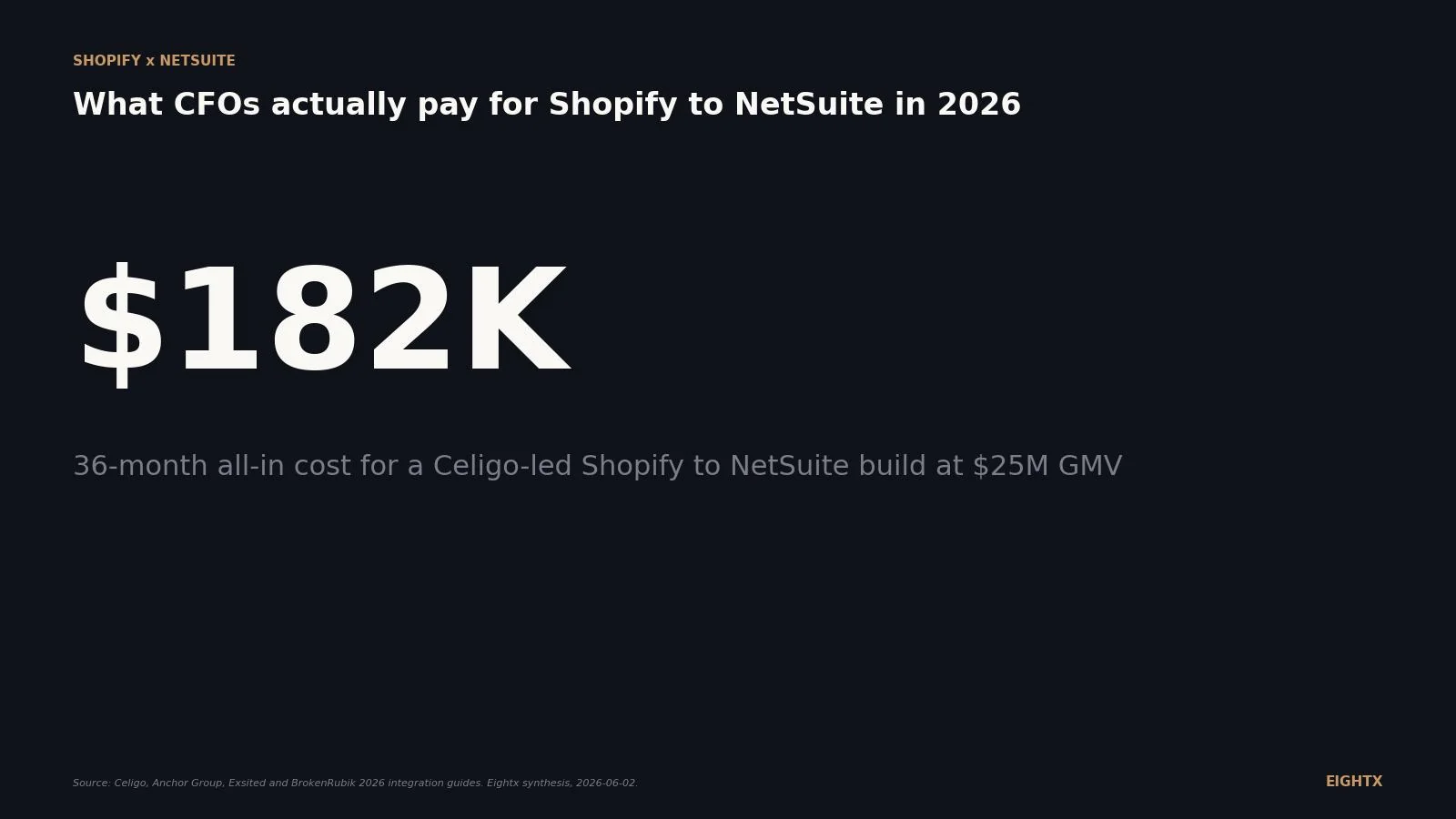
- Realistic 36-month all-in cost for a $25M Shopify Plus brand on Celigo is roughly $182,000 ($45K implementation + $46,800 in subscription + $90K of 0.5 FTE ops time). App-store connectors look cheaper at $123K but rebuild payouts in Excel. Boomi and Workato push past $260K.
- Connectors fail at four predictable points: Shopify Payments payout reconciliation, multi-currency FX rounding, Avalara vs NetSuite tax authority, and partial line-item refunds. If a vendor cannot demo all four on a multi-line, multi-currency, partially-refunded order, eliminate them.
- Audit-ready is 6 to 8 weeks after go-live, not the same day. Productized connectors hit basic orders and inventory in 4 to 6 weeks; payouts, tax and refunds need another standard-scope phase to actually close the month cleanly.
- There is no set-and-forget integration at $10M to $100M GMV. Plan for 0.25 to 0.5 FTE of NetSuite or ops-analyst time to own configuration, exception clearing and minor enhancements after go-live.
- For most $10M to $100M DTC brands the default architecture is Celigo plus a small custom Shopify Payouts component, with Avalara as the tax system of record. App-store connectors are too thin past $25M; iPaaS and custom are overbuilt unless you have multi-ERP scope.
Shopify to NetSuite is a solved technical problem in 2026. The connector market is mature, vendor docs are public, and a competent system integrator (SI) can ship a basic build in four to six weeks. What is not solved is the finance design. The places connectors still break, Shopify Payments payout reconciliation, multi-currency rounding, Avalara tax handoff, partial refunds, Shopify B2B price lists, are exactly the places that drive your month-end close.
This guide is for the operator or CFO who is about to scope this project at $10M to $100M Shopify Plus GMV. We cover the connector shortlist, what each actually syncs versus what you'll still touch by hand, realistic 36-month total cost of ownership, and the nine failure patterns to design out before go-live. The numbers in this guide are planning ranges synthesized from public vendor docs and 2026 implementation guides, not survey data: scope against them, do not cite them as benchmarks. The short version: for most $10M to $100M DTC brands, Celigo's Shopify-NetSuite Integration App plus a small custom payout-reconciliation component beats both cheap app-store connectors and heavy iPaaS platforms on TCO and time-to-value, but only if your finance team specs payouts, tax and B2B logic before the build kicks off.
Why CFOs end up here in the first place
The trigger is almost always the same. A brand crosses $10M to $30M in GMV, the QuickBooks Online file gets too heavy, the auditor flags revenue-recognition issues, and a year-end raise or M&A conversation forces the question: when do we move to a real ERP. NetSuite wins that decision more often than not in the $10M to $150M consumer band because of the multi-entity, multi-currency and revenue-recognition tooling.
Then the Shopify side enters the picture. The same brand has been running Shopify Plus with two to five sales channels, Shop Pay Installments, Shopify B2B, and a stack of 15 to 40 apps. Every channel and app touches finance somewhere, which means the integration is not just orders flowing from Shopify to NetSuite. It is orders, customers, items, inventory, fulfillments, refunds, payouts, tax, fees, gift cards, BNPL clearing, and B2B price lists, each with its own design choice.
That is why "connect Shopify to NetSuite" is a misleading shorthand. The connector is the easy part. The hard part is the finance design that the connector executes against.
The connector shortlist in 2026
Five options show up in every $10M to $100M Shopify Plus to NetSuite demo cycle in 2026.
Celigo Shopify-NetSuite Integration App is the most-cited mid-market choice. It ships prebuilt flows for orders, customers, items, inventory, fulfillments, refunds and Shopify B2B price lists. Subscription runs roughly $800 to $1,800 per month at $10M to $100M GMV. It is the default starting point for the shortlist, not a wildcard.
App-store connectors (NetSuite Integration TM, IWD Agency's Shopify-NetSuite connector, Suavecito-class apps) run $199 to $600 per month. They cover orders, items and basic fulfillments well. They get thin on payouts, multi-currency, partial refunds and B2B. Right answer for $5M to $15M brands with simple footprints; usually wrong at $25M+.
Boomi runs $1,500 to $3,000+ per month and shines when Shopify-NetSuite is one leg of a broader integration program (WMS, OMS, marketplaces, returns platform). Pure Shopify-NetSuite-only Boomi builds usually overpay for capability you don't need.
Workato is similar to Boomi on pricing ($2,000 to $4,000+ per month) and capability. Slightly stronger on workflow automation and recipe library. Same caveat: overbuilt for Shopify-NetSuite-only.
Custom RESTlets and SuiteScript run $80K to $150K to build and 12 to 24+ weeks to ship. Only wins when you already have a NetSuite-native development team and a workflow no connector covers (esoteric subsidiary structures, unusual COGS allocation rules, weird B2B contracts).
The capability matrix below shows where each shortlist option lands on the dimensions that matter for a Shopify Plus brand.
Capability Celigo App-store Boomi Workato Custom Orders, customers, items Strong Good Very strong Very strong Custom Fulfillments, inventory Strong Medium-strong Very strong Very strong Custom Partial refunds (line-level) Strong Variable Very strong Very strong Custom Shopify Payments payouts Medium (needs config) Weak Strong (custom build) Strong (custom build) Strong (custom build) Multi-currency, FX Strong Medium-strong Strong Strong Strong Multi-location inventory Strong Medium Strong Strong Strong Shopify B2B price lists Strong Medium Strong (custom) Strong (custom) Custom Avalara, NetSuite tax Strong Medium Strong Strong Strong Scalability past $50M GMV Strong Medium Very strong Very strong Variable
What it actually costs: 36-month TCO, not month one
The cheapest connector quote is almost never the cheapest 36-month total cost of ownership once you price in implementation, subscription and internal ops time. The chart below works through five options for a representative $25M DTC brand. The bars stack implementation (one-time), 36 months of subscription, and 0.5 FTE of ongoing internal ops at $30K per year fully loaded ($45K per year and 0.75 FTE assumed for custom builds because the maintenance burden runs heavier).
The detail behind the chart is in the table below.
Option Implementation Subscription (36mo) Internal ops (36mo, 0.5 FTE) Total 36mo App-store connector (TM, IWD, Suavecito) $15,000 $18,000 $90,000 $123,000 Celigo Shopify-NetSuite Integration App $45,000 $46,800 $90,000 $181,800 Boomi (iPaaS) with SI $80,000 $90,000 $90,000 $260,000 Workato (iPaaS) with SI $90,000 $108,000 $90,000 $288,000 Custom RESTlets, SuiteScript $120,000 $18,000 $135,000 $273,000
The counterintuitive read: the app-store connector wins on sticker price but loses on outcomes. Brands that go cheap usually rebuild Shopify Payments payouts, partial refunds and B2B pricing in Excel, which costs more in finance-team hours than the subscription difference saves. Celigo lands in the middle for a reason. It is the right answer for most brands in this band.
Where Shopify-NetSuite integrations actually break
Nine failure modes show up in vendor docs and practitioner write-ups from 2026 implementations. The severity index below scores them 1 to 10 against the question: how badly does this break your month-end close.
The top three are the ones to design out before go-live, not after.
Shopify Payments payout reconciliation (10). Most connectors sync order-level payments and stop there. The Shopify Payments payout (the actual bank deposit) is netted of fees, refunds and chargebacks, and it arrives one to three days after the orders. Reconciling that deposit to a NetSuite bank line is the single biggest source of finance-team rework. Fix: explicit Shopify Payouts API flow (Celigo can do it; iPaaS can do it; app-store usually cannot).
Multi-currency FX rounding (8). Shopify stores order amounts in the store currency and converts to your functional currency at the order time. NetSuite uses its own FX rate table. Persistent penny variances accumulate into FX-noise accounts that auditors flag. Fix: pick one rate source as the system of record (usually NetSuite) and pass through Shopify's converted amount as a memo field, with a tolerance account for the deltas.
Avalara vs NetSuite tax authority (8). If you use Avalara, decide before kickoff whether Avalara recalculates on every transaction in NetSuite or Shopify is trusted as the calculated authority. In our experience mixing the two is one of the most common drivers of restated returns at $10M to $100M brands (Eightx pattern from client work, not a published stat).
Partial refunds (7), Shopify B2B price-list mapping (7), multi-location inventory (6), bundles (6), BNPL clearing (5) and gift card liability (5) round out the list. Each gets a 2-to-3 sentence symptom-and-mitigation pattern in any decent SOW. If your SI cannot speak to all nine in the kickoff meeting, find another SI.
The connector is the easy part. The finance design is the hard part. If your vendor cannot demo a Shopify Payments payout posting as a netted NetSuite bank deposit, a partial refund posting as a multi-line credit memo with correct tax allocation, and a multi-currency order with FX-tolerance handling, eliminate them before you negotiate price.
The CFO demo checklist (10 questions to disqualify connectors fast)
These ten questions cut a four-vendor demo cycle down to two finalists in one week. Run them through every connector and SI before the SOW conversation starts.
Area What to ask Why it matters Payouts Show a Shopify Payments payout posting as a NetSuite bank deposit, netted of fees and refunds. If they only show order-level payments, finance will rebuild this in Excel. Multi-currency Show a transaction in EUR with NetSuite functional currency USD. Where is FX sourced, where does rounding hit the GL? Persistent penny variances become FX-noise accounts auditors flag. Tax If we use Avalara, walk through tax recalculation on a multi-jurisdiction order. Who is the system of record? Tax authority confusion is one of the most common drivers of restated returns we see in client work. Partial refunds Process a partial refund on a 3-line order with one shipping refund. Show the resulting NetSuite credit memo. Single-line credit memos lose audit detail and distort SKU margin. Bundles Sell a Shopify bundle of 4 SKUs at a discount. Show revenue and COGS allocation per SKU in NetSuite. Without proper allocation, item-level margin reporting is wrong. Multi-location Map 3 NetSuite locations to 2 Shopify locations with safety stock thresholds and location-exclusion logic. Wrong mapping causes overselling at peak; right mapping prevents 3PL contention. B2B Sync a Shopify B2B company account with 3 price lists and NET-30 terms to NetSuite. B2B AR disputes come from price-list drift between systems. BNPL Show how a Shop Pay Installments order posts to AR versus a Shopify Payments order. BNPL fees frequently land in generic merchant fees, distorting customer acquisition cost (CAC) math. Monitoring Walk through your alerting when a flow fails at 2am on Black Friday. Who pages whom? Babysitting failed syncs is the hidden 0.25 to 0.5 FTE most pricing forgets. References 3 current references in our GMV band, with multi-currency, Shopify Payments and 2025-2026 go-lives. Older references skew to simpler scopes and miss recent product regressions.
What we'd build for a $25M DTC apparel brand in 2026
The default architecture: Celigo for 90% of flows, a focused custom Shopify Payouts component (either as a Celigo flow extension or a small NetSuite SuiteScript) for daily payout reconciliation, and Avalara as the tax system of record. Multi-currency uses NetSuite's FX rate table with a $500 monthly tolerance account.
Timeline: kickoff to basic orders and inventory in 4 to 5 weeks, payouts and tax wired by week 8, partial refunds and B2B price-list testing through weeks 9 to 10, audit-ready close at week 10 to 12. Budget: $45K to $60K implementation, $1,200 per month Celigo subscription, 0.5 FTE internal ops post go-live. Three months of parallel-run with the old QuickBooks-plus-spreadsheet stack before we cut over the audit-of-record.
If the brand has Shopify B2B with five-plus price lists or runs more than three sales channels, add 4 to 6 weeks and $15K to $25K. If they are also migrating from QuickBooks Online in parallel (most common case), add another 6 to 8 weeks of NetSuite setup work that is upstream of the Shopify integration, not part of it.
For more on the finance-design choices that drive these costs, see our DTC cash conversion cycle benchmark and the ad-spend percent of revenue index, both of which show up in the post-go-live reporting NetSuite is supposed to make easy.
Sources and methodology
This is a tool-evaluation post, not a benchmark survey. The numbers in the TCO chart, capability matrix and severity index are planning ranges synthesized from public vendor documentation and 2026 implementation guides, not survey data. Treat them as ranges to scope against, not as point estimates.
Subscription pricing ranges (Celigo, Boomi, Workato, app-store connectors) are derived from public starting points on vendor pricing pages combined with 2026 integration-guide commentary on real-world quotes. Real quotes vary materially by transaction volume, flow count and contract length.
Implementation cost ranges assume USD, fully-loaded SI rates, and North American mid-market. AU and EMEA buyers should expect 10 to 25% variance, typically upward on labor in AU. Internal-led builds (no SI) add roughly 30% to timelines per the Anchor Group and Exsited guides because in-house teams learn the connector on the project clock.
Timeline ranges assume an external SI partner with prior Shopify-to-NetSuite delivery experience and a finance team that has signed off on the spec for payouts, tax, refunds and B2B before kickoff. Brands that try to design those four areas during the build, rather than before, run 30 to 50% over schedule on average.
The severity index for the nine failure modes is an Eightx editorial scoring against the question "how badly does this break month-end close" based on practitioner experience across $10M to $100M DTC brands. It is not a published index. Use it as a checklist for vendor disqualification, not as a stat to cite.
Primary sources synthesized: Celigo's "Shopify NetSuite integration" blog and SuiteApp documentation, Anchor Group's "Complete Step-by-Step Guide" (2026), Exsited's "Complete 2026 Guide," BrokenRubik's "Setup and Pricing Guide," the Shopify App Store NetSuite Integration TM listing, and IWD Agency's Shopify-NetSuite connector documentation. URLs are listed in the dataset schema above.
Frequently asked questions
how much does it cost to connect shopify to netsuite in 2026?
Plan for $50,000 to $75,000 all-in for an audit-ready go-live at $25M GMV (implementation plus the first 12 months of subscription) and roughly $182,000 over 36 months once you price in 0.5 FTE of internal ops time. App-store connectors quote $15K to $30K but rebuild payouts in Excel. iPaaS-led builds with a system integrator (SI) run $40K to $80K one-time plus higher subscription.
is celigo or boomi better for a shopify plus to netsuite integration?
For a single Shopify-to-NetSuite scope at $10M to $100M GMV, Celigo wins on time-to-value because the Integration App ships prebuilt flows for orders, items, inventory, fulfillments, refunds and B2B price lists. Boomi only wins when Shopify-NetSuite is one leg of a wider multi-system integration program (WMS, OMS, marketplaces) where you need the iPaaS layer anyway.
how long does a shopify netsuite implementation actually take?
Basic orders, inventory and customers go live in 4 to 6 weeks on a productized connector. Standard scope with Shopify Payments payouts, Avalara tax and partial refunds takes 8 to 10 weeks. Full omnichannel with Shopify B2B and multi-currency is 12 to 16 weeks. iPaaS adds 4 to 8 weeks. Custom SuiteScript runs 12 to 24+ weeks.
does any shopify netsuite connector handle shopify payments payouts properly?
Most stop at order-level payments and leave payout-to-deposit reconciliation as a manual Excel job. Celigo can do it but needs explicit Shopify Payouts API configuration. The clean answer at $25M+ GMV is a small focused custom flow (or Celigo flow extension) that posts the daily Shopify Payments payout as a NetSuite bank deposit netted of fees, refunds and chargebacks.
should we use shopify or netsuite as the system of record for sales tax?
If you sell in more than three US states or any international jurisdiction, Avalara is the system of record and both Shopify and NetSuite call into it. Shopify Tax is fine for small single-jurisdiction brands. NetSuite native tax codes are fine for businesses with simple sales-tax exposure. Mixing the three without a system-of-record decision causes restated returns.
how do partial refunds get handled between shopify and netsuite?
Out-of-box behavior on app-store connectors often collapses a partial refund into a single-line credit memo, which loses SKU-level audit detail and distorts item margin. Celigo and the iPaaS connectors can map a partial refund to a multi-line credit memo with the correct tax allocation, but only if you configure it during the design phase, not after go-live.
do we need a full-time netsuite admin after we connect shopify?
No, but you do need 0.25 to 0.5 FTE of NetSuite or ops-analyst time to own configuration changes, clear sync exceptions, and add small enhancements as your business changes. That is the line item most pricing decks forget. Brands that skip it spend the first 90 days post go-live in firefighting mode.
can we build the shopify netsuite integration ourselves with suitescript?
You can, but the 36-month TCO usually loses to Celigo. Custom RESTlets and SuiteScript cost $80K to $150K to build, take 12 to 24+ weeks to ship, and require heavier ongoing maintenance because every Shopify or NetSuite API change is your problem. Custom only wins when you have a NetSuite-native dev team already and a workflow that no connector covers.