
M&A
CPG Brand Acquirers and Multiples 2026
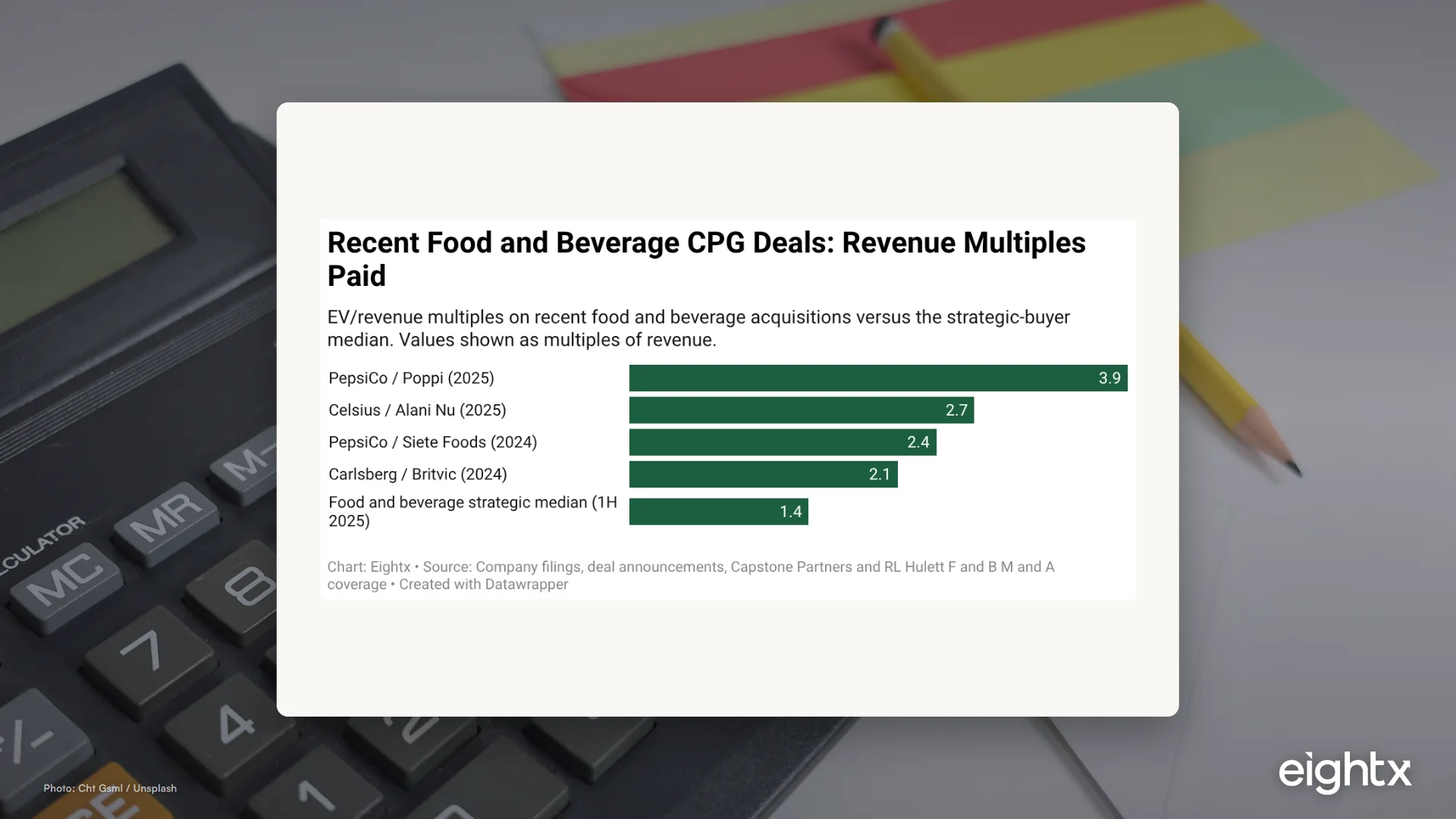
Most food and beverage brands sold near a 1.4x revenue strategic median in 2025, but high-growth functional brands cleared 2x to 4x. PepsiCo paid about 3.9x for Poppi and 2.4x for Siete, and Celsius paid about 3.0x revenue (12x EBITDA) for Alani Nu. Growth, velocity and gross margin drive the premium.
Key Takeaways
- The strategic-buyer median in food and beverage was about 1.4x revenue and 5.8x EBITDA in 1H 2025, per RL Hulett, so most brands trade well below the headline deals.
- PepsiCo paid roughly $1.95B for Poppi, about 3.9x its ~$500M revenue, the marquee functional-beverage deal of 2025.
- PepsiCo paid $1.2B for Siete Foods at about 2.4x revenue, and Celsius paid about $1.8B for Alani Nu at ~3.0x revenue / ~12x EBITDA.
- Strategics (PepsiCo, Mondelez, Hershey, Ferrero, Mars), PE roll-ups and platforms are the three buyer camps, and the camp that buys you sets your multiple.
- Public food and beverage runs a 43.05% median gross margin, far below beauty's ~69%, so growth and velocity, not margin alone, drive the premium.
Every food and beverage founder I work with at $5M to $50M has the same two headlines in their head. PepsiCo paid almost $2 billion for Poppi. Mars paid $35.9 billion for Kellanova. Then they look at their own brand and ask the only question that matters: what would someone actually pay for this, and what makes that number go up?
Here is the honest answer. Food and beverage trades at a lower multiple than beauty or supplements, because the gross margins are thinner. But the headline deals you read about are the very top of the distribution, not the middle. Below is who is buying, what they are paying, and the specific levers that separate a 1.4x exit from a 4x one.
Who is actually buying food, beverage and CPG brands
The 2025 and 2026 buyer pool splits into three camps.
Strategics write the biggest checks: PepsiCo, Mondelez, Hershey, Ferrero, Mars, Campbell, Nestle and Unilever. They buy for portfolio gaps, growth they cannot build organically, and access to a younger or different consumer. PepsiCo bought Poppi for the functional-soda growth it could not invent internally, and Hershey paid about $750M for LesserEvil to push into better-for-you snacking. These deals set the headline multiples because a strategic can underwrite distribution gains a financial buyer cannot.
Private equity and platform aggregators are active at the smaller end, rolling up sub-scale brands or backing a founder for a second act. They underwrite to EBITDA and free cash flow, which usually means a lower revenue multiple than a strategic will pay for the same brand, because they are not buying shelf and distribution gains.
The legacy CPG majors sit inside the strategic camp but behave differently. They tend to buy proven, profitable, scaled assets rather than momentum stories. Ferrero buying WK Kellogg for $3.1B ($23.00 a share) is a scaled-platform deal, and Mars buying Kellanova for $35.9B is a mega-deal, not a private-brand comp. A giant P&L wants brands that survive being run through it, not ones that need founder magic.
For a private operator, the camp that buys you determines your multiple. A strategic chasing your growth and shelf position will pay far more than a PE firm modeling your cash flow.
What multiples CPG brands command
This is where founders get the wrong anchor. The headline deals are outliers. The actual strategic-buyer median in food and beverage was about 1.4x revenue and 5.8x EBITDA in 1H 2025, according to RL Hulett's food and consumer M&A coverage. That is a strategic-buyer figure, so it is closer to a ceiling than a floor for sub-$50M brands that often sell to a PE or platform buyer, which usually pays a lower revenue multiple. The deals that make news sit well above it because they are bought for growth, not for what they are today.
When I talk to founders running a brand this size, the trap I see again and again is anchoring to the $1.95B Poppi headline and quietly assuming a 3.9x multiple is the going rate. It is not. The named deals are the top of the distribution, and the table below shows how much daylight sits between them.
| Acquirer / Target | Announced / closed | Price (EV or headline) | Target revenue | Implied EV/revenue | Implied EV/EBITDA | Disclosure note |
|---|---|---|---|---|---|---|
| PepsiCo / Poppi | Closed May 2025 | $1.95B (net ~$1.65B) | ~$500M (est) | ~3.9x | n/d | Target private; revenue is an estimate |
| Celsius / Alani Nu | Announced Feb 2025 | ~$1.8B | ~$595M | ~3.0x | ~12x | Per CELH 8-K + deep research |
| PepsiCo / Siete Foods | Announced Oct 2024 | $1.2B | n/d | ~2.4x | n/d | "Additional terms not disclosed" (banker est) |
| Carlsberg / Britvic | Announced Jul 2024 | ~£3.3B / ~$4.2B | n/d | ~2.1x | ~14.8x | Reuters; banker coverage |
| Ferrero / WK Kellogg | Announced Jul 2025 | $3.1B ($23.00/share) | n/d | n/d | n/d | Company newsroom |
| Hershey / LesserEvil | Announced Apr 2025 | ~$750M | n/d | n/d | n/d | WSJ reporting |
| Mars / Kellanova | Announced Aug 2024 | $35.9B | n/d | n/d | n/d | Mega-deal; not a private-brand comp |
The named deals tell the story. PepsiCo paid about $1.95B for Poppi on roughly $500M of revenue, an implied 3.9x (the net price was closer to $1.65B after $300M of anticipated cash tax benefits, so call it 3.3x net). Celsius agreed to buy Alani Nu for about $1.8B, structured as $1.275B cash plus a $25M earnout plus $500M of stock, against roughly $595M of trailing revenue, an implied ~3.0x revenue and ~12x EBITDA. PepsiCo agreed to buy Siete Foods for $1.2B at about 2.4x revenue per Meridian Capital. Carlsberg bought Britvic at about 2.1x revenue and 14.8x EBITDA.
The pattern is consistent with what bankers describe as the 2026 reality: most food and beverage brands trade roughly 1x to 2x revenue, while high-growth, high-velocity, strategically scarce brands push 2.5x to 4x and occasionally beyond.
What actually drives the multiple up
A revenue multiple is not magic. In CPG it is a proxy for things an acquirer can underwrite, and the order matters differently than in beauty.
Growth and shelf velocity come first. The pattern we see again and again is that sophisticated buyers are not really paying a revenue multiple at all. They are running a present value of future cash flows, and the EBITDA multiple they quote is just a derivative of that. Revenue velocity is what moves the number. As one way operators frame it: you would not get a revenue-based valuation unless you were raising venture capital, but dollar velocity in the top quartile (the kind you can pull straight from SPINS or Nielsen) is exactly what pushes up the multiple they pay on profit. A brand growing 30 to 40% with proven units-per-store-per-week is buying its acquirer future revenue and shelf space at once. A slow-growing brand at category-average velocity gets the 1.4x median no matter how clean the story is.
Gross margin is the constraint, not the headline. Across 8 public food and beverage brands in our food and beverage CPG benchmarks, the median gross margin is 43.05% and the median operating margin is just 9.04%. That is far below beauty's roughly 69% gross margin. Thinner margins mean less profit per dollar of revenue, which is exactly why CPG multiples sit below beauty and supplements. The honest version we give founders: the high-margin, fast-growing brands (think 80% gross margin, growing 20 to 30% a year) are the ones that clear 8x to 10x EBITDA. CPG rarely has that margin to work with, so the value has to come from growth and velocity instead.
It is worth seeing how wide the distribution actually is. There is no average food and beverage brand.
| Brand | Gross margin | Operating margin |
|---|---|---|
| Celsius Holdings | 96.15% | 10.70% |
| Monster Beverage | 55.85% | 29.17% |
| Hain Celestial | 52.80% | -72.96% |
| Boston Beer | 48.48% | 7.37% |
| Vital Farms | 37.62% | 11.64% |
| TreeHouse Foods | 37.02% | 6.96% |
| BellRing Brands | 33.26% | 15.43% |
| Beyond Meat | 2.78% | -121.10% |
| Median | 43.05% | 9.04% |
Channel and trade spend are real margin drags founders underestimate. When we talk to founders moving into grocery, the thing they keep getting wrong is the true cost of shelf. Slotting and listing fees can run thousands of dollars per SKU just to get in the door, then promos and cost-shares with the retailer eat into every case. The flip side is that contribution margins through retail are usually better than founders fear, often 30 to 40% on a good product even after trade spend, against more like 20% in DTC. Our CPG channel margin map breaks down where that money actually goes.
Operating quality decides whether the multiple holds. A brand with durable, defensible economics gets the high end; one that grows only on discounting or a single channel gets the low end. The same applies to the unit math, which we break down in beverage brand unit economics.
What to do about it
If you are building toward an exit or a raise, here is the work, in order.
- Prove durable growth and velocity, not just a good year. Acquirers in food and beverage pay for momentum and shelf performance. Show 12 plus months of growth with top-quartile dollar velocity that holds up. The hold-EBITDA-while-growing rule is the one I repeat most: if you can keep EBITDA between 10 and 15% while growing revenue 30% a year, that is genuinely great for valuation. Nobody wants a 5% EBITDA business unless it is doing $200M.
- Get gross margin to the top of your category. That usually means tightening co-packer terms, reformulating for cost, or moving volume to better freight and ingredient deals. In a 43%-median category, two extra margin points change the conversation.
- Reduce concentration. Customer concentration (one retailer is 60% of sales) and SKU concentration both cap the multiple because they are risk a buyer has to discount. Diversify before you go to market.
- Prove systems and processes. When we walk founders through what actually moves value at the small end, it is rarely one big lever. It is showing the acquirer you know what you are doing: quarterly goal-setting rhythms, real forecasting, a finance function that does not run on the founder's memory.
- Get your books diligence-ready early. The deal-killer is not a low number, it is a surprise in the data room. Build the data room before you need it: shareholder register, tax returns, AR/AP, clean accrual books, and an investment memo. Quality-of-earnings diligence is where the surprises bite, so the books have to tie out on an accrual basis.
This is exactly the pre-deal work our fractional CFO for food and beverage brands team runs: tightening the margin and growth story, building the data room, and making sure the number an acquirer arrives at reflects the business you actually built.
The mistake is treating the multiple like a fixed market price. It is not. It is the buyer's bet on your future cash flow, dressed up as a number. Move the things that change the bet (growth, dollar velocity, margin, and books they can trust) and you move the multiple. Anchor to a headline deal you cannot replicate and you will be disappointed at the table.
Methodology
Deal figures are drawn from company filings, deal announcements and banker coverage. PepsiCo / Poppi closed May 19, 2025 at a headline $1.95B (net ~$1.65B after $300M of anticipated cash tax benefits, plus a performance earnout); Poppi is private, so the ~$500M revenue and 3.9x multiple are widely-reported estimates, not a PepsiCo disclosure. Celsius / Alani Nu was announced Feb 20, 2025 at about $1.8B ($1.275B cash + $25M earnout + $500M stock + ~$150M tax assets) on ~$595M trailing revenue, an implied ~3.0x revenue / ~12x EBITDA, verified against the Celsius 8-K (SEC EDGAR accession 0001341766-25-000018). PepsiCo / Siete Foods was announced Oct 1, 2024 at $1.2B with "additional terms not disclosed," so the ~2.4x is a Meridian Capital estimate. Carlsberg / Britvic (~£3.3B / ~$4.2B) implied ~2.1x revenue and ~14.8x EBITDA per banker coverage and Reuters.
The 1.4x revenue and 5.8x EBITDA strategic medians are RL Hulett's reported food and consumer M&A figures for 1H 2025 (a reported figure, not a number we extracted from a specific line of the primary PDF), cross-checked directionally against Meridian Capital (about 1.0x revenue / 6.3x EBITDA on a broader consumer set) and Peakstone (about 1.5x revenue / 10.8x EBITDA, all-buyer food and beverage); the directional range holds across all three. Gross-margin and operating-margin benchmarks are from Eightx's analysis of 8 public food and beverage filings (FY2025), with a 43.05% median gross margin and 9.04% median operating margin; beauty's ~69% gross margin comes from Eightx's beauty ecommerce benchmarks.
Implied multiples are enterprise value (or headline price) divided by the most recent disclosed or estimated trailing revenue, and are approximations where exact EV, net price, or revenue timing is not fully disclosed. For private targets (Poppi, Siete, Alani Nu, LesserEvil), revenue is estimated or banker-sourced; this is flagged in every table cell. Operator-voice observations are drawn from Eightx's founder-call corpus and are anonymized.
Frequently Asked Questions
what multiple do cpg brands sell for in 2026?
The strategic-buyer median in food and beverage was about 1.4x revenue and 5.8x EBITDA in 1H 2025 per RL Hulett. Most brands trade there. High-growth functional brands clear 2x to 4x: PepsiCo paid about 3.9x for Poppi and 2.4x for Siete.
who is buying food and beverage cpg brands right now?
Strategics dominate the headline deals: PepsiCo, Mondelez, Hershey, Ferrero, Mars, Campbell, Nestle and Unilever. Private equity roll-ups and platform aggregators are active at the smaller end. The camp that buys you sets your multiple.
why do food and beverage brands sell for lower multiples than beauty?
Gross margin. Public food and beverage runs a 43.05% median gross margin versus about 69% for beauty. Thinner margins mean less profit per dollar of revenue, so acquirers pay less per dollar unless growth and velocity are exceptional.
do acquirers value my brand on revenue or ebitda?
On EBITDA, almost always. The revenue multiples you read in headlines are just the deal price divided by sales after the fact. Buyers underwrite to profit and future cash flow, and revenue velocity moves the multiple they pay on that profit. You only get a revenue-based valuation if you are raising venture capital.
what drives a cpg acquisition multiple up?
Growth rate and shelf velocity first, then gross margin and distribution. A brand growing 30 to 40% with proven retail velocity gets a strategic premium. A slow-growing brand at category-average margin gets the 1.4x median.
did pepsico overpay for poppi?
At about 3.9x revenue for a fast-growing prebiotic-soda brand in a category PepsiCo wanted, the multiple is rich versus the 1.4x median but defensible for the growth and shelf position. The net price was closer to $1.65B after $300M of tax benefits, or roughly 3.3x.
what is shelf velocity and why do buyers care about it?
Shelf velocity is how fast your product sells per store per week, often measured as dollar velocity in SPINS or Nielsen. Buyers care because it predicts whether your distribution sticks. Top-quartile dollar velocity is the single cleanest signal that retailers will keep you on shelf and expand you.
how do i prepare my cpg brand to sell for a strong multiple?
Prove durable growth and retail velocity, get gross margin to the top of your category, reduce customer and SKU concentration, and have clean accrual books an acquirer can diligence. That work takes 12 to 18 months, not 12 weeks.