
Supply Chain
Co-Manufacturing Cost and MOQs for CPG: How Minimum Runs Trap Your Cash (2026)
Co-manufacturing cost has two parts: a per-unit run cost and fixed setup plus changeover fees that only make economic sense at the MOQ. For shelf-stable food and beverage, MOQs of 5,000 to 50,000 units per SKU force a single run that can tie up six figures of cash and create spoilage risk if it overshoots true demand.
Key Takeaways
- Below the MOQ, fixed setup and changeover fees dominate: a $4,000 setup spread over 1,000 units adds $4.00 per unit, versus $0.08 at 50,000 units.
- Food and beverage co-man MOQs typically run 5,000 to 50,000 units per SKU, with industrial can lines starting near 180,000 cans, roughly one production run.
- A single 50,000-unit run at $1.18 per unit plus ingredient and packaging minimums can tie up $80,000 to $150,000 in cash before you sell a unit.
- Big minimum runs are a spoilage trap: nimble beverage brands turn inventory in about 38 to 41 days, so any run that overshoots demand risks expiry, not just carry cost.
- Use the MOQ-to-cash framework: months of cover at the MOQ, cash tied up per run, and break-even unit cost across run sizes before you sign.
Every food and beverage founder hits the same wall at the same time. You have a product that sells, a co-packer who will make it, and a quote that looks fine on a per-unit basis. Then you read the minimum order quantity and the setup fee, and the number you actually have to wire is two to five times bigger than the run you wanted. The MOQ, not the recipe, becomes the thing that decides whether the launch happens.
This is the piece I wish more brands read before they signed. Co-manufacturing economics are not complicated, but they are structured in a way that punishes small brands and traps cash. The per-unit cost you see in the quote is real only at volume. Below the MOQ, fixed setup and changeover fees dominate, and the run you can afford is usually too big for the demand you actually have. Here is how the math works, and the framework I use to size a run to cash instead of to the co-packer's minimum.
How co-man pricing is actually built
A co-manufacturer's cost to you has two parts that behave completely differently. The first is the variable per-unit run cost: the labor, line time, waste, and overhead attributable to each unit produced. For a simple shelf-stable food or beverage SKU this lands somewhere around $0.20 to $0.60 a unit at moderate volume for the conversion alone, and it barely changes whether you run 5,000 or 50,000.
The second part is fixed per run: the setup and changeover fee. This covers cleaning the line, reconfiguring equipment, staging your ingredients and packaging, and handling allergens before your SKU goes through. It is charged once per production run regardless of how many units you make. Documented co-packing pricing for 2026 puts a simple shelf-stable setup fee near $2,000, with complex or allergen-heavy lines running higher. Co-packers are clear that these changeover charges are the main reason small runs become expensive on a per-unit basis, and they rarely publish a universal dollar figure because it depends on cleaning, downtime, and complexity. Ask for it explicitly.
There is a reason co-packers price it this way, and it is worth understanding before you try to negotiate it down. As one operator put it to me, the standard manufacturing logic is that when a line is not at capacity you take any job that clears your variable cost, but the moment you have to stop, clean, and restart for a small run, the absorption math flips and the stop-start cleanup cost has to be recovered somewhere. The MOQ is where it gets recovered. A co-packer setting a 5,000 to 50,000 unit minimum is really saying: below this volume, my fixed costs per unit are too high for either of us to make money. When you push for a run below MOQ, you either get refused or get quoted a premium that reflects the fixed fee landing on fewer units.
The MOQ cliff: where small runs go to die
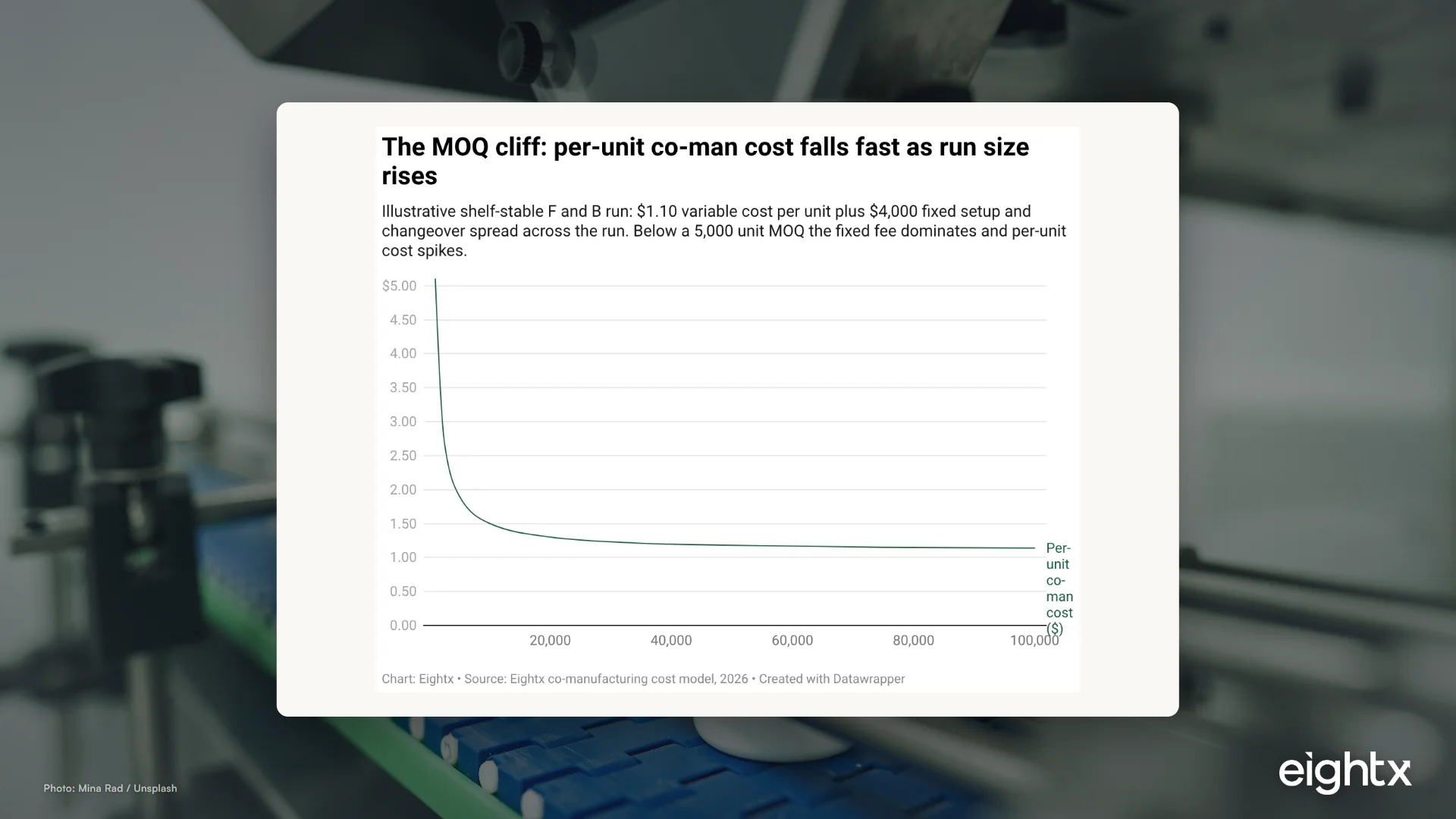
Put the two cost parts together and you get a curve that drops fast, then flattens. Take an illustrative shelf-stable run with $1.10 in variable cost per unit and a $4,000 combined setup and changeover fee, which bundles the documented setup charge with the extra line time a real first run eats. At 1,000 units the fixed fee adds $4.00 per unit, so your all-in cost is $5.10. At 5,000 units it adds $0.80. At 50,000 units it adds $0.08, and you are basically paying variable cost. That is the MOQ cliff.
The shape of that curve is the entire reason MOQs feel unfair to small brands. The co-packer is not gouging you; the fixed fee is genuinely there, and it genuinely has to land somewhere. But it means there is no efficient way to produce a small quantity. You are forced up the volume curve to get a sane unit cost, and getting up the curve means committing cash and inventory you may not have demand for yet. The cliff is steepest exactly where new brands live.
What MOQs actually look like in food and beverage
The minimums vary by format and line class far more than by category. Based on co-packer disclosures and 2026 sourcing reporting, here are the bands to plan against:
| Format | Typical first-run MOQ | Notes |
|---|---|---|
| Shelf-stable sauce / condiment (small batch) | 500 to 3,000 jars commercial | Specialty co-packers accept small lots at a premium unit cost |
| Bottled still drink (PET / glass) | 1,000 to 3,000 cases | Lower than cans on many hot-fill lines |
| Canned beverage (craft / sleeved line) | 2,500 to 10,000 cans | Sleeves allow lower MOQ than printed cans |
| Canned beverage (industrial / printed cans) | about 180,000 cans | Krones-class lines, roughly one production run; printed cans often 100% prepay |
| Stick-pack powder / sachet | 5,000 to 100,000+ units | Roll-stock printed film is often the real constraint |
| General beverage OEM / co-pack | 5,000 to 50,000 units per SKU | The most common early-brand planning band |
Two things matter here. First, the co-packer MOQ is only half the problem. Your ingredient suppliers and your packaging suppliers carry their own minimums, and those often overshoot the co-man run. You can be forced to buy a full roll of printed film or a pallet of caps to make a 50,000-unit run, and the leftover sits as raw-material inventory. Second, every one of these minimums is a finished-goods commitment you pay for before a single unit sells. The pattern we see again and again is a founder who negotiated the unit price hard and then got blindsided by the packaging minimum that doubled the real run.
The cash this traps, and the spoilage risk underneath it
Here is the number founders underestimate. Take the general band, a 50,000-unit run at roughly $1.18 per unit on the model above (on our model, not a quoted market price). That is about $59,000 in co-man cost alone. Layer in ingredient and packaging minimums and a realistic total cash outlay for a first commercial run lands in the $80,000 to $150,000 range, most of it due on deposit and on completion, well before retail sell-through or DTC velocity pays it back.
| Run scale | Approx. cash tied up (first run) | Typical deposit |
|---|---|---|
| Bottled pilot (about 2,000 cases) | $20,000 to $50,000 | 30% to 50% at booking |
| General band (50,000 units) | $80,000 to $150,000 | 30% to 50% at booking |
| Industrial printed-can run (180k+ units) | $150,000 to $350,000 | often 100% prepay on printed cans |
The deposit timing is the part that quietly breaks brands. You wire 30% to 50% at booking, the balance at shipment, and then retail pays you Net 60 to 120. The cash leaves months before it comes back. When I talk to founders running a brand this size, the constraint they describe is almost never demand or CAC, it is exactly this: managing cash and margins and buying inventory, all at once, while the runway shrinks. One founder scaling from $1M to $2M a month told me the cash flow side had become overwhelming, and it had nothing to do with whether the product sold.
Now the part that makes co-man cash different from any other inventory bet: spoilage. Food and beverage is the fastest-turning CPG vertical. We pulled inventory and COGS from recent public 10-Ks and computed days inventory outstanding for a spread of CPG brands. Nimble beverage names turn in about 38 to 41 days, against 137 at a beauty brand like Coty. The reason is shelf life: the product physically cannot sit.
So when a co-packer MOQ forces you to make six or nine months of cover in one run, you are not just paying carry cost on slow inventory the way an apparel brand would. You are risking a write-off when the dates expire. Shelf-stable does not mean shelf-forever. USDA loss research frames the same point from the other side: most shelf-stable food loss comes from overstocking and damage, not biological expiry alone, which is to say it comes from buying more than you can move before the date.
That gap between the run size the MOQ forces and the demand you actually have is where the cash gets trapped, and in food, where it spoils. It is also why your real lead-time risk is longer than the production window: in our experience, the working-capital lead time you carry on your balance sheet runs well past the quoted production lead time once safety stock and channel buffer stack up.
The MOQ-to-cash framework
Before you approve any co-man run, run these numbers. This is the exact sequence I walk brands through.
- Months of cover at the MOQ. Divide the run quantity by your realistic monthly sell-through, not your optimistic one. If a 50,000-unit run buys you nine months of cover and you have one channel, the MOQ is sized to the co-packer, not to your demand. Anything over four to six months on a perishable SKU is a spoilage flag. The tension is real: we have watched brands purposely carry more inventory than the financials would justify, as stockout insurance, while knowing it was too much. When the lead time is four to six months you cannot run on two months of cover, so you are choosing where on that range to sit, not whether to carry buffer at all.
- Cash tied up before any sale. Add the co-man cost (units times all-in per-unit) to the ingredient and packaging minimums you must buy to support the run. That is the cash you owe before the first dollar of revenue. Check it against your line of credit headroom and your operating cash. If the run would force you to delay payroll or ad spend, it is too big.
- Per-unit cost at three run sizes. Always get the quote at a pilot quantity, the standard MOQ, and a scaled run. The spread between pilot and MOQ tells you exactly what the fixed fee is costing you, and whether paying a higher unit cost on a smaller pilot is worth it to avoid trapping cash.
- Break-even on the smaller pilot. Compute the contribution margin at both the MOQ unit cost and the pilot unit cost. Often a pilot at a higher per-unit cost still beats a full MOQ run once you price in the carry, the cash lockup, and the spoilage probability on the overshoot. Cheaper per unit is not cheaper if half of it expires.
- Negotiate the run, not just the price. Ask the co-packer for a smaller first run with a step-down on subsequent reorders, a shared changeover if they are already running a similar SKU, or a scheduled standing order that lets them plan the line. Co-packers will trade a smaller first run for a committed reorder cadence more often than founders assume.
The goal is simple: size the run to demand and cash, then accept a higher unit cost as the price of not getting trapped. The cleanest version of this I have seen came from a founder who stopped chasing the price break entirely. In his words, to hell with bringing the cost down, he was going to bring the amount he had on hand down instead, so he ran small orders every two weeks for a year. It was a brutal amount of operational work, but his balance-sheet inventory stayed tiny and he could turn on a dime when demand moved. A slightly worse gross margin on a right-sized run beats a great margin on inventory that spoils.
For more on what happens to inventory that overshoots demand and how to get the cash back, see our work on how to clear dead stock. If you want a fractional CFO who runs this math with food and beverage brands every week, that is what our fractional CFO for food and beverage brands practice does.
Sources and methodology
The per-unit cost curve in the chart is an Eightx working model, not a vendor benchmark. It assumes a single-SKU shelf-stable run with $1.10 in variable co-man cost per unit and a $4,000 combined setup and changeover fee, with per-unit cost computed as variable cost plus fixed fee divided by run units. The $4,000 bundles a documented setup charge, which 2026 co-packing pricing places near $2,000 for a simple line, with the extra line time and waste a real first run carries. Treat the numbers as directional, not a quote: real costs vary widely by format, line speed, automation, and supplier.
MOQ bands are drawn from 2025 to 2026 co-packer disclosures and sourcing reporting (BEV.inc, ALNA Packaging, PowerBrands, IDL Australia, msl-indy), which place general beverage co-pack at 5,000 to 50,000 units per SKU, craft and sleeved can lines at 2,500 to 10,000 cans, bottle lines at 1,000 to 3,000 cases, industrial printed-can lines near 180,000 cans, and stick-pack powders from 5,000 to over 100,000 units. Co-packer MOQ and setup fees are inherently supplier-quoted, not government series, so we frame them as indicative ranges to confirm against three real quotes. The first-run cash and deposit figures come from a synthesis of co-packer payment terms and DTC funding sources, which consistently show 30% to 50% deposits at booking, the balance near shipment, full prepay on long-lead printed packaging, and retail payment on Net 60 to 120.
The days inventory outstanding chart is computed from SEC EDGAR 10-K filings as inventory divided by cost of goods sold times 365: Celsius (CELH, FY2025) 38 days, National Beverage (FIZZ, FY2025) 41, Simply Good Foods (SMPL, FY2025) 56, Kraft Heinz (KHC, FY2025) about 72, Coca-Cola (KO, FY2024) 94 (high because it carries concentrate), and Coty (COTY, FY2025) about 137. We lead with the nimble beverage brands to support the roughly 38 to 41 day claim and use the larger names to show even big food and beverage turns faster than beauty. Spoilage on shelf-stable food is not disclosed as a standalone 10-K line; it is absorbed into COGS through obsolescence reserves, so we frame it qualitatively, supported by USDA Economic Research Service food-loss research, rather than as a hard write-off percentage.
Frequently Asked Questions
what is a typical moq for a food or beverage co-manufacturer?
Most food and beverage co-packers quote 5,000 to 50,000 units per SKU. Craft canning lines often start at 2,000 to 5,000 cases, bottle lines at 1,000 to 3,000 cases, and large industrial can lines near 180,000 cans, roughly one production run. Some specialty stick-pack powders run 50,000 to 250,000 units.
why does my per-unit co-man cost drop so much at higher volume?
Because the fixed setup and changeover fee is spread over more units. A $4,000 setup adds $4.00 per unit on a 1,000-unit run but only $0.08 on a 50,000-unit run. The variable per-unit cost barely moves; the fixed fee is what creates the MOQ cliff. That is why running below MOQ is so expensive per unit.
what is a changeover or setup fee in co-manufacturing and how much is it?
It is the charge for cleaning the line, reconfiguring equipment, staging materials, and handling allergens when a co-packer switches to your SKU. It is a fixed cost per run, not per unit. Documented examples run around $2,000 for a simple shelf-stable changeover, and more for allergen-heavy or complex lines. Always ask for it at three run sizes.
how much cash does a co-man minimum order tie up?
More than founders expect. A 50,000-unit shelf-stable run at about $1.18 per unit is roughly $59,000 in co-man cost alone, before ingredient and packaging minimums, which can push the total to $80,000 to $150,000. You owe most of it before the first unit sells, which is why the MOQ is often a bigger cash risk than CAC.
what deposit do co-packers ask for and when is the balance due?
Most co-packers want 30% to 50% upfront at booking with the balance at or near shipment. New brands and long-lead printed packaging often face higher deposits or full prepay. Retailers then pay you Net 60 to 120, so the cash leaves months before it comes back. That funding gap, not the unit cost, is what sinks most first runs.
why are big minimum runs a spoilage risk for food brands?
Because food and beverage turns inventory faster than any other CPG vertical, with nimble beverage brands around 38 to 41 days in public 10-Ks. A run sized to the co-packer MOQ rather than to demand can hold months of cover, and shelf-stable does not mean shelf-forever. Product that outlives its date is a write-off, not just a carry cost.
should i take a price break for a bigger run or keep less cash tied up?
Run the contribution margin both ways. A cheaper per-unit cost on a big run is not cheaper if part of it expires or ties up cash you need for ads and payroll. On a perishable SKU, a smaller pilot at a higher unit cost usually wins once you price in carry, the cash lockup, and spoilage probability on the overshoot.
how do i decide whether a co-man run size is right for my brand?
Run the MOQ-to-cash framework. Calculate months of cover the run buys at your real sell-through, the cash tied up before any sales, and the per-unit cost at the MOQ versus a smaller pilot. If the run buys more than four to six months of cover or the cash exceeds what your line of credit can absorb, negotiate a smaller first run even at a higher unit cost.