
Inventory
Clearing Dead Stock Without Killing Margin
Dead stock costs 20 to 30 percent of its value per year to hold, so clear it fast but in the right order. Work the clearance ladder by margin recovered: bundle first (about 70 cents on the dollar of cost), then on-site markdown, outlet or resale, B2B liquidation broker, and donation or write-off last.
Key Takeaways
- Dead stock carries a 20 to 30 percent annual cost, so a $100,000 cohort burns $20,000 to $30,000 a year before you discount it. Holding to protect margin usually destroys more value than clearing does.
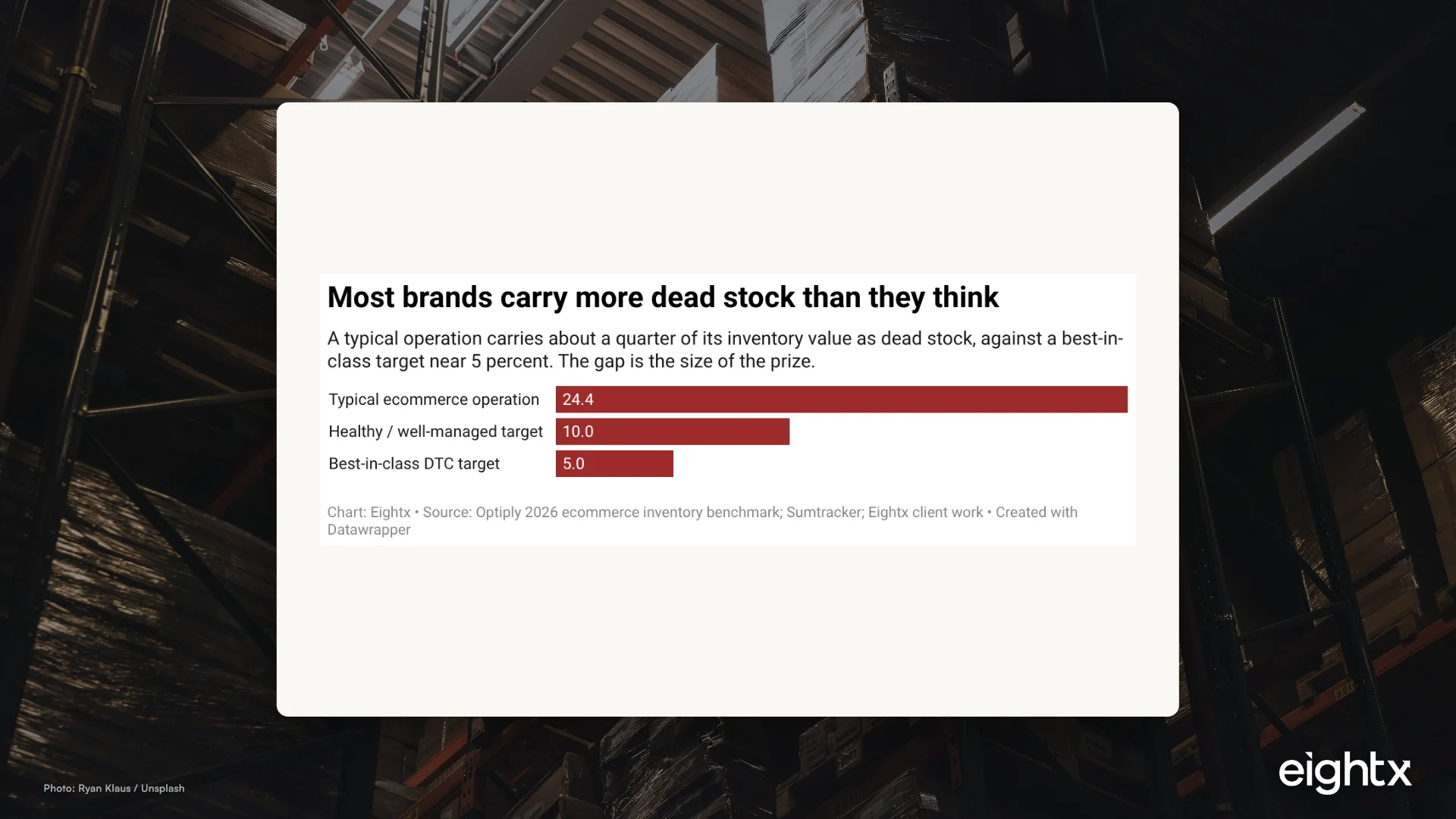
- Most brands underestimate their exposure. A typical ecommerce operation carries about 24 percent of inventory value as dead stock, against a target near 5 percent for the tightest-run brands.
- Recovery falls fast down the ladder: bundling recovers roughly 60 to 80 cents on the dollar of cost, markdown 40 to 70, outlet 30 to 60, B2B liquidation 20 to 40, and donation returns zero cash.
- Quoted against retail rather than cost, distressed-auction recovery collapses to a median near 9 percent, and apparel as low as 1.4 to 2 percent. Always check which denominator a number uses.
- Donation is not free money. From 2026 the OBBBA 1 percent floor and 10 percent cap shrink the corporate charitable deduction, so net the after-tax value against your worst cash offer before you accept it.
Every brand ends up holding stock that stopped selling. The instinct is to wait, because clearing it means taking a markdown and admitting the buy was wrong. That instinct is what turns a manageable problem into an expensive one. Dead stock is not free to hold. It costs you 20 to 30 percent of its value every single year, and the longer you sit on it protecting your margin, the more margin it quietly destroys.
The job is not to avoid the loss. The loss already happened when the product stopped moving. The job is to recover the most cash possible, in the right order, and to stop the bleed. Here is how to identify dead stock, run the carry-versus-liquidate math, and work a clearance ladder that protects the margin actually worth protecting.
First, identify what is actually dead
You cannot clear what you have not flagged. Most brands carry far more dead stock than they think because nobody is watching days on hand against trailing demand. Use two clean triggers, straight from the dead stock carrying cost framework:
- At-risk: no units sold in 180 days. Flag it, run the carry math, set a liquidate-or-write-off date.
- Dead: no units sold in 365 days, or days on hand over 365 versus trailing demand. It goes on the ladder now.
Fast fashion and seasonal brands compress the at-risk threshold to 90 days. The benchmarks are sobering: a 2026 ecommerce inventory study puts dead stock at about 24 percent of inventory value for a typical operation, while well-managed brands keep it under 10 percent and the tightest-run DTC operators hold it under 5. The gap between that 24 percent average and a sub-5 percent target is the size of the prize.
When I talk to founders running a brand this size, the cleanest way I have heard it framed is that dead stock is a bag of money sitting on a shelf you cannot access. Even selling it at exactly what you paid takes the bag off the shelf and frees the cash. If you have not measured your own number, assume it is higher than the figure in your head. The same discipline that keeps your inventory turnover healthy is what surfaces dead stock early, while you still have higher rungs of the ladder to work.
The real cost of holding versus clearing
Here is the math founders skip. Dead stock carries a blended 20 to 30 percent annual cost, and the stack below is consistent across independent sources. Use 25 percent as the clean default for board math. A $100,000 cohort of dead SKUs burns $20,000 to $30,000 a year before you discount it a single dollar.
| Component | Typical share of inventory value per year | What it covers |
|---|---|---|
| Cost of capital | 8 to 15% | Opportunity cost of cash tied up in stock |
| Storage | 2 to 5% | Warehouse rent, 3PL fees, utilities, handling |
| Service costs | 1 to 3% | Insurance, inventory software, taxes |
| Risk costs | 2 to 10% | Obsolescence, shrinkage, damage |
| Blended total | about 20 to 30% (use 25% for board math) | Full annual cost of holding a dollar of dead stock |
Now run the total drag formula:
Total Drag = (Value times Carry Rate times Time) plus (Value minus Liquidation Recovery)
Say a broker offers 30 cents on the dollar on that $100,000 cohort today. Clearing now nets you $30,000 in cash and stops the carry. Hold for another year instead, and you burn $25,000 in carry, then face a broker who will almost certainly offer less than 30 cents next year because the product is older and more obsolete. The decision rule is simple: liquidate when the carry plus the markdown risk over the next year exceeds the discount a buyer wants today. For dead stock, that condition is true far more often than founders want to believe.
The chart below is the trade drawn out. The carry line climbs $25,000 a year on the original value, so two years of holding has burned $50,000 before you sell a single unit. The broker line falls the other way, because an aging cohort draws weaker bids each season. Wait long enough and the two lines cross: you are paying more to store the stock than anyone will ever pay to take it off your hands.
Work the same $100,000 cohort down the first few rungs of the ladder and the order matters more than the headline rate. Say you have already held it six months: that is $12,500 of carry burned at the 25 percent default, gone no matter what you do next. Bundle the strongest third into kits with your hero SKUs at 70 cents and you recover about $23,000 with almost no incremental cost, because you are repackaging, not advertising weakness. Push the next third through an on-site markdown, where the discount and ad spend pull net cash closer to 35 to 40 cents. Send the last third, the genuinely dead slice, to a broker at 25 cents for about $8,300. Blended, you pull back roughly $45,000 to $48,000 in cash on a cohort that was costing you $25,000 a year to ignore. The math is not pretty, because the loss already happened. It is simply far better than carrying the whole $100,000 for another twelve months and handing the broker an older, cheaper problem.
When we have worked through this with operators, the visceral framing that lands is that a dollar of cost inventory often comes back as about 50 cents, so the instruction is to be as aggressive as possible while the cohort is still young. The pattern we see again and again is the opposite: a founder waits for a "right moment" that never arrives, the cohort ages past 400 days on hand, and the eventual broker bid drops below 20 cents because nobody wants a year-older problem. Holding "to protect margin" is usually a fiction. The margin is gone. Public DTC brands prove the point: per the Eightx inventory write-downs benchmark, well-run apparel brands hold write-downs to 0.3 to 0.5 percent of revenue precisely because they clear discipline-fast instead of letting cohorts age into a forced 50-cent write-down.
The clearance ladder, ranked by margin recovered
Not all clearance is equal. The order you work the channels determines how much you recover. Run the ladder top down: try the highest-recovery rung first, drop to the next only when the rung above it is exhausted.
| Rung | Channel | Typical recovery (vs cost) | When to use it |
|---|---|---|---|
| 1 | Bundle or kit with a seller | 60 to 80 cents | Slow mover pairs with a strong SKU; raises perceived value without a deep cut |
| 2 | Markdown clearance on-site | 40 to 70 cents | Demand still exists at a lower price; fastest cash on your own channel |
| 3 | Outlet or marketplace resale | 30 to 60 cents | Off-price channel keeps it away from your full-price storefront |
| 4 | B2B liquidation broker | 20 to 40 cents | Bulk exit; lowest cash because the buyer needs resale margin |
| 5 | Donation or write-off | 0 cents cash, tax value | Unsellable, expired, or no channel beats the cost to sell |
The pattern holds across categories: bundling protects the most margin because you are not advertising weakness, you are repackaging value. Liquidation brokers pay the least because they have to resell, cover freight, and absorb the risk themselves. One thing operators tell us helps is having an off-price retailer relationship ready before you need it, so the genuinely dead, off-trend stock has somewhere to go that is not your full-price storefront.
One critical caveat before you panic at the low rungs: those recovery rates are quoted against cost, not retail. The numbers look very different against retail. In distressed mixed-lot auctions, median recovery is only about 9 percent of retail value, and apparel is the worst performer at roughly 1.4 to 2 percent of retail. That is not a contradiction with the table above, it is a different denominator. When a liquidator or a calculator quotes you a recovery rate, the first question is always: against cost or against retail?
| Channel or measure | Recovery vs cost | Recovery vs retail |
|---|---|---|
| Structured B2B wholesale closeout | 40 to 70% | about 20 to 50% (depends on markup) |
| Outlet or off-price | 30 to 60% | 30 to 60% |
| Distressed auction (mixed lots) | not applicable | about 5 to 20% (median about 9%) |
| Apparel in distressed auction | not applicable | about 1.4 to 2% |
There is one more independent read worth knowing. When a brand borrows against inventory on an asset-based line, the lender assigns a net orderly liquidation value: what a structured wind-down would actually recover. In a real operator case, that came in at about 57 cents on the dollar for branded inventory and 49 cents for private label. That is the lender-blessed version of "structured liquidation," and it brackets the broker and wholesale rungs of the ladder. It also ties dead stock directly to how much your lender will advance against your stock, which is another reason to keep the dead percentage low.
The donation rung after the 2026 tax change
Donation feels like pure loss, but it is not, and it is also more complicated than it was a year ago. It removes the carrying cost immediately, clears the warehouse without putting more discounted product in front of your full-price customer, and can return tax value on inventory you could not sell anyway. On a net basis that often beats a 20-cent broker offer.
Two things changed for 2026 that you need to price in. First, the One Big Beautiful Bill Act (OBBBA) added a 1 percent floor and a 10 percent ceiling on corporate charitable deductions for tax years beginning after December 31, 2025. In plain terms, the first 1 percent of your taxable income worth of giving is no longer deductible, and anything over 10 percent of income carries forward rather than deducting this year. A C-corp with $1,000,000 of adjusted taxable income that gives $100,000 deducts only $90,000 (the gift minus 1 percent of income). Donation is still worth doing, but it no longer deducts dollar-for-dollar from the first dollar, so the after-tax value is a little thinner than the old math suggested.
Second, the "enhanced" inventory deduction under section 170(e)(3), which lets you deduct basis plus half the appreciation, is narrower than most operators assume. The clearly established enhanced path is for food inventory ("apparently wholesome food" used for the care of the ill, the needy, or infants). General merchandise gifts more commonly fall back to the basis-only rule unless specific use and donee tests are met. So if you sell apparel, beauty, or supplements, do not assume the enhanced deduction applies. Net the after-tax value against your worst cash offer, confirm the treatment with your accountant, and only then decide between the broker and the donation.
The loss happened when the product stopped moving. Everything after that is just deciding how much cash to recover and in what order. Work the ladder top down, clear while the cohort is young, and never let "protecting margin" talk you into carrying a bag of money you cannot spend.
What to do about it
- Pull a dead-stock report this week. Sort every SKU by days on hand against trailing demand. Flag everything over 180 days as at-risk and everything over 365 as dead.
- Run the total drag formula on each dead cohort. Compare a year of carry plus markdown risk against today's best clearance offer. If holding loses more, clear it.
- Work the ladder in order. Start with bundling, drop to on-site markdown, then outlet, then a broker. Do not jump to the broker before you have tried the rungs above it.
- Cap the markdown rung with a sell-through trigger, not a calendar date. Cut shallow and early on slow movers, the way you would in a real markdown strategy, instead of one deep blowout at the end.
- Price donation against your worst cash offer, after the 2026 OBBBA floor and cap. Use it as a real option, not a last resort, and confirm the deduction with your accountant.
- Fix the upstream cause. Dead stock is a buying and forecasting problem. Tighten re-order quantities and the work it takes to bring down inventory days so you stop manufacturing the next cohort. We have modeled brands holding eight months in one category and four in another, and simply harmonizing the buy freed up multiple millions in trapped cash.
Sources and methodology
The 20 to 30 percent annual carrying-cost rate breaks down into a stack that two independent sources agree on closely: cost of capital 8 to 15 percent, storage 2 to 5 percent, service costs 1 to 3 percent, and risk costs 2 to 10 percent (Finale Inventory carrying-cost guide; corroborated by an attn agency DTC carrying-cost guide and a Parallel.ai deep-research synthesis). We use 25 percent as the board-math default. The 180 and 365-day dead-stock triggers and the write-down benchmark are from the Eightx dead stock carrying cost and inventory write-downs references; for the booking mechanics, write the inventory down to net realizable value and book the hit to COGS in the period you take it.
The dead-stock prevalence benchmarks (about 24 percent of inventory value typical, under 10 percent healthy, under 5 percent for the tightest-run brands) come from Optiply's 2026 ecommerce inventory benchmark and Sumtracker, with the sub-5 percent figure reflecting Eightx client work and published DTC guidance.
The total drag formula is identity arithmetic: carry equals value times rate times time, and total drag adds the liquidation shortfall (value minus recovery). It is deliberately simple board math and treats recovery as gross; it does not net out the discount, ad spend, or fulfillment cost you incur to clear on the higher rungs, and it ignores the time value of the cash you free up today, so the real-world case for clearing now is usually stronger than the formula alone shows.
Channel recovery ranges (bundling 60 to 80 percent, markdown 40 to 70 percent, outlet 30 to 60 percent, B2B liquidation 20 to 40 percent, donation zero cash) are quoted against cost and are an Eightx estimate informed by published liquidation guidance, with the structured B2B wholesale band corroborated by the MAAS Companies 2026 surplus guide. The much lower recovery-versus-retail figures (median about 9 percent in distressed auctions, apparel 1.4 to 2 percent) are from the LiquiDonate disposition calculator and liquidation-cost analysis, and are quoted against retail, a different denominator. Treat all recovery ranges as planning bands, not a price list; they vary widely by category, condition, brand strength, and how aged the cohort is.
Donation tax treatment reflects the OBBBA 1 percent floor and 10 percent ceiling on corporate charitable deductions for tax years beginning after December 31, 2025 (The Tax Adviser, January 2026; Greenberg Traurig; Foster Garvey), and the section 170(e)(3) enhanced-deduction food-versus-general distinction (IRS Pub 526; 26 U.S. Code section 170). Treatment is general and jurisdiction-dependent; confirm eligibility with your accountant. The operator examples and figures in this post are anonymized composites from Eightx client work, with figures rounded; the net orderly liquidation value (about 57 cents branded, 49 cents private label) is from a single real asset-based-lending case. For brands that want this run against their own SKUs, that is the kind of work we do as a fractional CFO.
Frequently Asked Questions
how do i identify dead stock in my inventory?
Use two triggers off days on hand against trailing demand. No units sold in 180 days is at-risk: flag it and run the carry math. No units sold in 365 days, or days on hand over 365 versus demand, is dead: it goes on the clearance ladder now. Fast fashion compresses the at-risk threshold to 90 days.
is it better to hold dead stock or liquidate it?
Almost always liquidate. Dead stock costs 20 to 30 percent of its value per year to hold, and the recovery a broker offers next year is usually lower than the one on the table today. Run the total drag formula: holding for another year at a 25 percent carry plus deeper markdown risk usually loses more than clearing now does.
what is the best way to clear dead stock without losing money?
Work the ladder top down by margin recovered. Bundle slow movers with strong sellers first (about 60 to 80 cents on the dollar of cost), then on-site markdown, then outlet or marketplace resale, then a B2B liquidation broker, and donation or write-off last. Each rung recovers less, so do not jump to the broker before you have tried the higher rungs.
how many cents on the dollar will i actually get for old inventory?
It depends on the channel and on the denominator. Against cost, structured channels recover 30 to 70 cents and a broker 20 to 40. Against retail, distressed auctions collapse to a median near 9 percent, and apparel as low as 1.4 to 2 percent. When someone quotes you a recovery rate, always ask whether it is against cost or retail.
how do i clear dead stock without training customers to wait for discounts?
Lead with bundling and kitting, which raise perceived value instead of advertising a price cut, and keep markdowns shallow and early on a sell-through trigger rather than one deep blowout at the end. Push the genuinely dead, off-trend stock to off-price outlets, marketplaces, or a broker so it never appears next to your full-price storefront. The deepest public discount is rarely the most cash and it teaches your best customers to wait for the next fire sale.
did the 2026 tax changes change whether donating inventory is worth it?
Yes, at the margin. From tax years after December 31, 2025, the OBBBA adds a 1 percent floor and a 10 percent ceiling on corporate charitable deductions, so the first 1 percent of taxable income worth of giving is no longer deductible. Donation still clears the warehouse and removes carry, but net the after-tax value against your worst cash offer before you accept it, and confirm the treatment with your accountant.
when should i write off dead stock instead of selling it?
Write off when no channel will recover more than it costs to sell, when the product is unsellable or expired, or when accounting rules force it. Under lower of cost or net realizable value, you write the inventory down to what you can actually get for it, and the hit lands in COGS in the period you take it.