
Cash Flow
Building a Cash Reserve: How Much Runway Is Right for Your DTC Brand
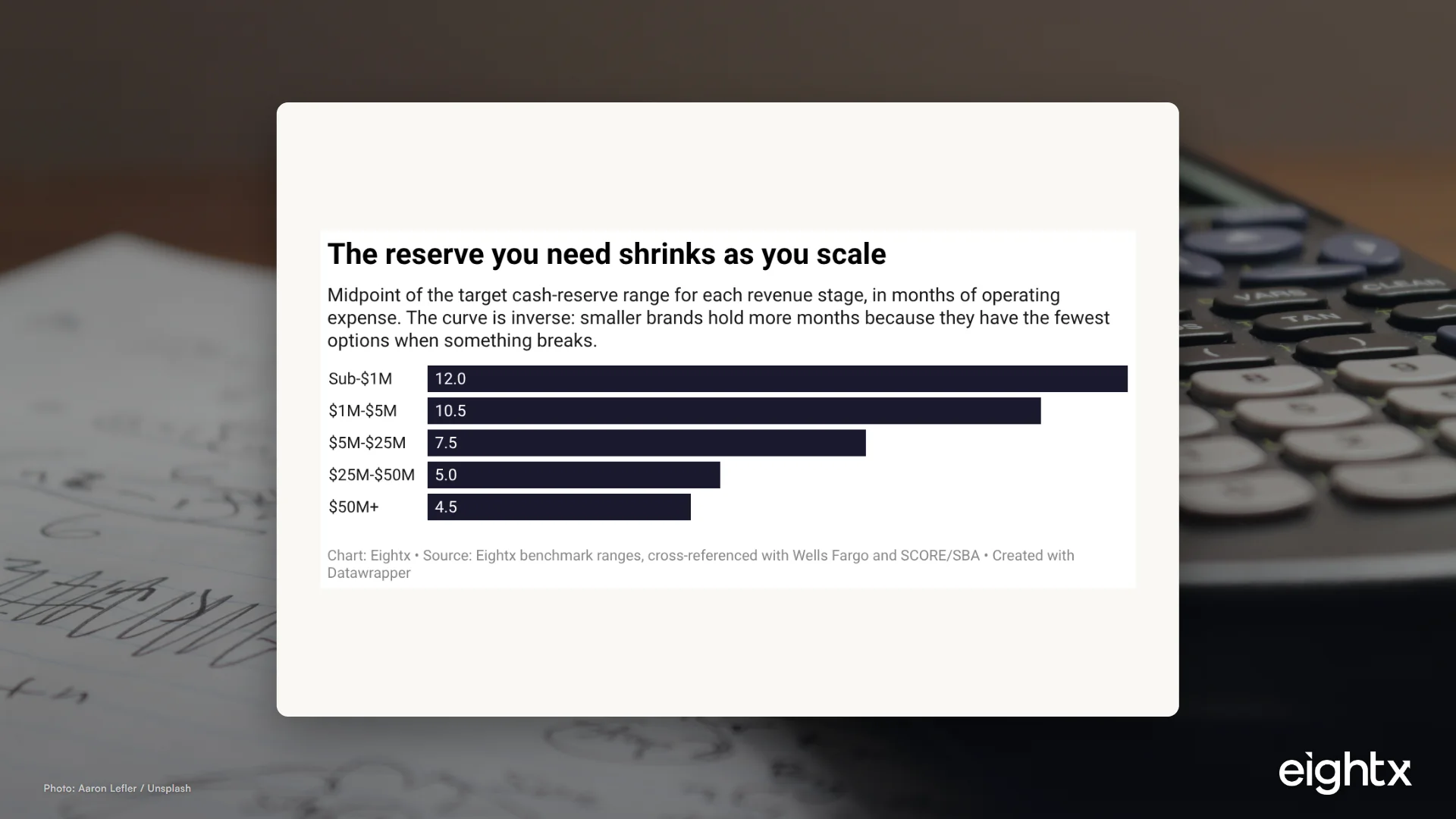
Most DTC brands should hold 6 to 12 months of operating expense in cash, scaled to stage and risk. Sub-$1M brands target 12-plus months, $1M-$5M brands 9 to 12, $5M-$25M brands 6 to 9 plus a credit line, and $25M-plus brands 4 to 6 backed by a revolver. Lower margin and heavier seasonality push the number higher.
Key Takeaways
- Target cash reserve follows an inverse curve by stage: sub-$1M brands need 12+ months, $1M-$5M need 9 to 12, $5M-$25M need 6 to 9 plus a credit line, and $25M+ run on 4 to 6 months plus a committed revolver
- Set your floor at the larger of two numbers: your months-of-opex target and 1.5x your peak seasonal cash swing through the trough
- A brand at 35% gross margin needs roughly twice the cash buffer of a brand at 65% running the same fixed costs
- Under 3 months of runway is the danger zone at any stage, and half of US small businesses operate with under 15 days of cash buffer
- Strip statutory liabilities and committed POs out of the cash number before you call it a reserve, or your true runway is 3 to 6 months shorter than the board pack says
Most founders check their bank balance and feel fine. Seven figures sitting there looks like safety. Then the Q4 inventory PO goes out, the quarterly tax payment hits, a wholesale customer pushes payment 30 days, and the seven-figure number becomes a five-figure number with three weeks of payroll in the queue. The reserve was never as big as the bank balance said it was.
A cash reserve is not the money in your account. It is the deliberate buffer you hold so your runway never falls into the danger zone, even through your seasonal trough or a demand shock. This post lays out how much to hold, in months of operating expense and as a multiple of your seasonal swing, by stage and by risk profile, and gives you a method to set your own number instead of borrowing someone else's.
What a cash reserve actually is
Cash runway is the number of months you can keep operating at your current net burn before you run out of cash: cash on hand divided by monthly net burn, calculated on a trailing 3-month average to smooth out the lumpiness. Your reserve is the cash you choose to hold so that number stays healthy on purpose.
The trap is computing either one off the headline cash figure. If you have $500K in the bank but a $300K supplier PO settling next week, your true reserve is $200K, not $500K. The reserve that counts is available cash after near-term committed outflows and after statutory liabilities: the GST, BAS, sales tax, and payroll tax that is someone else's money sitting in your account. Strip those out first. In practice the reserve on most board packs is 3 to 6 months optimistic because nobody does this.
When I talk to founders running a brand this size, the thing that lands hardest is the contrast with 2022 into 2023. As one operator put it after the fact: nobody wants to hang on to 500 grand of cash that just sits there doing nothing, but every brand they worked with would have benefited from that 500 grand sitting there doing nothing when demand turned. The reserve feels like dead money right up until the quarter it is the only thing keeping the lights on.
Benchmark reserve by revenue stage
The right reserve follows an inverse curve. Smaller brands need more months because they have the fewest options when things break, and larger brands run leaner because they hold committed credit facilities behind their operating cash. These are the benchmarks I work with across the Eightx client base, anchored to our cash runway benchmarks by stage and cross-referenced against Wells Fargo and SCORE small-business reserve guidance.
| Revenue stage | Recommended reserve | Danger threshold | Why this number |
|---|---|---|---|
| Sub-$1M (early) | 12+ months | Under 6 months | No access to debt, slow fundraising; every month buys product-market-fit time |
| $1M-$5M (scaling) | 9 to 12 months | Under 4 months | Working capital cycle stretches as inventory grows; first wholesale terms shock hits |
| $5M-$25M (growth) | 6 to 9 months plus a line of credit | Under 3 months | Asset-based and inventory financing change the math; runway can include undrawn capacity |
| $25M-$50M (mature) | 4 to 6 months plus a revolver | Under 2 months | Credit facility is mandatory; operating cash covers week-to-week, debt absorbs seasonality |
| $50M+ (institutional) | 3 to 6 months plus structured credit | Under 60 days | Treasury becomes its own discipline; cash splits across operating, reserve, and investment buckets |
External norms run a touch leaner than this. The common 2025-2026 rule of thumb for small business is 3 to 6 months of operating expense, rising to 9 to 12 for seasonal or cyclical firms, and that is a reasonable floor for a tightly run early brand with short inventory cycles. But the bigger danger signal is how little cash most firms actually hold: per the JPMorgan Chase Institute, half of US small businesses operate with fewer than 15 days of cash buffer. Product ecommerce carries inventory and paid-media risk that a service business does not, which is why I push the stage targets above the generic small-business number.
Adjust for your risk profile: margin and seasonality
Stage is the starting point, not the verdict. Two brands at $10M can have completely different reserve needs. Three variables move the number most.
Gross margin. The math is mechanical, not opinion. Lower margin means more revenue, and therefore more inventory and more working capital, to cover the same fixed cost base. DTC gross margin clusters in the 50% to 65% band, with smaller brands at the higher end and scaled brands compressing toward 50%. As a rule of thumb, not a published dataset, a brand at 35% gross margin needs roughly twice the cash buffer of a brand at 65% running the same fixed costs. The lower your margin, the further above your stage benchmark you should sit. A $5M home goods brand at 38% margin should target 9 to 12 months, not the 6 to 9 stage benchmark.
Cash conversion cycle. Cash conversion cycle, the days between paying for inventory and collecting the cash from selling it, runs 60 to 120 days for a typical inventory-carrying DTC brand; below 60 is strong. The longer the cycle, the more months of reserve you need on top of the stage benchmark, because the cash is locked in stock before sales recycle it. A pure-DTC brand with a 20-day cycle can run at benchmark. A DTC-plus-wholesale brand at 60 to 90 days should add 1 to 2 months; wholesale-heavy at 90 to 150 days adds 2 to 3. The pattern we see again and again on the wholesale side is terms stretching in the wrong direction: a customer and a supplier both moving to net 90 in the same quarter, with no realistic way to pull the 60 days back to 45 or 30. Every extra month in the cycle is another month of reserve you have to fund.
Seasonality. The reserve that matters is the one that carries you through the trough, not the average month. A brand doing 45% of annual revenue in Q4 has to fund that inventory in August and September, months before the cash recycles. This is where the second sizing method comes in: hold at least 1.5x your peak seasonal cash swing, measured from the top of the inventory build to the bottom of the post-build trough. If your Q4 build pulls $400K out of the account before sales land, your reserve floor is $600K on the seasonal test alone, regardless of what the months-of-opex math says.
A method to set your own target
Do not borrow a number off a table. Run this in four steps.
- Start with your stage benchmark from the table above, in months of operating expense. Use real opex, the trailing 3-month average, not last year's budget.
- Adjust for margin and CCC. Use the rule of thumb that a 35% margin needs roughly twice the buffer of a 65% margin, and scale up the further below 65% you sit. Long cash conversion cycle, add 1 to 3 months. This gives you a months-of-opex target in dollars.
- Calculate your seasonal floor. Find your peak-to-trough cash swing across a full year, then multiply by 1.5. This is the minimum that carries you through the build into your strongest season.
- Take the larger of the two dollar figures. That is your reserve floor. Hold it as available cash after committed POs and statutory liabilities, plus committed undrawn credit if you are above $5M.
Then pressure-test it. Run the cash crunch scenarios against the number: a Q4 that comes in 25% light, a 40% CAC jump, a major wholesale customer moving to net 90, a tariff or supplier price hike, a processor reserve hold. If 6 months of reserve becomes 2 months under any single scenario, your real reserve is 2 months conditional on nothing going wrong.
One adjustment we make constantly on the inventory side. When a brand is sitting on 250 days of inventory, the cash conversion cycle is enormous and the reserve target balloons with it. The first move is not to raise more cash, it is to get inventory down to 3 to 4 months at the outside, which frees up the liquidity that was the reserve problem in the first place. Reserve sizing and inventory discipline are the same conversation.
What the public companies teach about reserve size
The public data makes the case for a real buffer better than any benchmark table. We pulled the FY2025 10-K filings for five loss-making or near-breakeven public DTC brands and computed runway the same way you should: year-end cash divided by monthly operating cash burn. The spread is enormous, and the lesson is in the spread.
| Brand | FY2025 revenue ($M) | Year-end cash ($M) | FY2025 operating cash flow ($M) | Runway (months) |
|---|---|---|---|---|
| Allbirds | not disclosed here | 26.7 | -55.1 | 5.8 |
| Beyond Meat | 275.5 | 203.9 | -144.9 | 16.9 |
| Funko | 908.2 | 42.1 | -5.1 | 98.8 |
| Honest Company | 371.3 | n/a | +15.1 | OCF positive |
| Warby Parker | 871.9 | 286.4 | +110.8 | OCF positive |
The live danger case is Allbirds: 5.8 months of runway at year-end, and the Q1 2026 10-Q already shows cash down to $14.4M. That is what sub-6-months looks like on a public balance sheet. The other instructive name is Funko: $908M of revenue and only $42M of cash, against $954M of operating expense. Funko's runway reads as 99 months only because its FY2025 operating cash flow was near breakeven; the moment burn returns, that number collapses. Revenue does not buy time. Scale is not a reserve.
Beyond Meat is the cautionary version of the opposite move. Its cash balance jumped about 55% year over year, from $131.9M to $203.9M, but its runway barely moved, from 16.0 to 16.9 months. The cash came from a $223M financing raise, not from operations: operating cash flow actually worsened to -$144.9M, from -$98.8M the year before. Burn rose almost in lockstep with the cash, so the extra balance bought almost no extra time. A reserve topped up by debt or equity buys time only if burn holds; it does not fix burn. The threshold framework I want every private brand to internalize follows from all of this: 24 months is optionality, 12 months is urgency, 6 months is decision, 3 months is survival. In our experience boards routinely delay action by one full tier, acting at month 9 because they ignored the signal at month 18.
What to do about it
Here is the operating cadence that keeps a reserve real instead of theoretical.
- Put months of cash on the dashboard, not dollars. Dollars feel reassuring. Months of cash forces you to be honest about burn. The easiest version of this is net cash flow: look at your bank balance from one week to the next, take the difference, and put it on a Google Sheet every single week. Then convert to months at trailing-3-month average burn.
- Strip committed outflows and statutory liabilities before you call it a reserve. Near-term POs and tax money owed are not your cash. Subtract them every time.
- Set the floor at the larger of months-of-opex and 1.5x your seasonal swing. Write the dollar number down and make it a board metric. This is the difference between a reserve as policy and a reserve as accident: name the floor on purpose, then decide what the freed-up money above it is for.
- Secure the credit line at 24 months, not at 6. A committed revolver costs only a fraction of a percent in unused-line fees while it sits there, and it adds months of effective runway the moment something breaks. Banks lend to healthy brands, not desperate ones.
- Pair the reserve with a 13-week cash flow forecast and weekly KPIs. The reserve is the strategic number; the weekly forecast tells you which weeks you will be tight and why. Run both or you are flying half blind.
- Re-test against the big-five crisis scenarios quarterly. If any single one drops you below 3 months, raise the reserve or lock in more credit now.
A cash reserve is not a number you discover at the bottom of your bank account. It is a number you decide on purpose, strip down to real available cash, size against the larger of your months-of-opex target and your seasonal swing, and defend with a committed credit line you set up while you still look healthy. The brands that survive a bad quarter are the ones that funded the boring reserve before they needed it.
Sources and methodology
Stage benchmarks, gross margin multipliers, and cash conversion cycle adjustments are drawn from Eightx engagement data across 35+ ecommerce and CPG clients from $2M to $130M in revenue, cross-referenced against Wells Fargo and SCORE/SBA small-business reserve guidance and adjusted for physical-product working capital dynamics. The stage midpoints in the chart are Eightx engagement-derived ranges, not a single public dataset.
The danger-zone framing rests on the JPMorgan Chase Institute study "Small Business Cash Liquidity in 25 Metro Areas," which found that 50% of small businesses operate with fewer than 15 cash buffer days. The recommended-baseline ranges (3 to 6 months, rising to 9 to 12 for seasonal or cyclical firms) reflect 2025-2026 guidance from Wells Fargo, Capital One, and SCORE/SBA.
DTC margin and cash conversion cycle benchmarks come from Wayflyer (typical DTC cash conversion cycle of 60 to 120 days, below 60 considered strong) and Finaloop aggregated DTC cohort data (gross margin clustering 50% to 65%, median net margin 3% to 10%).
Public-company runway figures are calculated from fiscal 2025 Form 10-K filings on SEC EDGAR. Runway = cash and cash equivalents at fiscal year-end divided by monthly operating cash burn, where monthly burn = (negative full-year operating cash flow) / 12. Verbatim line items: Allbirds cash $26.69M, operating cash flow -$55.08M (CIK 1653909); Beyond Meat cash $203.89M, operating cash flow -$144.93M, revenue $275.50M (CIK 1655210); Funko cash $42.15M, operating cash flow -$5.12M, revenue $908.21M, operating expense $954M (CIK 1704711); Honest Company operating cash flow +$15.12M, revenue $371.3M (CIK 1530979); Warby Parker cash $286.36M, operating cash flow +$110.79M, revenue $871.91M (CIK 1504776). Operating-cash-flow-positive brands have no burn and are reported as such, not assigned a finite runway.
The margin multiplier (35% margin needing roughly twice the buffer of 65%) and the 1.5x seasonal-swing test are Eightx engagement heuristics, mechanically defensible but framed as rules of thumb rather than published datasets. All targets are point-in-time starting points; the right reserve for your business depends on margin, cash conversion cycle, and seasonality, and should be sized with your own numbers.
Frequently asked questions
how much cash reserve should a dtc brand hold?
Most DTC brands should hold 6 to 12 months of operating expense in cash. Sub-$1M brands target 12+ months, $1M-$5M brands 9 to 12, $5M-$25M brands 6 to 9 plus a credit line, and $25M+ brands 4 to 6 backed by a revolver. Lower gross margin and heavier seasonality push the target higher.
how do i calculate my own cash reserve target?
Take the larger of two numbers. First, your stage benchmark in months of operating expense, adjusted up for low margin and a long cash conversion cycle. Second, 1.5x your peak seasonal cash swing through the trough. Whichever is bigger is your floor.
how does seasonality change the reserve i need?
A brand doing 45% of annual revenue in Q4 has to fund that inventory by August or September, months before the cash comes back. The reserve that matters is the one that carries you through the trough, not the average month. Size it against the peak swing, not the calm period.
what is the danger zone for cash runway?
Under 3 months of runway is the danger zone at any stage. At that point you cut burn aggressively, defer non-essential POs, renegotiate supplier terms, and talk to your bank the same week. Half of US small businesses run on under 15 days of cash buffer, which is why one bad quarter ends so many brands.
why does a brand doing $900m in revenue run out of cash?
Because runway is cash divided by burn, and revenue sits in neither term. A nine-figure brand can carry thin cash and a heavy operating-expense base, so a few bad weeks of collections or one oversized inventory build drains the account regardless of top line. The reserve question is always how many months of burn your cash covers, not how big your revenue is.
should i count my credit line as part of my reserve?
Yes, if it is committed and undrawn. From $5M revenue up, runway is cash plus committed undrawn credit, not just the bank balance. Secure the facility before you need it, because banks lend to brands that look healthy, not desperate. Do not count an uncommitted or at-will line.