
Financial Strategy
Ecommerce CFO Canada 2026: Shopify Plus and Amazon CA operator scope for a $5M to $50M brand
Canada is Shopify's home market, with 170,300 active Canadian-headquartered merchants and roughly 3,850 on Plus as of mid-2026. Senior-partner ecommerce CFO retainers run CAD $5,000 to $15,000 per month for $5M to $50M revenue brands, roughly 20% to 33% of a full-time hire. The Bank of Canada cut 275 basis points to 2.25%, and USD/CAD averaging 1.3754 in April 2026 makes FX policy a core CFO deliverable.
Key Takeaways
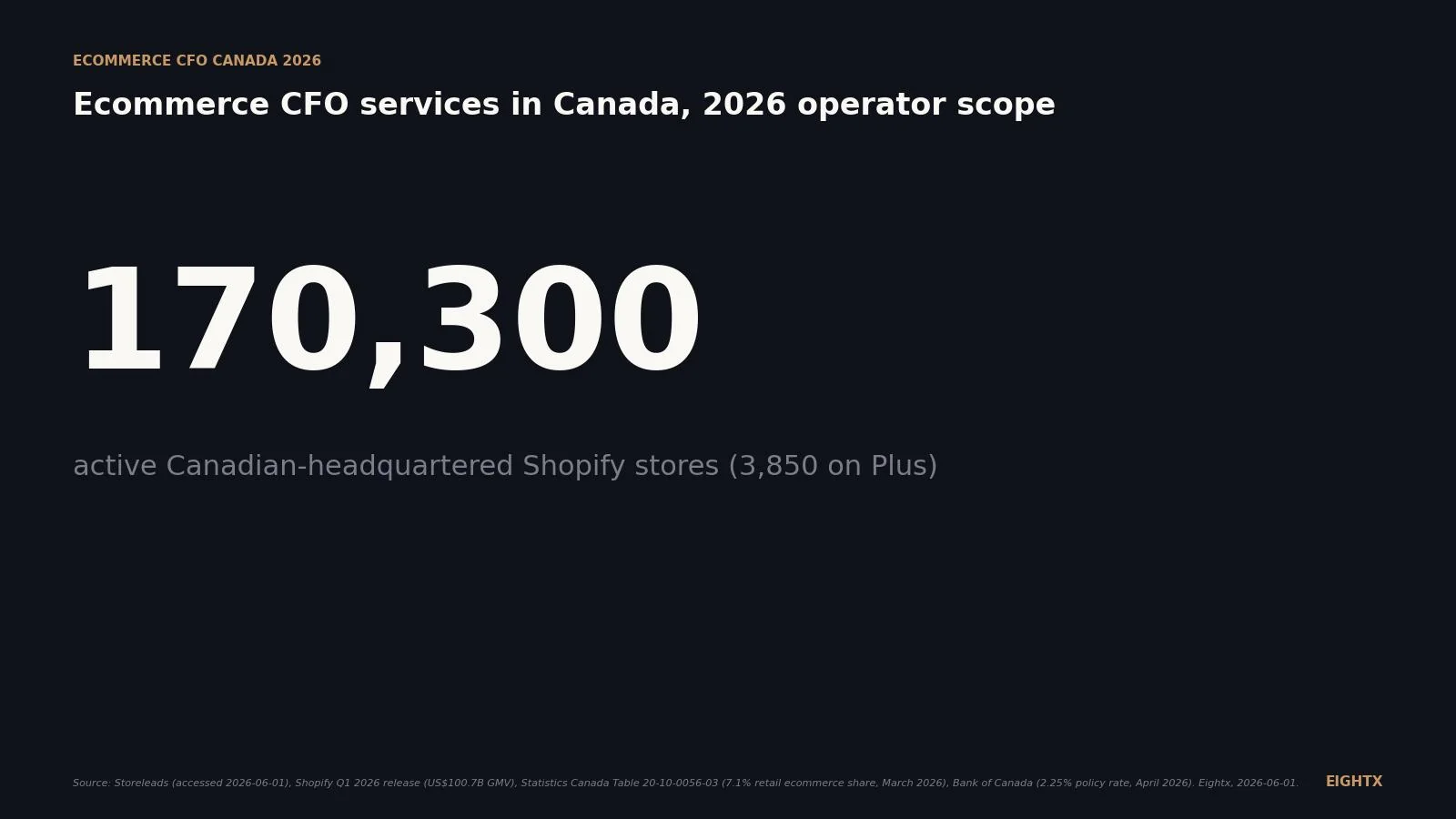
- Shopify hit US$100.7B global GMV in Q1 2026, +35% YoY, and roughly 170,300 of those active merchants are Canadian-headquartered, including about 3,850 on Shopify Plus (Shopify Q1 2026 release; Storeleads, accessed 2026-06-01). Canada is structurally Shopify's home market, and the ecommerce CFO buyer pool sits inside that population.
- Canadian retail ecommerce reached approximately $5B in March 2026, roughly 7% of total retail trade (Statistics Canada Table 20-10-0056-03, pending Daily release page confirmation). That is the highest sustained monthly share on record outside the 2020-2021 lockdown window, up from 5.5% on a 2022 annual basis (note: 2022 5.5% is an annual figure; 2026 ~7% is a monthly print, so this is a series-mix comparison).
- An ecommerce CFO scope for a Canadian Shopify or Amazon CA brand is narrower and sharper than generic CFO scope. The eight outputs: 13-week cash forecast in CAD, Shopify Payments and Amazon CA settlement reconciliation, GST/HST/PST/QST oversight, contribution margin by SKU and channel, USD/CAD FX policy, BoC operating-line negotiation, board pack, and the fundraising data room.
- Senior-partner ecommerce CFO retainers in Canada 2026 sit at CAD $5,000 to $15,000 per month for $5M to $50M revenue brands. A full-time CFO lands at CAD $250K to $400K+ all-in. Across that revenue band the retainer is roughly 20% to 33% of full-time cost.
- Bank of Canada held the policy rate at 2.25% on April 29, 2026, after 275 bps of cuts from the October 2023 peak (Bank of Canada FAD release). Canadian SME operating lines now price near posted prime 4.45% plus an estimated 1.5% to 4.0% (synthesis of commercial-bank disclosures and operator interviews, not a single primary source). For a fully floating, fully drawn $1M Prime-linked line, that implies roughly $30K to $45K less in interest per year than in late 2023.
If you run a Canadian DTC brand on Shopify or Amazon CA between $5M and $50M CAD in revenue, the CFO scope you actually need is narrower and sharper than the generic "fractional CFO" framing implies. Canada is structurally Shopify's home market (US$100.7B Q1 2026 global GMV, with roughly 170,300 active Canadian-headquartered merchants on the platform per Shopify Q1 2026 results and Storeleads, accessed 2026-06-01). Canadian retail ecommerce sits at roughly 7% of total retail trade in early 2026 (Statistics Canada Table 20-10-0056-03, March 2026 release; pending Daily release page confirmation, see methodology). The Bank of Canada has cut the policy rate from 5.00% to 2.25% since October 2023 (Bank of Canada FAD release, 29 April 2026). And USD/CAD has come off its December 2024 peak to 1.3754 in April 2026 (FRED DEXCAUS).
Each of those is a CFO-grade decision, not a bookkeeper task. This page covers the operator scope, the CAD retainer bands, the math against a full-time hire, and the 7 questions to ask before you sign. For the broader cost and decision-frame discussion (across virtual, fractional, and outsourced) see our companion piece on virtual CFO services Canada.
Canada is Shopify's home market and 170,000 Canadian merchants are running on that platform
Shopify is headquartered in Ottawa and reported US$100.7B in global GMV in Q1 2026, up 35% year-over-year. The 8-K and the press release don't break GMV out by merchant headquarters country, but Storeleads (a Shopify-detection web crawl) counts roughly 170,300 active Canadian-headquartered Shopify stores as of 2026-06-01, with about 3,850 on Shopify Plus. That is the structural addressable mid-market ecommerce CFO buyer pool in Canada.
The point isn't that every Canadian Shopify brand needs a CFO. It's that the operating context is different from a US-only Shopify brand. Most Canadian Shopify Plus brands at $10M to $30M CAD revenue are now running a US-Canada cross-border operation by default, with Shopify Payments settling in CAD, Amazon Canada settling in CAD, US side revenue in USD, Chinese supplier POs in USD, and a domestic Canadian operating line linked to the Bank of Canada's policy rate. That is a different CFO conversation than the one a US-only brand runs.
It also matters that Statistics Canada Table 20-10-0056-03 puts retail ecommerce at roughly 7% of total retail trade in March 2026 (pending Daily release page confirmation), the highest sustained monthly share on record outside the 2020-2021 lockdown spikes. The 2022 annual baseline was 5.5% (note: that 5.5% is an annual figure from Canada at a Glance 2023; the ~7% is a monthly seasonally adjusted print, so this is a series-mix comparison, not a like-for-like). Even with that caveat, if your board deck still anchors to a 2022 share assumption, your category-share math is a year and a half behind.
What an ecommerce CFO actually owns for a Canadian Shopify or Amazon CA brand
The scope of a senior-partner ecommerce CFO engagement in Canada in 2026 is narrower and more specific than a generic "fractional CFO" scope. Eight outputs cover the bulk of what gets delivered, and they map directly to how a Canadian Shopify or Amazon CA brand makes money.
- Rolling 13-week cash forecast in CAD with a USD subledger for cross-border ops, modelling inventory POs, paid media pacing, and Amazon CA reserve releases. Not a static budget. A weekly-refresh forecast you can run a decision against on Tuesday morning.
- Shopify Payments and Amazon CA settlement reconciliation in CAD. Daily Shopify payouts net of processing fees, chargebacks, and refunds map cleanly to revenue, fees, and refund GL accounts. Amazon CA's 14-day settlement cycle (single CAD payout net of FBA fees, referral fees, ads, reserves, refunds) reconciles by settlement period, not by sale date. Reserves time-lag and need their own subledger.
- Contribution margin modelling by SKU and channel after returns, processing fees, and ad spend. This is the report QuickBooks does not produce natively and the one that drives every actual CFO decision on the business.
- GST/HST/PST/QST oversight across provinces. Single GST/HST in Ontario and the Atlantic provinces, GST plus separate PST in BC, SK, MB, and QST administered by Revenu Quebec on top of federal GST. An ecommerce CFO sets the registration policy, confirms nexus thresholds as you cross provinces, and reviews returns before they go out.
- USD/CAD FX policy on US-side revenue. Natural hedging via USD costs first (inventory POs, Meta and Google ads, US 3PL fees), forward contracts on the residual exposure, and a treasury rule for the conversion cadence on operating cash. It's a margin-protection conversation.
- BoC-line negotiation and inventory finance. With posted prime at 4.45% in May 2026, the SME operating line that was priced at Prime plus 3% in 2023 is repricing now. An ecommerce CFO runs the spread-and-covenant conversation with your bank, BDC (Business Development Bank of Canada), or EDC (Export Development Canada).
- Board pack and KPI commentary on a monthly cadence. The dashboards a Canadian board actually wants: contribution margin by channel, ad efficiency, inventory turnover, cash runway, and the BoC-rate effect on interest expense.
- Fundraising data room and capital-stack design when one is open. BDC and EDC are the two specialist Canadian working-capital sources to know cold.
What is explicitly NOT in scope: bookkeeping, T2 corporate return preparation, day-to-day accounts payable, payroll runs, GST/HST return lodgement, CRA correspondence. Those sit with your bookkeeper, an external accountant, or an internal controller. An ecommerce CFO oversees them, but doesn't do them.
How an ecommerce CFO is priced in Canada in 2026, and how that compares to a full-time hire
Senior-partner ecommerce CFO retainers in Canada 2026 sit at CAD $5,000 to $15,000 per month. The bands cluster like this:
- Under CAD $5M revenue: $5,000 to $6,000 per month. Light-touch advisory, monthly board pack, quarterly forecast refresh, one strategic call per week.
- CAD $5M to $30M revenue: $7,000 to $12,000 per month. Embedded weekly cadence, full board pack ownership, rolling 13-week cash forecast, Shopify and Amazon CA reconciliation oversight, capital planning.
- CAD $30M to $100M revenue: $12,000 to $15,000 per month. Senior partner plus an analyst or controller pairing, multiple weekly touchpoints, fundraise or M&A workstream involvement.
A full-time CFO in Canada in 2026 lands at CAD $250K to $400K+ all-in across $5M to $100M revenue brands once you stack base, STI at target, statutory on-costs (CPP/EI/EHT/WSIB), and a 30% retained-search fee. Toronto mid-market base sits at $210K to $260K; Vancouver runs 5% to 10% below; Calgary is roughly at Toronto parity for energy and PE-backed roles; Montreal runs 10% to 15% below.
City Under $25M revenue $25-100M revenue $100M+ revenue Toronto CAD $170-210K CAD $210-260K CAD $260-340K Vancouver CAD $160-200K CAD $200-245K CAD $245-320K Calgary CAD $165-205K CAD $210-255K CAD $260-345K Montreal CAD $150-190K CAD $190-235K CAD $235-315K
For a worked example, take a $15M CAD Shopify brand in Toronto. The all-in year-one stack on a full-time CFO at $235K base looks like this:
Cost component (CAD) Full-time CFO Ecommerce CFO (mid-range retainer) Base salary $235,000 STI target (20%) $47,000 CPP + EI employer (capped) $5,800 Employer Health Tax (ON 1.95%) $5,500 WSIB workers comp (about 0.3%) $700 Retained search fee (30% of TC) $84,600 Monthly retainer ($10K x 12) $120,000 Statutory on-costs on retainer $0 Recruitment / severance exposure $0 Year-one total cash cost $378,600 $120,000 Year-two recurring cash $294,000 $120,000
Year-one full-time is 3.2x the ecommerce CFO retainer cost at this revenue scale. Year-two recurring is 2.4x.
The pattern holds across the revenue spectrum. At sub-$5M revenue, full-time runs nearly 5x the retainer. At $50M, it's still about 3x. Above $100M the gap stays wide as full-time comp scales, but at that scale you usually need a full-time finance leader anyway for the team build and the executive-committee seat.
The math of full-time vs ecommerce-specialist fractional: what changes at $5M, $15M, $50M, and $100M
The decision frame for a Canadian DTC operator running $5M to $100M CAD revenue on Shopify or Amazon CA:
Under CAD $30M revenue. Ecommerce CFO retainer almost always wins on math. A senior-partner at $7K to $12K per month plus a strong bookkeeper or financial controller at $80K to $120K covers the same scope a full-time CFO would at less than half the all-in cost. The exception is a defined capital raise or M&A calendar in the next 12 months that needs dedicated in-house bandwidth for due-diligence work.
CAD $30M to $50M revenue. The judgment-call zone. The full-time call depends on operational complexity: multi-entity, multi-currency, inventory finance lines with debt covenants, an active capital plan, or Amazon FBA exposure across multiple US states. Many brands at this scale run a senior-partner ecommerce CFO plus a full-time financial controller for 18 to 24 months before the full-time CFO hire becomes obvious.
CAD $50M to $100M revenue. Full-time math starts to clear, especially with cross-border complexity. The all-in cost at $450K to $575K is roughly 3x the annual ecommerce CFO retainer, but the availability and team-building bandwidth justify it once the finance team is more than two people deep.
CAD $100M+ with a defined M&A or financing calendar. Full-time usually wins. The all-in cost lands at $575K to $720K but the bandwidth to build the team, sit on the executive committee, and own investor relationships clears.
The risk founders underestimate is the cost of getting the hire wrong. SHRM and Canadian HR benchmarks put senior executive replacement cost at 100% to 200% of total annual compensation. For a $350K all-in Canadian CFO, the midpoint is roughly $525K in direct costs plus a 3 to 6 month productivity loss. That cost effectively doubles your year-one budget if the hire leaves inside 18 months. A 6 to 12 month ecommerce CFO retainer before the full-time search is the most common risk-managed sequence.
What's changed in 2026 for Canadian ecommerce: BoC cuts, CAD strength, and StatCan's ~7% print
The Bank of Canada held the policy rate at 2.25% on April 29, 2026, after 275 bps of cuts from the 5.00% October 2023 peak (Bank of Canada FAD release). Posted prime was 4.45% in late April-May 2026, down from 7.20% at the late-2023 peak. Canadian SME operating lines price at Prime plus an estimated 1.5% to 4.0% depending on collateral and operator strength (this band is synthesized from commercial-bank disclosures and operator interviews rather than a single published rate card; see methodology). A Canadian Shopify brand drawing on a $1M operating line is now paying roughly $30,000 to $45,000 per year less in interest than in 2023 on the same balance.
That is the conversation an ecommerce CFO runs with your bank. The bookkeeper does not. Many SME lines float automatically with prime, so part of the savings has already flowed through; the renegotiation is about compressing the spread, refreshing covenants, and resizing the line for 2026 revenue. If your spread and covenant package was last touched in 2023 or early 2024, there's real money sitting on the table. The two specialist Canadian working-capital lenders to know cold are BDC and EDC; both run programs that price tighter than commercial banks for ecommerce inventory finance and US-export receivables.
On the FX side, USD/CAD has come off the December 2024 peak of 1.4247 to 1.3754 in April 2026, a 3.5% CAD strengthening. For Canadian brands selling into the US, every 1% of CAD strengthening compresses USD-denominated revenue when translated back to CAD. For brands sourcing from China in USD, the opposite holds. An ecommerce CFO sets the FX policy: natural hedging via USD costs first (inventory POs, ad spend, US 3PL fees), forward contracts on the residual exposure, and a treasury rule for the conversion cadence on operating cash.
The roughly 7% share isn't a marketing stat. It's a planning assumption. If your board deck still anchors to a 2022 5.5% share, your category-share math is a year and a half behind, and the CFO conversation you're not having is the one that bridges that gap with Shopify and Amazon CA unit economics.
How to choose an ecommerce CFO for a Canadian brand: 7 questions to ask before you sign
Operator checklist for the buyer call:
- Have you actually managed a 13-week cash forecast for a sub-$30M Shopify Plus brand? Ask for a redacted example.
- Walk me through your Amazon Canada settlement reconciliation process. How do you handle FBA reserve releases that time-lag the sale they correspond to?
- How do you handle GST/HST cross-province and QST for a brand shipping nationally?
- What's your USD/CAD FX policy framework for a brand with 30% to 50% US revenue?
- Have you negotiated a Canadian operating line with a tier-1 bank or BDC since the 2024 BoC cuts started? What did you take off the rate?
- Can you sit in a board meeting and answer to a Canadian VC or family-office investor directly, not just brief me ahead of one?
- What's your handoff plan if I outgrow you and need a full-time CFO at $50M? Will you help me run the search?
Two more that matter for a differentiated firm. Do you have a US/CA cross-border practice, and have you read a 2026-vintage Canadian Shopify P&L in the last 30 days. If both answers are yes, you're in a small subset of the market.
Sources and methodology
Shopify. Q1 2026 global GMV of US$100.7B (up 35% year-over-year) is from the Shopify Q1 2026 financial results press release dated 5 May 2026 (Shopify IR) and the corresponding SEC 8-K. The 8-K does not disclose GMV by merchant headquarters country. Canadian-HQ Shopify merchant counts come from Storeleads (a Shopify-detection web crawl), not Shopify IR.
Storeleads. Canadian Shopify and Shopify Plus store counts (~170,300 active CA Shopify, ~3,850 Shopify Plus) carry over from a verified 2026-06-01 Storeleads query captured in our research bundle; the Storeleads MCP filter returned 0 in the current publish session, so the counts were not re-queried via the web UI on publish day. The figures are reliable for top-line addressable-market sizing. Revenue-banded sub-counts are noisier and were not used as primary inputs.
Statistics Canada. Retail ecommerce share figures are from Statistics Canada Table 20-10-0056-03 (monthly retail ecommerce sales, seasonally adjusted), matched against Table 20-10-0008-01 for total retail trade. The March 2026 release (latest available at publish) is reported here as approximately $5B retail ecommerce against approximately $72-73B total retail trade, roughly a 7% share. These March 2026 figures are pending direct StatCan Daily release page confirmation; if the Daily page lags, treat the print as "most recent confirmed month" rather than a hard March 2026 number. The 2022 annual baseline of 5.5% is from Statistics Canada Canada at a Glance 2023 Economy section. The 2026 monthly print and the 2022 annual baseline are different series cuts (monthly seasonally adjusted vs annual), so the comparison is directional, not strictly like-for-like. The Retail Trade Survey definition uses NAICS 44-45 only, so this share understates broader digital-economy footprint.
Bank of Canada. Policy rate path pulled from BoC Fixed Announcement Date (FAD) press releases (Oct 2023 peak at 5.00%, 29 April 2026 hold at 2.25%). Posted prime rate (4.45% in late April-May 2026) is from BoC notes on Canadian interest rates, series V80691311. SME operating-line pricing benchmark of Prime plus 1.5% to 4.0% is based on synthesis of Canadian commercial bank disclosures and ecommerce-operator interviews; ranges narrower for senior-secured asset-backed lending, wider for unsecured or growth-stage lines.
FRED DEXCAUS. USD/CAD monthly average series from the St. Louis Fed. April 2026 print is 1.3754; December 2024 peak is 1.4247. We use monthly averages for trend, not spot, because retainer math runs against monthly P&L cycles.
Full-time CFO salary bands. Synthesized from PayScale Canada CFO (visible, last updated 2026) and Morgan McKinley Canada 2026 figures as cited in Minted Search Group's 2026 Toronto manufacturing CFO benchmark. The 2026 editions of Robert Half Canada Salary Guide, Hays Canada Salary Guide, and Mercer Canada salary tables are registration-gated as of May 2026; bands were triangulated from public sources and Indeed Canada postings. PayScale skews toward smaller-company "CFO" titles and understates mid-market; recruiter guides skew enterprise. The truth sits between, weighted by revenue band.
Statutory on-costs. CPP and EI employer-side caps per CRA 2025 thresholds. Ontario Employer Health Tax at 1.95% above the $1M annual payroll exemption. Quebec employer-side burden (QST, FSS, CNESST, parental insurance) brings on-costs closer to 12% to 15% of salary, materially above the rest-of-Canada 5% to 6%. WSIB workers comp modelled at about 0.3% for office-based finance roles. Retained executive-search fee at 30% of first-year total cash compensation is the Canadian mid-market benchmark.
Ecommerce CFO retainer bands. The CAD $5K to $15K per month range is the senior-partner band. Lower-priced offerings exist (CAD $2K to $4K per month for advisory-only or junior-led work) but are outside the senior-partner-led scope this page addresses. The interim CFO band (CAD $15K to $35K per month for full-time intensity) is benchmarked separately from Canadian executive interim providers.
Limitations. PayScale and Indeed self-reported salary data both skew low against recruiter-guide benchmarks. Quebec's higher employer-side on-cost structure is a material differentiator versus ON/BC/AB and is summarized but not modelled line by line. The ecommerce CFO market in Canada is fragmented and most providers do not publish rate cards; the bands above represent the well-documented end of the market. Storeleads counts depend on its Shopify-detection accuracy and exclude any Canadian Shopify-Hydrogen or headless-storefront merchants its crawl misses.
Update cadence. This page is refreshed quarterly. Shopify quarterly GMV, the StatCan ecommerce share, the BoC policy rate, posted prime, USD/CAD, and Storeleads counts all move on quarterly or shorter cycles. Next planned refresh: September 2026 after Q2 2026 Shopify results, StatCan retail trade, and the next BoC FAD.
This page covers the operator scope and the math for an ecommerce-specialist engagement. For the broader cost and decision frame across virtual / fractional / outsourced modalities, see our companion piece on virtual CFO services Canada. For the wider Canadian ecommerce finance context, see financial advisory services Canada, the strategic benefits of virtual CFO services in Canada, and fractional CFO services for CPG brands in Canada. For pillar context: fractional CFO services for ecommerce and the interim CFO services overview.
Frequently asked questions
what does an ecommerce cfo actually do for a canadian shopify or amazon brand?
Strategic finance, scoped to ecommerce. A senior-partner ecommerce CFO owns the rolling 13-week cash forecast in CAD, Shopify Payments and Amazon Canada settlement reconciliation, contribution margin by SKU and channel, GST/HST/PST/QST oversight across provinces, USD/CAD FX policy on US-side revenue, the BoC operating-line conversation, the board pack, and the fundraising data room when one is open. They don't run payroll, file T2 corporate returns, lodge GST/HST returns, or do day-to-day bookkeeping.
ecommerce cfo vs fractional cfo vs virtual cfo, is there a real difference?
Virtual and fractional are used interchangeably in Canada for an ongoing senior-partner retainer 5 to 15 hours a week, billed monthly. Ecommerce CFO is a specialization, not a different modality. The scope is sharper: Shopify and Amazon unit economics, contribution-margin modelling by SKU and channel, channel-level paid media efficiency, returns and refund accounting. The retainer band is the same.
how much does an ecommerce cfo cost in canada in 2026 in cad per month?
Senior-partner ecommerce CFO retainers sit at CAD $5,000 to $15,000 per month. Under $5M revenue is typically $5K to $6K for light-touch advisory. $5M to $30M is $7K to $12K for embedded weekly cadence and full board pack ownership. $30M to $100M is $12K to $15K, often with a senior partner plus an analyst or controller pairing. Above $100M, full-time math starts to clear for most brands.
at what revenue should a canadian dtc brand hire a full-time cfo instead?
Under CAD $30M revenue an ecommerce CFO retainer almost always wins on math. $30M to $50M is a judgment call driven by complexity (multi-entity, cross-border, inventory finance, capital plan). Above $50M with a real M&A or capital-raise calendar, full-time clears its $450K to $700K+ all-in cost. The mis-hire risk (100% to 200% of total comp inside 18 months, per SHRM and Canadian HR benchmarks) is why most brands run a 6 to 12 month retainer first.
how does an ecommerce cfo handle shopify payments and amazon ca reconciliation?
Settlement reconciliation is a monthly close discipline. Shopify Payments lands a daily payout in CAD net of processing fees, chargebacks, and refunds; an ecommerce CFO owns the JE mapping so revenue, fees, and refunds hit the right GL accounts and your gross margin is correct. Amazon Canada is sharper. The 14-day settlement cycle lands a single CAD payout net of FBA fees, referral fees, advertising, reserves, and refunds. Reserve releases time-lag against the sale they correspond to, which trips up brands that don't reconcile by settlement period. An ecommerce CFO sets that process or audits the bookkeeper's process.
how does an ecommerce cfo handle gst/hst/pst and quebec qst across provinces?
Oversight, not preparation. An ecommerce CFO sets the registration policy across provinces (single GST/HST in Ontario and the Atlantic provinces, GST plus provincial PST in BC/SK/MB, separate QST in Quebec), confirms your nexus thresholds as you cross provinces, and reviews the bookkeeper's or accountant's returns before they go out. Quebec is the sharpest edge case because QST is administered separately by Revenu Quebec; your bookkeeper needs to know it cold.
how does an ecommerce cfo help with cad/usd fx exposure on my us shopify revenue?
USD/CAD averaged 1.3754 in April 2026, down from a 1.4247 peak in December 2024. For Canadian DTC brands selling in USD, every 1% CAD strengthening compresses USD revenue when translated back to CAD. An ecommerce CFO sets the policy: natural hedging via USD costs first (inventory POs, Meta and Google ad spend, US 3PL fees), forward contracts on the residual exposure, and a treasury rule for the conversion cadence. It's a margin-protection conversation, not a speculation one.
should i hire a us-based fractional cfo firm if i'm a canadian dtc brand?
Only if the firm has genuine Canadian tax and GST/HST experience and is willing to invoice in CAD. Most US-headquartered fractional CFO firms understate the Canadian operating reality (PST/QST fragmentation, T2 vs Form 1120 differences, BDC and EDC capital sources, Canadian banking norms) and price in USD. That triggers FX gain/loss noise on your monthly P&L and a knowledge gap on cross-border tax. Canadian-headquartered firms with US client experience are the better fit for most $5M to $50M DTC brands.