
Financial Strategy
Founder salary reality check: what BLS plus SEC actually say a DTC founder should pay themselves in 2026
BLS occupational data and SEC proxy filings say the same thing: most DTC founders underpay themselves at early stage and overcorrect late. The right salary depends on revenue band, ownership stake, and investor expectations. This post maps actual compensation data so you can benchmark your own number with evidence.
Key Takeaways
- The headline BLS Chief Executive wage is $213,990 median, $269,630 mean (May 2024 release). The retail-trade slice is lower at $243,120 mean. Neither is the right target for a DTC founder, but both anchor the floor.
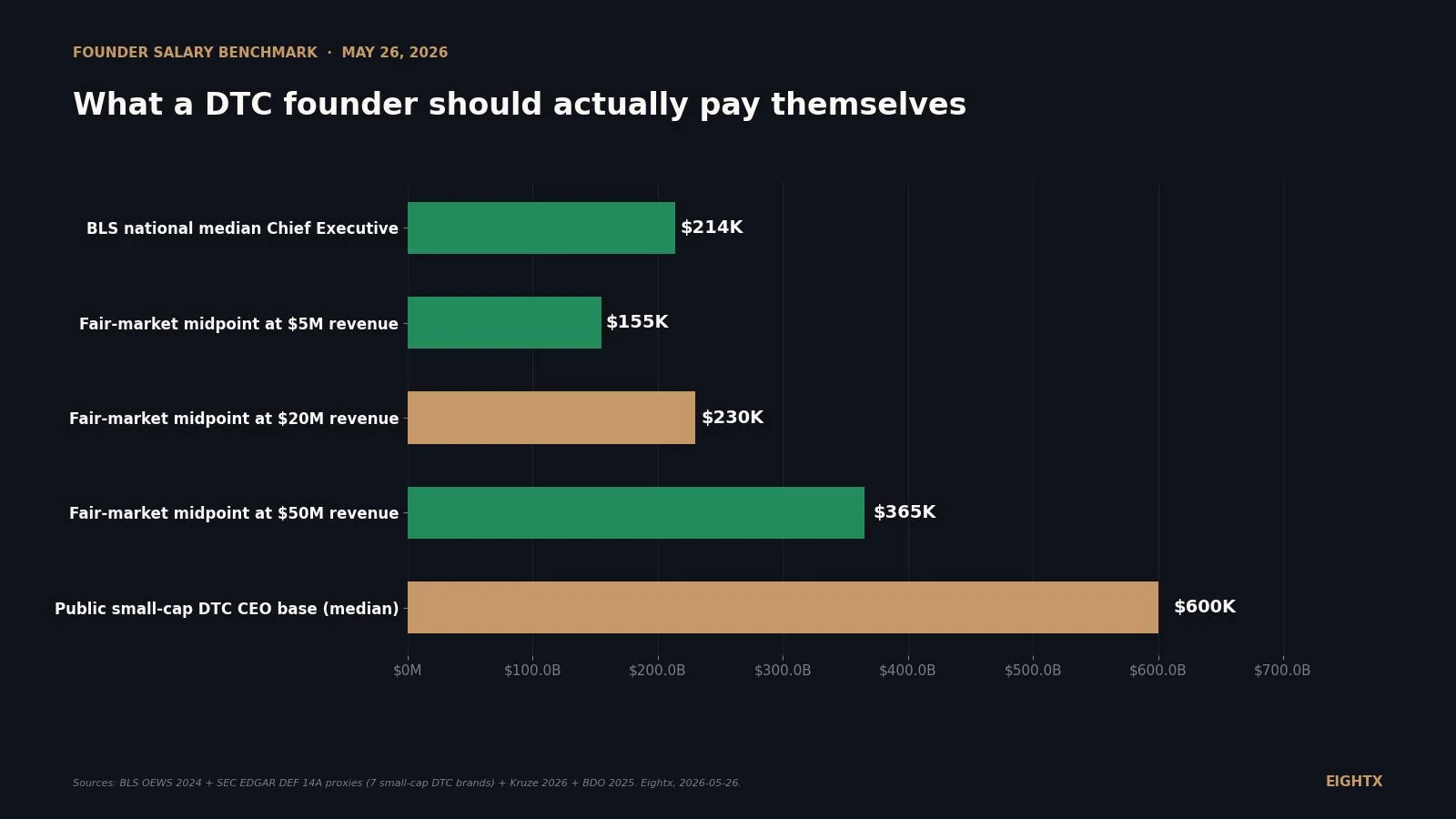
- Public small-cap DTC CEO base salaries cluster $400K to $900K at $250M-$620M revenue (7 brands: Allbirds, Honest, BARK, ThredUp, RTR, Lulus, Vital Farms). Total comp is dominated by stock and is not transferable to private founders.
- Fair-market base for private DTC founders by revenue: roughly $130-180K at $5M, $180-280K at $20M, $280-450K at $50M, $400-650K at $150M. Anchored to BLS plus BDO 2025 (n=341) plus Kruze 2026 (medians: Seed $153K, Series A $203K) plus the 7-brand proxy median.
- A $300K CEO at sub-$30M revenue is a yellow flag, not a target. Matt's read across 5,400 plus founder calls: the only sub-$30M brands paying $300K are venture-backed with 10 percent EBITDA headroom.
- Underpaying yourself hides profit today and becomes a QofE add-back at exit. A $150K compensation add-back at a 5x EBITDA multiple (typical for sub-$50M DTC) lifts enterprise value by $750K. Buyers know what you should have been paying.
Most founders running a $5M to $150M direct-to-consumer (DTC) brand are flying blind on their own salary. The two extremes they hear are pay yourself nothing until you are profitable (Twitter founder advice) and you should be making $500K plus equity (PE pitch decks). Neither is right. This post pulls the actual data: BLS Occupational Employment and Wage Statistics (OEWS) for the national and retail-trade benchmarks, plus the Summary Compensation Tables from 7 small-cap public DTC brand proxies (DEF 14A filings), plus the Kruze 2026 Startup CEO Salary Report (sample size not disclosed on the public report page), plus the Pilot Founder Salary Report 2025 (n=1,844 founders), plus the BDO 2025 Private Company Executive Compensation Survey (n=341). Together they give a defensible fair-market band by revenue. The decision this points to is straightforward: if you are underpaying yourself by more than roughly 30 percent versus that band, you are hiding profit today and stockpiling a quality-of-earnings (QofE) headache at exit.
What BLS actually says a CEO earns, and why the headline number misleads
The Bureau of Labor Statistics OEWS program publishes annual wage data for every occupation, including Chief Executive (Standard Occupational Code 11-1011). The May 2024 release (latest available, published 2025) reports a national annual mean wage of $269,630 and a median of $213,990 across all industries.
That is the number most founders see quoted on LinkedIn or in salary surveys. It is not wrong, but it is the wrong anchor for a DTC operator. Two reasons.
First, BLS Chief Executive captures every titled CEO in the United States: franchise owners, non-profit executive directors, small ESOP CEOs, holding-company principals, and family-business operators. The retail-trade slice (NAICS 44-45) drops to $243,120 mean because the mom-and-pop tilt is even heavier in that subsector. Second, the OEWS median ($213,990) is materially below the mean ($269,630), which tells you the distribution is right-skewed by a small number of very-large-company CEOs. Half of all CEOs earn less than $214K.
The right way to use the BLS numbers is as a floor anchor, not a target. If you are running a $5M DTC brand and paying yourself $80K, you are below not just your peer band but below the national CEO median across every industry and every company size combined.
The general and operations manager (SOC 11-1021) line on that same chart is the one most founders should actually anchor to in the early years. National annual mean is $134,940. In retail trade it drops to $94,670. If you are still doing your own ops, fulfillment oversight, ad buying, hiring, and bookkeeping, you are functionally a GM, not a CEO. Pay yourself accordingly, then re-band each time you genuinely hand off a function.
The public-DTC CEO comp data nobody pulls
A more useful upper-bound anchor comes from SEC proxies. Every public company files a DEF 14A annually with a Summary Compensation Table for its named executive officers. We pulled the most recent filing for 7 small-cap public DTC and consumer brands at $250M to $620M revenue.
Company Ticker FY Revenue ($M) CEO base ($K) Total comp ($K) Allbirds BIRD 2024 254 400 7,601 Rent the Runway RENT 2024 291 500 4,666 ThredUp TDUP 2024 331 525 6,119 Lulu's Fashion Lounge LVLU 2024 351 650 3,072 Honest Company HNST 2024 378 900 7,976 BARK BARK 2023 536 600 9,307 Vital Farms VITL 2024 621 609 4,858
Base salary clusters $400K to $900K. The median is $600K. Total compensation runs $3.07M to $9.31M, with a median around $6.1M. The gap between base and total is almost entirely stock awards.
For a private DTC founder, that stock line is not transferable. You already own the equity. The only number that translates is base salary. Solo Brands (SOLO ticker, CIK 0001870600) trades publicly at $454M FY24 revenue and sits in the same band; we did not pull its specific number this round because of a recent CEO transition that complicates the per-year comparison.
The pattern across all 7: total comp does not tightly correlate with revenue at this tier. BARK at $536M has higher total comp than Vital Farms at $621M. What does correlate, loosely, is base salary. That tells you boards anchor cash compensation to peer benchmarks and let stock float with performance and timing.
The fair-market band by revenue for private DTC founders
Working backwards from BLS as a floor, Kruze 2026 medians for venture-backed startups (Seed $153K, Series A $203K, Series B $216K), the BDO 1.78x multiplier between $50-100M and sub-$25M revenue tiers, and the 7-brand public proxy median, here is the synthesized band.
Revenue band Operator-founder (GM-equivalent) CEO-founder low CEO-founder mid CEO-founder high Anchor $5M $95-120K $130K $155K $180K Kruze Seed $153K $20M $120-160K $180K $230K $280K Kruze Series A $203K + BDO $50M $160-220K $280K $365K $450K BDO 1.78x + proxy interpolation $100M $220-300K $350K $475K $600K BLS retail mean + proxy interpolation $150M+ $300-400K $400K $575K $900K SEC DEF 14A 7-brand median
Two operator-friendly rules pop out of this.
Rule 1: a $300K CEO at sub-$30M revenue is a yellow flag, not a target. Across thousands of recorded founder and broker calls, the only sub-$30M brands paying their CEO $300K were venture-backed brands with 10 percent EBITDA headroom and a board signing off on the spend. If you are bootstrapped at $20M and you are paying yourself $300K, you are likely overpaying versus the band and crowding out either reinvestment or distributions.
Rule 2: a $300K CEO at $80M revenue with the VP of Finance making $200K is a structural tell. When founders compare their own salary to the senior hires they brought in, the gap often points the wrong direction. The CEO seat at $80M revenue should be $400K plus, and the VP of Finance at $200K is in band. If the founder is below the VP, the founder is in operator-GM mode and has not actually moved into the CEO seat yet.
Why this matters at exit: the QofE add-back trap
When a buyer commissions a quality-of-earnings (QofE) analysis before signing, one of the first lines they normalize is founder compensation. Two cases.
You underpaid yourself. Say you ran a $20M brand on $80K when fair-market was $230K. The QofE analyst adds back the $150K gap as a founder compensation normalization. Reported EBITDA goes up by $150K. At a 5x multiple (typical for sub-$50M DTC), enterprise value rises by $750K. The calculator below tiers multiples by revenue (5x sub-$50M, 7x at $50-100M, 9x above $100M); use the tier appropriate to your scale. That sounds great, but two things happen at the same time. First, sophisticated buyers know what the role should have paid; they often discount the multiple to reflect that the business was carrying hidden labor cost. Second, if the QofE provider is the buyer's (not yours), they may dispute the add-back entirely, leaving you with a lower EBITDA than you expected at LOI.
You overpaid yourself. Say you ran a $20M brand on $400K. The QofE adds back $170K of excess as a normalization. Reported EBITDA rises by $170K, enterprise value by roughly $850K at the same 5x. This is the better problem to have, but it still creates re-trade risk: aggressive or unsupported add-backs (claiming non-recurring marketing, growth-investment add-backs, or related-party costs) are the leading cause of buyers lowering their offer during due diligence.
There is also a quieter mechanical issue most operators miss: how you classify the salary on your books. If you route founder pay through cost of goods sold because you touch product, you muddy gross margin and complicate the QofE normalization. The default should be opex unless 100 percent of the role is production-line work. Keep it clean and the buyer's analyst does the easy version of their job.
The two cleaner exits, ordered by revenue: under $5M, brokers tend to use Seller's Discretionary Earnings (SDE), which adds back the entire salary of one owner; above roughly $20M EBITDA, buyers use straight EBITDA and add back only the excess portion of comp. Knowing which bucket your deal will sit in tells you whether to normalize 18-24 months pre-LOI or whether the broker math already handles it.
Underpaying yourself does not save the business money. It moves cost from a labor line into a forgone-distribution line, hides true profitability today, and at sale forces a buyer's QofE analyst to do the normalization for you. The math is the same. Your bargaining position is not.
What to do this quarter
Concrete moves, in order.
1. Run your numbers through the calculator below. It maps your revenue to the band midpoint, calculates the gap versus your current salary, and outputs the QofE implication at sale. Industry vertical is captured but does not yet differentiate the band (v2 will).
2. If you are underpaying by 30 percent or more, raise to the low end of the band on the next pay run if cash flow allows. If cash flow does not allow it, document the deferred amount as a founder note payable. That preserves the claim at exit and keeps the P&L clean in the meantime.
3. If you are overpaying by 30 percent or more, decide whether to keep the excess as salary or move it to distributions. Distributions are usually cleaner on the P&L and easier to defend at QofE, but they only work if your entity supports them (S-corp or LLC).
4. If you are within 30 percent of the midpoint, hold. Revisit at the next revenue-band crossing or in 12 months, whichever comes first.
5. If you are 18-24 months from a sale, normalize now. The QofE analyst will look at the trailing 12-month P&L. Get fair-market labor on the books for at least the most recent 12 months before LOI.
The calculator
Plug in your revenue, your current salary, your vertical, and your ownership share. The output gives you the fair-market band, your gap, and the QofE implication at sale.
Prefer a spreadsheet you can edit and share with your accountant? We also publish a downloadable Google Sheet version of the calculator on the standalone tool page. Make a copy, plug in your numbers, model multiple revenue scenarios side by side.
For related calculators and operator playbooks, see the contribution margin calculator, the True Interest Cost calculator for evaluating MCAs and lines of credit, and our interim CFO services for the CFO-reviewed version of this analysis on your real numbers.
Sources and methodology
BLS OEWS data. The Bureau of Labor Statistics Occupational Employment and Wage Statistics program is the canonical US source for occupation-level wage data. We pulled Chief Executive (SOC 11-1011) and General and Operations Manager (SOC 11-1021) national series via the BLS public API: national annual mean wage $269,630 for CEO and $134,940 for general/ops manager; national annual median $213,990 for CEO and $105,770 for general/ops manager (May 2024 release, published 2025). Retail-trade-specific numbers (NAICS 44-45) come from the BLS OEWS industry tables for May 2023: CEO mean $243,120; general/ops manager mean $94,670.
SEC EDGAR DEF 14A proxies. The Summary Compensation Table for each named executive officer is required disclosure in every annual proxy filing. We pulled the most recent DEF 14A for 7 small-cap public DTC and consumer brands (Allbirds, Honest Co, BARK, ThredUp, Rent the Runway, Lulu's, Vital Farms) covering FY 2023-2024. Solo Brands (SOLO) filed a 2026 proxy that we directionally validated but did not extract a per-year figure for given a recent CEO transition. The 7-brand sample is small and not representative; treat it as a ceiling anchor for the highest revenue band.
Triangulating private-company surveys. The BDO 2025 Private Company Executive Compensation Survey (n=341 private companies, data Jan-Jul 2025, published March 2026) reports a historical 1.78x total-cash multiplier between sub-$25M and $50-100M revenue tiers; the 2025 release's detailed revenue-tier tables remain paywalled, so we apply the prior BDO multiplier and flag it as the bridge variable to refresh once the new tier cuts are public. Pearl Meyer's 2025 Executive Compensation and Benchmarking Survey (n=997 organizations, effective 4/1/2025) and the Chief Executive Group CEO and Senior Executive Compensation Report for Private Companies 2025-26 edition (n=1,500+ private companies) corroborate the band shape but their revenue-tier cuts are paywalled.
Founder-focused surveys for the low-revenue band. Kruze Consulting's 2026 Startup CEO Salary Report (April 2026 update; sample size not disclosed on the public report page) reports medians of $153K Seed, $203K Series A, $216K Series B. The Pilot Founder Salary Report 2025 (n=1,844 founders) and Creandum Founder Compensation Guide 2025 (n=2,678 responses, Oct 2025 update) provide additional VC-backed-founder anchors. These skew tech but include consumer brands and are appropriate floor anchors for the $5-20M private DTC band.
Limitations. Four caveats. First, BLS OEWS Chief Executive captures every CEO including franchise, ESOP, and non-profit executives, so it understates the appropriate band for a DTC operator. Second, the 7 small-cap public proxy sample skews IPO-era over-funded brands and overstates the band; treat it as a ceiling. Third, no public dataset cleanly gives DTC-only private founder salaries by revenue band; the table is a synthesis, not a direct transcription. Fourth, stock-heavy comp at public brands is not transferable to private founders who already own equity; the post focuses on cash compensation throughout.
Update cadence. BLS OEWS publishes annually each spring. SEC proxies refresh April-May. This page will be updated each May, plus mid-year if a major DTC IPO or proxy with revised CEO comp lands.
Frequently asked questions
how much should i pay myself as a founder if my dtc brand is doing $5m revenue?
The fair-market band sits roughly $130-180K with a $155K midpoint. That assumes you are the CEO, not a player-coach still doing GM work. If you are functionally an operator-GM, anchor to the BLS general and operations manager band ($95-120K). Below $130K at $5M revenue and you are likely hiding profit on your own P&L.
what does bls actually say a ceo earns? the numbers feel all over the place
BLS OEWS reports a national median of $213,990 and a mean of $269,630 for Chief Executives across all industries (May 2024 release). The retail-trade slice (NAICS 44-45) drops to $243,120 mean because it includes mom-and-pop, franchise, and small ESOP CEOs. The right way to use BLS: as a floor anchor for the $5-20M revenue band, not a target.
if public dtc ceos earn $400-900k base at $300m revenue, what does that mean for me at $20m?
It means the high end of the band scales sub-linearly with revenue, not linearly. The 7 public DTC CEOs we tracked clustered $400-900K base at $250-620M revenue. Working backwards through BDO's 1.78x scale-up multiplier between $50-100M and sub-$25M revenue tiers, a $20M private DTC founder lands in the $180-280K range with a $230K midpoint.
am i underpaying myself if my brand does $10m and i am on $80k a year?
Yes. $80K at $10M revenue is roughly 56 percent below the fair-market midpoint ($180K interpolated). That $100K gap shows up two places: today it hides true profitability on your P&L, and at sale a buyer's quality-of-earnings analysis will add it back. The cleanest fix is to raise the salary now if cash flow supports it and run the next 12 months at fair-market labor.
how does my founder salary affect ebitda and the multiple a buyer pays?
If you underpay yourself, reported EBITDA is artificially inflated and buyers normalize it down. If you overpay yourself, EBITDA is artificially depressed and sophisticated buyers add the excess back. A $150K compensation add-back at a 5x multiple (typical for sub-$50M DTC; 7x at $50-100M, 9x above $100M) shifts enterprise value by $750K to $1.35M. The cleanest path is to be in the band so the negotiation does not turn on this line.
what is a qofe add-back and why do buyers care what i pay myself?
Quality of earnings (QofE) is the diligence buyers commission before signing. Add-backs are adjustments that normalize reported EBITDA to a hypothetical fair-market operating cost structure. Founder under or overpayment is one of the most common add-backs. Buyers care because they price the multiple off a defensible, post-normalization EBITDA, not your raw P&L.
should i pay myself in salary or distributions if i own 100 percent of the brand?
Run a fair-market salary through payroll and take the rest as distributions if cash flow allows. The salary line gives you clean P&L, payroll-tax credit, retirement-plan eligibility, and a defensible number at QofE. Distributions on top of that are tax-efficient if your entity supports it (S-corp, LLC). What you do not want is a $0 salary with $400K in distributions: it triggers reasonable-compensation scrutiny and muddies every benchmark.
does the pay yourself last mantra still apply once you cross $5m revenue?
No. The pay yourself last advice is calibrated to pre-revenue or sub-$1M founders who genuinely cannot afford to draw a salary. Above $5M, it becomes harmful: it hides labor cost, distorts your unit economics, and creates the QofE problem at exit. The new rule above $5M is pay yourself at the low end of the band and revisit each revenue-tier crossing.