
Financial Strategy
Fractional CFO for UK Amazon FBA sellers: the VAT and EU-export decisions a bookkeeper cannot make for you (2026)
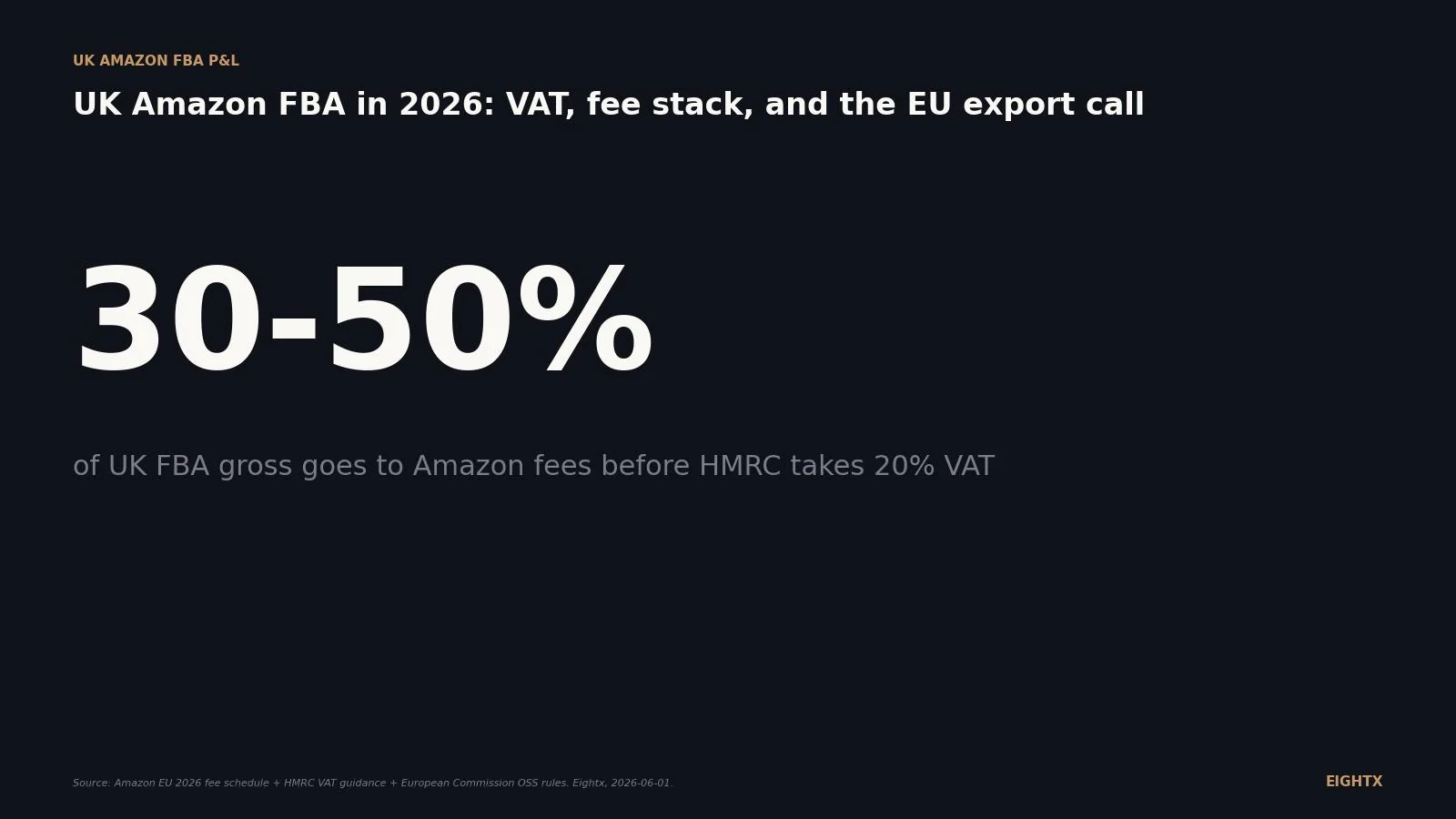
UK Amazon FBA fees absorb 30 to 50 percent of gross selling price, HMRC takes 20 percent VAT once you cross the 90,000 pound threshold (or from your first sale if you hold UK stock without UK establishment), and Pan-EU FBA has been closed to UK sellers since January 2021. A fractional CFO surfaces the VAT branch decision in the first 30 days, worth 4 to 6 net-margin points.
Key Takeaways
- UK Amazon FBA fees take 30-50% of gross selling price (incl. VAT) in 2026 across referral, FBA fulfilment, storage and the new 1.5% fuel and logistics surcharge that landed in April. HMRC then takes 20% VAT on top of that for VAT-registered sellers.
- The UK VAT registration threshold sits at £90,000 rolling 12-month turnover for 2026/27. But for any non-UK-established seller with stock in a UK Amazon fulfilment centre, there is no threshold. Registration is required from the first sale.
- Pan-EU FBA has been off-limits to UK sellers since 1 January 2021. The European Fulfilment Network (EFN) exists but is slower, more expensive per unit, and not Prime-eligible in the same way. Split-stock plus OSS is the structural answer for EU growth.
- From 1 July 2026 the EU's €150 IOSS duty relief is abolished and replaced by a temporary €3-per-parcel customs duty on low-value e-commerce. Direct UK-to-EU consumer parcels lose a fresh slice of margin on every sub-£135 order.
- Target ≥15% true net margin and 30-50% ROI per SKU on UK FBA in 2026 to stay safely profitable. SKUs below ~10-12% net margin are increasingly unviable as the fee stack tightens.
If you sell on Amazon UK at any meaningful scale, you are running a P&L that three separate regulators take a slice of before you ever see contribution. HMRC takes 20% VAT on every sale once you cross the £90,000 rolling threshold, or from your first sale if you are not UK-established. Amazon takes 30% to 50% of gross between referral fees, fulfilment by Amazon (FBA) fees, storage and the new 1.5% fuel and logistics surcharge that landed in April 2026. Brussels takes a third bite when you want EU growth back, because Pan-EU FBA has been off-limits to UK sellers since 1 January 2021 and the European Fulfilment Network (EFN) is materially slower and pricier per unit.
The bookkeeper question is whether the books are right. The fractional chief financial officer (CFO) question is whether the structure is right. This post lays out the four numbers that change the answer for a UK Amazon FBA brand in 2026, the framework we use with clients on the VAT and EU calls, and the contribution margin we defend against the moving 2026 fee schedule.
Why UK Amazon FBA is a three-regulator P&L, not a one-channel business
The composite from three independent UK fee guides puts Amazon's total take on a typical UK FBA sale at 30% to 50% of gross selling price (inclusive of VAT). The actual stack on a £20 average selling price (ASP) product with a 15% category referral, mid-tier FBA fulfilment and 20% VAT looks like this.
The chart compresses to roughly £20 of contribution before opex, payroll and ad spend on every £100 of gross. That is before you stack TACOS (total advertising cost of sales) at the typical bands most categories now run to defend Buy Box visibility. Net of TACOS, contribution on the same £100 lands materially lower in many categories. That is the math a fractional CFO defends every month, and it is why SKUs running below 10% to 12% true net margin are increasingly unviable.
Line item £ per £100 gross Notes Gross sale 100.00 Inclusive of 20% VAT HMRC VAT (1/6 of gross) -16.67 Output VAT Amazon referral fee (15%) -15.00 Top of typical range Amazon FBA fulfilment -17.50 ~£3.50/unit on a £20 item Fuel + logistics surcharge (April 2026) -0.26 1.5% of fulfilment fee Cost of goods sold (~30%) -30.00 Indicative Contribution before opex + ad spend 20.57 ~21% before TACOS, opex, payroll
That is one regulator's take laid against Amazon's. The third (Brussels) hits when you try to chase EU growth back. We get to that in section three.
The VAT decision tree HMRC actually applies
There are three branches and most UK FBA sellers sit in the wrong one for at least one quarter of their growth.
Branch one: UK-established and below £90,000 rolling 12-month turnover. Registration is optional. Voluntary registration became significantly more attractive after August 2024, when Amazon began charging 20% VAT on most seller fees for UK-established businesses. If you are not registered, that 20% is a hard cost with no recovery. For a seller hovering at £80,000 to £90,000 in turnover, that one rule change wiped 4 to 6 percentage points off net margin without a single underlying business decision.
Branch two: UK-established and at or above £90,000 rolling 12-month turnover. Registration is mandatory within 30 days of crossing. The forward-look rule also applies. If you expect to exceed £90,000 in the next 30 days alone (think peak Q4 or a viral product launch), registration is required on that basis. Deregistration kicks in at £88,000 if turnover later falls and stays there.
Branch three: not UK-established but holding stock in a UK Amazon fulfilment centre. Registration is required from your first sale. There is no threshold. The 2021 marketplace rules also make Amazon the deemed supplier for VAT on sales to UK consumers in many cases, but you still need a UK VAT registration to make the zero-rated supply from your business to Amazon correctly. The HMRC Amazon seller letters in 2024 and 2025 were driven off marketplace-supplied data, not random selection. If you are in branch three and unregistered, the detection risk is now real.
Seller type UK stock? UK sales (rolling 12 mo) VAT action UK-established Yes Below £90,000 Optional; consider voluntary for fee VAT recovery UK-established Yes At or above £90,000 Mandatory UK VAT registration within 30 days UK-established Yes Forecast >£90k in next 30 days alone Mandatory registration on the forward-look basis Non-UK-established Yes (FBA) Any, including £1 Mandatory from first sale; Amazon is deemed supplier on B2C Non-UK-established No (overseas direct) Consignments ≤£135 Marketplace accounts for VAT Non-UK-established No (overseas direct) Consignments >£135 Import VAT + duty on entry; seller's normal VAT rules
This is the decision a fractional CFO surfaces in the first 30 days of any UK FBA engagement, because the wrong branch costs 4 to 6 net margin points and the right branch unlocks recovery on every Amazon fee invoice going forward.
The EU export question every UK FBA seller has to answer in 2026
The 1 January 2021 Pan-EU FBA cut is permanent for UK-established sellers. Before Brexit, a UK seller reached roughly 512 million Amazon consumers through a single pooled inventory. After Brexit, the reachable consumer base via UK FBA alone is the 66 million UK market. Everything else requires either EFN (slower, pricier, not Prime-eligible in the same way) or split stock plus EU VAT registrations.
Two rules have materially tightened the EU export math in 2026.
First, the EU One Stop Shop (OSS) cross-border threshold is €10,000 in combined B2C sales across all EU member states per calendar year. Cross that and you must register for OSS and charge the destination-country VAT rate on every order. Those rates range from Luxembourg at 17% to Hungary at 27%, with the EU median around 21%.
Second, from 1 July 2026 the EU's €150 IOSS duty relief is abolished. Until that date, parcels into the EU valued at €150 or less qualified for duty relief if you used IOSS to remit VAT. From that date, a temporary €3 customs duty per parcel applies to low-value e-commerce while the EU completes its broader customs reform. For a £20 ASP product shipping direct from a UK warehouse, that is a fresh 15% margin hit on every sub-£135 EU order you fulfil from UK stock.
The structural CFO call: at what point does the cost of an EU VAT registration plus a parallel EU fulfilment leg (split stock in Germany or the Netherlands plus OSS plus EORI) pay back inside 12 months versus paying the EFN per-unit premium and the new €3 per-parcel duty on every direct UK-to-EU order? That answer depends on your EU sales mix, your ASP, and your category, not on a generic template.
What changed in 2026 that breaks last year's unit economics
Four moving pieces have shifted the UK FBA P&L in the last 12 months. Any one of them changes your contribution by 1 to 3 points. Together they reset it by 4 to 8 points before you touch a single SKU.
The April 2026 fuel and logistics surcharge added 1.5% on top of all UK FBA fulfilment fees. On a £20 ASP item carrying £3.50 of fulfilment, that is roughly £0.05 per unit. Small per-unit, real money at volume.
Low-Price FBA eligibility expanded from £10 to £20 in 2026, with category-specific reductions on referral fees: clothing 12% on £15 to £20 items (down from 15%), home 8% up to £20 (down from 15%), pet, grocery and vitamins 5% up to £10 (down from 15%). For sellers concentrated in those bands the rebalanced fee schedule is a net positive. For sellers above the £20 threshold it is not.
The August 2024 introduction of 20% VAT on Amazon seller fees for UK-established businesses continues to ripple through P&Ls that never fully reset. If you have not adjusted your contribution model to reflect either the recoverable input tax (if VAT-registered) or the unrecoverable cost (if not), your reported net margin is wrong by 4 to 6 points.
HMRC's access to marketplace-supplied seller data, in force from 2024 and tightening again in August 2026, is the enforcement environment underneath all of this. Sellers who used to assume detection risk was low are now in a system where their declared VAT position is reconciled directly to what Amazon reported. The Amazon seller letter waves of 2024 and 2025 confirmed which side the algorithm sits on.
When a UK FBA seller actually needs a fractional CFO
The threshold the UK Amazon-specialist fractional CFO market typically describes is around £500,000 of consistent annual revenue, or roughly £40,000 per month. Below that, an ecommerce-savvy accountant and a strong bookkeeper usually cover the work. The published market range for fractional engagements specialising in Amazon brands runs £2,500 to £7,000 per month.
Above £200,000 of monthly revenue, the structural calls start arriving fast enough that a part-time finance leader is no longer optional. The four moments where it becomes structural rather than nice-to-have:
When EU expansion is on the table. The Pan-EU exit, the OSS threshold, the 1 July 2026 IOSS change and the split-stock economics need someone who can model the full payback, not just file the returns.
When monthly revenue moves past £200,000. Amazon's 14-day payout cycle stacked against 30 to 60-day PO cycles creates working-capital pressure that can deflate profitable businesses through cash starvation alone.
When an HMRC compliance check is on the desk. The Amazon seller letter waves, the marketplace data sharing rules and the August 2024 fee VAT change have produced a steady stream of historical-period corrections. The cost of getting that wrong is real money.
When the fee schedule moves. April 2026 alone introduced a new surcharge, expanded Low-Price FBA and rebalanced category referral fees. The brand that updates its SKU-level contribution model the same week wins on what to keep and what to cut.
That is what bookkeepers cannot do. It is not a slight on bookkeepers, it is a different job.
The $35,000 median FBA seller revenue figure is from a global Jungle Scout third-party-seller survey, not a UK-specific dataset, and the math on a UK-only Amazon business at that level rarely supports a fractional engagement. The point at which the math reverses is the same point most providers describe as their entry threshold: roughly £500,000 of consistent annual revenue, with the structural moments above doing most of the actual work.
The 90-day plan if you're a UK FBA brand reading this
Three numbered moves, in order.
First, confirm your VAT branch against the rules above and recover the August 2024 fee VAT if you missed the registration window. If you are UK-established and hovering near £90,000 in rolling turnover, model whether voluntary registration pays back through the recoverable input tax on Amazon fees and on landed-cost VAT.
Second, model the German or Dutch split-stock plus OSS scenario against your current UK-only contribution. The €3 per-parcel customs duty from 1 July 2026 changes the answer for any seller doing meaningful direct UK-to-EU consumer volume. Run the math against your top 20% of SKUs, not the average.
Third, lock the SKU-level contribution dashboard against the April 2026 fee schedule before peak Q4. Update the FBA fulfilment band per SKU, the 1.5% surcharge, the category-specific referral if you are below £20 ASP, and the recoverable VAT on fees. Anything still using a 2024 or 2025 fee schedule is overstating contribution.
For more on the fee mechanics specifically, see our Amazon FBA profit analysis walkthrough and the Amazon FBA tax planning primer. The structural piece on fractional CFO services overall sits at our fractional CFO services overview.
Sources and methodology
The fee-stack numbers come from the Amazon EU 2026 announcement and the UK 2026 fee schedule, cross-checked against the composite ranges published by independent UK Amazon-accounting specialists (Elver E-Commerce Accountants and Social Commerce Accountants 2026 fee guides). The 30% to 50% gross-take band is a composite of three independent UK fee guides and varies materially by category, size tier and ad spend; the worked example assumes a 15% category referral (top of the typical band for most categories), a mid-tier standard-size FBA unit and a VAT-registered UK seller. Those assumptions sit explicitly alongside the table.
UK VAT registration thresholds are pulled from gov.uk (HMRC), with the £90,000 threshold confirmed at the April 2026 Spring Statement and held for a third consecutive year. The deemed-supplier rules for UK marketplace VAT on non-established sellers are from HMRC guidance dated post-31-December-2020. The August 2024 introduction of 20% VAT on Amazon seller fees for UK-established businesses is sourced from Amazon Seller Central UK and reconciled against the same 2024 to 2025 effective-date documentation.
EU rules are from the European Commission's e-commerce VAT page: the €10,000 OSS threshold (combined cross-border B2C, per calendar year), the IOSS €150 consignment relief, and the 1 July 2026 abolition of that relief replaced by the temporary €3 per-parcel customs duty. The €3 figure is described in source documentation as a transition mechanism pending the EU's broader customs reform package, so we flag it as a moving target rather than a permanent rate. EU27 standard VAT rates are the January 2026 edition.
The Pan-EU FBA position for UK-established sellers is from Amazon Seller Central UK guidance on Pan-European FBA product eligibility, plus the SimplyVAT and Sitruna composite on the active-VAT-registration requirement (currently a minimum of five EU member states for Pan-EU eligibility in 2026). The pre-Brexit reachable-consumer figure of roughly 512 million combines EU27 population data with the 66 million UK population baseline.
The $35,000 median and $160,000 mean Amazon seller revenue figures are global third-party-seller surveys (Jungle Scout and composites), reported in USD and not UK-specific. They are framed as such throughout and not converted to GBP, because the underlying survey is a global sample with no UK cross-tab. The roughly 330,000 active UK Amazon sellers figure is the only confirmed UK-specific count we cite.
The fractional CFO engagement bands of £2,500 to £7,000 per month and the £500,000 consistent-revenue entry threshold are sourced from published UK-market Amazon-specialist provider pricing (Elver E-Commerce Accountants, SellerCFO). Eightx itself does not publish per-month pricing on this page because the right answer depends on revenue, SKU complexity, EU mix and the structural questions on the table.
Frequently asked questions
do i need to register for vat if i'm under the £90k threshold but my stock sits in an amazon uk warehouse?
It depends on where your business is established. If you are UK-established and your rolling 12-month turnover is below £90,000, you do not have to register, though you can voluntarily. If you are not UK-established (you are based outside the UK but your stock sits in Amazon UK fulfilment), HMRC requires you to register for UK VAT from your first sale. There is no threshold for non-established sellers with UK stock.
amazon already pays vat as the deemed supplier on my fba sales so why do i still need to register for vat?
Two separate obligations. Amazon is the deemed supplier for VAT on the sale to the end customer in the cases the rules cover, but the underlying supply from you to Amazon is zero-rated and you still need to be VAT-registered to make that supply correctly. You also need a registration to recover the 20% VAT Amazon now charges on your seller fees, and to handle any sales outside the deemed-supplier perimeter.
what changed with the 20% vat on amazon seller fees in august 2024 and how do i recover it?
From August 2024 Amazon started charging 20% UK VAT on most seller fees for UK-established businesses. If you are VAT-registered, that 20% goes through your VAT return as input tax and you recover it. If you are not registered, it is a hard cost. For sellers in the £80,000 to £90,000 band who never registered, fees effectively jumped 20% overnight with no recovery, which wipes 4-6 points of net margin at that revenue band.
can i still use pan-eu fba as a uk seller in 2026 or is it permanently gone?
Permanently gone for UK-established sellers in its old form. The UK has been out of Pan-EU FBA since 1 January 2021. To replicate it, you need active VAT registrations in at least five EU member states plus UK VAT, plus OSS, plus an EORI number. The European Fulfilment Network (EFN) lets you fulfil UK-to-EU and EU-to-UK from a single inventory pool, but it is slower, more expensive per unit, and not the same Prime experience.
is it worth setting up a german vat registration and shipping inventory to amazon de?
If your EU sales already make up a meaningful share of revenue (rule of thumb: 15-20%+) and you are forecasting growth there, yes. The math compares the cost of EU VAT registration, ongoing compliance and an EU inventory leg against the EFN per-unit premium plus the new €3-per-parcel customs duty from 1 July 2026 on direct UK-to-EU consumer orders. Germany or the Netherlands are the usual entry points. A fractional CFO models this against your actual SKU economics, not a generic template.
what does the 1 july 2026 ioss €150 duty relief abolition mean for my eu orders?
Before 1 July 2026, consumer parcels into the EU valued at €150 or less qualified for duty relief if you used IOSS to remit VAT. From 1 July 2026 that relief ends. A temporary €3 customs duty per parcel applies to low-value e-commerce while the EU finalises its broader customs reform. For a £20 ASP product shipping direct from a UK warehouse, that is a fresh 15% hit on per-order margin you did not have to model last year.
how does hmrc actually find unregistered amazon sellers since marketplaces report data?
HMRC receives direct seller turnover data from Amazon and other marketplaces under digital-platform reporting rules in force from 2024. The wave of HMRC 'Amazon seller letters' that hit UK sellers across 2024 and 2025 was driven off marketplace-supplied turnover figures, not random sampling. If your declared VAT position does not reconcile to what Amazon reported to HMRC, you are on the list. Detection risk goes up materially again from August 2026.
at what monthly revenue does it actually pay to hire a fractional cfo for a uk amazon business?
The published UK market range for fractional CFO engagements specialising in Amazon brands runs £2,500 to £7,000 per month. The threshold most providers describe as the entry point is around £500,000 of consistent annual revenue (roughly £40,000+ per month). Below that, an ecommerce-savvy accountant and a strong bookkeeper usually cover the work. Above £200,000 monthly revenue, or anytime EU expansion is on the table, the fractional CFO call becomes structural rather than nice-to-have.
how does a fractional cfo for amazon fba differ from a regular ecommerce accountant?
An ecommerce accountant reports the past: monthly books, VAT returns, year-end accounts. A fractional CFO defends the future: SKU-level contribution against the moving Amazon fee schedule, the VAT election decisions, the EU expansion model, the working-capital math behind a 30-day PO cycle stacked on Amazon's 14-day payout, and the scenario plans for tariffs, fee changes and EU customs reform. Both matter. They cover different jobs and you usually need both.