
Financial Strategy
Fractional CFO for UK Shopify brands 2026: what £3k-£7k/month buys when Klarna is 22.7% of your checkout
There are 251,169 active UK Shopify stores and 6,233 on Plus (Storeleads, June 2026), with Klarna on 22.7 percent of them, the highest of any major Shopify market. Fractional CFO retainers cluster at 3,000 to 7,000 pounds per month for 1M to 10M pound DTC brands, about one-fifth the all-in cost of a full-time hire.
Key Takeaways
- Fractional CFO retainers for UK Shopify brands cluster at £3,000-£7,000 per month (ex VAT) for £1-10M DTC. Pre-£1M sits at £1,500-£3,000. Shopify Plus multi-country and PE-backed runs £7,000-£12,000+.
- There are 251,169 active UK Shopify storefronts and 6,233 on Shopify Plus (Storeleads, 2026-06-01). UK Plus penetration is 2.48% vs roughly 2.10% globally, an 18% over-index that reflects London's 8 and 9-figure DTC concentration.
- Klarna runs on 22.7% of UK Shopify stores (56,908 stores), the highest Klarna saturation of any major Shopify market. Shop Pay 64.1%, PayPal Express 53.1%, Apple Pay 66.8%. Klarna reconciliation is a default workstream in the UK, not an edge case.
- Bank of England Bank Rate is 3.75% (30 April 2026 hold), down from the 5.25% peak but still elevated. UK 10-year gilt 4.82%. Working-capital cost is the modelling job, not statutory accounts.
- A full-time UK ecommerce CFO costs ~£200,000-£290,000 all-in plus £60,000-£90,000 retained search. At £6,000/month fractional (£72,000/year), the break-even to full-time rarely triggers before roughly £30M revenue.
If you run a UK Shopify brand between £1M and £30M in revenue, the finance wall lands in a specific UK shape. Value Added Tax (VAT) crossed the £90,000 threshold a long time ago. Gross margin is moving the wrong way under a Bank of England Bank Rate of 3.75% plus 25% corporation tax above £250,000 profit. Klarna lands inside Shopify Payments deposits and your bookkeeper has it filed as a Klarna payout that never arrives. Amazon UK keeps eating into category share and nobody on the inside has the contribution view that tells you what to actually do about it.
A fractional CFO for UK Shopify brands runs £3,000-£7,000/month (ex VAT) for £1-10M DTC, with pre-£1M at £1,500-£3,000, Shopify Plus £10-30M multi-country at £5,000-£10,000, and £30M+ or PE-backed at £7,000-£12,000+. The job is not to file VAT returns. The job is to own multi-channel unit economics, cash and forecasting, design the workflow around Klarna and Clearpay so the bookkeeper has a chance, and stress-test the next 18 months against a Bank Rate that is still elevated and a UK 10-year gilt at 4.82%. This page is the canonical UK Shopify answer: pricing, scope, the five UK-specific Shopify finance traps a generic CFO will miss, and the threshold where fractional stops working.
What a fractional CFO actually does for a UK Shopify brand (and what your accountant does not)
A fractional CFO is a senior finance leader who serves your brand on a monthly retainer instead of as a full-time employee. The two roles people most often confuse are CFO and accountant, and in UK practice the line is sharper than founders realise.
Your accountant or bookkeeper records what happened. They file VAT returns, run MTD (Making Tax Digital) for VAT updates, lodge the CT600 corporation tax return, sign off statutory accounts, and handle PAYE. That work is compliance: backward-looking, deadline-driven, regulatory.
A fractional CFO designs what should happen next. For a UK Shopify brand at £1-10M revenue, the core scope is six things: a rolling 13-week cash forecast that nets VAT in and out, a monthly board pack with KPI commentary by channel, gross-margin and contribution diagnostics by Stock Keeping Unit (SKU) and channel, an ad-spend stress test against the budget, fundraising or lender support, and senior-partner attendance at one weekly leadership meeting. The retainer should also cover Klarna and Clearpay clearing-account hygiene, OSS/IOSS architecture for EU sales, and a quarterly view on the 25% corporation tax marginal-relief band.
Confusing the two is the single most common reason UK Shopify founders feel their CFO retainer isn't pulling its weight. If the deliverable list reads like a year-end checklist, you've hired an accountant on a CFO retainer. If it reads like "13-week cash, gross-margin by channel, Klarna reconciliation system, board pack, fundraising prep" you've hired a CFO.
What you should pay: UK fractional CFO retainer ranges by Shopify brand stage, 2026 (GBP, ex VAT)
Published UK retainers across ScaleWithCFO, FD Capital, Consult EFC, Fractional C-Suite UK and the Eightx London DTC engagement bands cluster like this.
The modal band for an embedded growth-stage £1-10M UK Shopify brand is £3,000-£7,000 per month ex VAT. London runs roughly 15-25% above regional UK for equivalent seniority. The detail by stage:
Revenue stage Cadence Typical scope Modal retainer GBP/month (ex VAT) Pre-£1M Shopify Monthly Cash, 13-week forecast, COA cleanup £1,500-£3,000 £1-3M Shopify Bi-weekly Above plus gross margin and channel P&L (Shopify vs Amazon UK), VAT-MTD workflow £3,000-£5,000 £3-10M Shopify Weekly Above plus board reporting, working-capital model, Klarna and Clearpay clearing-account audit £3,500-£7,000 £10-30M Shopify Plus Weekly plus Slack Above plus OSS/IOSS architecture, multi-currency FX policy, scenario planning £5,000-£10,000 £30M+ Shopify Plus Embedded Above plus M&A readiness, treasury, transitional support for full-time CFO hire £7,000-£12,000
Cross-check the pricing against the sibling virtual CFO services UK page, the Eightx London fractional CFO money page, and the global fractional CFO services for ecommerce guide if you want the wider context. In UK practice "virtual CFO," "fractional CFO" and "outsourced FD" describe the same role. Pick the provider, not the label.
The five UK-specific Shopify finance traps a generic CFO will miss
This is the section that separates a UK-experienced fractional CFO from a US-only one. Each of these five traps creates a real P&L distortion that a generic ecommerce CFO will not catch by default.
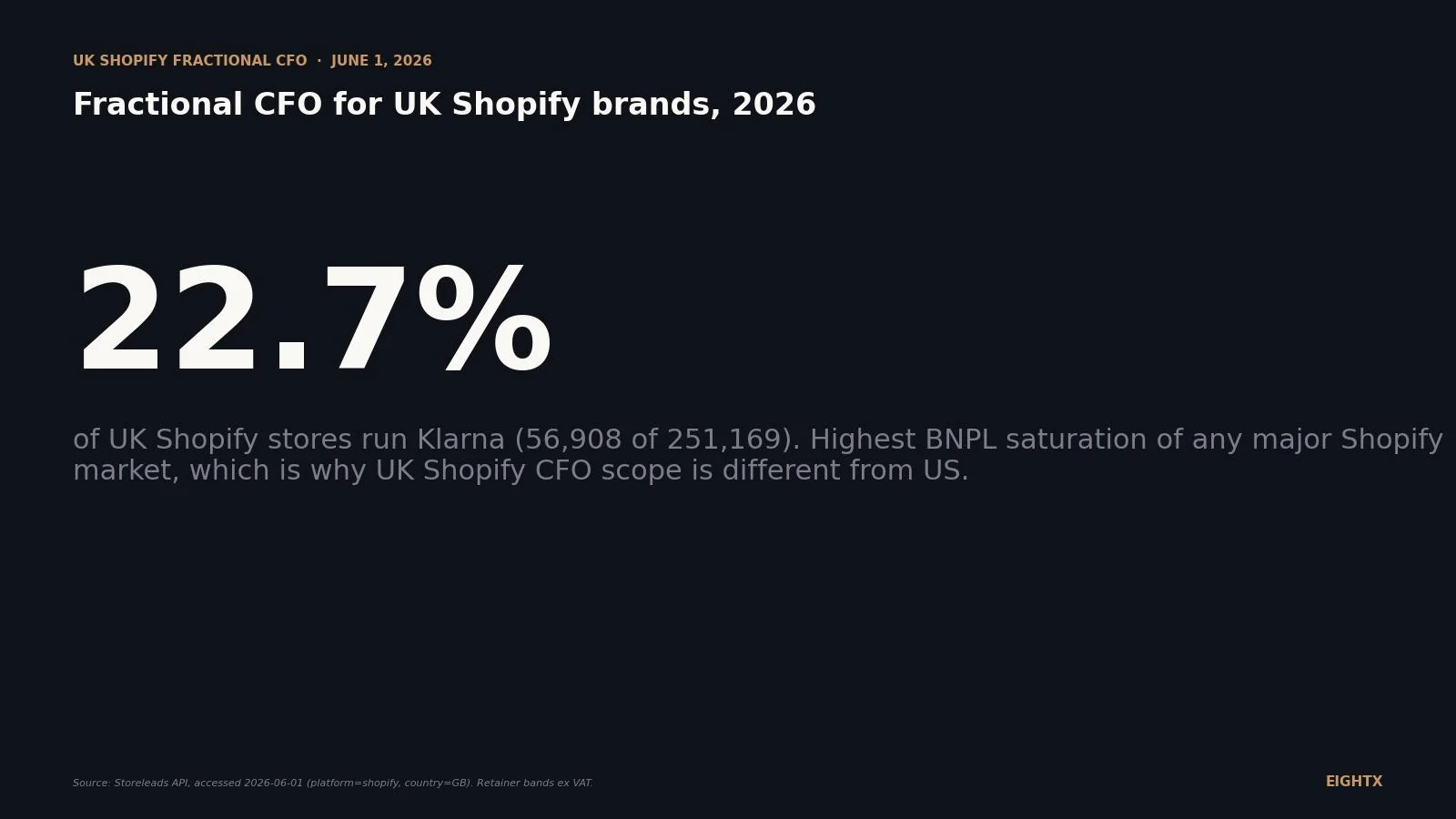
Why the chart sits in this section: Klarna runs on 56,908 UK Shopify stores (22.7% of the 251,169 active GB population per Storeleads on 2026-06-01). That is the highest Klarna saturation of any major Shopify market globally. It is also the single most common BNPL reconciliation issue we see in UK Shopify accounts. The other four traps are below.
Trap 1: Shopify Payments GBP payouts absorbing Klarna. Klarna purchased through Shopify Payments lands in your next Shopify Payments deposit, not in a separate Klarna deposit. If your bookkeeper treats Klarna as a second gateway they will book the Klarna sale, wait for a deposit that never lands, and eventually write the difference to "bank charges." Sales get overstated, processing-fee bucket gets understated, and the BNPL P&L is unknowable.
Trap 2: Klarna and Clearpay clearing-account VAT timing. BNPL providers take their fees off the top before they pay you out. Without a clearing account in the chart of accounts the gross sale and the bank deposit will never reconcile, refunds create VAT timing differences against the quarterly return, and HMRC queries land. Link My Books and Social Commerce Accountants both publish reconciliation workflows; the CFO's job is to pick one, install it, and audit it monthly.
Trap 3: Amazon UK marketplace deemed-supplier rules on consignments under £135. For imported goods under £135 sold via online marketplaces, Amazon is the deemed VAT supplier. UK brands must NOT charge VAT on those orders. Get it wrong and you have double-collected VAT, refund liability to customers, and a mis-stated Amazon UK channel margin that overstates the channel's contribution.
Trap 4: EU OSS and IOSS post-Brexit plus the UK intermediary requirement. UK brands selling B2C into the EU often need an EU-based intermediary to use IOSS for under-150-euro consignments. OSS does not cover UK-to-EU flows post-Brexit. Under or over-collected EU VAT mis-prices cross-border AOV and breaks the contribution view on EU revenue.
Trap 5: Northern Ireland Protocol XI-VAT and XI-EORI dual reporting. Northern Ireland is still inside the EU VAT area for goods. Brands moving stock GB to NI may need an XI-VAT registration and an XI-EORI number, plus dual EC Sales List and Intrastat reporting. Most UK Shopify brands won't have NI flows, but the ones that do underestimate the customs and reporting load by an order of magnitude.
The five together explain why a UK-experienced fractional CFO will design more of the workflow than a US-only CFO. The accountant lodges the returns. The CFO architects the system so the returns are right.
TAM context: 251,169 UK Shopify stores, 6,233 on Plus
Storeleads on 2026-06-01 returned 251,169 active Shopify storefronts in GB and 6,233 on Shopify Plus. UK Plus penetration is 2.48% vs roughly 2.10% globally, an 18% over-index that reflects London's concentration of 8 and 9-figure DTC apparel and beauty brands. ONS J4MC put internet sales at 27.3% of total UK retail in April 2026, one of the highest online shares in the world.
The four biggest UK Shopify verticals are Apparel (57,941 stores, 23.1%), Home and Garden (31,163, 12.4%), Beauty and Fitness (24,535, 9.8%) and Food and Drink (16,714, 6.7%). Apparel dominance is the reason BNPL plus multi-currency EU plus returns is the modal UK Shopify CFO scoping conversation. For the full TAM breakdown see the UK Shopify landscape 2026 pillar.
When fractional stops working: the £30M revenue threshold to a full-time UK CFO
The fractional vs full-time math in the UK looks like this in 2026.
A fractional CFO at £6,000/month is £72,000/year fully variable. Cancel any month with 30 days notice. A full-time UK ecommerce CFO at the mid-market band has a base salary of £160,000-£200,000. Stack on 18-22% employer on-costs (employer NI at 13.8%, pension auto-enrolment minimum, holiday accrual at 12.07% of base, apprenticeship levy if your payroll is over £3M) and a Short-Term Incentive (STI) bonus at target of 20-30% of base. Add a 30-33.3% retained executive search fee on first-year total cash compensation. Year-one all-in lands at £200,000-£290,000 plus £60,000-£90,000 search.
That's a 3-4x year-one cost vs fractional, on the same scope until you genuinely need a 5-day-per-week senior. Year-two recurring drops back to the £200,000-£290,000 all-in band once the search fee rolls off, still roughly 3-4x fractional.
The break-even threshold is not a fixed revenue number but most UK Shopify brands hit it around £30M revenue or when one of these triggers fires: a Series A or B raise that needs a full-time data room owner, a multi-entity UK plus US plus EU footprint, a PE buyer who insists on a CFO in seat for diligence, or M&A activity. Below those signals, fractional wins on cost and on scope flexibility.
How to engage an Eightx fractional CFO for your UK Shopify brand
If your UK Shopify brand is between £1M and £30M in revenue and you're looking at one of the three trigger signals (VAT-threshold cash tightness, an unexplained 200 basis point gross-margin move, or a fundraise in the next 6-12 months), book a 30-minute call. We'll walk through your Klarna reconciliation, your contribution view by channel and your cash position before we talk about scope.
For the wider services context see virtual CFO services UK, the London fractional CFO location page, and the global fractional CFO services for ecommerce guide. To book, head to /book.
The UK Shopify finance wall is not VAT compliance, it's Klarna absorbing 22.7% of checkout, Amazon UK eating channel margin under deemed-supplier rules, OSS/IOSS architecture post-Brexit, and a Bank Rate that's still elevated. The accountant files. The CFO designs the system the accountant files inside.
Sources and methodology
Storeleads UK Shopify pull, 2026-06-01. We filtered platform=shopify&country=GB and got 251,169 active storefronts. Filtering further on plan="Shopify Plus" returned 6,233. Filtering on app_name="shopify.klarna" returned 56,908. Vertical counts (Apparel 57,941; Home and Garden 31,163; Beauty and Fitness 24,535; Food and Drink 16,714) came from the same pull, cross-referenced into the uk-shopify-landscape-2026 pillar bundle. Storeleads composes filters as AND across detect-classes that don't always co-occur in the index, so Plus-by-category subcuts return zero and we report the unconditional Plus and unconditional category counts separately.
UK fractional CFO retainer triangulation. Bands were cross-referenced across ScaleWithCFO's 2026 UK guide (scalewithcfo.com/post/fractional-cfo-uk-guide-2026), FD Capital's virtual CFO page (fdcapital.co.uk/virtual-cfo/), Consult EFC's UK SaaS pricing breakdown (consultefc.com/saas-fractional-cfo-cost-uk/), Fractional C-Suite UK rates (fractional-csuite.com/cfo/uk/), DNA Growth's 2026 practical guide (dnagrowth.com/fractional-cfo-costs-in-2026-a-practical-guide-for-founders-cfos-dealmakers/), and the Eightx London DTC engagement bands at eightx.co/locations/london-fractional-cfo/. All published bands are ex VAT and reflect UK market posting as of June 2026.
UK full-time CFO cost math. Year-one all-in cost (£200,000-£290,000) reflects a £160,000-£200,000 base, 18-22% employer on-costs (employer NI at 13.8%, pension auto-enrolment, 12.07% holiday accrual, apprenticeship levy where payroll exceeds £3M), and an STI bonus at target of 20-30% of base. Retained executive search at 30-33.3% of first-year total cash compensation per TGS Executive Search and Cowen Partners published fee schedules. Cross-checked against the sibling virtual-cfo-services-uk research bundle.
UK macro and regulatory anchors. Bank of England Bank Rate of 3.75% per the 30 April 2026 decision (bankofengland.co.uk/monetary-policy/the-interest-rate-bank-rate). UK 10-year gilt yield at 4.82% in April 2026 via FRED series IRLTLT01GBM156N. ONS J4MC internet sales share at 27.3% in April 2026 (ons.gov.uk/businessindustryandtrade/retailindustry/timeseries/j4mc/drsi). VAT registration threshold of £90,000 from 1 April 2024 per HMRC. Corporation Tax bands of 19% small profits, 25% main rate, marginal relief between £50,000 and £250,000 profit per gov.uk. MTD for Income Tax phasing from April 2026 for qualifying income over £50,000.
UK Shopify finance traps. Synthesised from Shopify Brexit guidance (shopify.com/ie/blog/brexit-impact-ecommerce), ACCA AB Magazine on post-Brexit VAT and customs (abmagazine.accaglobal.com), Social Commerce Accountants on Klarna reconciliation (socialcommerceaccountants.com/blog/reconcile-klarna-settlements), and Link My Books' Shopify-Klarna workflow (help.linkmybooks.com/en/articles/6826612-how-to-reconcile-shopify-sales-paid-via-klarna). Accessed 2026-06-01.
Update cadence. This page is refreshed quarterly when published UK retainer bands move, when Storeleads UK counts shift meaningfully, and when the Bank of England updates Bank Rate. Next refresh target: September 2026, after the August 2026 Monetary Policy Committee decision.
Frequently asked questions
what does a fractional cfo for a uk shopify brand actually cost per month in 2026?
For a £1-10M UK Shopify or DTC brand the modal monthly retainer in 2026 is £3,000-£7,000 ex VAT. Pre-£1M sits at £1,500-£3,000. Shopify Plus multi-country or PE-backed runs £7,000-£12,000 or higher. London rates sit roughly 15-25% above regional UK for equivalent seniority. Bands are published by ScaleWithCFO, FD Capital, Consult EFC and Fractional C-Suite UK and match the Eightx London engagement bands.
is a fractional cfo different from my uk accountant or is it the same thing rebadged?
They are different roles. Your accountant files VAT returns, MTD updates and the CT600, and signs off year-end statutory accounts. The fractional CFO designs the system around those filings: when to register, how VAT timing hits weekly cash, contribution margin by channel, Klarna and Clearpay clearing accounts, the 13-week forecast, board pack and fundraising or lender support. Filings sit with the accountant. Strategic finance sits with the CFO. If a provider does both they are usually under-investing in one of them.
when does a uk shopify brand actually need a fractional cfo and not just a better bookkeeper?
Three operator signals trigger it. You've crossed the £90,000 VAT threshold and cash feels tighter than top-line suggests. Your gross margin moved 200 basis points the wrong way and you can't isolate which of mix, Klarna fees, freight or 3PL pick-pack is doing it. Or you're raising or refinancing in the next 6 to 12 months. Most UK Shopify brands cross at least one of these between £1M and £3M revenue.
how does a uk fractional cfo handle klarna and clearpay on shopify payments without breaking vat?
By forcing a BNPL clearing account into the chart of accounts. Klarna and Clearpay take their fees off the top before they pay you out, and on Shopify Payments the Klarna money lands inside the next Shopify Payments deposit, not as a separate Klarna payout. Without a clearing account the gross sale and the bank deposit never reconcile, fees get buried in "bank charges", and refunds create VAT timing differences. The CFO's job is to design the workflow, get the bookkeeper or Link My Books to run it, and check it monthly.
do uk shopify brands need a fractional cfo who understands eu oss and ioss post-brexit?
If you ship B2C into the EU, yes. UK brands selling into EU consumers can no longer use UK OSS for EU flows post-Brexit. To use IOSS for under-150-euro consignments most UK brands need an EU-based intermediary. Get this wrong and you either over-collect EU VAT (refund liability) or under-collect (HMRC and EU tax authority risk). A UK-experienced fractional CFO will own the OSS, IOSS and EORI architecture even though the accountant lodges the returns.
what's the break-even point where a uk shopify brand should hire a full-time cfo instead of fractional?
Roughly £30M revenue or genuine multi-entity, multi-country complexity. A fractional CFO at £6,000/month is £72,000/year fully variable. A full-time UK ecommerce CFO at a £180,000 base lands at £200,000-£290,000 year-one all-in once 18-22% employer on-costs (NI, pension, holiday accrual, apprenticeship levy above £3M payroll) and STI at target are stacked on, plus a £60,000-£90,000 retained executive-search fee in year one only. Year-two recurring drops back to the £200,000-£290,000 all-in band once the search fee rolls off. The fractional math wins until the scope genuinely needs a 5-day-per-week senior.
how does a fractional cfo for shopify uk think about amazon uk channel margin vs direct shopify?
As two different P&Ls under one brand. Amazon UK takes referral fees, FBA storage and pick-pack and ad spend off the top, and on consignments under £135 Amazon is the deemed VAT supplier so you must NOT charge VAT on those orders. Shopify gives you the customer, the margin and the data but you carry the ad spend and 3PL. A UK fractional CFO will run a contribution view by channel (revenue, ad spend, fees, fulfilment, refunds) every month and price decisions about Amazon expansion or pullback against it. Most UK brands we see are overweight Amazon on contribution and don't know it.
how do uk fractional cfos charge, monthly retainer, day rate or hourly, and what's normal in 2026?
Monthly retainer is the modal pricing for ongoing UK Shopify engagements in 2026, £3,000-£7,000/month ex VAT at the £1-10M band. Day rate is used for project work (£800-£1,800/day senior). Hourly is rarer for retained CFO work but shows up at £150-£500/hour for niche advisory. If a provider only quotes hourly for an ongoing engagement that's usually a signal they don't have a defined scope. A UK retainer typically rolls month to month with 30 days notice.