
Financial Strategy
Ecommerce CFO UK: what a DTC fractional CFO actually owns in 2026
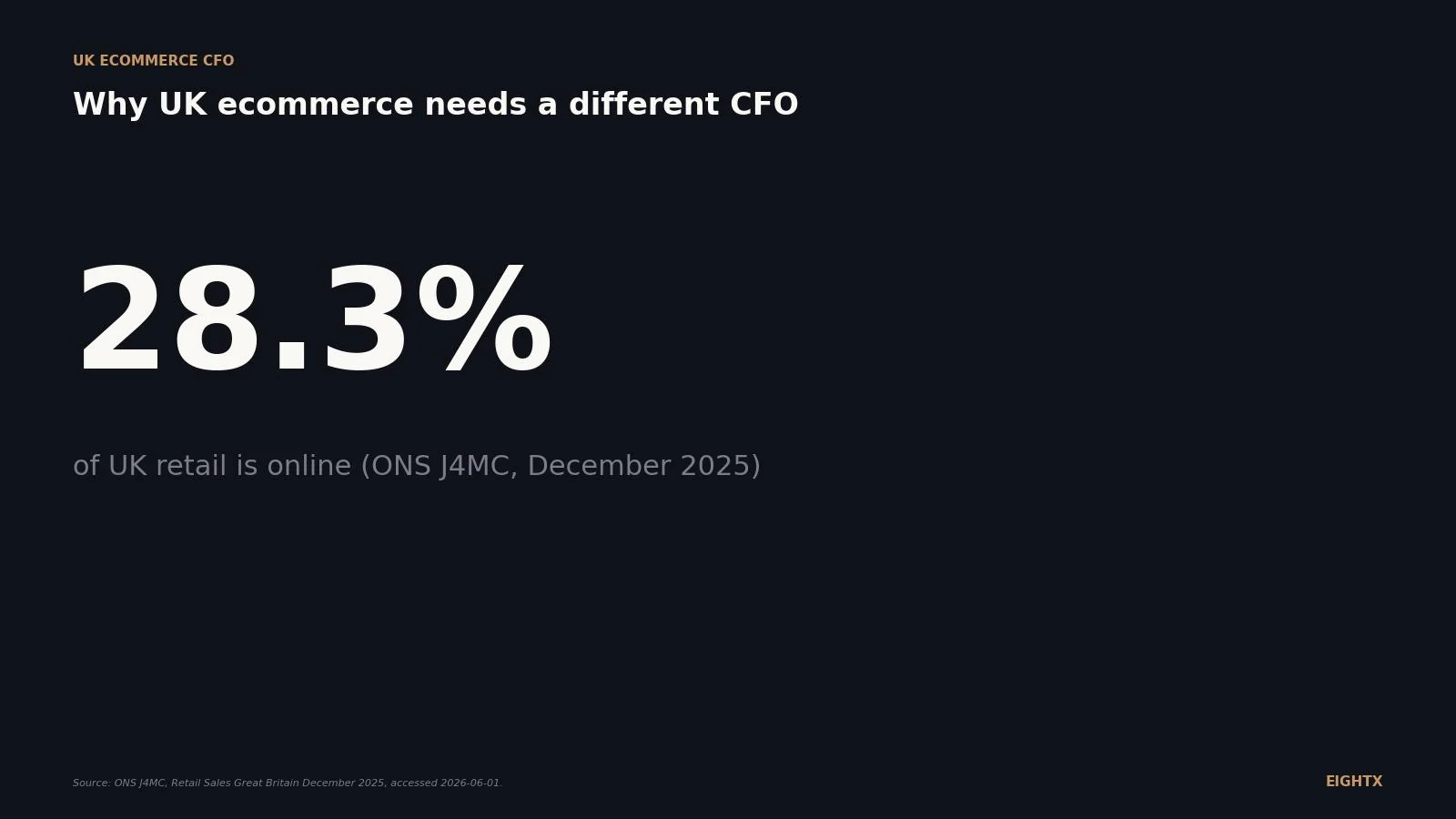
28.3% of UK retail is online (ONS J4MC, December 2025), one of the highest shares in the world, but UK ecommerce growth in 2026 comes from margin and working capital, not channel-shift tailwinds. A UK ecommerce CFO owns eight items a US or AU CFO will miss, including VAT cash timing, MTD workflow, post-Brexit IOSS, and multi-currency Shopify reconciliation. Brands selling into the EU without an IOSS strategy lose 300 to 600 basis points of contribution margin per EU order.
Key Takeaways
- 28.3% of UK retail is online (ONS J4MC, December 2025), around 6 percentage points above the 21.8% global benchmark and structurally above the United States and Australia. Your TAM as a UK DTC operator is durable, but it's also mature. Growth has to come from margin and working capital, not channel-shift tailwinds.
- A UK ecommerce CFO owns eight items a US or AU CFO will miss: VAT cash timing, Making Tax Digital (MTD) records workflow, post-Brexit EORI and IOSS, the merged R&D scheme, Plastic Packaging Tax, multi-currency Shopify (GBP/EUR/USD), PAYE and NIC cadence, and Companies House identity verification.
- The single biggest margin leak we see in UK DTC brands selling into the EU is bad IOSS or OSS strategy. Brands defaulting to DDP shipping with no Import One Stop Shop registration can lose, in our engagement-base observation, 300 to 600 basis points of contribution margin per EU order without realising it.
- The CFO doesn't file VAT, MTD updates or the CT600. Those sit with your accountant or bookkeeper. The CFO designs the system around them: when to register, how VAT timing hits cash, how MTD for Income Tax from April 2026 changes the records workflow, and how the 19% vs 25% corporation-tax bands affect your effective rate as you scale.
- The right hire moment is operator-signal driven, not revenue-threshold driven. Three signals dominate: VAT-threshold cash dynamics, an unexplained 200 basis point gross-margin drop, or a fundraise or refinance inside 12 months. Most UK Shopify brands cross at least one between £1M and £3M revenue.
If you run a UK ecommerce or direct-to-consumer (DTC) brand between £1M and £30M in revenue, the same finance problem keeps landing on your desk. VAT cash-cycle stress used to begin at the £90,000 registration threshold. The same dynamic re-emerges every time you change inventory cadence or open a new channel. Gross margin moves the wrong way under a Bank of England Bank Rate that has eased to 3.75% while the UK 10-year gilt yield has risen to 4.82% (Bank of England, May 2026 Monetary Policy Summary; UK Debt Management Office, gilt market closing data). Your EU orders are getting stuck at the border because nobody set up IOSS. And the bookkeeper can record what happened, but can't model what happens next.
A UK ecommerce CFO is the senior finance leader who owns the strategic and design layer that sits above the bookkeeping, VAT filing and year-end accounts. For a DTC brand, the role is materially different from a generalist UK virtual CFO and materially different from a US or Australian ecommerce CFO. UK ecommerce sits at the intersection of post-Brexit customs, HMRC digital-records reform, multi-currency Shopify accounting and a domestic market that's already one of the most penetrated online retail markets on the planet. This page is the canonical answer to what a UK ecommerce CFO actually owns, what differentiates the role, and when to hire one.
How big the UK ecommerce market actually is in 2026
The UK has been one of the three most online-penetrated retail markets in the world for the last four years. ONS series J4MC, which tracks internet sales as a percentage of total retail sales (seasonally adjusted), printed 28.3% in December 2025, up from 28.0% in November.
The chart shows the COVID spike to 35% in early 2021, the gradual unwind through 2022 and 2023, and the plateau at 26-28% from 2024 onward. The shape that matters is the plateau, not the spike. UK ecommerce is no longer a high-growth channel-shift story. It's a mature, durable market that grows roughly with total retail, with periodic share gains when fuel prices or weather push consumers online.
Period Metric Value Source December 2025 Internet sales as % of UK retail (J4MC, SA) 28.3% ONS November 2025 Same series, prior month 28.0% ONS 2025 UK ecommerce market (B2C, all categories, triangulated) ~£170-185bn ONS total retail x J4MC share 2026 forecast UK ecommerce and online-auction industry revenue (SIC G47.910) £64.9bn IBISWorld 2026 Active UK ecommerce businesses (SIC G47.910) ~39,870 IBISWorld 2026 forecast Global ecommerce share of retail 21.8% SellersCommerce
Two numbers anchor the comparison. UK online share at 28.3% sits around 6 percentage points above the 21.8% global benchmark, and visibly above the United States (around 16% per US Census MRTS Q4 2025 e-commerce share of total retail) and Australia (around 18% per ABS online-share estimates). The UK is structurally a more online-heavy economy, but the headroom for further share gain is genuinely narrow.
For a UK DTC operator, the strategic implication is direct. You don't get to ride a 5 percentage-point penetration tailwind anymore. Growth has to come from the operating model: margin, working capital efficiency, cross-border efficiency, and ad-spend yield. That's the job a CFO does. The accountant can't get you there.
What a UK ecommerce CFO actually owns (the DTC-specific scope)
A virtual or fractional CFO embedded in a UK DTC brand covers six core items on a typical monthly retainer: a rolling 13-week cash forecast, a monthly board pack with KPI commentary, gross-margin and contribution diagnostics by SKU or channel, an ad-spend stress test against the budget, fundraising or lender support, and senior partner attendance at one weekly leadership meeting.
That scope is shared with any good fractional CFO. What makes the UK ecommerce role different is the UK-specific layer the CFO has to design and stress-test on top of the standard scope. None of these items apply in a US or Australian engagement at the same depth.
HMRC Making Tax Digital (MTD). Mandatory for all VAT-registered businesses since April 2022, with digital records and Application Programming Interface (API) submission from source systems. The CFO designs the records workflow, sets the bridging-software decision (Xero, QuickBooks Online, Sage plus a bridge or full-quarterly-update tool), and stress-tests how the April 2026 MTD for Income Tax rollout changes founder and sole-trader cash workflow.
VAT registration threshold and multi-rate handling. Standard rate 20%, with zero-rated categories (children's clothing, books, food) that complicate fashion and CPG DTC. The CFO models when to register, how to time inventory purchases against the quarterly remittance cycle, and how VAT recovery flows through gross margin.
Companies House and the Economic Crime and Corporate Transparency Act (ECCTA) 2023. Annual accounts plus confirmation statement, plus the staged director identity verification rolling through 2024 to 2026. Not a daily CFO task but a system the CFO is responsible for designing.
R&D tax credit reform (post-2024 merged scheme). A material item for tech-heavy DTC: custom Shopify development, AI for personalisation, dynamic pricing, fulfilment automation, internal data infrastructure. Many UK DTC brands lost the SME premium in the 2024 reform and need restructured claims. The CFO scopes eligibility and cash impact; a specialist R&D consultant files.
EORI numbers and post-Brexit customs. Every UK DTC selling into the EU needs an Economic Operators Registration and Identification (EORI) number plus an IOSS or One Stop Shop (OSS) strategy, a customs intermediary, and a duty model. This is the biggest single margin lever for any UK DTC brand selling into Europe, and the area we see most often mishandled.
Multi-currency Shopify accounting (GBP, EUR, USD). Channel-level reconciliation, FX-aware contribution margin, EU fulfilment hub return-on-investment modelling. Shopify Payments multi-currency settles in GBP for UK brands, which means FX gain or loss hits monthly and needs to flow through the management accounts cleanly.
PAYE and National Insurance contributions (NIC) cadence. Monthly Real Time Information (RTI) submissions for payroll, plus the employer NI cost layer that landed in the April 2025 changes (the Autumn Budget 2024 lifted the employer NI rate to 15% and dropped the secondary threshold to £5,000). The CFO models the total cost of headcount including the typical 18-22% employer on-costs we see across Eightx engagements (employer NI, pension auto-enrolment, apprenticeship levy where applicable), not just base salary.
Plastic Packaging Tax. £217.85 per tonne in 2025 and £223.69 per tonne 2026 indicative. Bites CPG, beauty and apparel DTC at scale, and changes the supplier conversation if you cross the 10 tonnes per 12 months trigger. Not a finance-team filing item, but a CFO-tracked threshold.
The composite test: a US or Australian ecommerce CFO who doesn't know J4MC, MTD bridging software, IOSS or the merged R&D scheme will burn margin in a UK brand. The reverse is also true. The UK regulatory map is dense, it changes every couple of years, and it sits inside CFO scope as design and stress-test work.
What a UK ecommerce CFO actually costs (transparent pricing by revenue stage)
Most UK ecommerce CFO providers do not disclose pricing publicly. We do. The table below is the live Eightx retainer band for UK DTC brands, broken down by revenue stage and scope. It is the same range published on our London fractional CFO and UK ecommerce fractional CFO pages, restated here so the buying decision is honest.
Revenue stage Typical retainer (GBP/month) Scope Senior time £1M-£3M Shopify or single-channel DTC £2,500-£3,500 13-week cash forecast, monthly board pack, gross-margin diagnostic, one quarterly stress test ~1-2 senior days/month plus analyst support £3M-£10M multi-channel (Shopify + Amazon UK + EU) £3,500-£5,000 Above plus contribution-margin by SKU/channel, ad-spend stress test, IOSS/OSS routing, one weekly leadership meeting ~2-3 senior days/month plus analyst support £10M-£30M multi-channel with EU expansion or fundraise £5,000-£7,000 Full embedded retainer: above plus fundraise/refinance support, 3-statement model, R&D merged-scheme scoping, EU fulfilment hub modelling ~3-4 senior days/month plus analyst support Project-based (sub-£1M or specific brief) £3,000-£8,000 one-off 13-week cash model build, diagnostic, or 90-day fundraise readiness; no ongoing retainer Scoped per project
The pricing logic is straightforward. Cash forecast plus board pack at £1-3M revenue. Add channel and contribution complexity at £3-10M. Add fundraise or EU expansion at £10M+. The retainer scales with the operating model, not the founder's appetite.
How Eightx compares to other UK ecommerce CFO providers
The UK ecommerce CFO SERP has roughly nine credible providers. The table below is a positioning snapshot as of June 2026, sourced from each provider's public website. We do not trash competitors. We compare on the dimensions that matter: DTC specificity, pricing transparency, and scope.
Provider Positioning Pricing disclosed DTC focus Eightx DTC/ecommerce CFO, UK + global; £1M-£30M operators Yes: £2,500-£7,000/mo Pure DTC + Shopify/Amazon multi-channel Elver E-Commerce Accountants Shopify, Amazon and WooCommerce DTC + FBA finance Not disclosed publicly Pure DTC multi-channel Finsight Accountants Brighton-based; ecom + DTC; KPI dashboards, contribution margin Discovery call only DTC-leaning Accountancy Cloud Tech/ecom outsourced finance + CFO; venture-backed positioning Not disclosed publicly SaaS-leaning, some ecom FD Capital UK-wide recruitment/interim network for FDs and CFOs Placement fees, not retainer Generalist, ecom on request GMPA London ecom virtual CFO; generalist accountancy with ecom page Not disclosed publicly Ecom-leaning generalist Cherry Black London boutique; broader scope Not disclosed publicly Generalist growth.accountants Amazon/Shopify ecom accountant + advisory Not disclosed publicly Accountant-led, not CFO-led
The pattern is the SERP gap we built this page around. Pricing transparency in UK ecommerce CFO is rare. If the answer to "what does it cost" is "discovery call," you are paying for the friction of not knowing.
The IOSS and OSS margin lever most UK DTC brands are mispricing
If your brand sells more than a handful of orders into the European Union per month and you don't have an IOSS registration, this is the single most likely thing eroding your gross margin without you seeing it on a P&L line.
The post-Brexit customs regime treats every UK-to-EU consumer parcel as a third-country import. If you ship Delivered Duty Paid (DDP), you absorb the import VAT (EU standard VAT rates run 17% to 27% by member state per the European Commission VAT-rates table) plus a customs-clearance handling fee (typically several euros to mid-teens per parcel under published carrier tariffs such as DHL Express and Royal Mail International) into your landed cost. If you ship Delivered Duty Unpaid (DDU), the customer pays at the door, refuses a meaningful share of deliveries (carriers have publicly reported elevated refusal rates on door-step VAT collections post-IOSS), and your brand absorbs the order refund plus return-freight cost. Either way, your contribution margin drops.
The Import One Stop Shop is the workaround that HMRC and the EU put in place in July 2021. You register once (through an EU member state, typically Ireland or the Netherlands for UK brands, though other member states are common picks too), charge EU VAT at checkout, remit monthly, and the parcel clears customs without door-step charges. The customer experience matches a domestic order. The margin impact for a typical £40 EU order can be 300 to 600 basis points of recovered contribution margin compared to a DDP-without-IOSS default (this is an Eightx engagement-base observation across UK DTC brands selling into the EU 2022-2026, not a published statistic). We've found this on most UK DTC engagements that arrived at Eightx selling into the EU without an active IOSS or OSS configuration.
OSS (One Stop Shop) is the parallel scheme for goods over €150 or for orders fulfilled from EU stock. If you operate an EU fulfilment hub (Netherlands, Germany and the Czech Republic are the picks we see most often for UK brands; other member states are also viable depending on your category and customer geography), OSS is the equivalent registration. The CFO models which scheme applies to which order profile and routes the operational workflow.
The single biggest CFO-led margin recovery we see on UK DTC engagements selling into the EU is not pricing power or 3PL renegotiation. It's the IOSS or OSS setup that was never done because nobody read the regulations after Brexit. 300 to 600 basis points of contribution margin sits in that decision.
CFO scope vs accountant scope: who owns which UK item
This is the question UK founders get wrong most often. The split matters because it determines whether you're paying a CFO retainer to do bookkeeper work (waste) or paying a bookkeeper to do CFO work (margin leak).
UK item 2026 threshold or rate Who designs the system (CFO) Who files (accountant or specialist) VAT registration £90,000 turnover (from 1 April 2024) CFO models cash timing and registration trigger Bookkeeper or accountant files quarterly returns Making Tax Digital for VAT Mandatory since April 2022 CFO designs records and bridging-software workflow Accountant files via API Making Tax Digital for Income Tax Over £50k from April 2026, over £30k April 2027, over £20k April 2028 CFO designs records system Bookkeeper files quarterly updates Corporation Tax 19% small profits, 25% main, marginal relief £50k to £250k CFO models effective rate as you scale Accountant files CT600 R&D tax relief Merged scheme from 1 April 2024 CFO scopes eligibility and models cash impact R&D specialist files the claim EORI (post-Brexit imports and exports) GB EORI required for non-UK trade CFO factors landed-cost model Customs broker or freight forwarder files IOSS or OSS for EU consumer sales Under €150 (IOSS), over €150 or EU-stock (OSS) CFO designs registration and routing Tax representative or EU intermediary files Plastic Packaging Tax 10 tonnes per 12 months trigger CFO tracks threshold and supplier cost model 3PL or packaging compliance lead files Companies House identity verification (ECCTA 2023) Phased 2024-2026, mandatory autumn 2026 CFO ensures governance compliance Company secretary or director files
The pattern that holds across all nine items is the same. The CFO owns the design, the model and the stress test. The accountant or specialist owns the filing. The bookkeeper owns the data integrity that feeds both. If your accountant is being asked to design your VAT strategy or scope your R&D claim, you're under-resourced on CFO. If your CFO is being asked to file your CT600, you're over-paying.
The three operator signals that mean it's time to hire (not the revenue threshold)
Revenue is a lagging indicator. By the time your top-line says you can afford a fractional CFO, you've already been losing 12 to 18 months of decision quality. Three operator signals are leading indicators, and these are the ones we see across the Eightx UK DTC engagement base.
VAT cash-cycle stress. VAT changes the rhythm of your working capital. You collect VAT on every sale and remit quarterly, but the gap between collection and remittance can mask a real cash hole if your inventory cycle isn't aligned. The pattern starts at the £90,000 registration threshold and re-emerges every time you change inventory cadence, open a new channel, or shift category mix. A fractional CFO models this with a 13-week cash forecast that nets VAT in and out, and adjusts your ad-spend or purchase cadence around the quarterly payment.
Your gross margin moved 200 basis points the wrong way and you can't isolate why. The drop usually isn't one driver. It's a mix of SKU mix shift (lower-margin products taking share), promotional intensity, freight, foreign-exchange on landed cost, 3PL pick-pack creep, and IOSS or OSS leakage on EU orders. Untangling it needs a contribution-margin view by SKU and channel that bookkeeping records don't produce.
You're raising or refinancing in the next 6 to 12 months. UK Venture Capital (VC) and lender diligence in 2026 is more rigorous than it was in 2021. A credible data room, a 3-statement model, a defensible Customer Acquisition Cost (CAC) and contribution view, and a clean cash forecast are table stakes. Building this against a deal calendar takes 6 to 12 weeks of CFO time. Starting at the term-sheet stage is too late.
A fourth signal worth flagging: an EU expansion decision. If you're choosing between an EU fulfilment hub (Netherlands, Germany, Czech Republic), a 3PL relationship in the EU, or a parent-company restructure to put EU operations into a separate entity, the maths is genuinely complex and the wrong answer costs 200 to 400 basis points of margin for the life of the operation. Get a CFO scoping this before you sign the lease or the warehouse contract.
How to evaluate a UK ecommerce CFO before signing the retainer
Five questions cover most of the fit risk. Run them in your first conversation with any UK ecommerce or DTC fractional CFO before signing.
Who specifically is on my account each week, named. The honest answer is one senior plus zero, one or two supporting analysts or controllers. A vague "the team" is a flag. At Eightx, a named senior partner is on every account.
Show me a redacted weekly or monthly board pack. Ask for a real artefact. A two-page summary plus a six-page detail pack is the modal good answer. KPI commentary, 13-week cash, gross-margin bridge and a single Priority 0 decision item should all appear. If the sample looks like a templated dashboard with no commentary, the engagement will produce the same.
How do you handle UK-specific items. Specifically: VAT cash timing, MTD-ITSA records workflow from April 2026, R&D merged-scheme eligibility, IOSS or OSS strategy for EU sales, and post-Brexit EORI implications for your supply chain. A UK-experienced ecommerce CFO can answer these in plain English in 60 seconds each. A US-only CFO can't.
Notice period and rollover. 30 days notice with no auto-rollover is the UK standard for a high-quality engagement. 90 days notice or auto-renewal lock-in is a flag. Quality providers keep retention by delivering value, not by contract structure.
What does success look like in the first 90 days. A crisp answer here is the strongest fit signal. The right answer for a UK growth-stage DTC brand: 13-week cash forecast operating, monthly board pack delivered, one gross-margin or ad-spend stress-test workstream in flight, an IOSS or OSS diagnostic completed if you sell into the EU, and at least one finance-team or accountant-workflow improvement shipped. If the answer is generic ("we'll get to know your business"), the engagement will be too.
For UK-specific finance context beyond this page, our virtual CFO services UK explainer covers the broader fractional CFO market (not DTC-specific), and the outsourced CFO services for ecommerce breakdown covers the full-stack finance team model for brands that need bookkeeping plus controller plus CFO in one provider.
Sources and methodology
UK ecommerce market sizing. ONS series J4MC, internet sales as a percentage of total retail sales (seasonally adjusted), pulled from the Retail Sales, Great Britain December 2025 bulletin (gov.uk ONS). The £170-185bn 2025 B2C market figure is triangulated by multiplying ONS total retail turnover by J4MC share and cross-referenced against the £177bn 2024 industry estimate (George Mudie synthesis of ONS and industry data). The narrower IBISWorld figure of £64.9bn for 2026 (SIC G47.910 ecommerce and online auctions) and the ~39,870 active business count are headline figures from the IBISWorld UK industry report. No free, official 2025 or 2026 GBP total exists in a single primary source; investor-grade work substitutes the IMRG Capgemini index, which is paywalled.
International benchmarks. The 21.8% global ecommerce share figure is from SellersCommerce's 2026 ecommerce statistics synthesis, which itself triangulates eMarketer, Statista and national stats agencies. The United States ~16% figure is the US Census Bureau Monthly Retail Trade Survey (MRTS) estimate of e-commerce share of total retail, Q4 2025 release. The Australia ~18% figure is the Australian Bureau of Statistics (ABS) online-share-of-retail estimate from the 2025 retail trade releases. Eurostat is the source for the Germany and France figures.
UK macro (lede). The Bank of England Bank Rate of 3.75% is per the Bank of England Monetary Policy Summary (May 2026 MPC decision). The UK 10-year gilt yield of 4.82% is per the UK Debt Management Office gilt market closing data published in May 2026; gilt yields move daily, so this figure is point-in-time at publication.
UK regulatory items. VAT registration threshold of £90,000 from 1 April 2024 per HMRC. Corporation Tax 19% small profits, 25% main rate, marginal relief between £50,000 and £250,000 per gov.uk. MTD for Income Tax phasing per the ATT MTD FAQ: over £50,000 qualifying income from April 2026, over £30,000 from April 2027, over £20,000 from April 2028. Plastic Packaging Tax 10 tonnes per 12 months trigger and £223.69 per tonne 2026 indicative rate per HMRC. R&D merged scheme effective 1 April 2024 per HMRC, with the 20% above-the-line credit replacing the prior SME enhanced deduction and large-company R&D Expenditure Credit (RDEC) split. Employer NI rate of 15% and £5,000 secondary threshold per the Autumn Budget 2024 changes effective April 2025 (HMRC).
IOSS and OSS scope. Import One Stop Shop applies to distance sales of goods imported into the EU with a consignment value at or below €150. One Stop Shop applies to intra-EU distance sales of goods (typically from an EU fulfilment hub) and to certain B2C services. UK brands typically register IOSS through an EU member state via an authorised intermediary. EU standard VAT rates run 17% to 27% by member state per the European Commission VAT rates table. Customs-clearance handling fees vary by carrier; figures are from carrier published tariffs (DHL Express, Royal Mail International). The 300-600 basis points margin impact figure is an Eightx engagement-base observation across UK DTC brands selling into the EU between 2022 and 2026, not a published statistic. The 18-22% employer on-costs range is an Eightx CFO base-of-practice number across UK engagements, not a published statistic.
Competitor and pricing matrix. UK ecommerce CFO competitor positioning and pricing-disclosure status was verified by visiting each provider's services or pricing page in June 2026 (Elver, Finsight, Accountancy Cloud, FD Capital, GMPA, Cherry Black, growth.accountants). The Eightx retainer band is the live UK retainer card. The £60-£300/month UK ecommerce accountant anchor is from E2E Accounting, "Top 10 UK Ecommerce Accountants 2026."
Triangulation layer. Perplexity Sonar Pro deep research completed two queries on UK ecommerce CFO market context and competitor positioning on 1 June 2026. The Eightx founder-call library was referenced for the engagement-base observations on VAT cash timing, IOSS and OSS pain, EU fulfilment hub decisions, and R&D claim restructuring; named client quotes and case studies are not included in this edition of the page.
Update cadence. This page is refreshed quarterly when ONS J4MC and IBISWorld release new editions and when HMRC or gov.uk updates UK regulatory thresholds. Next refresh target: September 2026.
Frequently asked questions
what does an ecommerce cfo in the uk actually do that an accountant doesn't?
The accountant files VAT, MTD updates, CT600 and your year-end accounts. The CFO designs the system around them: when to VAT-register, how IOSS or OSS changes your EU contribution margin, how MTD for Income Tax records affect cash workflow, and how the corporation-tax marginal-relief band shapes your effective rate. Filings sit with the accountant; system design and stress-tests sit with the CFO.
do i need a uk-based cfo or can i use a us or australian fractional cfo for my shopify brand?
If your brand has UK VAT exposure, MTD obligations, R&D claims under the merged scheme, or post-Brexit EORI and IOSS complexity, you want UK or UK-experienced. A US-only CFO will be excellent on unit economics and ad spend but will miss VAT cash timing, the corporation-tax marginal-relief band, and the EU customs map. If you're US-headquartered selling into the UK, a US CFO plus a UK-experienced advisor on retainer is usually the right shape.
when should a uk dtc brand hire an ecommerce cfo?
Three operator signals usually trigger it. VAT cash-cycle stress (used to begin at the £90,000 registration threshold; re-emerges every time you change inventory cadence or open a new channel). Your gross margin moved 200 basis points the wrong way and you can't isolate the driver. Or you're raising or refinancing in the next 6 to 12 months and need a credible model. Most UK Shopify brands cross at least one of these between £1M and £3M revenue.
what's the difference between an ecommerce cfo and a generalist virtual cfo in the uk?
An ecommerce CFO has lived inside Shopify, Amazon Seller Central, Klaviyo and a 3PL contract. They know how to read a contribution-margin bridge by SKU and channel, how IOSS or OSS routes EU orders, how Meta and Google ad-platform reporting maps to channel revenue, and how a returns rate of 25%+ in fashion DTC changes the cash model. A generalist UK virtual CFO knows VAT, MTD and Companies House but treats ecommerce as another vertical. The gap shows up fastest in EU expansion decisions and ad-spend stress tests.
how does post-brexit ioss or oss change my ecommerce margin if i sell into the eu?
Without IOSS, every EU order under €150 either gets hit with import VAT and a customs-clearance fee at the door (kills customer experience and inflates refunds) or your brand absorbs the VAT and clearance as a margin hit if you ship DDP. With IOSS registration, you charge EU VAT at checkout, remit it monthly, and the parcel clears without door-step charges. The contribution-margin difference on a typical £40 EU order can be 300 to 600 basis points in our Eightx engagement-base observation (not a published statistic). Brands defaulting to DDP with no IOSS usually find this in a CFO diagnostic, not before.
does an ecommerce cfo handle r&d tax credits under the merged scheme?
The CFO scopes eligibility and models the cash impact. A specialist R&D consultant or accountant files the claim. The post-2024 merged R&D scheme treats SME and large-company claims under one set of rules with a 20% above-the-line credit, which materially changed the maths for tech-heavy DTC brands (custom Shopify dev, AI for personalisation or pricing, fulfilment automation, internal data infrastructure). Many UK DTC brands lost the SME premium and need restructured claims. The CFO catches that in the budget; the specialist files.
what's the cheapest way to get cfo support for a uk shopify brand under £1m revenue?
Three options in roughly that order of cost. First, project-based CFO work (build a 13-week cash model and a contribution-margin view once, then run it yourself for 6 months). Second, a quarterly board-pack and review engagement with a fractional CFO (low day count, focused on diagnostics and decisions, not weekly meetings). Third, a low-touch monthly retainer focused on the cash forecast and one operator question per month. The full embedded growth-stage retainer is usually overkill under £1M revenue.
how do i evaluate an ecommerce cfo in the uk before signing the retainer?
Five questions cover most of the risk. Who specifically is on my account each week, named senior. Show me a redacted weekly board pack. How do you handle UK-specific items: VAT cash timing, MTD-ITSA records workflow from April 2026, R&D merged scheme, EORI and IOSS. What's your notice period and rollover (30 days is standard, 90 is a flag). And what does success look like in the first 90 days. If you don't get crisp answers on the first call, that's the answer.