
Cash Flow
Funding Inventory and Ad Spend at the Same Time: The DTC Double Squeeze
Funding inventory and ads together means covering both your purchase order and the acquisition spend to sell it before any revenue lands. Size the combined need as inventory cost plus the ad spend across your cash conversion cycle, then fund the inventory side with cheaper inventory or PO financing and the ad side with a line of credit or RBF.
Key Takeaways
- Your combined cash need is roughly inventory cost plus ad spend over the 30 to 60 day ad-spend-to-revenue gap, sitting inside a full 60 to 150 day cash conversion cycle, often 1.5x to 2x a single inventory order.
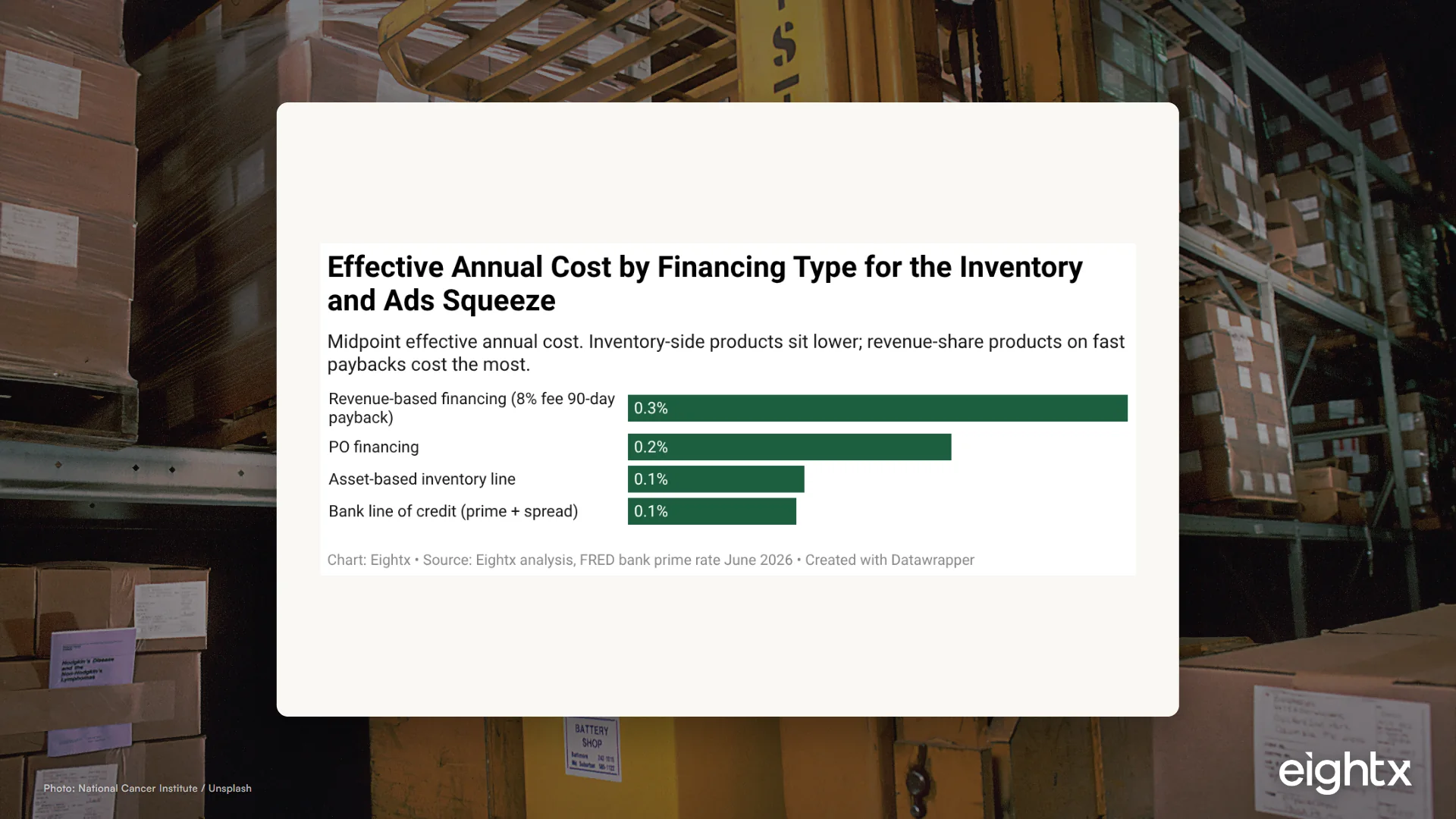
- Fund the inventory side with the cheapest capital: an asset-based inventory line runs 8 to 15 percent APR versus PO financing at 12 to 30 percent.
- Fund the ad side with flexible capital: a line of credit at prime plus a spread (prime was 6.75 percent in June 2026) or revenue-based financing for seasonal flex.
- RBF on a fast 90-day payback is a 32.5 percent effective APR, four times its 8 percent headline fee, so reserve it for the ad side, not the inventory side.
- Sequence the spend: commit the PO first, then scale ads only against confirmed inbound stock and a 90-day cash forecast.
Here is the squeeze nobody warns you about until you are in it. You wire the supplier for a purchase order. Weeks later the stock lands, and now you have to spend again, this time on ads, to actually sell it. Both outflows happen before a single dollar of that revenue comes back. You are funding the inventory and funding the demand to clear it, at the same time, out of the same bank account.
This is the DTC double squeeze. The P and L looks fine. The bank account is the thing that can kill you. Let me show you how to size the combined need, sequence the spend, and match the right financing to each side so you stop white-knuckling your cash balance every quarter.
Why inventory and ads are two separate cash problems
Most founders model inventory and ads as one lump of "growth spend." They are not the same animal, and treating them the same is why the financing gets expensive. A founder I worked with put the squeeze bluntly: "in the past we have made a lot more sales, but then we've hit cash flow issues because we're having to buy so much inventory in order to fulfill the sales, with way less profit." More sales did not save them. The inventory bill landed first.
Inventory is a hard asset. You can borrow against it, the lender can repossess it, and that collateral keeps the rate down. Ad spend is the opposite: the moment the money hits Meta or Google it is gone, with no asset behind it. No lender will give you a cheap secured loan against last month's ad invoices.
That difference is the whole game. As we lay out in what is inventory financing, the stock itself is the collateral, which is exactly why an inventory line is cheaper than unsecured working capital. So the right move is almost never one product covering both. It is two products, each matched to the nature of the spend.
How to size the combined cash need
The number that matters is not the inventory order. It is the inventory order plus the ad spend you will burn across the cash gap before that inventory turns into collected revenue.
Walk it through with real timing, and keep two clocks separate. The first is the full cash conversion cycle: from the day you pay your supplier to the day that inventory turns into collected cash, which for growth-stage DTC brands runs 60 to 150 days. The second, shorter clock is the ad-spend-to-revenue lag: once stock is live and you start running ads, that ad spend takes roughly 30 to 60 days to come back as collected revenue. The squeeze is that the second clock sits inside the first. You place a PO. Stock lands, then sells over the back half of a cycle that does not fully close for months. As we cover in scale DTC ad spend without blowing up cash flow, doubling ad spend means cash out now and revenue arriving over the next 30 to 60 days, with COGS and fulfillment in between. So you stack a second outflow on top of an inventory order you have not even recovered yet, and you are short on cash for longer than the 30 to 60 day ad lag alone implies.
Here is a simple version of the math for a single cycle:
| Cash component | Example figure | Timing |
|---|---|---|
| Inventory order (COGS) | $300,000 | Paid at PO, weeks before sale |
| Ad spend across the gap | $180,000 | Paid as you sell, before cash lands |
| Combined peak cash need | $480,000 | Both out before revenue returns |
| Revenue collected | begins day 30 to 60 | Lags both outflows |
The combined peak need is what you actually have to fund, and it routinely runs 1.5x to 2x the cost of a single inventory order. If you only sized the PO, you are short by the entire ad budget. That gap is where brands stall: they buy the stock, then cannot afford to move it. I watched one brand more than double its online ad spend into a hit product, then have to throttle the ads back down because the cash to keep buying inventory and feeding Meta at the same time simply was not there. The product worked. The cash math did not.
Which financing fits which side
Once you split the need, the financing choices get obvious. Match cheap secured capital to the inventory side and flexible capital to the ad side.
Inventory side. Use the cheapest secured option you qualify for. An asset-based inventory line runs 8 to 15 percent APR because the stock collateralizes it. Purchase order financing, where the lender pays your supplier directly, is faster but pricier at 12 to 30 percent APR, with advance rates typically roughly 50 to 90 percent of supplier cost. Both numbers come straight from our inventory financing breakdown, and they line up with third-party lender data: independent comparison sites peg PO financing around 1.5 to 6 percent per 30-day period, which annualizes into the same 12 to 30 percent band for normal turns.
Ad side. There is no collateral, so you need flexible capital. A bank line of credit is the cheapest path if you qualify: it is priced at prime plus a spread, and the bank prime rate sat at 6.75 percent in June 2026 (FRED), so a line for a brand that qualifies for prime plus roughly four points lands around 10 to 12 percent. Revenue-based financing is the alternative when you want repayment to flex with sales through a seasonal trough.
Just understand what RBF actually costs. Market RBF runs anywhere from 8 to 40 percent effective APR depending on payback speed; the number below is the fast-payback worked case, not the cheapest one you might find. As we show in Settle vs Wayflyer, an 8 percent flat fee paid back in 90 days is a 32.5 percent effective APR, four times the headline rate, because the fee is fixed at origination no matter how fast you repay. Convert any flat fee yourself: APR equals (factor minus 1) times (365 divided by payback days) times 100. RBF earns its keep on the ad side, where flex matters and the payback can stretch. It is the wrong tool for a slow inventory turn.
How to sequence the spend
Sizing and financing only work if you spend in the right order. Get the sequence wrong and you either sell out of a hit product or torch ad budget against stock that has not landed.
- Lock the purchase order first. You cannot sell what you do not have inbound. Commit the inventory, confirm the ship date, and fund it with your cheapest secured line.
- Build the 90-day cash forecast before you touch ad budget. Model inventory out, ads out, and revenue in week by week. This is the discipline we detail in the cash flow mastery guide: a forecast that triggers daily cash tracking when your reserve gets thin.
- Scale ads only against confirmed inbound stock. Tie spend to landing dates. Ramping ads three weeks before inventory arrives just pre-pays CAC you cannot fulfill.
- Gate ad scaling on unit economics, not vibes. Keep your CAC payback under 12 months and your contribution margin healthy enough to service the financing before you lean on the ad line. If the economics are not there, financing just buys you a bigger hole.
- Free up trapped cash first, borrow second. Before you draw on any line, check whether trapped working capital can fund part of the gap. Cheaper than any lender. One brand I worked with was sitting on roughly 250 days of inventory; harmonizing that down toward 3 to 4 months of cover freed up multiple millions of dollars, money that was funding the squeeze instead of a lender.
- Decide debt versus equity deliberately. If the combined need is structural and recurring, debt is usually right. If it is a one-time leap, weigh the tradeoff in bridge financing vs equity for the cash gap.
What to do about it
Here is the play I run with brands stuck in this squeeze:
- Calculate your real combined peak. Inventory order plus every dollar of ad spend across the 30 to 60 day gap. Not the PO alone.
- Split the financing by side. Cheapest secured line for inventory. Flexible line or RBF for ads. Never one expensive product for both.
- Convert every flat fee to an APR. Run the factor-rate formula before you sign. The number you get is what your bank line has to beat.
- Forecast 90 days before scaling. Tie ad ramp to inventory landing dates and a live cash model.
- Drain trapped cash before drawing debt. It is the cheapest capital you own.
Methodology
Financing cost figures are drawn from Eightx published analysis: asset-based inventory line APRs of 8 to 15 percent and PO financing APRs of 12 to 30 percent from our inventory financing guide, and the 32.5 percent RBF effective APR (8 percent fee, 90-day payback) from our Settle vs Wayflyer factor-rate analysis. The line-of-credit benchmark uses the U.S. bank prime loan rate of 6.75 percent as of June 2026, sourced from FRED series DPRIME, plus an assumed 4-point spread (DPRIME is the prime rate, not the all-in line rate). PO financing, RBF, and working-capital ranges were cross-checked against 2025 to 2026 third-party lender market data (PO financing quoted at 1.5 to 6 percent per 30-day period; RBF market effective APR of 8 to 40 percent). The 30 to 60 day figure is the ad-spend-to-revenue lag once stock is live; the full inventory-inclusive cash conversion cycle for growth-stage DTC brands runs 60 to 150 days, and the combined peak must be funded across that longer window. The cash-need example uses illustrative figures to show the structure; your numbers depend on your turn speed, margin, and ad payback period.
Frequently Asked Questions
how do i fund inventory and ad spend at the same time?
Size the combined need as inventory cost plus ad spend across your cash conversion cycle, then split the financing: cheaper inventory or PO financing for the stock, and a line of credit or revenue-based financing for the ads. Do not put both on the same expensive product.
how much cash do i need to fund inventory and ads together?
Take your inventory order cost and add the ad spend you will run across the 30 to 60 day gap before that revenue lands. For most DTC brands that lands at roughly 1.5x to 2x the cost of a single inventory order, not just the order alone.
should i use inventory financing or revenue-based financing for ad spend?
Use inventory financing for inventory, where the stock is the collateral and rates run 8 to 30 percent APR. Ad spend has no collateral, so fund it with a line of credit or revenue-based financing. RBF flexes with sales, which suits seasonal ad pushes.
what is the cheapest way to finance a dtc inventory order?
An asset-based inventory line is usually cheapest at 8 to 15 percent APR because the inventory secures the loan. PO financing is faster but pricier at 12 to 30 percent. A bank line of credit at prime plus a spread can beat both if you qualify.
why is revenue-based financing so expensive on fast paybacks?
RBF fees are fixed at origination, so the faster you repay, the higher the effective APR. An 8 percent fee paid back in 90 days is a 32.5 percent effective APR. Convert any flat fee with: APR equals factor minus 1, times 365 over payback days, times 100.
what order should i spend in when funding inventory and ads?
Commit the purchase order first so you have stock to sell, then scale ad spend only against confirmed inbound inventory and a 90-day cash forecast. Spending hard on ads before stock is locked is how brands sell out and burn CAC at the same time.