
eCommerce
Germany Ecommerce KPI Benchmark 2026
Germany is Europe's second-largest ecommerce market (EUR 83.1B goods, 2025). Conversion (~2%) and AOV (EUR 70-140) sit in the global band, but fashion return rates of 30-44%, driven by buy-on-invoice and a returns-friendly culture, break a US contribution margin if you do not re-underwrite returns and payments first.
Key Takeaways
- German B2C ecommerce is a EUR 83.1B goods market in 2025 (bevh), the second-largest in Europe. Broader online-retail scopes (HDE) put it nearer EUR 88.8B-92.4B. Online is ~13.4% of total retail, growing incrementally, not explosively.
- Conversion sits in the global ~2% band (top quartile 3.5-5%+) and AOV clusters EUR 70-140. There is no official Germany-only series for either, so treat them as proxies off Shopify/IRP data, not gospel.
- Returns are the line item that breaks a US model. German fashion return rates run 30-44%+, among the highest in Europe, versus single digits for electronics and beauty. Blended all-category sits 10-25%.
- The payment mix is the hidden driver. Invoice (Kauf auf Rechnung) plus PayPal dominate. Buy-on-invoice plus a strong consumer-protection culture make bracketing the default, which is why returns are structurally high.
- The macro backdrop has eased. German HICP inflation cooled to 2.3% in 2025 from an 8.7% peak, unemployment is ~3.8% (among the EU's lowest), and the ECB main refi rate is down to 2.15%. Cheaper capital, steadier demand.
If you run a US direct-to-consumer (DTC) brand and Germany is on your 2026 expansion list, the temptation is to copy-paste your home-market model, swap the currency, and call it a plan. That is exactly how a healthy US P&L turns into a German one that bleeds. Germany is the second-largest ecommerce market in Europe, the consumer base is real and the macro backdrop has eased, but the unit economics behave differently in two places that matter: returns and payments. This is the local-market companion to our global benchmark, built on German national statistics rather than US figures with the labels swapped.
A quick definition before the numbers, because the acronyms pile up fast: AOV is average order value, CVR is conversion rate, and "blended" return rate means across all categories rather than one vertical. Where a metric is a proxy rather than an official German series, we say so. Germany does not publish a single consolidated "DTC vs. online retail: CVR, AOV, returns, margin" table, so every KPI except market size and the store counts is a synthesized benchmark range.
How big is German ecommerce, really?
German B2C ecommerce goods revenue reached roughly EUR 83.1 billion gross in 2025, according to bevh (the Bundesverband E-Commerce und Versandhandel, Germany's ecommerce trade association), which also expects further growth into 2026. That is the most authoritative goods-only figure, and it is the one to lead with.
You will see larger numbers quoted, and they are not wrong, they are just measuring something wider. The HDE (the German Retail Association) and Statista summaries put the 2024 market at about EUR 88.8 billion (up 3.8% year-over-year) and forecast around EUR 92.4 billion for 2025, using a broader online-retail scope. The lesson is to always check what a German market-size number counts before you anchor a forecast to it. bevh counts goods revenue; HDE counts a wider basket.
Either way, the online share of total German retail sits around 13.2-13.4% (2024 into 2025). That tells you something important about the growth story: Germany is a mature, digitized market where online share is grinding up a few tenths of a point a year, not doubling. When I talk to founders eyeing Germany because "Europe is underpenetrated," I push back on the framing. Germany is not underpenetrated. It is large, saturated, and competitive, which is a different opportunity that rewards margin discipline over land-grab spending.
The German KPI scorecard: conversion, AOV, returns, margin
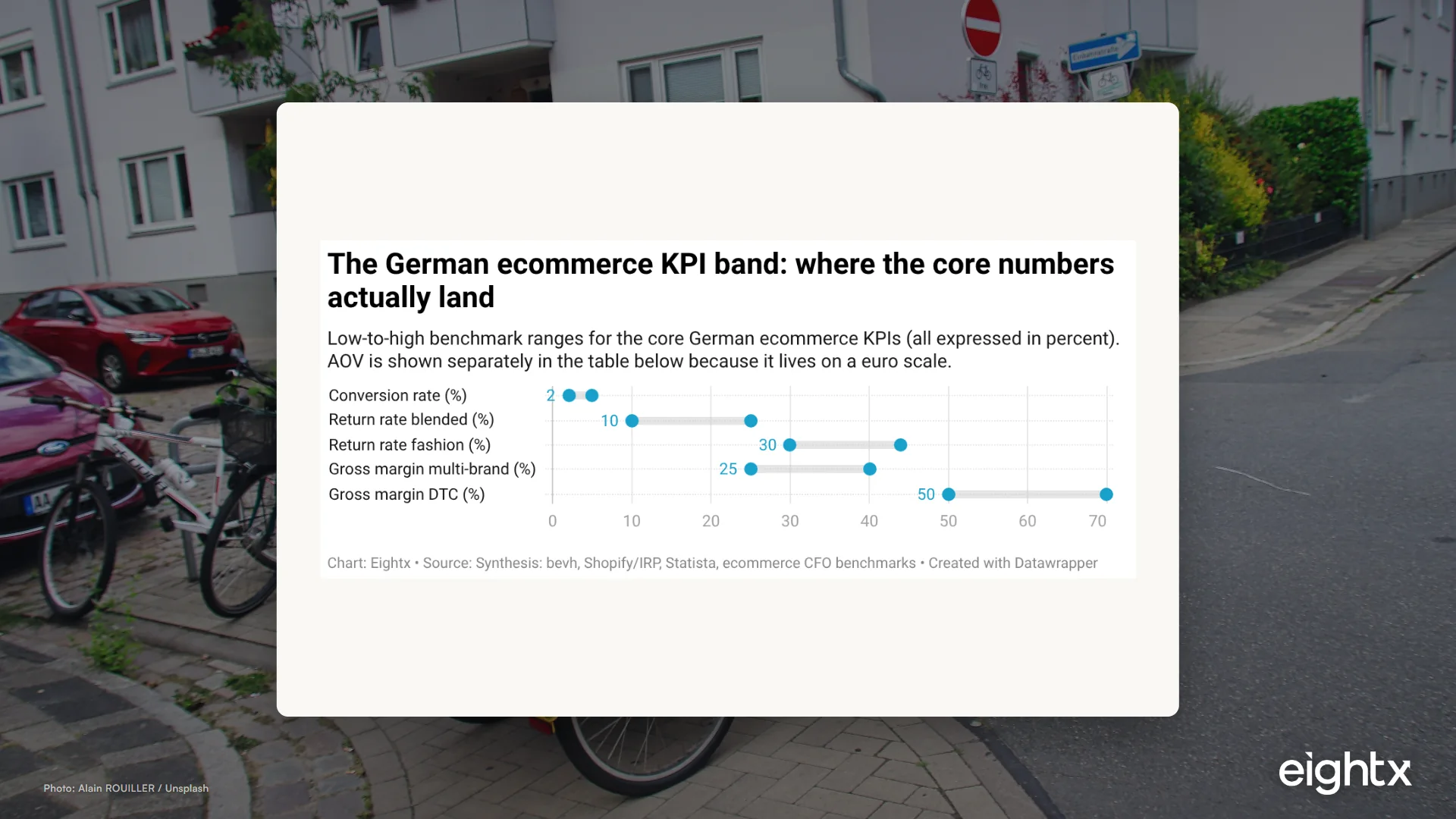
Here is the core benchmark, the part the title promises. Treat every figure below as a range, because the honest answer is that no German statistics office publishes a DTC scorecard, and anyone who hands you a single precise German conversion rate is guessing with false confidence.
| KPI | Benchmark range | Source basis |
|---|---|---|
| Ecommerce conversion rate | 2.0%-3.5% (top quartile 3.5-5%+) | Shopify/IRP proxy (no DE-only series) |
| Average order value (AOV) | EUR 70-140 | IRP / DTC Pages sample |
| Blended return rate | 10%-25% | Statista / EU benchmarks |
| Fashion return rate | 30%-44% | Statista (DE fashion) |
| Gross margin (DTC) | 50%-70% | Ecommerce CFO benchmarks |
| Gross margin (multi-brand retail) | 25%-40% | Ecommerce CFO benchmarks |
| DTC net margin (2026) | 3%-10% | DTC profitability benchmarks |
Read the conversion and AOV rows the way a German operator actually experiences them: unremarkable. CVR lands in the global ~2% band with a top quartile around 3.5-5%+, and AOV clusters EUR 80-100 for most DTC stores, stretching to EUR 140 for electronics-heavy or multi-brand retailers. Ignore the device-blended marketplace AOV figures near $224 you may see quoted; that is a marketplace-and-electronics artifact, not a DTC target.
The rows that should make you sit up are returns and the gross-to-net gap. A 50-70% gross margin looks comfortable until you carry it down to a 3-10% net margin, and the distance between those two numbers is where ads, returns, and reverse logistics live. The pattern we see again and again is operators who underwrote Germany at their US return rate, then watched contribution margin evaporate the first peak season. That is the next section.
Returns are quietly eating your margin. See by how much.
Get our Real Cost of Returns calculator: plug in your numbers, see the true hit per return.
Check your inbox. We'll send the Real Cost of Returns calculator shortly.
Returns are the line item that breaks your US model
If you remember one chart from this post, make it this one. German fashion return rates run 30-44%+, among the highest in Europe, while electronics sit near 8% and beauty near 6%. The blended all-category rate lands 10-25%, with Germany consistently cited at the top of the European range (Europe overall runs ~20-25% versus ~20% globally).
Why is fashion so extreme here? Two structural reasons, and neither is a UX problem you can design away. First, Kauf auf Rechnung (buy-on-invoice) is a default payment method: the shopper receives the goods, then pays only for what they keep. Ordering three sizes and returning two costs nothing up front. Second, German consumer-protection norms make returns frictionless and culturally expected, so "bracketing" (deliberately over-ordering to try at home) is normal behaviour, not edge-case abuse.
Run the contribution-margin math and the problem is obvious. Take a fashion brand at EUR 90 AOV and a 60% gross margin. On a clean sale that is EUR 54 of gross profit. Now apply a 40% return rate (the top of the German fashion band, not the ~32% typical-retailer case, but the one you should plan against): every 100 orders becomes 60 kept, and the 40 returns each carry round-trip shipping, inspection, repackaging, and a slice of write-off for items that come back unsellable. When I talk to founders running a brand this size, the ones who get burned are the ones who modelled Germany at a US 15-20% return assumption. The ones who model it at 35-40% and still make the category work are the ones who priced reverse logistics into the landed cost from day one. The rule of thumb we give: in German fashion, your return cost line is a primary P&L item, not a footnote, and it should be underwritten before you commit inventory.
Payment mix, and why it drives both cash and returns
Returns and payments are not two separate topics in Germany. The payment mix is the engine that makes the returns so high, which is why an operator has to plan for both together.
| Payment method | Approx. share of online transactions | Why it matters |
|---|---|---|
| PayPal | 30%-40% | Often #1 by volume; valued for buyer protection |
| Invoice (Kauf auf Rechnung) | 25%-35% | Pay after delivery; fuels bracketing and returns |
| SEPA direct debit (Lastschrift) | 10%-20% | Strong for subscriptions and repeat purchase |
| Credit cards | Secondary | Lower share than most other markets |
Two operator consequences fall out of this table. The first is conversion: if you launch a German store without invoice and PayPal at checkout, you are missing the two methods that carry the majority of transactions, and a US-style credit-card-first checkout will quietly suppress your CVR. The second is cash. Buy-on-invoice means you ship before you are paid, and a meaningful share of those shipments come back. That ties up working capital in inventory that is in transit, in a customer's hallway on approval, or moving back through your returns pipeline. When we have struggled with German cash flow, what worked was modelling a longer cash conversion cycle than the US equivalent, because invoice plus high returns lengthens the gap between shipping a unit and recognising clean revenue on it.
The macro backdrop: cheaper capital, low unemployment
The operating environment in Germany has genuinely improved since the 2022-2023 squeeze, and it is worth a paragraph because it changes how aggressive you can afford to be.
German HICP inflation (the Harmonised Index of Consumer Prices, the EU-standard inflation measure) cooled to 2.3% in 2025 from an 8.7% peak in 2022. Unemployment sits around 3.8%, among the lowest in the EU and well below France (7.7%), Italy (6.1%), and Spain (10.5%). And the ECB main refinancing rate has been cut to 2.15% as of June 2025, down from a 4.50% peak. Cheaper capital plus low unemployment means a financing and demand environment that has eased, not tightened. For an operator, the read is that inventory financing and growth capital cost less than they did 18 months ago, and the consumer is employed. That does not change the returns math, but it does mean the cost of carrying the inventory and reverse-logistics buffer Germany demands is lower than it was at the peak.
For context on the merchant landscape you would be competing in: a Storeleads geo cut on 2026-06-12 returned 121,343 Shopify stores in Germany, including 5,168 on Shopify Plus (about 4.3% of the base, a useful "scaled brand" denominator), alongside roughly 121,097 WooCommerce stores and 19,065 stores running Klaviyo. This is a deep, mature merchant universe, not a greenfield.
Germany will not break your model on conversion or AOV; those sit in the global band. It breaks it on returns and payments. Fashion returns of 30-44%, fuelled by buy-on-invoice and a returns-friendly culture, are structurally normal here. Re-underwrite contribution margin for that before you ship a single pallet, and the second-largest market in Europe is a great one to be in.
What this means for your brand
Three moves before you commit to Germany. First, rebuild your contribution margin model at the German return rate for your category, not your US one: 30-40%+ if you sell fashion, single digits to low teens if you sell electronics or beauty. Second, add invoice and PayPal to checkout from launch, and plan a longer cash conversion cycle because you will ship before you are paid. Third, treat reverse logistics as a named line item in landed cost, not an afterthought, and price it in before you set retail.
If you want a second set of eyes on the model before you green-light the expansion, that is exactly the kind of re-underwriting a fractional CFO does. For the cross-country picture this geo benchmark extends, see our EU ecommerce KPI benchmarks by country, and for a sibling market in the same format, the Australia ecommerce KPI benchmark 2026.
Sources and methodology
Market size. The headline B2C goods-revenue figure of EUR 83.1 billion for 2025 is from bevh (Bundesverband E-Commerce und Versandhandel), reported via beyond-print and confirmed in a Parallel.ai deep-research pass (run_id trun_6bebc15578ef4c38955ac28d408b4942). Broader online-retail scopes (EUR 88.8 billion for 2024, EUR 92.4 billion forecast for 2025) come from HDE and Statista summaries via ecommercenews.eu. The two are presented as a range because they use different scopes: bevh counts goods, HDE counts a wider online-retail basket.
Conversion, AOV, and gross margin. No official Germany-only series exists for any of these, which the research repeatedly confirmed. The conversion benchmark (~2% blended, 3.5-5%+ top quartile) is proxied from Shopify and IRP Commerce cross-store data; the Germany-specific evidence is the absence of any signal that German stores deviate from the global band. AOV (EUR 70-140) is bracketed by the IRP April 2026 sample and the DTC Pages Shopify sample (mean ~$85). Gross-margin and net-margin ranges come from ecommerce CFO and DTC profitability benchmarks. All are labelled as proxy ranges, never as official German figures.
Returns. Category return rates are a synthesis of Statista, prime-ai, and synctrack analyses covering German and EU benchmarks, 2022-2025. The German fashion figure spans a "typical retailer" estimate near 30-34% and a bracketing-inclusive estimate near 44%, which is why the chart shows both. These are best-available benchmark ranges, not a single official 2025 series, and they are labelled as such.
Payment mix. Directional shares for PayPal, invoice, SEPA direct debit, and cards are synthesized from German payment studies (2023-2025). Exact shares vary by study and merchant mix, but the ranking (PayPal and invoice on top, cards secondary) is stable across sources.
Macro. HICP inflation for Germany was pulled from the Eurostat Data MCP (annual rate of change, DE): 2021 3.2%, 2022 8.7%, 2023 6.0%, 2024 2.5%, 2025 2.3%. Comparative unemployment (DE 3.8%, FR 7.7%, IT 6.1%, ES 10.5%) came from the same Eurostat MCP. The ECB main refinancing rate path was pulled from the European Central Bank MCP: from 0.50% (mid-2022) to a 4.50% peak (late 2023), easing to 2.15% (latest, 2025-06-11). Year-end and representative values are used in the chart.
Store universe. Shopify, Shopify Plus, WooCommerce, and Klaviyo counts are a Storeleads geo cut for Germany, pulled 2026-06-12. Store counts are reliable; per-store sales and AOV fields were not populated in this pull, so no per-store German sales estimates are published here.
Limitations. The biggest caveat is that Germany has no single consolidated DTC KPI table, so most of this benchmark is synthesized ranges, not a primary series. Operator-voice anecdotes in this post are anonymized patterns from founder conversations, with figures preserved and identities removed. Treat the numbers as planning ranges to pressure-test your own P&L against, not as guarantees.
Frequently asked questions
what is the average ecommerce conversion rate in germany in 2026?
Plan around ~2% blended, with a top quartile of 3.5-5%+. There is no official Germany-only conversion series, so this is a proxy off Shopify and IRP cross-store data. German DTC stores cluster around 2-3.5%, and there is no evidence Germany deviates from the global band.
what is the typical return rate for online retail in germany?
Blended across all categories, plan for 10-25%, with Germany at the high end of Europe. The number is dragged up by fashion, which runs 30-44%+. Electronics and beauty sit in the single digits, so your real return exposure depends heavily on your category mix.
how does germany ecommerce cac compare to other european markets?
There is no reliable Germany-only CAC series to benchmark against, so do not chase a single number. Proxy off your own blended CAC, then stress it for the German payment and returns mix: invoice plus high fashion returns means more gross orders convert than net keep, so your true cost per kept customer runs higher than your checkout CAC suggests.
why are fashion return rates in germany so high?
Two structural reasons. First, Kauf auf Rechnung (buy-on-invoice) lets shoppers pay only after they receive and keep goods, so ordering three sizes and sending two back costs nothing up front. Second, German consumer-protection culture makes returns frictionless and expected. Together they make bracketing the default behaviour.
what gross margin should a dtc brand expect selling in germany?
DTC brands typically run 50-70% gross margin, and multi-brand online retail 25-40%, both category-dependent. The trap is the gross-to-net gap: median DTC net margin in 2026 is only ~3-10% once ads, returns, and reverse logistics come out, and German returns make that gap wider than a US operator expects.
what aov benchmarks apply to germany ecommerce operators in 2026?
Most DTC Shopify-style stores cluster EUR 80-100, with the broader band running EUR 70-140 for electronics-heavier or multi-brand retailers. Ignore device-blended marketplace figures near $224, which are not a DTC target.
how big is the german ecommerce market in euros?
bevh puts B2C goods revenue at EUR 83.1 billion for 2025. Broader online-retail scopes from HDE land nearer EUR 88.8 billion (2024) to EUR 92.4 billion (2025 forecast). The gap is scope, not contradiction: bevh counts goods, HDE counts a wider online-retail basket.
what payment methods do german online shoppers actually use?
PayPal and invoice (Kauf auf Rechnung) lead, followed by SEPA direct debit (Lastschrift). Credit cards are a secondary method, unlike in the US. If you launch in Germany without invoice and PayPal at checkout, you leave conversion on the table.
is germany a good market for a us dtc brand to expand into?
Yes, if you re-underwrite the model. It is Europe's second-largest market with a strong, low-unemployment consumer base and cheaper capital than two years ago. But you cannot port a US contribution margin: returns, reverse logistics, and the invoice-heavy payment mix have to be modelled in before you commit inventory.
how many shopify stores are there in germany?
A Storeleads geo cut on 2026-06-12 returned 121,343 Shopify stores in Germany, of which 5,168 are Shopify Plus (~4.3% of the base), plus roughly 121,097 WooCommerce stores and 19,065 stores running Klaviyo. It is a large, real merchant universe, not a thin one.