
News
Glossier Borrowed $45M Instead of Raising Equity
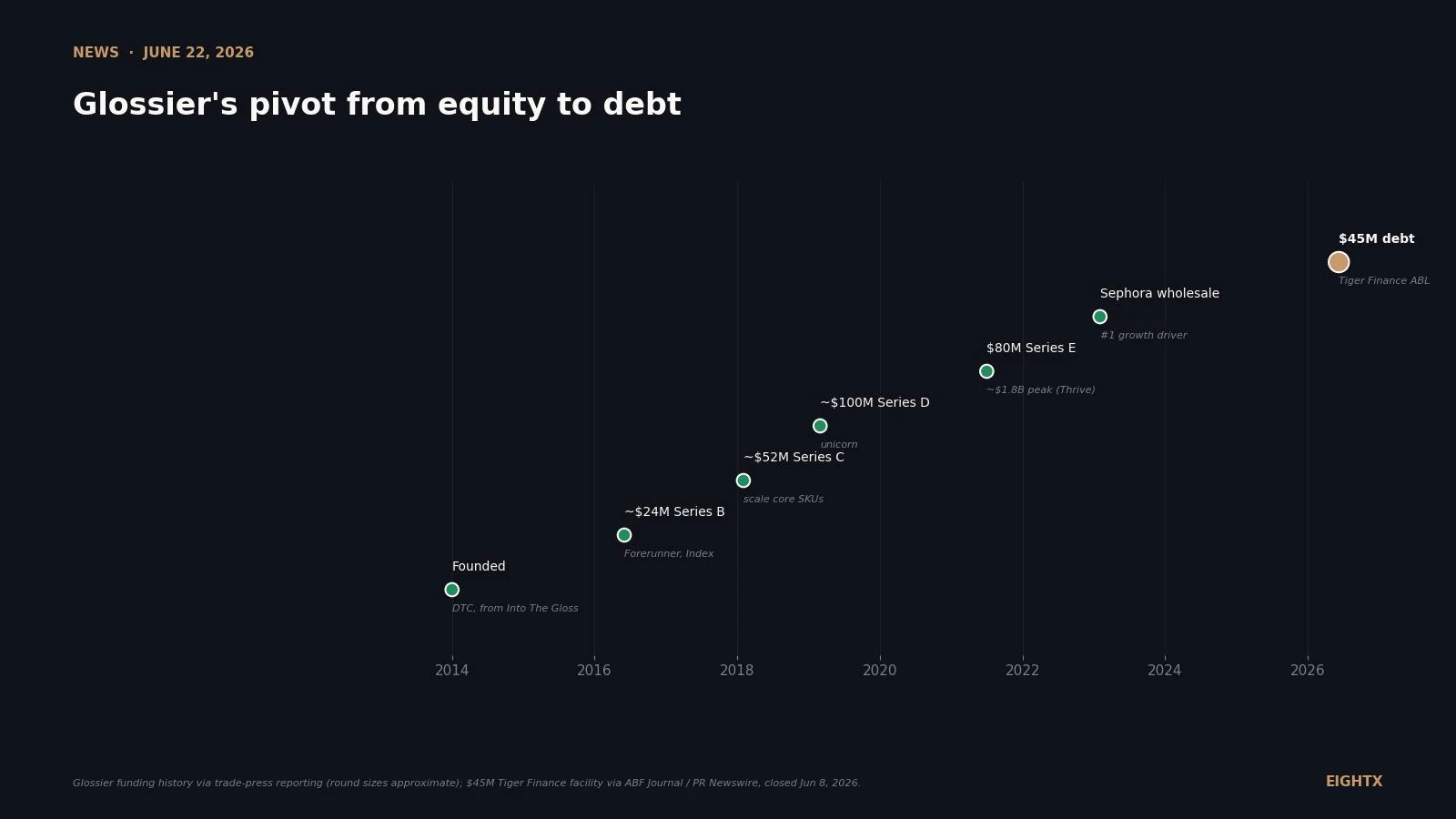
On June 8, 2026, Glossier closed a $45 million asset-based revolving credit facility from Tiger Finance, the lending arm of Tiger Group. After raising roughly $266-280M of equity at a peak ~$1.8B valuation in 2021, the beauty brand chose non-dilutive debt secured against its inventory and receivables rather than a down-round. It matters because the choice is a working-capital tool, not a rescue, and a textbook sign of a DTC brand growing up.
Key Takeaways
- On June 8, 2026, Glossier closed a $45M asset-based revolving credit facility with Tiger Finance, its first widely reported debt raise after about $266-280M of equity.
- This is a fallen unicorn (peak ~$1.8B in 2021) choosing non-dilutive debt over a down-round. Borrowing protects the cap table; new equity at today's price would not.
- The lender is an asset-based shop, so the money is secured against inventory and receivables, a borrowing base, not a growth multiple.
- Glossier's 2023 move into Sephora is probably what makes the loan work: wholesale created collectible receivables a lender can margin. The DTC-only Glossier of 2019 couldn't have borrowed this cleanly.
- What to watch: the pricing. A special-situations lender like Tiger costs more than a bank revolver, so read the choice as speed and flexibility, and watch that it stays a working-capital tool, not a crutch.
If you run a consumer brand, the most useful business story this month is not a funding round. It is the opposite. Glossier, one of the most-hyped venture darlings of the last decade, just chose to borrow money rather than raise it. It matters because the instrument a brand reaches for when it needs cash tells you exactly how it sees its own value, and Glossier's choice tells you more about running a brand than any Series E ever did.
For how we think about the debt-versus-dilution call, see our take on when an ecommerce brand should raise debt instead of equity, and how a fractional CFO for ecommerce frames working-capital financing.
What happened
On June 8, 2026, Glossier closed a US$45 million asset-based revolving credit facility with Tiger Finance, the lending arm of Tiger Group. RetailDive reported the deal and the company confirmed it through a press release that framed the money as support for "ongoing operations and future growth opportunities."
The quotes were the usual handshake. Tiger Finance's Andrew Babcock said the firm's "experience across consumer brands and retail enabled us to structure a flexible financing solution." Glossier CEO Colin Walsh, in the job since September 2025, said the line "supports the next chapter of Glossier's growth." Neither said the interesting part out loud, so we will.
This is a brand that raised roughly US$266-280 million of equity on its way to a US$1.8 billion valuation in 2021, then spent the next four years becoming the textbook "fallen unicorn": a one-third layoff in 2022, two CEO changes, and a pivot from pure direct-to-consumer to wholesale shelves in Sephora. And now, when it needs capital, it is not calling its venture investors. It is borrowing against its own inventory. Glossier is one chapter in a much larger story: the DTC capital cycle that ran from Tiger Global to Tiger Group.
| Glossier capital story | Figure |
|---|---|
| Founded | 2014 (from the Into The Gloss blog) |
| Total equity raised (Seed-Series E) | ~US$266-280 million |
| Peak valuation | ~US$1.8 billion (2021 Series E, US$80M) |
| 2022 layoffs | ~1/3 of corporate staff |
| Sephora wholesale launch | 2023 (cited as its #1 growth driver) |
| Company-owned stores | ~12 |
| Est. online DTC sales (Storeleads, .com only) | ~US$159 million/year |
| New facility | US$45M revolving credit (Tiger Finance), closed Jun 8, 2026 |
Source: RetailDive and ABF Journal/PR Newswire (facility); Storeleads (online sales estimate, June 2026); trade-press estimates for funding and valuation history. Revenue and valuation figures are estimates, not audited disclosures.
See your real margin on every order.
Get our Contribution Margin calculator: COGS, shipping, fees, ads, what's left.
Check your inbox. We'll send the Contribution Margin calculator shortly.
Why a fallen unicorn borrows instead of raises
Start with the number Glossier will never put in a press release: its valuation today. Nobody marks a 2021 consumer unicorn at 2021 prices anymore. Beauty multiples have compressed, growth has slowed, and the brand's cultural lead has narrowed. Any honest equity round in 2026 would price below that US$1.8 billion peak, a down-round.
A down-round is not just a smaller number. It re-prices everyone on the cap table, can trigger anti-dilution ratchets that punish the founders and earliest believers, and broadcasts to the market, your staff and your acquirers that the company is worth less than it used to be. For a brand whose whole equity is "people believe in us," that signal is expensive in ways that do not show up on a term sheet.
Debt sidesteps all of it. A US$45 million line is non-dilutive: no new shares, no fresh 409A markdown, no headline about a haircut. You pay interest and you keep your ownership. When your equity is underwater relative to its peak, borrowing is not a weakness, it is the disciplined move. The cost of that capital is a coupon you can model. The cost of selling equity at the bottom is permanent.
This is the call we walk founders through constantly, just with fewer zeroes. The instinct, after years of raising, is that "capital" means "investors." But equity is the most expensive money you will ever take, and it is the only money you can never pay back and be done with. The mature question is not "who will fund us," it is "what is this money actually for, and what is the cheapest instrument that fits."
What asset-based lending actually is (and why Sephora made it possible)
Tiger Finance is not a bank and not a venture-debt fund. It is the credit arm of Tiger Group, a firm best known for appraising and liquidating retail inventory. That pedigree is the tell. Tiger lends because it knows, to the dollar, what a beauty brand's stock and unpaid invoices are worth if everything goes wrong. That is asset-based lending.
An asset-based revolver is secured against a borrowing base: a percentage of eligible inventory and accounts receivable. Lenders typically advance something like 50-85% against good receivables and a more conservative 20-60% against inventory, and the available line moves up and down with those balances. You are not borrowing against your story. You are borrowing against the things on your balance sheet that turn back into cash.
Here is the part most coverage will miss. The Glossier of 2019, almost entirely direct-to-consumer, would have struggled to raise a clean ABL line, because DTC throws off cash but very little in the way of receivables. A customer pays at checkout; there is no invoice sitting unpaid for 60 days for a lender to margin. What changed is Sephora. Since 2023, wholesale has been Glossier's number-one growth driver, and wholesale generates exactly the asset an ABL lender loves: invoices owed by a large, creditworthy retailer. Glossier ships to Sephora, books a receivable, and can now borrow against that receivable to fund the next production run.
In other words, the same channel shift that diluted Glossier's gross margin (wholesale is lower-margin than DTC) is what unlocked its access to cheap, non-dilutive, asset-backed debt. That is not a coincidence. It is the financial mechanics of growing up from a DTC darling into an omnichannel consumer brand.
The working-capital cycle this is really solving
Strip away the narrative and a revolver solves one very specific, very boring problem: you pay for inventory long before your customers and retailers pay you.
A beauty brand commits cash to components, manufacturing and freight months ahead of a launch. Then it sells: some DTC (cash today), much of it through Sephora on net terms (cash in 30, 60, sometimes 90 days). The gap between "cash out for stock" and "cash in from sales" is the cash conversion cycle, and every growing physical-product business has to fund it somehow. Grow faster and the gap gets wider, because you are buying the next, bigger inventory build before the last one has fully paid you back. Growth eats cash.
You can fund that gap three ways. Sit on a pile of idle equity (wasteful, and dilutive to raise). Squeeze suppliers and starve your own growth (limiting). Or put a revolver in place that you draw when you build inventory and repay when the receivables land. The third option is what a US$45 million line is for. It lets Glossier minimise idle cash, match its borrowing to its actual inventory swings, and fund holiday and launch builds without phoning Thrive Capital.
That is why "is Glossier in trouble?" is the wrong question. A revolver is not a bailout; it is plumbing. The right question is the one we ask every brand we work with: do you know your cash conversion cycle in days, and is the way you fund it the cheapest tool that fits? Most founders cannot state their number. Glossier just paid Tiger Finance to fund theirs, which means someone there knows it cold.
What to watch next
Three things tell you whether this stays a healthy story.
- The pricing and the lender. This is the one yellow flag. Glossier went to an asset-based, special-situations lender, not to a cheap bank revolver. That usually buys speed, flexibility, and a lender who will lend through messiness, but it costs more, often a high-single to low-double-digit spread plus fees. If a brand this size could only get comfortable terms from a liquidation-savvy lender, watch whether a cheaper bank facility refinances it within a year. That refi would be the real "we're fine" signal.
- Whether it stays a working-capital tool. A revolver funding inventory is plumbing. A revolver quietly funding operating losses is a crutch. The use of proceeds, "ongoing operations", is vague enough to be either. The tell is the borrowing base: if draws track inventory and receivables, it is healthy; if the line is permanently maxed regardless of stock levels, the brand is borrowing to stay alive.
- The Sephora concentration. The wholesale receivables that make this loan work also make Glossier dependent on one retailer's open-to-buy and payment behaviour. Great while Sephora is leaning in. A risk if that relationship ever cools, because the collateral behind the line would shrink at exactly the wrong moment.
The operator takeaway
The interesting thing about this deal is not the US$45 million. It is the instrument. Glossier looked at its situation (strong brand, slower growth, depressed valuation, a real inventory cycle to fund) and reached for the tool that fit, instead of the tool it was used to.
That is the entire discipline of capital structure, and almost every founder gets it backwards. They raise equity to fund inventory (selling the most expensive capital there is to cover a gap that closes in 60 days), then try to fund a permanent bet (a new market, a new team) with a line of credit that a lender can yank. Match the money to the job. Self-liquidating needs that turn back into cash, like inventory and receivables, are what debt is built for. Permanent needs that may never pay back on a schedule are what equity is for.
Glossier may or may not recover its old cultural heat. But on this one decision, it is behaving like a grown-up consumer company: funding its working capital with asset-backed debt, protecting its owners from a down-round, and keeping its powder dry. The lesson for your brand is not "go get a revolver." It is to know your cash conversion cycle, know what each dollar is actually for, and stop reaching for equity every time the account looks tight. If you want the full framework behind that call, we lay it out in equity vs debt vs revenue-based financing.
Frequently Asked Questions
what did Glossier announce in June 2026?
Glossier closed a US$45 million asset-based revolving credit facility with Tiger Finance, the lending arm of Tiger Group, on June 8, 2026. It is a flexible line of credit the company says will support ongoing operations and future growth. It is debt, not an equity round, and it is the brand's first major reported debt raise after roughly US$266-280M of venture funding.
is a $45 million credit line a sign Glossier is in trouble?
Not on its own. A revolving facility is a normal working-capital tool, and choosing debt over equity at a brand that raised at a ~US$1.8B peak is a rational way to avoid a dilutive down-round. The detail worth watching is that the lender is an asset-based, special-situations shop rather than a cheap bank, which usually means higher pricing and a faster, more flexible structure. Read it as a maturing brand funding its inventory cycle, while keeping an eye on the cost.
what is asset-based lending and how is it different from venture debt?
Asset-based lending (ABL) is a loan secured against things the business owns that can be sold, mainly inventory and accounts receivable. The lender advances a percentage of that eligible collateral, called a borrowing base, and the line rises and falls with it. Venture debt, by contrast, is usually lent against a company's equity story and recent raise, often with warrants attached. ABL is cheaper to underwrite and more durable, because it is backed by assets, not by the next funding round.
why would Glossier raise debt instead of more equity?
Because equity is expensive when your valuation has fallen. Glossier peaked near US$1.8B in 2021. Raising equity in 2026 would likely price as a down-round, heavily diluting founders and early investors and sending a bad signal. A US$45M asset-based line is non-dilutive: it funds the working-capital cycle without touching the cap table or marking the company down.
who is Tiger Finance?
Tiger Finance is the credit arm of Tiger Group, a firm best known for asset appraisal, valuation and retail liquidations. It specialises in asset-based facilities for consumer and retail businesses, lending against inventory and receivables. It is the kind of lender that understands exactly what a beauty brand's stock and wholesale invoices are worth in a downside, which is precisely why it can get comfortable lending against them.
does this debt change anything for Glossier customers?
No. A credit facility is a balance-sheet decision. Your prices, products and the Sephora shelf are unchanged. The only thing it changes is how Glossier funds the inventory behind those products, with a revolver instead of equity.
should my ecommerce brand raise debt or equity?
It depends on what the money is for. Permanent needs (building the team, entering a market, funding losses) are usually equity. Self-liquidating needs (inventory and receivables that turn back into cash within months) are what debt, especially an asset-based revolver, is built for. The mistake is funding a working-capital timing gap by selling equity, or funding a permanent bet with a line that can be pulled. Match the financing to the cash conversion cycle.