
Finance
Tiger Group: Appraiser, Lender, and Liquidator in One
Tiger Group, legally Tiger Capital Group, is a roughly 50-year-old collateral specialist that does three things to the same assets: appraises them, lends against them through Tiger Finance, and liquidates them in going-out-of-business sales. The through-line is one number, net orderly liquidation value (NOLV). It is not Tiger Global, the venture fund.
Key Takeaways
- Tiger Group (Tiger Capital Group) does three things to the same assets: appraises, lends, and liquidates. The same firm that finances a brand is the one that runs going-out-of-business sales for brands like it.
- It is not Tiger Global, the Chase Coleman venture fund. Same name, no connection. Tiger Group is a liquidator-appraiser-lender; Tiger Global is a VC.
- The number behind all three arms is NOLV (net orderly liquidation value), the value of your inventory in an orderly wind-down. It is lower than cost and far lower than retail, and it sets your borrowing base.
- When Tiger shows up, read which door: appraiser (your lender is sizing your loan), lender (you are collateral-rich and non-bankable), or liquidator (it is a wind-down).
- By their own numbers Tiger has appraised $490B+, monetized $38B+, and deployed $849M+ of capital over 50+ years. Recent consumer work spans Glossier's $45M loan and francesca's ~400-store liquidation, both ends of the same cycle.
When Glossier raised $45 million in June 2026, the headline was the beauty brand. The more interesting name was the lender: Tiger Finance. It is worth knowing who that is, because the firm behind that loan does something most operators never think about until it is too late. It lends money to consumer brands, and it runs the going-out-of-business sales when consumer brands fail. Same firm, both ends of the cycle.
If a financier like this turns up in your category, on your cap table, or in your lender's diligence pack, you want to understand exactly what you are looking at. For how we think about reading your own capital structure, see how a fractional CFO for ecommerce frames debt, and our guide to inventory write-downs, which turns on the same idea as everything below: what your stock is really worth.
Who Tiger Group actually is
First, the disambiguation that trips up almost everyone, because it matters enormously. Tiger Group is not Tiger Global. Tiger Global Management is Chase Coleman's venture and hedge fund, the firm that wrote enormous startup cheques through the 2021 boom. Tiger Group, legally Tiger Capital Group, is a completely separate company with no shared ownership. It is a liquidator, appraiser and asset-based lender. They share a name and nothing else. When a brand takes money from "Tiger," which Tiger it is tells you almost the whole story. We trace the full arc from one Tiger to the other in the DTC capital cycle.
Tiger Group has been at this for more than 50 years. By its own published figures it has appraised over $490 billion of assets, monetized (its word for liquidated and auctioned) over $38 billion, and deployed more than $849 million of its own capital as loans. It runs six offices, with its global headquarters in New York, and describes its business in three words: Advisory, Finance, Monetization. Translated into plain English, that is appraise, lend, and liquidate.
| Tiger Group (Tiger Capital Group) | Figure |
|---|---|
| In business | 50+ years |
| Offices | 6 (New York HQ, Los Angeles, Boston, Chicago, Houston, Toronto) |
| Assets appraised | $490 billion+ |
| Assets monetized (liquidated / auctioned) | $38 billion+ |
| Capital deployed (Tiger Finance) | $849 million+ |
| The three arms | Advisory (appraise) · Finance (lend) · Monetization (liquidate) |
| Recent consumer work | Glossier $45M loan (Jun 2026); francesca's ~400-store wind-down (Feb 2026) |
Source: Tiger Group corporate site (firm-reported scale figures, accessed June 2026); RetailDive and ABF Journal (Glossier); ABL Advisor (francesca's).
The three doors: appraise, lend, liquidate
Most finance firms do one thing. Tiger does three, and the three are the point. Think of them as doors a brand can walk through.
Door one: the appraiser (Advisory). This is the quiet, high-volume business and the one you are most likely to meet first. When an asset-based lender or a bank is deciding how much to lend a retailer against its inventory, equipment or brand, it hires an independent appraiser to value the collateral. Tiger is one of a handful of firms lenders trust for this. They send in a field exam, look at your stock by category, age and channel, and produce a recovery value. That number, more than your revenue or your story, sets how much you can borrow.
Door two: the lender (Tiger Finance). This is the arm that made the Glossier loan. Tiger Finance makes asset-based loans: revolving credit lines and structured facilities secured by inventory, receivables, equipment and, increasingly, brand and IP value. Its borrowers are companies that are rich in assets but light on the steady cash flow a bank wants to see, which is most growth-stage and turnaround-stage consumer brands. It has deployed over $849 million this way. The pitch to a brand is simple: a bank lends against your profits, which you may not have yet; we lend against your stuff, which you do.
Door three: the liquidator (Monetization). This is the business the firm is oldest and best known for. When a retailer files for bankruptcy or decides to wind a chain down, someone has to run the going-out-of-business sales, clear the inventory, sell the fixtures and auction the equipment. Tiger does this, usually as part of a joint venture with the other big liquidation houses. In early 2026 it was engaged, alongside SB360 and GA Group, to run the store-closing sales for francesca's, the specialty retailer that filed its second Chapter 11 and is closing roughly 400 stores. Years earlier it was part of the group that liquidated 279 Stein Mart locations. This is the end of the line, and Tiger is one of the firms you call to manage it.
Here is the part to sit with. The same company runs all three doors. The firm that wrote Glossier a cheque is the firm that buries francesca's. That is not a contradiction. It is the entire business model, and the next section is why.
Turn dead stock into a 90-day recovery plan.
Get our free Inventory Optimization AI: one Shopify export in, a SKU action plan out.
Check your inbox. We'll send the free Inventory Optimization AI shortly.
The one number behind all three: NOLV
Everything Tiger does runs on a single number: net orderly liquidation value, or NOLV.
NOLV is the cash you would actually net if you sold your inventory in an orderly wind-down, over a reasonable period, after paying the costs of running that sale. It is not what your stock cost you, and it is nowhere near what it rings up at retail. A rack of apparel that retails for $100 and cost you $35 might have an NOLV of $20 to $25, because in a liquidation it sells at a steep discount, on a clock, with fees coming out of the proceeds. Beauty and supplements take their own haircuts for shelf life and regulation. Seasonal goods get marked for the calendar. NOLV is the cold, downside number for your warm, full-price inventory.
That number is the hinge of the whole operation:
- The appraiser exists to estimate NOLV.
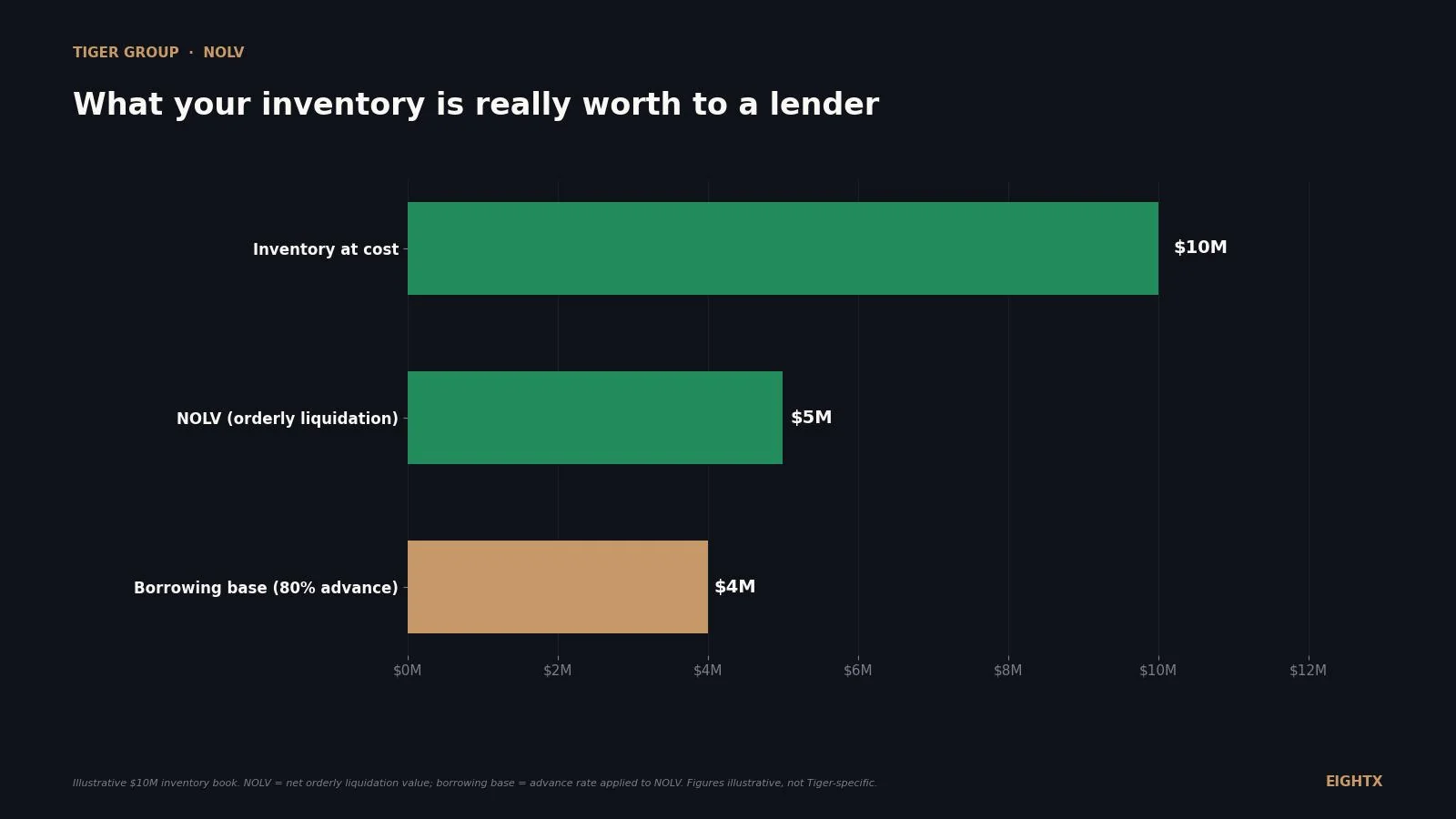
- The lender sets your borrowing base as an advance rate applied to NOLV. Carry $10 million of inventory at cost, have it appraised at a 50% NOLV, lend against that at an 80% advance rate, and you can borrow roughly $4 million, not $10 million. The rest is air, as far as the loan is concerned.
- The liquidator is the arm that goes out and proves the NOLV by actually selling the goods.
Now you can see why doing all three under one roof is an advantage rather than a conflict. A pure appraiser guesses at recovery values. A pure lender has to trust someone else's guess. Tiger appraises the assets, lends against its own appraisal, and has a liquidation business that tells it, deal after deal, what these assets really fetch when the music stops. It can get comfortable lending against inventory and brands that a bank will not touch, precisely because it knows exactly how to turn them back into cash if it has to. The liquidation expertise is not a separate business from the lending. It is the underwriting.
What it means when Tiger shows up
So a firm like Tiger appears. The useful question is not "is this good or bad," it is "which door am I walking through." The same name means three very different things.
| Which door | Who brought them in | What it signals | Your move |
|---|---|---|---|
| Appraiser | Your lender, or a buyer | Your borrowing base is being set off NOLV | Know your own NOLV first; contest aging and category discounts with data |
| Lender (Tiger Finance) | You | You are collateral-rich and cash-light, outside a bank's box | Fine if matched to a working-capital cycle; model the real advance rate and all-in cost |
| Liquidator | The court or your secured lender | An orderly wind-down of inventory and fixtures | This is the downside the other two were always pricing to |
If Tiger is the appraiser, your lender hired them, and your available credit is about to be decided by their recovery percentages. This is routine and not a danger sign. But the appraisal is negotiable in the sense that it is built on assumptions, about how fast your categories sell, how aged your stock is, what channel clears it, and a brand that walks in knowing its own inventory cold can push back on a lazy discount with data. A brand that has never thought about NOLV takes whatever number it is handed.
If Tiger Finance is the lender, the read is that you are a real business with real assets that a bank would not fund on cash flow. That can be exactly right. Asset-based debt is the correct tool for a working-capital cycle, where you buy inventory now and sell it over the next two quarters. The caution is the one we gave in our piece on Glossier's decision to borrow rather than raise: an asset-based line is for self-liquidating needs, inventory that turns back into cash. The moment it is quietly funding operating losses instead, the same lender who is fluent in liquidation is watching your borrowing base shrink as your stock ages.
If Tiger is the liquidator, the other two conversations are over. This is the scenario the appraiser was estimating and the lender was pricing against, made real. For an operator, the value of understanding the first two doors is that you never get surprised by the third.
Know your NOLV before they do
The thread through all of this, the thing almost no founder can state about their own business, is the spread between three numbers on the same pile of inventory: what it cost, what it retails for, and what it is worth in a liquidation. Most operators know cost and retail. NOLV is the blind spot, and it is the one a lender cares about most.
That blind spot has real consequences even if you never go near a liquidation:
- It is your true borrowing capacity. If you are planning growth around the inventory on your balance sheet, the borrowable number is NOLV times an advance rate, not cost. Founders routinely overestimate how much their stock can raise.
- It is your downside. If anything ever forces a sale, the recovery is NOLV, not cost. That is the number that decides whether a bad season is a write-down or an existential event.
- It is your negotiating position. When an appraiser values your collateral, knowing your own categories, sell-through and aging lets you argue for a higher recovery percentage and a bigger borrowing base. That is real money.
You do not need Tiger to run the exercise. You need to look at your inventory the way an asset-based lender does: by category, by age, by how fast it actually sells and at what discount. The brands that get blindsided, by a borrowing base smaller than they expected, by a fire-sale that recovers a fraction of cost, are the ones who only ever looked at the cost column.
The operator takeaway
Tiger Group is not a villain and not a white knight. It is a mirror. It shows you what your business looks like stripped of its story, valued purely as a pile of assets that can be appraised, lent against, or sold off. That is a useful and uncomfortable picture, and the operators who do well are the ones who have already looked at it themselves.
This is exactly the lens a real CFO brings that a bookkeeper does not. A scorekeeper tells you what your inventory cost and what it is carried at. An operating partner tells you what it would actually raise from a lender, what it would actually recover in a downturn, and which of those three doors your current capital structure is steering you toward. The point of knowing who Tiger is, and what NOLV means, is not to fear the call. It is to have done the math before anyone else does it for you.
Frequently Asked Questions
what is tiger group, or tiger capital group?
Tiger Group, legally Tiger Capital Group, is a privately held firm that has been in business for more than 50 years and specialises in the value of physical and intangible business assets. It runs three connected arms: an advisory practice that appraises inventory, equipment and intellectual property; a lending arm, Tiger Finance, that makes asset-based loans; and a monetization arm that liquidates assets through going-out-of-business sales and auctions. By its own figures it has appraised more than $490 billion and monetized more than $38 billion of assets.
is tiger group the same as tiger global?
No. Tiger Group (Tiger Capital Group) is a liquidator, appraiser and asset-based lender to operating companies. Tiger Global Management is a New York venture capital and hedge fund firm founded by Chase Coleman that backs technology and growth companies. They share a name and nothing else, no common ownership and no operating relationship. If a brand took money from a "Tiger," it matters a great deal which one.
what is tiger finance and who does it lend to?
Tiger Finance is Tiger Group's lending arm. It provides asset-based loans, mainly revolving credit lines secured by inventory, receivables, equipment and sometimes brand and IP value. Its niche is collateral-rich, cash-flow-light borrowers that traditional banks will not underwrite on cash flow alone, including consumer, retail and beauty brands. Its June 2026 $45 million facility to Glossier is a representative deal: a known brand with real inventory and IP, funded against those assets rather than against profits.
what does it mean if my lender hires tiger to appraise my inventory?
It means your lender is sizing or re-checking your borrowing base off the net orderly liquidation value (NOLV) of your collateral, not its cost. A Tiger field exam and appraisal will put a recovery percentage on your inventory by category, age and channel. That percentage, times an advance rate, is how much you can borrow. It is routine in asset-based lending, but the number they land on directly controls your available credit, so you want to know your own NOLV before they tell you theirs.
what is NOLV, net orderly liquidation value?
NOLV is the estimated cash you would net from selling your inventory in an orderly wind-down over a reasonable period, after the costs of running that sale. It sits below your cost (you rarely recover full cost in a liquidation) and far below retail (the sale is discounted to clear). In asset-based lending, your borrowing base is an advance rate applied to NOLV, so it is the single number that decides how much your assets can actually raise.
is it bad if tiger finance is my lender?
Not inherently. An asset-based lender like Tiger Finance can fund a brand that banks turn away, and lending against inventory and IP can be exactly the right tool for a working-capital cycle. The thing to understand is that the same firm is fluent in liquidating brands like yours, which is precisely why it is comfortable lending against your assets, and why it prices and sizes everything to the downside. Used deliberately it is a strength. The risk is using asset-based debt to fund losses rather than inventory.
who are tiger group's competitors?
The same small club of firms that appraise, lend against and liquidate retail and consumer assets: Hilco Global, Gordon Brothers, B. Riley (Great American Group) and SB360 Capital Partners, among others. On the largest retail wind-downs these firms often team up in joint ventures to run the liquidation. Tiger's pitch is that it does all three functions, appraisal, lending and disposition, under one roof, where some rivals lean more heavily on one.