
Finance
From Tiger Global to Tiger Group: the DTC Capital Cycle
Two unrelated firms named Tiger bookend the direct-to-consumer era. Tiger Global, the venture fund, helped inflate the 2020-21 boom; Tiger Group, the appraiser and liquidator, cleans up the bust. The brands between them follow a predictable arc: venture darling, then asset-based debt, then liquidation. The rise of the liquidators signals DTC is now priced against assets, not stories.
Key Takeaways
- Two unrelated firms named Tiger bookend the DTC era: Tiger Global (the venture fund) financed the boom; Tiger Group (the appraiser-liquidator-lender) runs the wake. Same name, opposite ends of the cycle.
- The arc is predictable: VC darling, then asset-based debt, then a brand sale or liquidation. Glossier is mid-arc; Allbirds and francesca's are near the end.
- Global venture funding peaked at $681B in 2021, then fell 35% to $445B in 2022. Tiger Global marked its own venture book down about 33% (~$23B).
- The US DTC IPO window has been shut roughly 31 months, the longest in the modern era, and rounds now average 819 days apart. Primary equity is effectively off the table for many brands.
- The signal: capital now prices DTC brands on inventory turns, unit economics and liquidation value, not GMV growth. The operator response is to build to cash, not to the next round.
Here is a coincidence that turns out to explain the entire direct-to-consumer era. Two firms share the name Tiger. They are completely unrelated, with no common ownership. And they sit at opposite ends of the same story.
Tiger Global Management is the venture and hedge fund that, in 2020 and 2021, helped push DTC brands to valuations nobody could later justify. Tiger Group, the appraiser and liquidator we profiled separately, is one of the firms you call when one of those brands runs out of road. One funded the boom. The other runs the wake. If you want to understand what happened to the DTC era, you can do worse than follow the journey from one Tiger to the other.
The two Tigers
Say it plainly, because the names cause genuine confusion. Tiger Global is a crossover investor, Chase Coleman's firm, one of the most aggressive late-stage cheque-writers of the last boom. Tiger Group is a 50-year-old collateral specialist that appraises inventory, lends against it, and liquidates it. They are not related. But the brands that took Tiger Global's money in 2021 are, increasingly, the same kind of brands that meet Tiger Group in 2026. The arc between those two meetings is the cycle this piece is about, and it runs in four acts.
Act I: the boom that priced stories
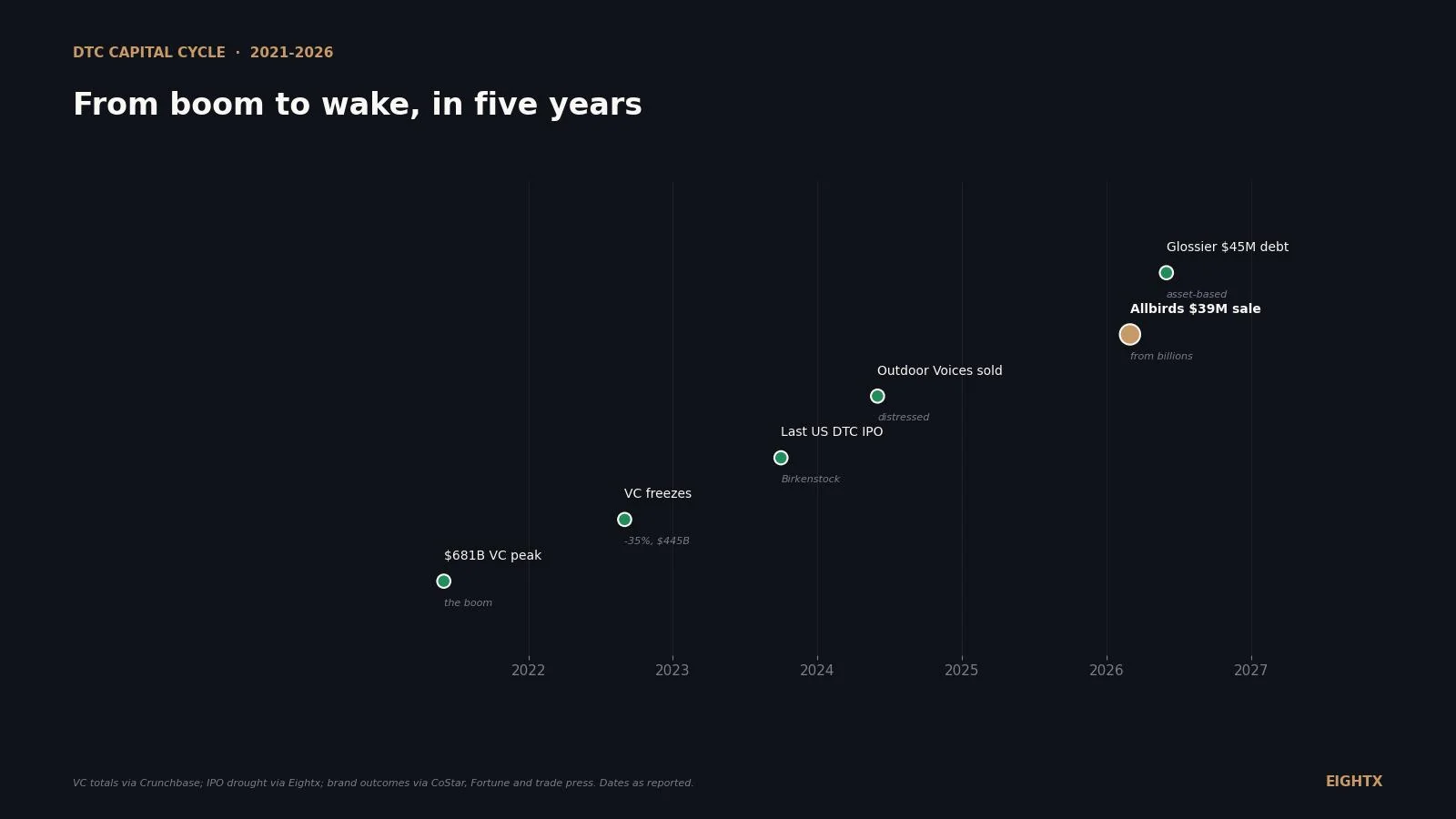
In 2021, global venture funding hit $681 billion, more than double the year before and an all-time record. Consumer and DTC were among the most aggressively funded corners of it. Crossover funds like Tiger Global, Coatue and D1 wrote enormous late-stage cheques at 10 to 20 times forward revenue, with light covenants and a thesis that customer-acquisition arbitrage on Facebook and Google would scale forever.
The valuations followed. Glossier hit $1.8 billion. Allbirds, Warby Parker and The Honest Company all went public in a roughly twelve-month window in 2020 and 2021. Casper had listed in early 2020. The story those rounds told was that DTC brands were high-growth, tech-adjacent assets that would compound their way to enormous public-market exits. Capital was priced on that story, not on the underlying retail economics, which in most cases had never actually proven out.
Act II: the freeze
Then the marginal buyer disappeared. Global venture funding fell 35% to $445 billion in 2022, and by the third quarter it had dropped below $100 billion for the first time in over two years. Tiger Global marked its own venture funds down about 33%, erasing roughly $23 billion of value, and pulled back hard from late-stage deals. The crossover funds that had set 2021's clearing prices simply stopped clearing.
For DTC brands the effect was brutal, because their public comparables led the way down. Allbirds, Warby Parker and Honest traded off 70 to 90% from their IPOs, which dragged every private mark in the category lower. New primary equity, the lifeblood of the boom-era model, effectively switched off.
It has not switched back on. By Eightx's own DTC funding-drought analysis, no pure-play US DTC brand had gone public for about 31 months as of mid-2026, since Birkenstock in October 2023, the longest drought in the modern era. And our analysis of time between rounds found the average DTC brand now waits 819 days, more than two years, between funding events. The brands raised for a world of capital every twelve months and woke up in a world of capital every two-plus years, if at all.
See your real margin on every order.
Get our Contribution Margin calculator: COGS, shipping, fees, ads, what's left.
Check your inbox. We'll send the Contribution Margin calculator shortly.
Act III: borrowing against the furniture
When equity is gone, or too dilutive to take at a depressed valuation, a brand with real assets does the rational thing. It borrows against them. This is the asset-based middle of the cycle, and it is where a lot of the surviving 2021 cohort sits right now.
The clearest example is Glossier, which in June 2026 raised a $45 million asset-based credit facility from Tiger Finance, the lending arm of, yes, Tiger Group. A brand that once raised equity at $1.8 billion chose to borrow against its inventory and IP rather than mark itself down in a new round. That is not failure. Done deliberately, it is discipline. But it is a different act of the play, and it tells you the equity story has paused.
The whole logic of lending changes here. In the boom, a lender underwrote your growth. In this act, a lender underwrites your collateral: your inventory turns, your receivables, the liquidation value of your stock. The covenants stop being about growth targets and start being about borrowing-base certificates. Equity stops being the headline and becomes what it always legally was, the residual, a claim behind the lenders that is worth something only if everything else gets paid first.
Act IV: the wake
For the brands that cannot make the economics work, even on asset-backed terms, the cycle has a final act, and it is busy.
| Brand | Boom marker | Where it landed | When |
|---|---|---|---|
| Casper | 2020 IPO | Taken private at $6.90, a ~43% discount to its $12 IPO | Nov 2021 |
| Brandless | SoftBank-backed hype | Shut down | Feb 2020 |
| Outdoor Voices | DTC activewear darling | Distressed sale (Tiger-advised) | 2024 |
| The Body Shop | Legacy ethical brand | UK administration | Feb 2024 |
| Allbirds | 2021 IPO, multi-billion | $39M brand sale | Mar 2026 |
| francesca's | PE relaunch on asset-based debt | Second Chapter 11, ~400 stores | Feb 2026 |
Source: Fortune, TechCrunch, Reuters, NY Post, CoStar and SFNet coverage, by company and date.
Read that table as a single sentence and it is the whole thesis. Allbirds went from a multi-billion-dollar public listing in 2021 to a $39 million sale of the brand in 2026. francesca's was relaunched by private equity on an asset-based facility and then filed its second bankruptcy, with roughly 400 stores now being liquidated by Tiger Group and its partners. Outdoor Voices, once the most-hyped activewear brand in the country, was sold in a distressed process whose realignment was advised by Tiger Advisory Services, part of Tiger Group. The exits in this act are not IPOs. They are brand-and-IP sales to aggregators, court-supervised 363 sales, and quiet liquidator-run wind-downs where almost nothing reaches the original equity.
What the liquidators are actually telling you
The single most useful market signal in consumer right now is not a funding announcement. It is which firms are getting busy. When the appraisers, the asset-based lenders and the liquidators are the most active capital providers in your sector, the market has rendered a verdict: it no longer values these businesses as growth stories.
That is the real meaning of the journey from Tiger Global to Tiger Group. DTC has been re-rated from a growth-equity frontier into what it probably always was, a form of cyclical retail. Capital is now priced the way it prices retail: on gross-margin durability, on marketing efficiency, on inventory turns, on liquidation value. The crossover funds that treated brands like software have been replaced, at the margin, by collateral lenders and restructuring specialists who treat brands like inventory. The same names rhyme across the cycle because the cycle is the point.
None of this means DTC is dead. Brands with durable margins, genuine repeat purchase and disciplined inventory are still being funded, increasingly by private equity and credit rather than venture. What died is the specific bargain of the boom: raise cheap equity, spend it on growth, and trust that scale will eventually fix the unit economics. The brands liquidating now are, almost to a one, the brands that took that bargain.
The operator takeaway: build to cash, not to the next round
If you run a brand, the practical lesson of the cycle is not to time it. It is to build something that does not depend on it.
The brands moving through Act IV have a common cause of death, and it is not bad luck. They raised against a story, spent against a forecast, and never built an operation that threw off its own cash, so when the equity stopped they had nothing to fall back on but their collateral. The brands that will be standing on the other side share the opposite habit. They know their unit economics to the decimal. They fund inventory with the right instrument instead of selling equity to cover a working-capital gap. They watch the spread between what their stock cost and what it is actually worth to a lender, the same downside number we wrote about in our inventory write-downs guide. They run, in short, to cash rather than to the next round. Building that operating discipline before the next round is forced on you is exactly the work a fractional CFO for ecommerce owns.
That is the entire job of a real finance partner in a cycle like this, and it is the opposite of what a bookkeeper does. A scorekeeper tells you what happened last month. An operating partner tells you which act of this story you are in, what the down years will demand of your balance sheet, and how to build so that the call you eventually take is from a growth investor and not from a liquidator. The two Tigers are a reminder that those are both real possibilities. Which one shows up is mostly decided years earlier, by how you ran the business when capital was still cheap.
Frequently Asked Questions
are tiger global and tiger group the same company?
No, and the difference is the whole point. Tiger Global Management is a venture capital and hedge fund firm founded by Chase Coleman that backed technology and consumer startups, including many DTC brands, at high valuations in 2020 and 2021. Tiger Group, legally Tiger Capital Group, is a separate firm that appraises, lends against and liquidates business assets. They share a name and have no common ownership. One helped fund the boom; the other works the bust.
what happened to DTC venture funding after 2021?
It froze. Global venture funding peaked at about $681 billion in 2021 and fell 35% to $445 billion in 2022, and consumer and DTC were among the hardest-hit categories. Crossover funds like Tiger Global, which had set record valuations, marked their portfolios down and retreated. For many late-stage DTC brands, new primary equity effectively disappeared, replaced by bridge notes, down-rounds, or asset-based debt.
how long has the DTC IPO drought lasted?
By mid-2026, no pure-play US DTC brand had gone public for roughly 31 months, since Birkenstock listed in October 2023, the longest such drought in the modern DTC era. Alongside that, the average time between funding rounds for DTC and ecommerce brands has stretched to about 819 days, more than two years, versus a year to 18 months during the boom.
which DTC brands collapsed or sold for a fraction of their value?
A long list. Casper IPO'd in 2020 and was taken private in 2021 at $6.90 a share, a roughly 43% discount to its $12 IPO price. Brandless shut down in 2020. Outdoor Voices was sold in a distressed process in 2024. The Body Shop's UK arm went into administration in 2024. Allbirds, a multi-billion-dollar 2021 IPO, sold for $39 million in 2026. francesca's filed its second Chapter 11 in 2026 and is liquidating roughly 400 stores.
why are asset-based lenders and liquidators suddenly everywhere in DTC?
Because the question lenders ask has changed. In the boom, capital was priced on revenue growth and brand heat. Now it is priced on hard collateral: inventory, receivables and IP. Asset-based lenders advance money against the liquidation value of those assets, and liquidators dispose of them when a brand fails. Their growing prominence is a sign the sector is being valued like mature, cyclical retail rather than high-growth tech.
is the DTC model dead?
No, but the easy-money version of it is. Brands with durable gross margins, loyal repeat customers and disciplined inventory can still raise capital and build real value, increasingly from private equity and credit funds rather than growth VCs. What is over is the model of funding losses with cheap equity in the expectation that scale alone fixes the economics. The brands that survive the down part of the cycle are the ones that built to cash.
how do I keep my brand out of the liquidation bucket?
Know your unit economics cold, fund working capital with the right instrument rather than equity, and watch the gap between what your inventory cost and what it is actually worth to a lender. The brands that end up in a wind-down are usually the ones that raised against a story, spent against a forecast, and never built a business that threw off cash. Build to cash, and the cycle's down years are survivable instead of fatal.