
Fundraising
How Much to Raise (and How to Size the Round) in 2026
Size your raise from the next clear value-inflection milestone plus a buffer, which usually means funding 18 to 24 months of runway. Estimate the burn to hit that milestone, add 6 to 9 months to raise again, then check the dilution. Aim for 15 to 25 percent per round, not more.
Key Takeaways
- Raise to fund the next value-inflection milestone plus a buffer, which usually lands at 18 to 24 months of runway.
- Start your next raise with 6 to 9 months of cash left, because in DTC the process now takes 6 to 9 months, not the 3 to 4 it took in 2021.
- Target 15 to 25 percent dilution per round. Median Series A dilution was 17.9 percent in early 2025 per Carta.
- Raising too little is the more common killer. Raising too much over-dilutes you and resets the valuation bar you have to clear next time.
- All-sector medians anchor the math: seed $3.0M, Series A $19.6M. DTC rounds typically price 10 to 30 percent below that.
Most founders pick a raise number the wrong way. They look at what a competitor raised, round up, and put it in the deck. That is how you end up raising too little and dying six months short of the milestone, or raising too much and handing away a third of your company before Series A.
The right number is not a vibe. It is the output of a calculation: what is the next milestone that materially de-risks the business, how much cash does it take to get there, and how much buffer do you need so you can raise again from a position of strength instead of panic. Get that math right and the dilution mostly takes care of itself. This guide walks the four moves in order: pick the milestone, size the burn, check the dilution, and pressure-test the total against the 2026 benchmarks.
Raise against milestones, not calendar time
The first rule is that you raise to reach the next value-inflection point, not to "get to next year." A value-inflection milestone is something that visibly de-risks the company and justifies a higher valuation: hitting $10M in revenue, proving repeat-purchase economics, landing national retail distribution, or getting contribution margin above a threshold a Series A investor will underwrite.
Once you name that milestone, the size of the raise is mostly arithmetic. Estimate the monthly net burn it takes to get there, multiply by the months of execution, then add the time it takes to raise the next round. Multiple sources converge on funding roughly 12 to 18 months of execution, which stretches to 18 to 24 months of total runway once you include fundraising and a cushion. Runway is simply cash on hand divided by monthly net burn, and venture-funded brands generally target 12 to 18 months of it at any given moment, with tighter markets pushing the planning number toward 24 to 36.
When I talk to founders running a brand this size, the pattern we see again and again is that they frame the raise as a calendar problem ("we need to get to next summer") instead of a milestone problem. One operator working back from a target put it as: get to the revenue number that unlocks the next round, then figure out how many months of cash that takes, not the other way around. The milestone is the anchor. The months are the output.
Start the next raise before you are desperate
Here is the part founders skip: you do not raise when you run out of money. You raise while you still have 6 to 9 months of cash in the bank, because the process of pitching, negotiating, and closing routinely takes months, and investors can smell desperation. A term sheet negotiated with nine months of runway looks very different from one negotiated with two. If you want better terms, know how to negotiate a term sheet as a founder before you are under the gun.
That is why the planning target is 18 to 24 months even though the execution window is shorter. The extra cushion is your negotiating power. And in DTC the cushion has to be bigger than it used to be, because the fundraising cycle itself has roughly doubled, from 3 to 4 months in 2021 to 6 to 9 months by 2026. Consumer is the hardest-hit category of the venture reset: US DTC venture investment peaked above $5B in 2021 and fell to just over $130M in a recent year, a decline of roughly 97 percent. When capital is this scarce, running out of runway mid-raise is fatal.
When we have struggled alongside founders trying to close in this market, what they describe is that the capital itself is slow. One operator talking to several lenders for months summed up the climate as macroeconomically brutal right now, with every bank moving at a crawl. That is the environment you are starting a raise into. Start it early, while you still have options.
The dilution math
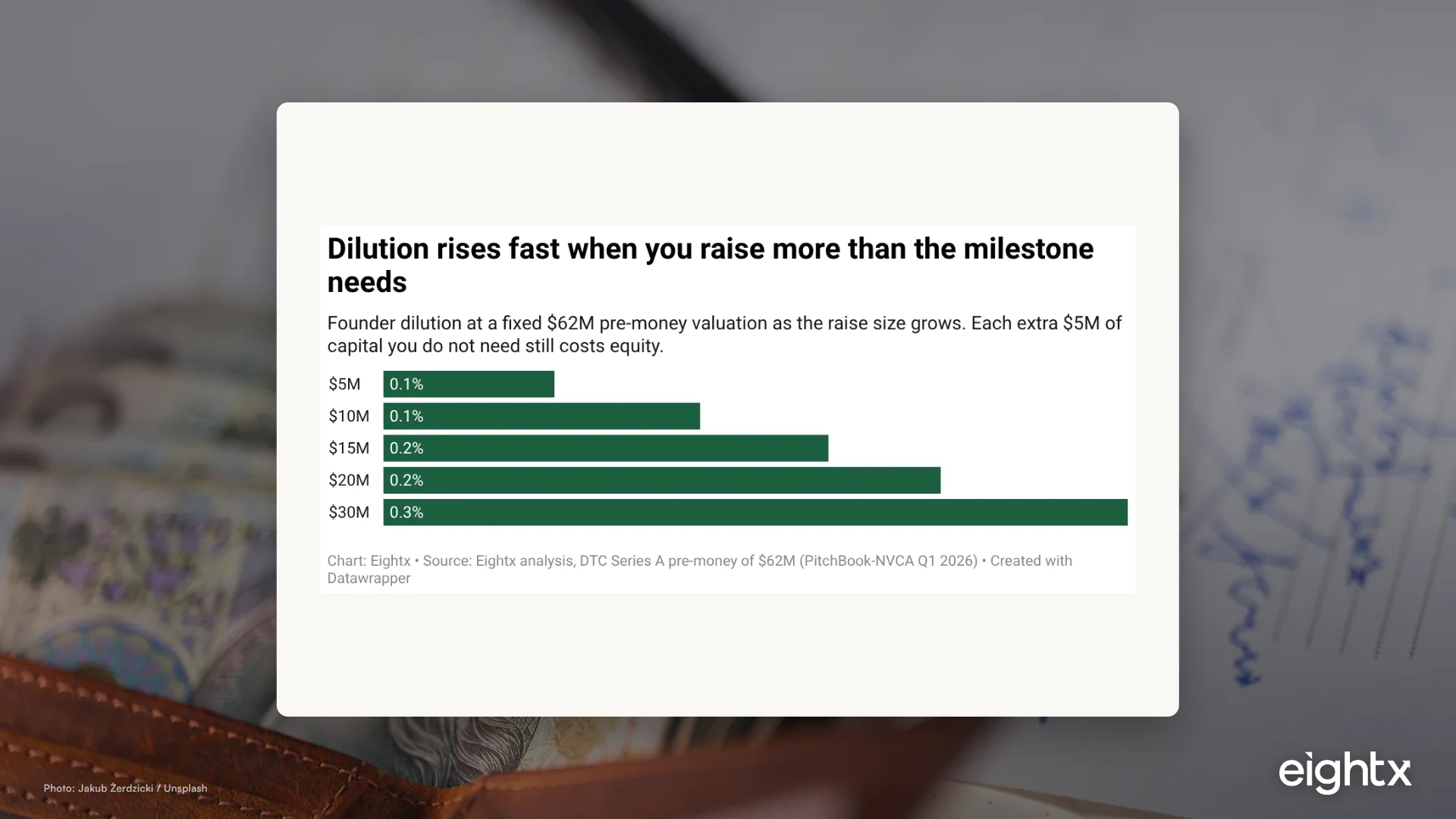
Dilution is the price of the cash. The formula is simple: dilution equals the raise divided by the post-money valuation, where post-money is your pre-money valuation plus the raise. At a fixed pre-money, every extra dollar you raise costs more equity.
Use the 2026 Series A median pre-money of roughly $62M as the anchor and watch what happens as the raise grows.
A $15M raise at that valuation costs you about 19.5 percent, right in the healthy band. Push to $20M and you are at 24.4 percent. Push to $30M and you have handed over 32.6 percent in a single round. The target for a healthy round is 15 to 25 percent dilution. Carta put median Series A dilution at 17.9 percent in early 2025, down from 20.9 percent the year before, and median dilution across all rounds from seed through Series C has compressed from roughly 18 to 16 percent over the past year. If your number implies more than 25 percent, you are either raising too much or your valuation is too low to be raising at all.
The honest truth from the founders we work with is that dilution modeling is the real work of a raise, not the pitch deck. One operator advising a founder framed it plainly: the big task with your counsel is the dilution modeling, and you do not actually need a fractional CFO to get through a round as long as you believe your own numbers and can speak to the model in the room. The model is the thing investors test you on.
Pressure-test against the 2026 benchmarks
Your milestone math produces a number. Before you commit to it, sanity-check that number against what rounds actually price at right now, so you are not anchoring on a 2021 figure that no longer exists.
The all-sector US medians are a seed round of $3.0M on an $18.4M pre-money and a Series A of $19.6M on a $62.0M pre-money. DTC and consumer brands typically price 10 to 30 percent below those headline numbers, which is a directional Eightx estimate rather than a published median, so treat it as a planning band. The table below puts the round size, pre-money, and typical dilution side by side.
| Stage | Median round size | Median pre-money | Typical dilution |
|---|---|---|---|
| Seed | $3.0M | $18.4M | 15 to 20% |
| Series A | $19.6M | $62.0M | ~18% (17.9% Q1 2025) |
The timing piece is the other half of the sanity check. DTC funding has not recovered with the broader market, and the share of seed-funded consumer brands that ever reach a priced Series A has collapsed across cohorts.
Only about 20 percent of the 2022 consumer seed cohort had raised a priced Series A by mid-2025, versus 51 to 61 percent for the 2018-2020 cohorts. Median seed-to-Series-A time for consumer startups hit 819 days, about 2.2 years, in Carta's late-2024 data. Translation: if you are a DTC brand, plan for a longer gap between rounds and a bigger cash buffer than the all-sector averages imply, because the next round is both slower to arrive and less certain to happen.
A worked example
Say you run a $6M-revenue DTC brand. The next milestone that unlocks a real Series A is $15M in revenue with positive contribution margin, and you estimate that takes 18 months of execution.
| Input | Value |
|---|---|
| Monthly net burn to hit the milestone | $250,000 |
| Execution window | 18 months |
| Execution cost (18 x $250K) | $4.5M |
| Fundraising buffer (6 months x $250K) | $1.5M |
| Contingency for slippage (~15%) | $1.0M |
| Round to raise | ~$7M |
Now check the dilution. If your pre-money is $20M, a $7M raise is 7M divided by 27M, or about 26 percent. That is a touch hot. The disciplined moves are to tighten burn, raise slightly less, or push the pre-money up with stronger traction before you open the round. The point is that the milestone sets the floor on the raise, and the dilution check sets the ceiling. You solve for the number that satisfies both.
The reason we push founders to model this bottom-up rather than eyeball it is not the headline number. It is that a real model flags the month the plan slips. When we build a brand's fundraising model, the point isn't the number at the bottom, it's that the model tells you where something's wrong the moment your actual results diverge from plan, all the way down the funnel from impressions to add-to-carts to revenue. That early warning is worth more than precision on the raise.
The two failure modes
Raising too little is the more common killer. You raise $4M for an 18-month plan that actually needs $6.5M, the milestone slips, and you hit the market again with five months of runway and nothing new to show. That is how down rounds and ugly bridges happen. The fix is honest burn estimates and a real contingency line.
There is a hard-won line we hear in angel and seed conversations: raise enough, but nobody ever raises enough. Founders systematically underestimate how long the milestone takes and how slow the next raise will be, so the plan that looked conservative on the spreadsheet leaves them short. Build the contingency in on purpose, because optimism is already baked into your burn forecast.
Raising too much feels like winning and bites later. The extra capital over-dilutes you today, and worse, it resets the bar: a $30M raise at a $90M post-money means your next round has to clear a valuation well north of that or it is a down round. Big rounds also tend to fund undisciplined spending, which is exactly what investors penalize in a tight DTC market. One more option to keep in mind: for funding inventory specifically, the path of least resistance often is not equity, it is debt. Operators repeatedly weigh a line of credit or a working-capital facility against selling equity, because you should not give up 25 percent of your company to finance stock you will sell and restock in 90 days. If you are stuck on which instrument fits which need, our equity versus debt versus revenue-based financing decision matrix walks through where each one actually wins.
What to do about it
- Name the single next milestone that visibly de-risks the business and unlocks a higher valuation. Write it down in dollars and dates.
- Build a bottom-up monthly net burn forecast to reach that milestone. Do not eyeball it, model it in a fundraising financial model.
- Multiply burn by the execution months, then add 6 to 9 months of fundraising buffer.
- Add a contingency line of 10 to 20 percent for slippage. Plans always run late.
- Calculate the implied dilution at your realistic pre-money. If it is above 25 percent, cut burn, raise less, or strengthen traction before opening the round.
- Sanity-check the total against stage norms: DTC rounds run 10 to 30 percent below the all-sector medians of seed $3M and Series A $19.6M.
- For inventory and other short-cycle working capital, price the debt option before defaulting to equity.
- Commit to starting the raise with 6 to 9 months of cash still in the bank, not zero.
The number is not the hard part. The discipline is. Size the raise to clear one real milestone, keep dilution in the 15 to 25 percent band, and start the process with most of a year of cash still in the bank. Do that and you raise from strength every time. Skip it and you raise from panic, which is the most expensive equity you will ever sell.
Sources and methodology
Round-size and pre-money figures come from the PitchBook-NVCA Venture Monitor, Q1 2026 cut (data as of March 31, 2026): median seed round $3.0M on an $18.4M pre-money, and median Series A round $19.6M on a $62.0M pre-money. These are all-sector US medians; a prior-quarter cut showed a higher seed and lower Series A round size, so treat the Q1 2026 numbers as the headline and any single quarter as a planning range rather than a fixed truth.
Dilution figures come from Carta's State of Private Markets. Median Series A dilution was 17.9 percent in Q1 2025, down from 20.9 percent a year earlier, and median dilution across all rounds from seed through Series C has compressed from roughly 18 to 16 percent over the past year, with lower dilution reported at every stage for three years running. The 15 to 25 percent healthy band, and the "above 25 percent in one round is a flag" rule, are a synthesis of that Carta data.
The dilution chart uses the standard formula, dilution equals raise divided by pre-money plus raise, computed by hand at a fixed $62M pre-money. The only assumption is the published $62M anchor; there are no fabricated inputs.
Runway norms (18 to 24 months total, 24 to 36 in tighter markets, and starting the next raise with 6 to 9 months of cash left) are corroborated across NYU Entrepreneurial Institute, Brex, Scaleup Finance, JPMorgan, and 500 Startups fundraising guidance. The DTC-specific timing data (the funding decline from roughly $5B to $130M, the cohort graduation rates, and the 819-day median seed-to-Series-A gap) comes from Crunchbase-based coverage via Retail Dive and Carta.
PitchBook and Carta are proprietary datasets, so their figures here are sourced via published reports and triangulation rather than a first-party data feed. The "DTC rounds price 10 to 30 percent below all-sector medians" claim is a directional Eightx estimate, not a published median, and is labeled as such throughout. Treat every figure in this post as a planning range, not a promise.
Frequently Asked Questions
how much should i raise for my ecommerce brand?
Raise enough to hit your next clear value-inflection milestone plus a buffer, which usually works out to 18 to 24 months of runway. Work backward from the milestone, estimate the burn to reach it, then add 6 to 9 months so you can fundraise again before cash runs out.
how many months of runway should a fundraise buy?
Plan for 18 to 24 months of total runway. That leaves roughly 12 to 18 months to execute and reach the milestone, plus 6 to 9 months to run the next raise. Working-capital-funded brands can run leaner at 12 to 18 months total.
what is a normal dilution per funding round in 2026?
Most rounds land at 15 to 25 percent dilution. Carta put median Series A dilution at 17.9 percent in early 2025, down from 20.9 percent a year earlier, and median dilution across all rounds has compressed toward 16 percent. Anything above 25 percent in one round is a flag.
what happens if i raise too little?
You run out of cash before hitting the milestone that justifies the next valuation step-up. That forces a down round, a bridge on bad terms, or a fire sale. Too little is usually more dangerous than slightly too much.
is it bad to raise too much money?
Yes. Excess capital over-dilutes you, raises the valuation bar you have to clear next time, and tends to fund undisciplined spending. Each extra $5M you do not need still costs equity at a fixed pre-money valuation.
how do i size a round from a milestone instead of guessing?
Name the next milestone that visibly de-risks the business, model the monthly net burn to reach it, multiply by the execution months, add 6 to 9 months of fundraising buffer plus a contingency, then check the implied dilution. The milestone sets the floor and the dilution check sets the ceiling.
when should i start fundraising before i run out of cash?
Start with 6 to 9 months of runway still in the bank, and 9 to 12 if you can. In DTC the process now takes 6 to 9 months versus 3 to 4 in 2021, and investors can smell desperation when you are nearly out of cash.
how is raising for a dtc brand different from a saas startup?
DTC rounds price below all-sector medians, the funding market is far tighter, and inventory is often better funded with debt than equity. Only about 20 percent of the 2022 consumer seed cohort had reached a priced Series A by mid-2025, so plan for a longer gap and a bigger cash buffer.