
Fundraising
Funding Your Ecommerce Brand: The Complete Guide (2026)
DTC brands fund growth six ways: bootstrapping, equity (angel and VC), debt (lines of credit, term loans, venture debt), revenue-based financing, inventory financing, and non-dilutive capital like grants and credits. The right mix depends on stage, margins, and how much control you will trade for speed and cost.
Key Takeaways
- There are six funding categories, not two; most successful brands stack three or four of them over their life, not pick one.
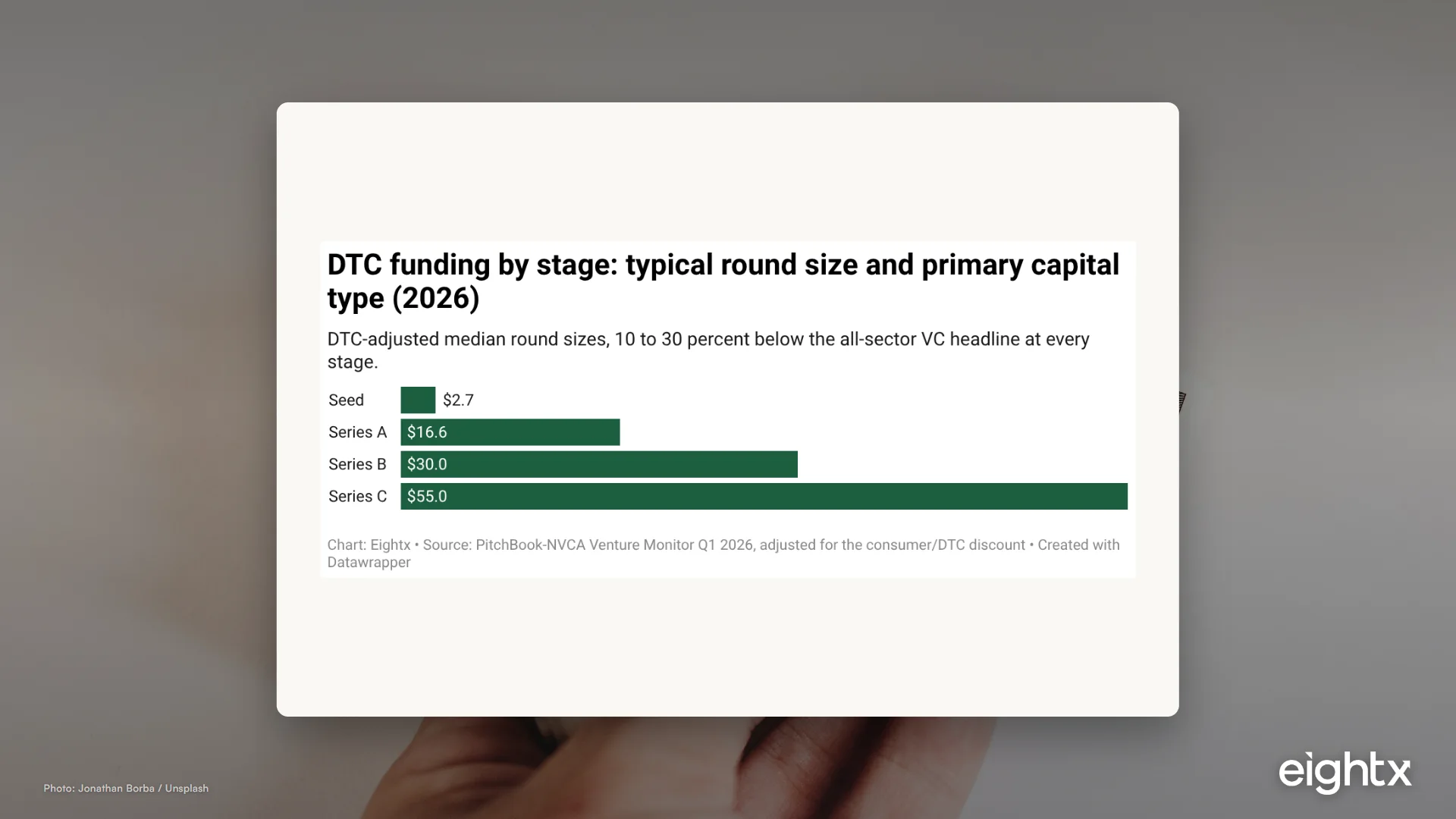
- DTC-adjusted round sizes run 10 to 30 percent below the headline VC medians: roughly $2.7M seed, $16.6M Series A, $30M Series B.
- Equity is the most expensive capital on a fully diluted basis: $5M of equity often costs more over three years than $5M of 12 to 14 percent bank debt.
- US bank asset-based inventory lines run about 7 to 10 percent all-in; fintech inventory lines run 15 to 30 percent for speed and looser covenants.
- Only raise venture if the round funds non-payroll growth and your unit economics already throw off cash; otherwise debt or RBF is usually cheaper.
Most founders treat funding as a binary: bootstrap or raise. That framing has cost more brands more equity than almost any other mistake we see on diligence calls. There are six ways to fund an ecommerce brand, not two, and the brands that compound the longest stack three or four of them over their life, each matched to a specific job at a specific stage.
When I talk to founders running a brand at this size, the line I hear most often is some version of "we need to raise." Almost as often, the honest answer is that the cheapest dollar in front of them is not equity at all. As one founder put it on a working-capital gap, the path of least resistance is not equity, it is debt. That instinct, reach for the round, is exactly the one this guide is built to slow down.
This is the hub. It maps all six funding categories, what each actually costs in 2026, when each fits, and the one tradeoff that sits underneath every financing decision: cost versus control. Each section routes to a more detailed guide if you want to go down a level. Read this first, then go deep on the one or two that fit where you are right now.
The six ways to fund a DTC brand
Every dollar that funds your brand comes from one of six places. They are not interchangeable, and the cheapest is rarely the fastest.
| Funding type | What it is | Typical cost | Dilutes equity? | Best for |
|---|---|---|---|---|
| Bootstrapping | Reinvested profit and founder capital | Opportunity cost only | No | Early traction, control-focused founders |
| Equity (angel/VC) | Cash for ownership | Dilution, most expensive at exit | Yes | Non-payroll growth, defensibility plays |
| Debt (LOC/term/venture) | Borrowed cash, repaid with interest | 7 to 20% APR | No (venture debt: warrants) | Predictable spend with clear ROI |
| Revenue-based financing | Advance repaid as a revenue share | 15 to 35% effective APR | No | Inventory, ad spend, bridges |
| Inventory financing | Capital secured against stock | 7 to 30% APR | No | Funding purchase orders and builds |
| Non-dilutive (grants/credits) | Money you do not repay or give equity for | Near 0%, application cost | No | Extending runway, lowering blended cost |
The decision is never "which one." It is "which one for this dollar, at this stage, for this job." A brand can be bootstrapped, carry a bank line for inventory, and raise an equity round for international expansion all in the same year. The pattern we see again and again with the brands that keep the most ownership is that they treat bootstrapping as the default and only step up the cost-and-control ladder when the job in front of them genuinely needs it. Choosing to bootstrap over equity, as a founder once framed it to us, sometimes just means you move a little slower so you do not have to rely on outside funding. For a structured walk through the first fork, see our bootstrap or raise guide. For the equity-versus-debt-versus-RBF version of the decision, the full breakdown is at /blog/equity-vs-debt-vs-rbf-decision.
What each stage actually raises
Round sizes for brand-heavy DTC businesses sit well below the headline venture medians. The all-sector Q1 2026 numbers (seed $3.0M, Series A $19.6M) are dragged up by a small number of AI mega-rounds. Strip those out and the DTC-adjusted curve runs 10 to 30 percent lower at every stage, per our funding round size index.
Two numbers matter as much as the round size. Early-stage dilution at seed and Series A sits in a 19 to 25 percent band in Carta's 2026 data, and it has been compressing slightly, so the market is buying smaller pieces. And the seed-to-Series A graduation rate for consumer brands is roughly 20 to 30 percent. Of every 100 DTC seeds funded, only one in four to one in five clears a Series A. That filter is the steepest in the whole funnel because brands have to grow revenue eight to twelve times to clear it.
When we talk to founders prepping a raise, the first question we push back on is not "how much" but "how much of it has to actually be working." A founder once asked us exactly that, "we want to raise two or three million bucks, what do we need to present, and how much of it has to be working?" The answer shapes the round more than any benchmark. Anchor your raise on the DTC-adjusted curve, not the headline, and size it to clear the next milestone with margin.
Equity: the most expensive capital you can take
Equity feels free because nothing leaves your bank account. It is the most expensive capital you will ever raise, measured at exit. A founding team that raises across four rounds at today's dilution bands ends up owning less than half the company before option-pool refreshes (illustrative, assuming roughly 20 percent dilution per round). The cost is not interest. It is the slice of every future dollar of enterprise value you no longer own. The way one founder put it to us still lands: the equity is nice because you do not have to pay it back, but you then experience a significant amount of dilution at a lower valuation. That last clause is the whole trap. Raising equity at a soft valuation locks in the worst possible price for the most expensive money you will ever take.
Equity earns its cost when the round funds growth your margins cannot fund alone: new product lines, brand defensibility, international launches, or infrastructure that compounds. It is the wrong tool for working capital or paid-acquisition arbitrage, which debt funds far more cheaply. The discipline we push on operators is simple: only raise to buy growth that pays back. If you can acquire a customer that throws off positive lifetime profit inside a timeframe you can live with, fund as much of that as you can. If you cannot, no amount of equity fixes it. Before you take the meeting, know what investors actually underwrite, the metrics they will scrutinize, and how early-stage paper is structured. When the term sheet lands, read the preferences stack carefully, because a "flat" round with a 1.5x participating preference is functionally a down round.
Debt and the working-capital layer: cheaper, if your cash flow can carry it
Debt keeps your cap table intact. The tradeoff is repayment pressure: if cash flow hits a seasonal dip or a soft launch, the schedule does not flex. The 2026 backdrop helps. The base cost of debt has fallen hard. SOFR sits at 3.63 percent and the bank prime rate at 6.75 percent, both down sharply from their 2024 peaks, so anything that prices off them is structurally cheaper than it was two years ago.
For a $5M to $50M DTC brand on an asset-based inventory line, US bank pricing runs about 7 to 10 percent all-in (SOFR plus a 2 to 6 point margin), per our cost of capital tracker. Fintech inventory lines run 15 to 30 percent because you are paying for speed and looser covenants, not for the credit quality you actually carry. Run the comparison directly: $5M of equity given up at a $40M post-money is 12.5 percent of the company forever, while $5M of 12 to 14 percent bank debt is repaid in full over three years and you keep every point of upside. For most brands with serviceable cash flow, debt is the cheaper structure on a fully diluted basis. The fuller breakdown is at debt vs equity for ecommerce. Venture debt sits in its own lane, layered on top of an equity round to extend runway without a fresh markdown.
Between bootstrapping and a priced round sits the layer most operators underuse: financing that funds the cash conversion cycle without touching your cap table. Revenue-based financing advances cash repaid as a share of revenue, capped at 1.06 to 1.20 of the advance, which works out to a 15 to 35 percent effective APR depending on payback speed, per our breakdown of what revenue-based financing is. It fits inventory with predictable repeat purchase, ad-spend amplification when LTV:CAC is healthy, and bridges between raises. It does not fix broken unit economics. It accelerates the bleed if you use it to cover losses.
| Instrument | All-in cost / effective APR | Dilution | Cap or advance size | Speed to fund |
|---|---|---|---|---|
| Bank ABL inventory line | 7 to 10% (SOFR + 2-6%) | None | 40-70% of inventory cost; 80-85% of AR | Weeks |
| Venture debt | ~10 to 13.5% (SOFR/prime + 6-9%) | 1-3% warrants | 20-35% of last equity round | 4 to 8 weeks |
| Revenue-based financing | 15 to 35% effective APR | None | 1.06x-1.20x cap; 1-4x monthly revenue | 24-72 hours |
| Fintech inventory line | 15 to 30% | None | Based on store and ad data | Days |
| Equity round (DTC) | No coupon; ~30% implied | 19-25% per round | DTC-adjusted round size | 3 to 6 months |
| Merchant cash advance | 50 to 180%+ effective APR | None | 1.30x-1.50x cap | Days |
When operators ask us how to structure the debt layer cleanly, the answer is almost always the same shape: a term loan that funds your working-capital base with an asset-based line that floats on top of it. One founder described the ideal as eight million of a term loan with four million of an ABL, financing the base then adding a flexible floater for the swings. It is close to the best structure that exists for a product business with real inventory. The two rules underneath it: never stack RBF across multiple providers, because the compounding remittances drain cash velocity the same way stacked merchant cash advances do, and never reach for debt to paper over broken unit economics. As one lender-side conversation put it, when a founder is unsure the business will recover, the last thing you want to hand them is debt they have to repay no matter what the business does. Before you commit, build the cash math: a proper fundraising financial model shows whether the advance clears the gap or just moves it.
Non-dilutive capital: the layer founders forget
The cheapest capital is the kind you neither repay nor trade equity for. R&D tax credits, government grants, platform and ad credits, and supplier net terms all extend runway and lower your blended cost of capital before you give up a single point. Supplier terms in particular are financing hiding in plain sight: one operator described deliberately moving from net 30 to net 60 and carrying a bit more inventory so they could draw down stock slowly without a facility at all. For CPG and ingredient-led brands the grant and credit landscape runs deeper than most founders realize, with named non-dilutive funds now active in the category alongside the credits. None of this replaces a growth round, but every dollar of non-dilutive capital is a dollar you do not have to raise at a dilutive price.
What to do about it
A practical sequence for any $5M to $50M DTC operator deciding how to fund the next phase.
- Pull your weighted-average cost of capital across everything you already use: equity given up, every debt facility, every RBF advance. The mechanics are the weight of each source in the structure multiplied by its own cost, summed. You cannot compare a new dollar against your existing stack without that baseline, and most founders we talk to have never actually computed it.
- Sort the next dollar by job. Working capital and inventory: debt or RBF first. Non-payroll growth that compounds: equity. Runway extension: non-dilutive credits and supplier terms.
- Anchor any raise on the DTC-adjusted curve, not the headline VC median. A $10M to $16M Series A at $40M to $60M post-money is what a clean round looks like in 2026.
- Model dilution against debt on a fully diluted, multi-year basis before you accept equity. Equity that looks free today is usually the most expensive line on the cap table at exit.
- Refinance any non-bank line above 14 percent APR if you qualify for a bank ABL. The spread often pays back the diligence cost inside twelve months.
- Build to the bar that exists: gross margin above 50 percent, contribution-margin positive, payback inside 9 to 12 months, channel diversification beyond paid social. That bar is not easing.
Methodology
Round size, dilution, and graduation-rate figures are drawn from our funding round size index, which triangulates the PitchBook-NVCA Venture Monitor Q1 2026 (seed $3.0M, Series A $19.6M, Series B $40.0M, Series C $75.0M medians) and Carta's 2026 record-setting-valuations data (seed and Series A dilution in a 19 to 25 percent band, declining slightly) and applies a 10 to 30 percent consumer discount. The seed-to-Series A graduation rate of 20 to 30 percent for consumer brands comes from Crunchbase and Carta data on the 2022 seed cohort, with SVB's State of the Markets confirming seed-to-A as the steepest filter in the funnel. The base rate series (SOFR 3.63 percent on 2026-06-05, bank prime 6.75 percent on 2026-06-03) are pulled live from FRED. Cost-of-debt bands (bank ABL 7 to 10 percent, fintech inventory lines 15 to 30 percent) come from our global DTC cost of capital tracker, built on those FRED policy-rate series and 2026 market terms. Revenue-based financing cost ranges (1.06 to 1.20 cap, 15 to 35 percent effective APR) come from our revenue-based financing explainer. DTC-adjusted figures are directional triangulations, not measured medians, because no source publishes a free, current, consumer-only by-stage table. The revenue-based-financing and merchant-cash-advance effective-APR bands are inferred from public fee and factor structures, not observed vendor quotes, and equity's roughly 30 percent figure is an estimate of investor required return rather than a cash coupon.
Frequently Asked Questions
what are the main ways to fund an ecommerce brand?
Six categories: bootstrapping (reinvested profit), equity (angel and VC), debt (lines of credit, term loans, venture debt), revenue-based financing, inventory financing, and non-dilutive capital like grants and R&D credits. Most brands stack three or four of these over their lifetime rather than relying on one.
should i bootstrap or raise money for my ecommerce business?
Bootstrap if your margins fund the growth rate you want and you value control. Raise if a clear, capital-efficient use of funds will compound faster than reinvested profit, your unit economics already clear the bar, and the round funds non-payroll growth like product or brand rather than just working capital.
how much should a dtc brand raise at seed and series a in 2026?
Plan for a DTC-adjusted seed around $1M to $5M (clustering $2M to $4M) and a Series A around $10M to $16M at $40M to $60M post-money. The headline all-sector Series A median of $19.6M is the wrong yardstick because mega-AI rounds drag it up.
is equity or debt cheaper for an ecommerce brand?
On a fully diluted basis, equity is usually the most expensive capital. $5M of equity given up early can be worth far more at exit than $5M of 12 to 14 percent bank debt repaid over three years. Debt is cheaper when your cash flow can service it; equity makes sense when the round funds growth your margins cannot.
what is revenue-based financing and when should i use it?
Revenue-based financing advances cash repaid as a percentage of revenue, with a fixed cap (1.06 to 1.20) rather than interest. Effective APR runs 15 to 35 percent. Use it for inventory with predictable repeat purchase, ad-spend amplification when LTV:CAC is healthy, or as a bridge between raises. Do not use it to cover operating losses.
what non-dilutive funding is available for ecommerce and cpg brands?
Non-dilutive options include R&D tax credits, government grants, platform and ad credits, supplier net terms, and inventory or AR financing that does not touch your cap table. They will not replace a growth round, but they extend runway and lower your blended cost of capital before you give up any equity.
what is the cheapest way to finance inventory in 2026?
For a strong DTC borrower, a bank asset-based inventory line is usually cheapest at about 7 to 10 percent all-in (SOFR plus a 2 to 6 point margin), advancing 40 to 70 percent of inventory cost. Fintech inventory lines fund in days but cost 15 to 30 percent. If you carry a non-bank line above 14 percent and you qualify, refinancing into a bank ABL usually pays back the diligence cost inside a year.