
Fundraising
Grants and Non-Dilutive Capital for CPG Brands (2026 Toolkit)
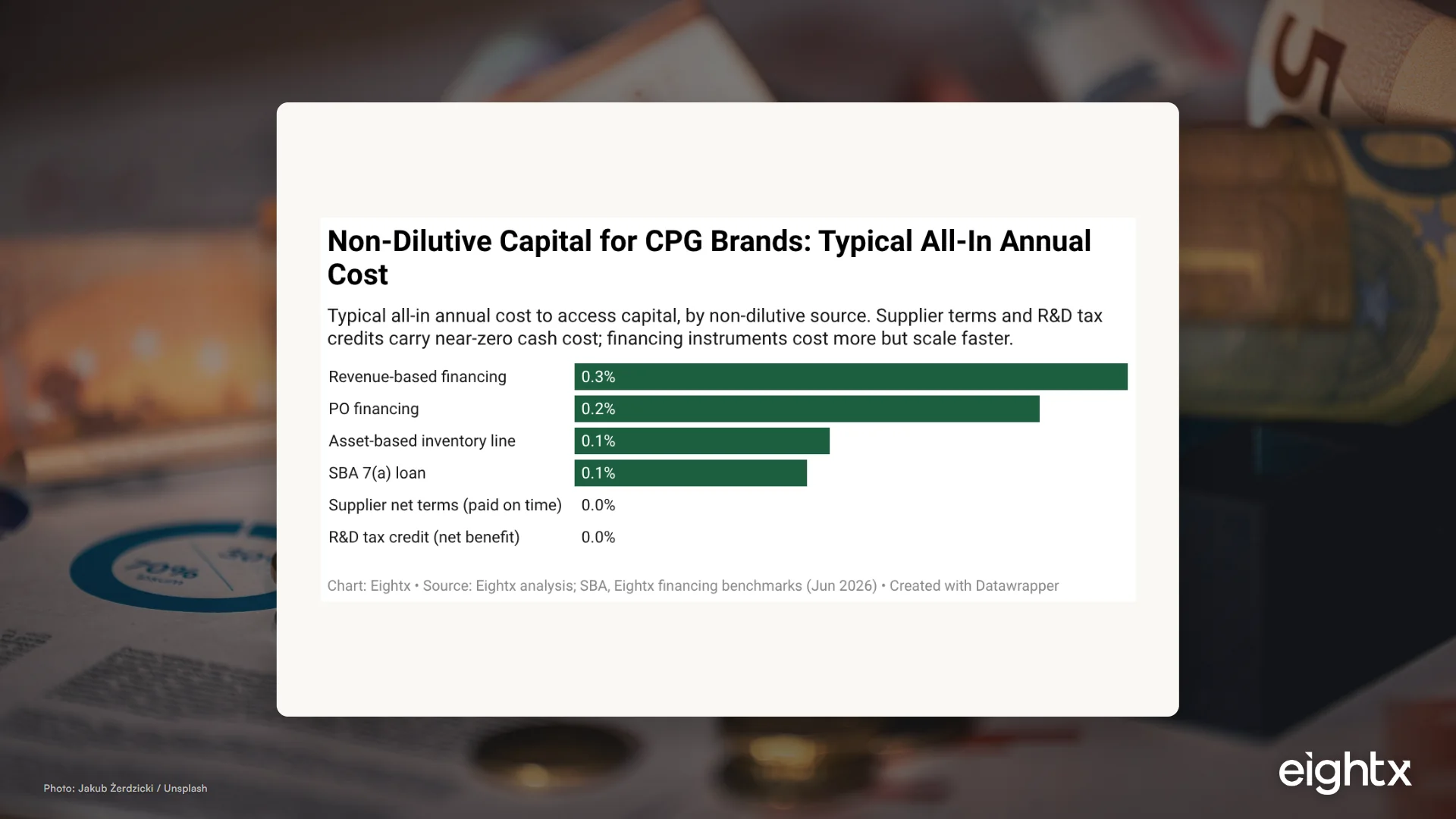
Non-dilutive capital lets CPG brands fund growth without selling equity. The cheapest sources are supplier net terms and R&D tax credits at near-zero cash cost, then SBA 7(a) loans around 10% and asset-based inventory lines around 11%, with PO financing near 21% and revenue-based financing near 25%. Stack them cheapest first.
Key Takeaways
- Supplier net terms and R&D tax credits are the cheapest capital you can get: near-zero cash cost versus 8% to 35% for financing instruments.
- SBA 7(a) loans cap at $5M and run about 9.75% to 13.25% in 2026 (prime 6.75% plus a 3.0% to 6.5% statutory spread by loan size), with real lender quotes often below that.
- Asset-based inventory lines cost 8% to 15% APR; PO financing runs 12% to 30%; revenue-based financing runs 15% to 35% effective APR.
- Stack capital cheapest-first: free supplier terms, then tax credits and grants, then a low-cost line, and use RBF only at the margin.
- Every dollar of non-dilutive capital you use is a dollar of equity you do not have to sell, which at a 5x exit is worth 5x the cash.
Most CPG and DTC founders treat equity as the default funding button. A retailer says yes, a big inventory buy is due, ad spend is working, and the fastest way to find the cash feels like selling a slice of the company. It is also the most expensive money you will ever take. A dollar of equity you sell today is worth roughly five dollars at a 5x exit. A dollar of debt costs you the interest and nothing else.
When we talk to founders running a brand at this size, the line we hear most is that the path of least resistance feels like equity. The pattern we see again and again is the opposite: the path of least resistance should be debt, because equity at an early-stage valuation locks in a lot of dilution at a low number you can never buy back. The good news is that there is a whole toolkit of non-dilutive capital built for brands exactly your size, and most founders use one tool when they could be stacking six. This is the menu, what each source costs, who qualifies, and how to layer them so you fund growth without giving up a point of ownership.
The non-dilutive menu, cheapest first
There are six tools worth knowing. Ranked by cost to access a dollar of capital, they fall into three tiers: near-free (supplier terms, tax credits, grants), cheap scalable debt (SBA loans, inventory lines), and fast expensive debt (PO financing, revenue-based financing).
The chart shows cash cost only. It deliberately leaves out the hidden cost of equity, which does not show up as a rate but is by far the most expensive line on any real funding stack. The whole toolkit is also a menu, not a mandate. Some founders want debt, some do not, and the right plan is the one that fits the risk you are actually willing to carry.
| Source | Typical cost | Best use | Tradeoff |
|---|---|---|---|
| Supplier net terms | ~0% if paid in window | Inventory working capital | Forgoes early-pay discount; needs trust and history |
| R&D tax credit | ~0% (tax offset) | Formulation, process, packaging work | Documentation plus an advisor; must meet the IRS 4-part test |
| Grants (USDA VAPG, SBIR, state) | 0% (non-repayable) | Equipment, facility, R&D milestones | Application-heavy; project-specific; often reimbursable |
| SBA 7(a) loan | 9.75% to 13.25% (Jun 2026) | Bulk working capital up to $5M | Slow to close; collateral plus personal guarantee |
| Asset-based inventory line | 8% to 15% APR | Proven SKUs and seasonal builds | Do not finance slow movers |
| Purchase order financing | 12% to 30% APR | One-off large confirmed orders | Expensive; reserve for high-confidence sell-through |
| Revenue-based financing | 15% to 35% effective APR | Inventory plus ad spend with healthy LTV to CAC | Daily or weekly remittance bites cash velocity |
Tier 1: near-free capital (terms, credits, grants)
Supplier net terms. The most underused balance sheet tool in CPG. Net 30, 45, or 60 terms are interest-free working capital if you pay inside the window. Push a supplier from net 30 to net 60 and you have effectively financed two months of inventory at zero cash cost. The way we frame it with founders: free or extended inventory from a supplier is a loan, just a massive one with no interest. Eligibility is about trust, your buying history, a clean payment record, and sometimes financials. The honest caveat is bargaining power. For the average brand under $10M you do not have a lot of pull with suppliers, and you only get real pull once you make up roughly 10% or more of a supplier's business. One trick that works before you have that scale: a letter of credit, a bank guarantee to the factory, can sometimes move a supplier from no terms to 30-day terms because they know the bank will cover them.
R&D tax credits. If you reformulate products, extend shelf life, re-engineer a process, or redesign packaging for performance, you likely have qualifying research. The federal credit is 20% under the regular method or 14% under the alternative simplified method, per the IRS. Critically, a qualified small business can apply up to $500,000 of the credit against payroll taxes each year, so even a pre-profit brand gets cash value. The cost is documentation and a good advisor, not capital.
State and federal grants. These vary widely but commonly fund facility buildout, equipment, manufacturing investment, R&D milestones, and job creation. They do not require repayment if you meet the conditions. If you are producer-owned or farm-linked, the USDA Value-Added Producer Grant funds up to $50,000 in planning and up to $200,000 in working capital, with a 1:1 match. SBIR and STTR fund genuine R&D milestones, not marketing or working capital. DTC-first programs like Project Potluck and the SHOPLINE Next Gen DTC Founders Grant exist too. The tradeoff: grants are application-heavy, project-specific, and often reimbursable only after you spend. Treat them as a bonus that offsets a planned capital project, not as cash you can count on for a deadline.
Tier 2: cheap scalable debt (SBA, inventory lines)
SBA 7(a) loans. The workhorse of US small-business lending, capped at $5M per loan. The maximum variable rate is the prime rate plus an allowed spread that shrinks as the loan grows. With prime at 6.75% in June 2026, the statutory ceiling runs 9.75% to 13.25%, and a typical larger loan lands near 9.75% to 11.25%. Real lender quotes on bigger loans often sit below the statutory cap, so treat the table below as the legal maximum, not the rate you will be quoted. There is also a fresh 2026 development worth knowing: on May 18, 2026 the SBA doubled the cumulative 7(a)-plus-504 exposure cap to $10M, while the single-loan 7(a) cap stays at $5M. So a borrower can take up to $5M in a 7(a) and stack toward $10M combined.
| Loan size | Max spread over prime | Max all-in rate at 6.75% prime |
|---|---|---|
| Up to $50K | +6.5% | 13.25% |
| $50K to $250K | +6.0% | 12.75% |
| $250K to $350K | +4.5% | 11.25% |
| Above $350K | +3.0% | 9.75% |
The macro backdrop helps. Prime has fallen from 7.5% in mid-2025 to 6.75% since January 2026, so the base rate behind every SBA loan and floating-rate line is cheaper than it was a year ago.
Asset-based inventory lines. A revolving line collateralized by inventory on your balance sheet, typically advancing 50% to 70% of cost at an 8% to 15% APR, per Eightx's inventory financing breakdown. You draw as needed and pay interest only on what you draw. There is a risk-management angle here too. With only lines of credit or overdrafts, the bank can shrink or pull the facility at the worst possible time, and we have watched a founder's line get cut right when they needed it. A term loan shifts that risk back: they give you the money now and can only claw it back if you blow a covenant. Best fit for an inventory line: proven SKUs with predictable sell-through, seasonal builds, and supplier discounts that beat the financing cost. Do not finance slow movers, the cost compounds while the goods sit.
Tier 3: fast expensive debt (PO financing, RBF)
PO financing. The financier pays your supplier directly against a confirmed purchase order, and you repay from sales, typically a 2% to 6% fee per cycle, working out to 12% to 30% APR per Eightx benchmarks. This is the textbook tool for an incremental, off-plan order. When a brand wins a wholesale contract and needs a few million in inventory that was never in the budget, financing the order keeps it from eating the cash the rest of the business runs on. The cost is real, so reserve it for high-confidence sell-through. Note that the wider market range for PO financing runs higher, roughly 18% to 72% effective APR depending on fee and cycle speed; the Eightx benchmark reflects the better end of what a healthy brand can secure.
Revenue-based financing. RBF advances capital against future revenue at a fixed cap of 1.06 to 1.20, repaid as a percent of daily or weekly revenue, with an effective APR of 15% to 35%, per Eightx's RBF guide. No equity, no personal guarantee, no covenants, and fast to underwrite. The flip side is price and a daily remittance that bites your cash velocity. Good for inventory and ad-spend amplification when LTV to CAC is healthy; bad for covering operating losses.
The whole game is sequencing. Squeeze free supplier terms first, claim the credits and grants you already qualify for, put the bulk of your working capital on the cheapest scalable line you can get, and reserve the fast expensive money for the margin. Do that and a dollar of equity you never sold is worth five at a 5x exit, which is the most valuable line on any funding stack and the one no rate sheet shows you.
What to do about it
- Map your capital needs to assets. Inventory, ad spend, equipment, and product development each have a natural funding source. Match them before you shop for money. Free up your own cash first: a brand sitting on 200-plus days of inventory has a long cash conversion cycle, and getting that down to three or four months of stock at the outside releases liquidity you would otherwise borrow.
- Squeeze supplier terms first. It is free. Push your three biggest suppliers for longer terms before you borrow a dollar.
- Claim the R&D credit you are leaving on the table. Get an advisor to scope formulation, process, and packaging work from the last open tax years.
- Line up a low-cost facility for the bulk. An SBA loan or asset-based inventory line should carry most of your working capital at 8% to 11%.
- Reserve RBF and PO financing for the margin. Use them for fast, high-confidence needs, not as your base layer.
- Compare the full stack to equity. Run the cost of capital against dilution. For a healthy brand, non-dilutive almost always wins. For the framework, see the equity vs debt vs RBF decision and the full funding an ecommerce brand guide.
For the deeper debt-versus-equity tradeoff, our debt vs equity financing guide walks through when each one is the right call.
Sources and methodology
Cost figures combine SBA 7(a) program rules with FRED's bank prime rate and Eightx's published financing benchmarks. The SBA inputs are the $5M single-loan cap, the prime-plus spreads of 3.0% to 6.5% by loan size, and the May 18, 2026 notice that doubled the cumulative 7(a)-plus-504 exposure cap to $10M.
The base rate is the US bank prime rate, 6.75% as of June 2026, taken from FRED series MPRIME (the Federal Reserve H.15 monthly average) and cross-checked against the daily DPRIME series. Prime sat at 7.5% in mid-2025 and stepped down to 6.75% by January 2026, where it has held. The broader easing shows up in the effective federal funds rate too, which fell from 4.33% in mid-2025 to 3.63% by May 2026.
The R&D credit figures come from IRC section 41: a 20% regular-method credit or 14% under the alternative simplified method, with a qualified-small-business election to apply up to $500,000 per year against payroll taxes via Form 6765 and Form 8974. Qualifying food and beverage activities include new formulations, shelf-life and stability work, process and manufacturing improvements, and packaging engineering.
Grant figures come from USDA Rural Development for the Value-Added Producer Grant (up to $50,000 planning, up to $200,000 working capital, 1:1 match) and from the SBIR and STTR programs for federal R&D milestone funding. Private DTC grants referenced (Project Potluck, SHOPLINE Next Gen DTC) are small-dollar and application-specific.
Financing costs use Eightx's published benchmarks: asset-based inventory lines at 8% to 15% APR, PO financing at 12% to 30% APR, and revenue-based financing at 15% to 35% effective APR. Independent market data spans wider bands (PO financing up to roughly 72% effective APR and RBF up to roughly 40%), so we note those ranges where they matter and keep the body consistent with the Eightx benchmark set. All ranges are market norms, not quotes for any specific brand, and the operator examples are anonymized patterns drawn from our founder calls, never a single named client.
Frequently Asked Questions
what is non-dilutive capital for a cpg brand?
Non-dilutive capital is any funding you raise without selling equity, so you keep full ownership and control. For CPG and DTC brands it includes supplier net terms, R&D tax credits, state and economic-development grants, SBA loans, asset-based inventory lines, PO financing, and revenue-based financing. You repay debt instruments with cash, but you never give up a slice of the company.
what is the cheapest way to fund a cpg brand without giving up equity?
Supplier net terms and R&D tax credits are the cheapest, at roughly 0% cash cost. Net terms are free working capital if you pay inside the window, and R&D credits are a tax offset, not a loan. After those, an SBA 7(a) loan around 10% or an asset-based inventory line around 11% are the cheapest scalable debt. Revenue-based financing at 15% to 35% is the most expensive, so use it last.
how much does an sba 7(a) loan cost in 2026?
SBA 7(a) loans cap at $5M. The maximum variable rate is the prime rate plus an allowed spread that shrinks as the loan grows: prime plus 6.5% up to $50K, plus 6.0% from $50K to $250K, plus 4.5% from $250K to $350K, and plus 3.0% above $350K. With prime at 6.75% in June 2026, the statutory ceiling is roughly 9.75% to 13.25%, and real lender quotes on larger loans often land a bit below that.
how big of an sba loan can a cpg brand actually get?
A single SBA 7(a) loan caps at $5M. As of May 18, 2026 the SBA doubled the cumulative 7(a)-plus-504 exposure cap to $10M, so a borrower can take up to $5M in a 7(a) and stack toward $10M combined across 7(a) and 504. You still have to qualify on cash flow, credit, and collateral for each facility.
can a food or beverage brand claim the r&d tax credit?
Often yes. Qualifying activities for food and beverage brands include new formulations, shelf-life and stability work, process and manufacturing improvements, and packaging engineering. The federal credit is 20% under the regular method or 14% under the alternative simplified method, and a qualified small business can apply up to $500,000 of the credit against payroll taxes each year, so even pre-profit brands benefit.
what grants can a cpg or dtc brand actually get?
If you are producer-owned or farm-linked, the USDA Value-Added Producer Grant funds up to $50,000 for planning and up to $200,000 in working capital with a 1:1 match. SBIR and STTR fund genuine R&D milestones (Phase I around $150K to $275K). DTC-first programs like Project Potluck and the SHOPLINE Next Gen DTC Founders Grant exist too, but most are small-dollar and application-heavy.
how do i stack non-dilutive funding sources?
Sequence by cost, cheapest first. Start with free supplier net terms, then layer in R&D tax credits and any grants you qualify for, then a low-cost SBA loan or asset-based inventory line for the bulk of working capital, and finally use revenue-based or PO financing only at the margin for fast, uncollateralized needs. Match each source to the asset it funds and never finance slow-moving inventory.
should i use non-dilutive capital or raise equity?
Use non-dilutive capital for anything with a clear, near-term payback: inventory, ad spend with healthy LTV to CAC, and defined projects. Raise equity for long-horizon bets with no repayment path, like building a new category or funding multi-year losses. Every dollar of debt you use instead of equity is a dollar you do not sell, which at a 5x exit is worth five times the cash.
does taking on debt mean i have to sign a personal guarantee?
Often, but not always. SBA loans and most bank lines require a personal guarantee, which means you are on the hook if the business cannot pay. Revenue-based financing and PO financing usually do not. You can also negotiate a guarantee down or cap it. How much personal risk you take is a temperament call, not just a math one.