
Financial Strategy
Skincare Brand Financial Benchmarks 2026
Public skincare brands post 69 to 74 percent gross margins, yet those margins collapse to operating margins between minus 5.5 and plus 4.5 percent because SG&A consumes 57 to 66 percent of revenue. For private DTC skincare, a healthy brand clears 65 percent gross, holds blended CAC near 45 to 70 dollars, and runs an LTV to CAC ratio above 3 to 1.
Key Takeaways
- Gross margin clusters at 69-74% for public skincare and beauty pure-plays (e.l.f. 70.7%, Olaplex 69.4%, Estee Lauder 74.0%, FY2025/26 10-Ks). A healthy private DTC skincare brand should clear ~65% gross. Below that, the model is broken before marketing even starts.
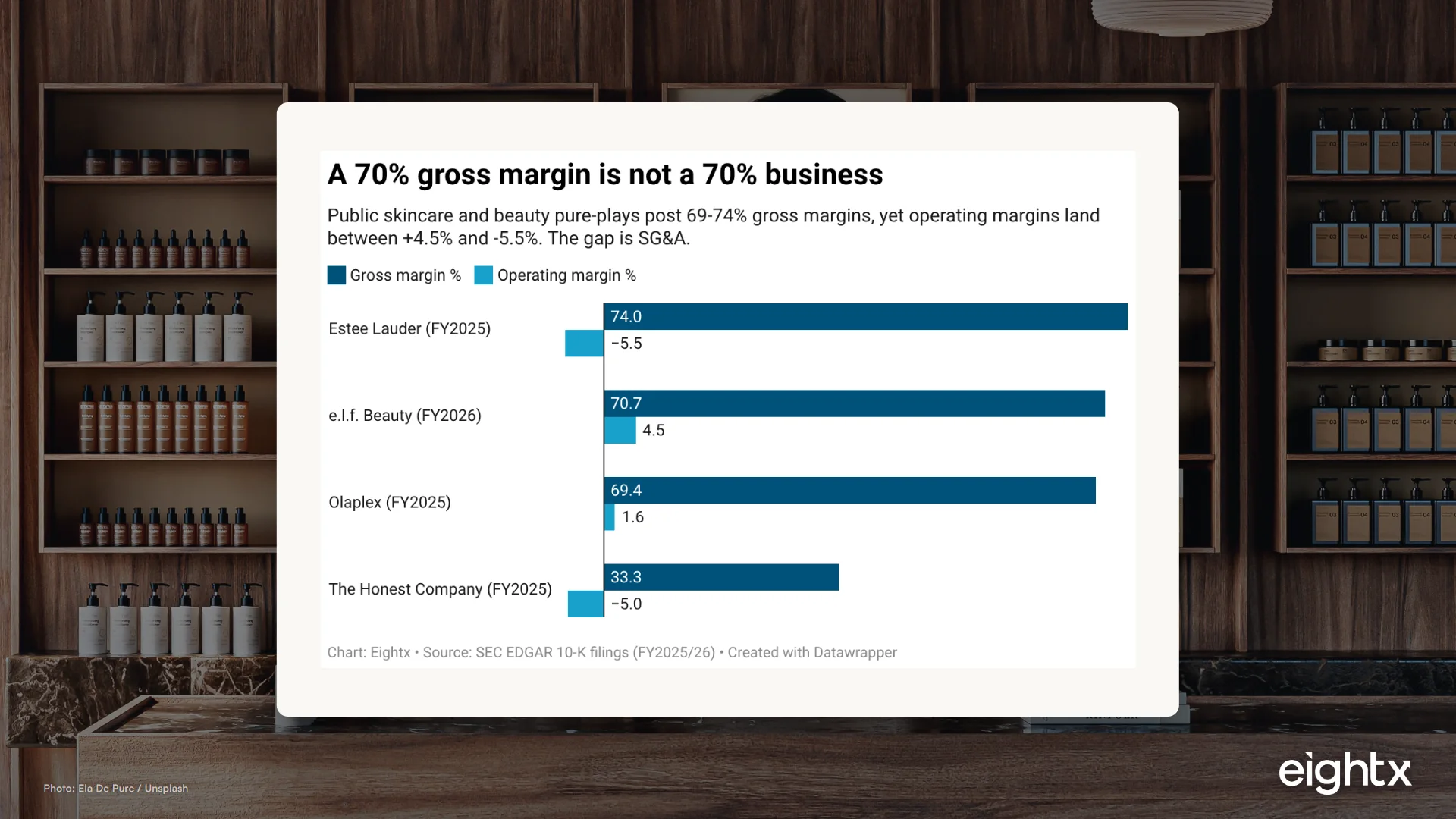
- That 70% gross margin routinely collapses to a low-single-digit operating margin. Olaplex ran 69.4% gross into 1.6% operating; both Estee Lauder (-5.5%) and The Honest Company (-5.0%) posted operating losses. In skincare the bottleneck is SG&A, not cost of goods.
- SG&A eats 57-66% of revenue at scaled public skincare brands. Marketing plus overhead, not product cost, is where the category's high margin goes to die.
- At a ~$66 AOV and ~$66 blended CAC, a skincare brand's first order barely breaks even on contribution. Profit lives entirely in the repeat, which is why a 25-30% 90-day repeat rate and a 3:1+ LTV:CAC are the ratios that decide the model.
- Public skincare comps turn inventory just 1.7-2.9x a year (126-213 days on hand). A brand with a 70% gross margin can still be cash-starved if four to seven months of product is sitting on the shelf.
Skincare is the highest-margin consumer-goods category most operators will ever run. Public skincare and beauty pure-plays post 69-74% gross margins, the kind of number that looks like a license to print money. Then you read down the income statement and the same companies show how fast that margin disappears. This benchmark pulls the real numbers from public 10-K filings (gross margin, operating margin, SG&A, inventory turns) and pairs them with the private DTC skincare benchmark ranges (CAC, AOV, returns, repeat rate, LTV:CAC) so you can locate your own brand on each metric. The audience here is operators running $2M to $100M skincare brands, not analysts covering the publics.
The 70% gross margin trap
Here is the finding the whole report turns on. In FY2025/26, e.l.f. Beauty carried a 70.7% gross margin down to a 4.5% operating margin. Olaplex turned a 69.4% gross margin into a 1.6% operating margin. Estee Lauder posted a 74.0% gross margin and a 5.5% operating loss. The Honest Company, a structurally lower-margin baby and personal-care brand we include as the deliberate contrast point, ran a 33.3% gross margin into a 5.0% operating loss.
So the category's signature high margin is not the thing that makes a skincare brand healthy. Gross margin is table stakes. It tells you the product is priced and sourced correctly. It tells you almost nothing about whether the business makes money.
Two caveats keep this honest. e.l.f.'s FY2026 operating margin of 4.5% is depressed by its Rhode acquisition and related costs. Its FY2025 operating margin was closer to 12% on a GAAP basis (higher, up toward 17%, on an adjusted basis), so read 4.5% as a one-time-distorted floor, not a run-rate. Estee Lauder's operating loss is driven by goodwill and intangible impairments plus a large restructuring program, not by day-to-day operations. In both cases the clean signal is the gross margin, and the operating line carries an asterisk. Even with those asterisks, the shape holds: a 70% gross margin does not protect you from an operating loss.
For a private DTC skincare brand, the practical floor is about 65% gross margin. When I talk to founders running a brand this size, the ones in trouble almost always have a gross margin that looks fine on the deck and a landed-cost reality that is 8-10 points worse once freight, duties, samples and breakage are loaded in. Clear 65% on a fully loaded basis or the rest of this benchmark cannot save you.
Where the margin actually goes: SG&A and CAC
If gross margin is not the problem, SG&A is. At scaled public skincare brands, selling, general and administrative expense eats 57-66% of revenue: e.l.f. at 62.7%, Olaplex at 57.5%, Estee Lauder at 66.0% (each computed from reported SG&A divided by revenue). That is where a 70% gross margin goes to die. Marketing and overhead, not product cost, is the battlefield.
The single most useful piece of math here is the first-order contribution check. Take the category benchmarks: a ~$66 AOV and a ~$66 blended CAC (Shopify Beauty and Personal Care data via Polar and Foundry). On a 69% gross margin, a $66 order generates about $45.50 of gross profit. Subtract the $66 you paid to acquire that customer and the first order loses roughly $20 before you have paid for a single package insert. The first order does not make money. It cannot. Profit lives entirely in the second, third and fourth orders.
That is why CAC creep is the quietest killer in this category. When we've struggled with this on the operator side, the pattern is always the same: blended CAC drifts from the mid-$40s to the high-$60s over two or three quarters as the easy audiences saturate, nobody re-runs the contribution math, and the brand keeps scaling spend into a first order that now loses $25 instead of $15. The P&L does not flash red until the cash does.
What to do this week: pull your blended CAC, your true fully loaded AOV, and your gross margin, and compute first-order contribution the way it is done above. If it is negative (it usually is in skincare), you are not running a profitability problem, you are running a retention problem, and the next section is the one that matters.
The metric that saves the model: repeat purchase and LTV:CAC
Skincare has one structural advantage that rescues the ugly first-order math: people run out and reorder. Healthy skincare brands see roughly 25-30% of customers repeat within 90 days and 30-45% within 12 months, on a reorder interval around 104 days. Subscribe-and-save customers carry about 2.3x the lifetime value of one-time buyers. Replenishment is the moat. The LTV:CAC math only works because skincare reorders, and the brands that win are the ones that engineer the second purchase deliberately instead of hoping for it.
That feeds the one ratio every skincare operator should be able to recite: LTV:CAC. Target at least 3:1 on a margin basis. Mature, retention-heavy brands should be running 4-5:1. Below 2:1 is the danger zone where every new customer is buying revenue you will not keep long enough to recover acquisition cost. Above 5:1, you are usually under-spending and leaving growth on the table.
The pattern we see again and again: a skincare founder shows me a 70% gross margin and asks why there is no cash in the bank, and the answer is almost always sitting in two line items, paid CAC and the inventory on the shelf. The repeat rate is what converts that 70% gross margin into actual lifetime profit. If you can move 90-day repeat from 18% to 28% (better post-purchase flows, a real subscribe-and-save offer, a replenishment reminder timed to the 104-day interval), you change the LTV:CAC ratio more than any CAC cut you can realistically pull off in the same quarter.
In skincare, gross margin is table stakes and SG&A is the battlefield. A 70% gross margin tells you the product is priced right. It tells you nothing about whether the business makes money. The three numbers that decide that are CAC, repeat rate and inventory turns, and only one of them shows up on the gross-margin line.
The benchmark scorecard: where does your brand land?
This is the section operators bookmark. Below are the 2026 private DTC skincare benchmark bands across the six metrics that decide the model. These are directional industry ranges synthesized from external benchmark sources (attn agency, Foundry CRO, Polar Analytics, Yotpo, NRF), not audited figures like the SEC numbers above. Use them to find your brand on each row.
| Metric | Needs work | Average | Strong |
|---|---|---|---|
| Gross margin % | < 65 | 65-72 | > 75 |
| Blended CAC ($) | > 90 | 45-70 | 35-45 |
| AOV ($) | < 55 | 55-80 | > 80 |
| Return rate % | > 15 | 10-15 | < 10 |
| 90-day repeat rate % | < 12 | 25-30 | > 30 |
| LTV:CAC ratio | < 2:1 | 3:1 | > 4:1 |
One note on returns. Skincare return rates run about 10-15%, higher than beauty overall (4-10%) but well below apparel. It is a second-order drag, not a first-order one. If your returns are sitting at 12%, leave it alone and go fix CAC and inventory. Do not spend a quarter shaving two points off a return rate while a $25 negative first-order contribution bleeds out underneath it.
The cash trap nobody benchmarks: inventory
Here is the number that gets left off most skincare benchmark reports, and it is the one that explains the "70% margin but no cash" problem better than anything else. Public skincare comps turn inventory just 1.7-2.9x a year. That is 126-213 days of product sitting on the shelf: The Honest Company at 126 days, e.l.f. at 168 days, Olaplex at 212 days, Estee Lauder at ~213 days (each from 10-K cost of goods divided by ending inventory; Estee Lauder's is approximate, computed on FY2024 ending inventory).
Translate that into cash. Four to seven months of inventory means a meaningful slice of every dollar of revenue is frozen as product on a shelf or in a container, not available to fund the next ad dollar or the next production run. A brand can be "profitable" on the P&L and still be unable to make payroll because the profit is sitting in a warehouse. Skincare makes this worse than most categories because the high gross margin tempts operators into over-ordering: when each unit looks so profitable, holding six months of it feels safe right up until the cash gap appears.
The full public-comp scorecard below is the pillar's anchor table. It is the audited spine the private benchmark bands hang off, and it shows all five line items (margin, SG&A, turns, days) in one place.
| Company | Revenue ($M) | Gross margin % | Operating margin % | SG&A % of revenue | Inventory turns (x) | Days inventory |
|---|---|---|---|---|---|---|
| Estee Lauder (FY2025) | 14,326 | 74.0 | -5.5 | 66.0 | 1.7 | 213 |
| e.l.f. Beauty (FY2026) | 1,636 | 70.7 | 4.5 | 62.7 | 2.2 | 168 |
| Olaplex (FY2025) | 423 | 69.4 | 1.6 | 57.5 | 1.7 | 212 |
| The Honest Company (FY2025) | 371 | 33.3 | -5.0 | 21.4 | 2.9 | 126 |
For context on the private market those publics sit atop, StoreLeads tracks roughly 102,800 skincare stores across all platforms, about 69,400 of them on Shopify (25,800 in the US, 4,760 in the UK, 3,650 in Australia). Only about 2,170 have reached Shopify Plus scale, and around 14,400 run Klaviyo. The category is enormous and fragmented, which is exactly why a brand that gets inventory discipline right has an edge most of its 69,000 competitors never build. If your turns are stuck below 3x, that is the single highest-return cash project you have, and it is the kind of thing our interim CFO services exist to fix.
How to read your own numbers
If you only track three numbers from this report, track these. First, gross margin on a fully loaded basis: clear 65% or the model is broken before marketing. Second, LTV:CAC: hold it above 3:1, and if it climbs above 5:1 you are under-spending. Third, inventory turns: every day you cut off your days-on-hand is cash that comes back to the business at zero cost to margin.
Run those three against the scorecard, find the one that is furthest from "strong," and fix that one first. In skincare it is usually CAC or inventory, almost never gross margin. For the same treatment on adjacent categories, see our beauty brand financial benchmarks and apparel brand financial benchmarks, which run the same public-comp-plus-DTC-band method on different cost structures.
Sources and methodology
The audited figures in this report come from SEC EDGAR 10-K filings (annual reports). e.l.f. Beauty (CIK 1600033) FY2026 10-K, fiscal year ended 2026-03-31: revenue $1,636.5M, COGS $479.1M, gross profit $1,157.3M (70.7%), operating income $73.6M (4.5%), SG&A $1,026.1M (62.7%), ending inventory $220.2M. Olaplex Holdings (CIK 1868726) FY2025 10-K, fiscal year ended 2025-12-31: revenue $423.0M, COGS $129.3M, gross profit $293.6M (69.4%), operating income $7.0M (1.6%), SG&A $243.1M (57.5%), ending inventory $75.2M.
The Honest Company (CIK 1530979) FY2025 10-K, fiscal year ended 2025-12-31: revenue $371.3M, COGS $247.6M, gross profit $123.8M (33.3%), operating income -$18.5M (-5.0%), ending inventory $85.3M. Honest is a baby and personal-care brand with retail-heavy distribution, included as the deliberate structurally-lower-margin contrast point rather than a pure premium-skincare comp. Estee Lauder Companies (CIK 1001250) FY2025 10-K, fiscal year ended 2025-06-30: revenue $14,326.0M, COGS $3,729.0M, gross profit $10,597.0M (74.0%), operating income -$785.0M (-5.5%), SG&A $9,456.0M (66.0%). Its operating loss is driven by goodwill and intangible impairments plus the PRGP restructuring, so it is not a clean operating run-rate.
Inventory turns are computed as COGS divided by ending inventory, and days inventory outstanding as ending inventory divided by COGS times 365. Estee Lauder's FY2025 ending inventory was not returned by the filing API, so its FY2024 ending inventory of $2,175.0M was used as the most recent available figure, which makes its turns and days values approximate. The two operating-margin caveats above (e.l.f.'s Rhode-distorted FY2026 line and Estee Lauder's impairment-driven loss) mean operating margin should be read as directional context, with gross margin and SG&A intensity as the cleaner cross-company signals.
The private-market store counts come from StoreLeads (category Beauty & Fitness / Face & Body Care / Skin & Nail Care), pulled 2026-06-11. The API tier did not support a revenue-band filter, so the usable aggregates are store counts by geography, platform and tech stack rather than revenue segmentation.
The DTC benchmark bands (CAC, AOV, return rate, repeat rate, LTV:CAC) are directional industry ranges, not audited figures. They are synthesized from external benchmark publishers including attn agency's DTC Profitability Benchmarks 2026, Foundry CRO's DTC Beauty Marketing Benchmarks 2026, Polar Analytics ecommerce benchmarks, Yotpo's 2026 Ecommerce Benchmarks and the NRF 2025 Returns Landscape, with web and primary-source triangulation via Perplexity and Parallel.ai. Treat the SEC numbers as audited and the benchmark bands as directional. This bundle is documented in full in the post's research.md file.
Frequently asked questions
what is a good gross profit margin for a skincare brand?
Aim to clear roughly 65% gross margin. Public skincare and beauty pure-plays run 69-74% (e.l.f. 70.7%, Olaplex 69.4%, Estee Lauder 74.0%), and private DTC skincare brands typically land at a ~65-72% median with the strongest brands above 75%. Below 65%, the model is usually broken before a dollar of marketing is spent.
is a skincare ecommerce business actually profitable?
It can be, but the high gross margin is not the reason. Among public comps, a 69-74% gross margin routinely collapses to a low-single-digit operating margin or an operating loss, because SG&A eats 57-66% of revenue. Skincare profitability is decided by CAC discipline and repeat purchase, not by product cost.
what is a typical cac for a skincare dtc brand in 2026?
Blended CAC for DTC skincare runs roughly $45-$70 in 2026. Under $45 is strong, and $70-$90+ is usually only sustainable on venture-style funding. At a ~$66 AOV, a $66 CAC means your first order barely breaks even on contribution, so the math only works on the repeat.
what ltv:cac ratio should a skincare brand target?
Target at least 3:1 on a margin basis, and 4-5:1 for mature, retention-heavy brands. Below 2:1 is the danger zone where you are buying revenue you cannot keep. This single ratio tells you whether to spend more on acquisition or pull back.
what are average inventory turns for a skincare brand?
Public skincare and beauty comps turn inventory just 1.7-2.9x a year, which is 126-213 days of product on the shelf. For a private DTC skincare brand, pushing turns up toward 4-6x (60-90 days) frees a large amount of trapped cash without touching margin.
why do skincare brands have high margins but low profit?
Because the cost is downstream of the product. A skincare brand can buy product for 25-30 cents on the dollar, but then spends 57-66% of revenue on paid acquisition, salaries and overhead. The gross margin is real, it just gets spent on SG&A before it reaches the bottom line.
what is the average order value for a skincare brand?
Skincare AOV sits at roughly $55-$80, with a median near $60-$70. Skincare is mid-ticket, so the main AOV levers are bundling and subscribe-and-save rather than raising single-unit prices.
what is a normal return rate for skincare ecommerce?
Skincare return rates run about 10-15%, higher than beauty overall (4-10%) but below apparel. Returns are a second-order drag in skincare, not a first-order one, so fix CAC and inventory before you obsess over the return rate.
what repeat purchase rate is healthy for a skincare brand?
A healthy skincare brand sees roughly 25-30% of customers repeat within 90 days and 30-45% within 12 months, on a ~104-day reorder interval. Subscribe-and-save customers tend to carry about 2.3x the lifetime value of one-time buyers, which is why replenishment is the category's structural advantage.
Related Eightx benchmarks: Beauty Ecommerce Gross Margin 2026 and Who's Buying Beauty Brands? Acquirers and Multiples 2026.