
Financial Strategy
TreeHouse Foods (THS) Teardown: The 16% Gross Margin Problem
TreeHouse Foods (THS) was the largest U.S. private-label packaged food manufacturer, generating $3.4B in revenue at a 16.4% gross margin. In February 2026, Investindustrial took it private for $2.9B, closing the book on a five-year public market question: does private-label scale ever earn its cost of capital?
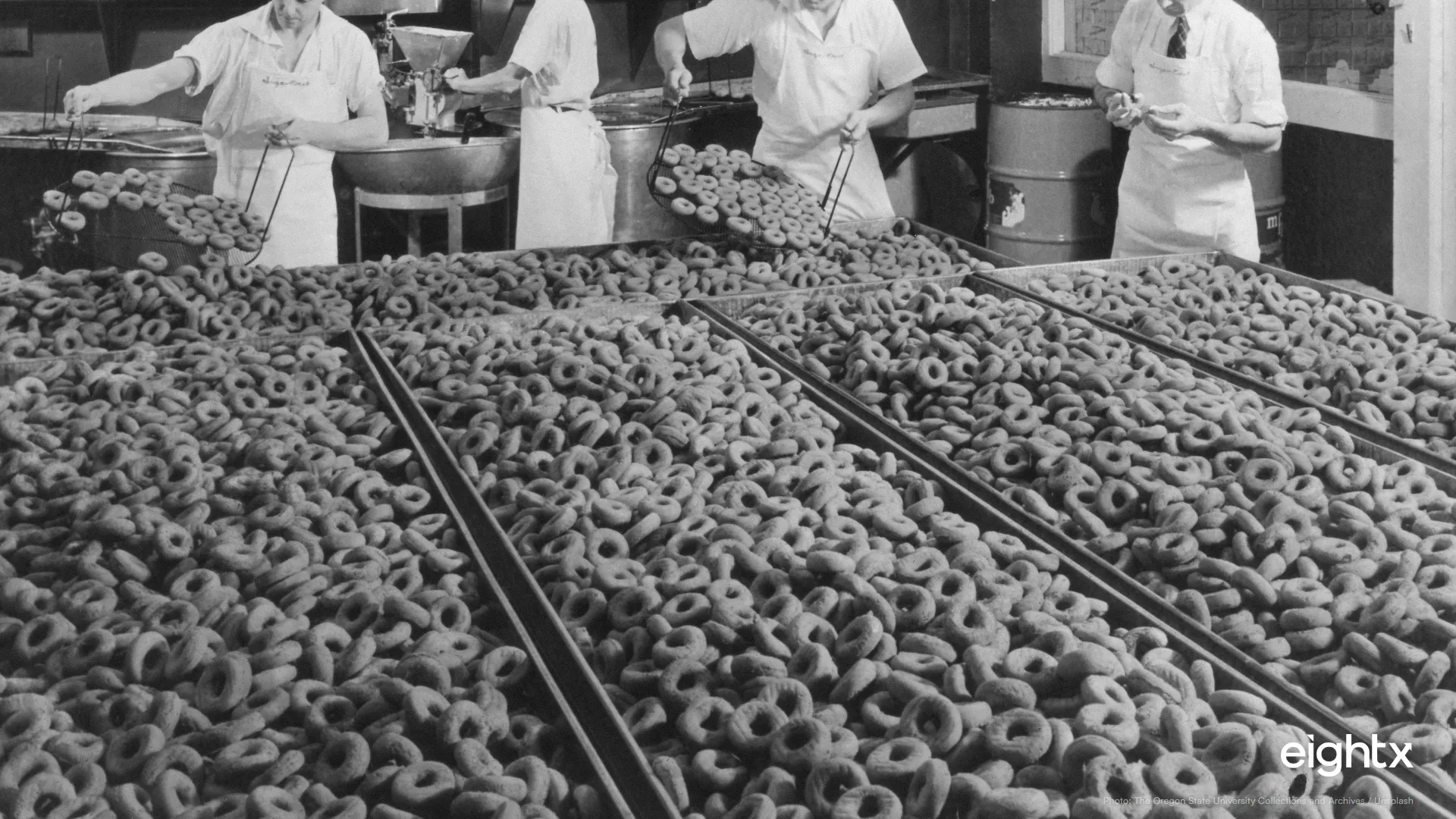
Key Takeaways
- Gross margin ranged between 15.8% and 18.2% across FY2020 to FY2024, against branded peers Conagra at 27.7% and B&G Foods at 21.8% in FY2024. Private-label manufacturers are structural price-takers; scale compresses costs but cannot close the brand premium gap. Source: THS 10-K FY2024; Conagra 10-K FY2024; B&G Foods 10-K FY2024.
- Walmart represented 23.9% of FY2024 net sales, up from 21.1% in FY2022, with the top 10 customers at 57.1% of total sales. Being the OEM behind Walmart's store brand is the strategy -- that relationship sets the price ceiling and can renegotiate terms at any time. Source: THS 10-K FY2024.
- Net debt of $1,119.5M equaled 3.32x FY2024 Adjusted EBITDA of $337.4M, with $63.4M in annual interest expense absorbing 61.5% of GAAP operating income. A single recall -- like the FY2024 frozen-griddle event that cost 1.1 percentage points of gross margin -- can wipe out the annual operating income buffer. Source: THS 10-K FY2024; THS Q4 2024 Earnings Release.
- Q3 2025 included a $289.7M non-cash goodwill impairment triggered by a sustained decline in share price, driving a nine-month 2025 net loss of $300.5M and reducing cash from $289.6M at year-end 2024 to $21.0M. Source: THS 10-Q Q3 2025.
- Investindustrial closed the take-private at $22.50/share plus a contingent value right on Feb 11, 2026, implying approximately $2.9B enterprise value and roughly 8.6x FY2024 Adjusted EBITDA. Post-deal capital structure: $1.0B term loan (SOFR+425) and $800M of 7.75% senior notes, both due 2033; Fitch rated the entity B/Stable. Source: Investindustrial press release Feb 11, 2026; Fitch Ratings Jan 23, 2026.
For five years, Wall Street ran the same model on TreeHouse Foods and arrived at the same verdict: a structurally thin-margin food manufacturer with too much debt and too little pricing power to justify a public market premium. The math was not broken. TreeHouse generated $3.4B in FY2024 net sales at a 16.4% gross margin, a number that leaves almost no room for recall events, commodity spikes, or interest rate moves. When Investindustrial closed its $2.9B take-private in February 2026, the deal was not a rescue. It was a structural thesis: private-label food at scale is better owned by patient capital than quarterly-reporting public shareholders.
The question this teardown answers is whether the public market thesis was ever coherent in the first place. TreeHouse was the largest U.S. private-label packaged food manufacturer, supplying store-brand crackers, coffee pods, broths, and condiments to Walmart (23.9% of FY2024 sales), Kroger, and roughly 900 other retail customers. Its economic structure is closer to a contract manufacturer than a consumer brand: it takes the price the retailer sets, absorbs input cost volatility, and competes on scale and service rather than marketing. The 16% gross margin is not a management failure. It is the model.
Section 1 - Financial Snapshot
The five-year financial arc shows a business caught between an acquisition-driven cost structure inherited from the 2015-2017 buying spree and a gross margin ceiling it could not escape regardless of revenue scale.
| Metric | FY2022 | FY2023 | FY2024 |
|---|---|---|---|
| Net Revenue | $3,297.1M | $3,431.6M | $3,354.0M |
| Revenue YoY | +17.2% | +4.1% | -2.3% |
| Gross Profit | $522.4M | $576.1M | $548.4M |
| Gross Margin | 15.8% | 16.8% | 16.4% |
| Operating Income (Loss) | ($12.6M) | $146.9M | $103.1M |
| Operating Margin | -0.4% | 4.3% | 3.1% |
| Net Income (Loss) | ($146.3M) | $53.1M | $26.9M |
| Diluted EPS | ($2.61) | $0.94 | $0.51 |
| Operating Cash Flow | ($150.7M) | $157.3M | $265.8M |
| Long-Term Debt | $1,405.0M | $1,405.0M | $1,405.0M |
Source: THS 10-K FY2024, FY2023, FY2022 (SEC EDGAR)
The five-year view makes the structural story clearer. Revenue grew through acquisition, then shrank as management rationalized the portfolio. Gross margin never meaningfully escaped the 16-18% band regardless of revenue level.
| Period | Revenue | Gross Margin | Net Income (Loss) | Diluted EPS |
|---|---|---|---|---|
| FY2020 | $2,994.3M | 18.2% | $13.8M | $0.24 |
| FY2021 | $2,814.3M | 16.8% | ($12.5M) | ($0.22) |
| FY2022 | $3,297.1M | 15.8% | ($146.3M) | ($2.61) |
| FY2023 | $3,431.6M | 16.8% | $53.1M | $0.94 |
| FY2024 | $3,354.0M | 16.4% | $26.9M | $0.51 |
Source: THS 10-K filings FY2020 through FY2024 (SEC EDGAR)
Section 2 - Business Model
TreeHouse operates as the invisible OEM of the American grocery aisle. The company does not own meaningful consumer-facing brands. It manufactures products that retailers badge as their own house labels, supplying roughly 65 product categories across three reporting segments in FY2024: Snacking ($1,270.2M net sales, 37.9% of total), Beverages ($1,109.0M, 33.1%), and Grocery ($974.8M, 29.1%).
The revenue model is structurally B2B. TreeHouse bids on retailer contracts, wins on price and manufacturing reliability, and earns its margin on operational efficiency rather than brand equity. Retailers use private-label programs to anchor price perception and improve shelf economics; TreeHouse's value proposition is that it can produce across categories at a cost retailers cannot replicate in-house at similar scale.
The consequence is a gross margin ceiling the model cannot escape. Branded CPG companies earn pricing power through consumer pull: a shopper who wants a specific national brand will pay more for it. TreeHouse's customers -- the retailers -- always pressure its price down, because their store brand's value proposition requires a spread versus the national brand. The result: 16% gross margin versus Conagra's 27.7% in FY2024 and B&G Foods' 21.8%. That 10-to-12 percentage point gap is not operational. It is structural.
Operating leverage is limited as a result. FY2024 SG&A totaled $445.3M (13.3% of sales), including $153.3M in selling and distribution and $198.0M in G&A. After gross profit of $548.4M, operating income was $103.1M (3.1% margin). One bad quarter -- a recall, a commodity spike, a weather event at a single plant -- can erase the operating income that took the entire year to build.
FY2024 Adjusted EBITDA was $337.4M (non-GAAP) and free cash flow was $126.1M after $139.7M in capital expenditures. The business does generate cash. The question is whether it generates enough cash relative to its capital structure to earn a public equity return.
Section 3 - Strengths
Scale moat and category breadth. TreeHouse is the largest U.S. private-label food manufacturer by revenue. Its 65-category footprint means it can supply a retailer's entire private-label program through a single relationship -- a structural advantage over smaller regional competitors who cover 5-10 categories. Retailer consolidation, where fewer and larger buyers control more shelf space, has tended to favor suppliers who operate at this scale.
The Walmart relationship as strategic asset. Walmart representing 23.9% of FY2024 sales is usually cited as a concentration risk. The other way to read it: TreeHouse is sufficiently embedded in Walmart's private-label supply chain that Walmart cannot easily replace it across 65 categories without operational disruption. That is a form of lock-in, even if the customer holds pricing leverage in any individual negotiation.
Cash generation when the machine runs clean. FY2024 operating cash flow was $265.8M and free cash flow was $126.1M. FY2023 operating cash flow was $157.3M. When no extraordinary events interrupt the manufacturing cadence, TreeHouse generates meaningful cash relative to its asset base -- the kind of predictable industrial cash flow that patient capital can model over a long hold period.
Private-label secular tailwind. Private-label dollar share reached 21.2% in H1 2025 (PLMA, July 2025), and private-label unit volume grew approximately 3x faster than national brands in 2025. Consumers under budget pressure trade down to store brands and rarely fully trade back after the pressure eases. TreeHouse is the infrastructure play on that behavioral shift, not a brand competing for consumer loyalty.
Returns are quietly eating your margin. See by how much.
Get our Real Cost of Returns calculator: plug in your numbers, see the true hit per return.
Check your inbox. We'll send the Real Cost of Returns calculator shortly.
Section 4 - Weaknesses
The gross margin ceiling is not a solvable problem under the current model. Five years of SEC EDGAR data shows a gross margin band of 15.8% to 18.2%. The FY2020 high of 18.2% partly reflected pandemic pantry-loading pricing dynamics that normalized by FY2021. The 16% midpoint is what the model earns in steady state. Management's "Project Vitalize" efficiency program targets genuine improvement, but cost reductions at a private-label manufacturer tend to get competed away in the next bid cycle rather than accreting to margin.
Customer concentration rising, not stabilizing. Walmart concentration moved from 21.1% in FY2022 to 23.9% in FY2024. Top-10 customer revenue concentration grew from roughly 55% to 57.1% over the same period. TreeHouse is becoming more dependent on fewer relationships -- each of which holds the ability to force price concessions, reduce SKU counts, or reopen contracts.
$1.4B debt load with no deleveraging path as a public company. Long-term debt remained at exactly $1,405.0M from FY2022 through FY2024. Interest expense of $63.4M in FY2024 absorbed 61.5% of GAAP operating income of $103.1M. At 16% gross margin, there is no earnings buffer to absorb a bad year and still service debt comfortably.
One operator we work with put the constraint plainly: thin margins leave no room to absorb anything. When your working capital cycle runs 70+ days of inventory, a demand interruption creates a cash pressure event before gross margin has any chance to catch up.
Recurring food-safety events. The FY2024 frozen-griddle recall cost 1.1 percentage points of gross margin per the company's own 10-K MD&A. This was not an isolated incident in TreeHouse's operating history. Running 65 product categories across multiple manufacturing plants creates chronic exposure: a single plant issue can trigger category-wide recalls that compress the already-thin gross margin with no pricing mechanism to recover the cost.
The goodwill problem. TreeHouse carried $1,819.3M in goodwill heading into Q3 2025, legacy of the 2015-2017 acquisition strategy. The $289.7M Q3 2025 impairment was the market telling management what the balance sheet already implied: acquisition premiums paid in the growth-through-M&A era were not being recovered through operating returns. Total goodwill fell to $1,601.4M. Cash fell from $289.6M at FY2024 year-end to $21.0M by Q3 2025.
Section 5 - Opportunities and Threats
Opportunity: CVR upside from Green Mountain litigation. The contingent value right attached to the Investindustrial deal gives former shareholders exposure to a patent infringement and antitrust lawsuit against Keurig Dr Pepper. TreeHouse alleged Keurig's K-Cup licensing practices illegally locked it out of the single-serve coffee market. Claimed damages range from $719.4M to $1.5B pre-trebling under antitrust law, plus $358M in false advertising claims. A favorable settlement or judgment would be material relative to the company's enterprise value and would flow to CVR holders.
Opportunity: Project Vitalize efficiency gains under private ownership. Management's restructuring program targets SKU rationalization, plant optimization, and procurement consolidation. The logic is sound: a 65-category operation accumulated complexity through acquisition-driven growth, and private ownership is better positioned to execute multi-year rationalization without quarterly earnings guidance pressure. The open question is whether savings accrete to margin or get competed away in the next retailer bid cycle.
Opportunity: Private-label structural tailwind extending. As grocery inflation persists and consumers become more value-oriented, the store-brand price advantage widens the addressable market. A sustained post-recession trade-down in consumer behavior -- similar to what followed the 2008 financial crisis -- would extend the private-label growth cycle materially beyond any cyclical explanation.
Threat: Amazon Grocery expansion. Amazon's push into grocery private label (Amazon Fresh branded products) is a structural threat to the traditional retailer relationship model. If major retailers shift procurement to Amazon-adjacent suppliers or invest in vertical integration for high-volume categories, TreeHouse's category-breadth advantage narrows.
Threat: Walmart pricing pressure. At 23.9% revenue concentration, a Walmart decision to rebid key categories, reduce SKU counts, or vertically integrate specific product lines would be a material revenue and margin event. Walmart has exercised this leverage with other food and consumer goods suppliers historically.
Threat: GLP-1 demand disruption. Weight-loss medications (Ozempic, Wegovy, and category successors) are associated with reduced caloric intake and specific demand shifts in snack food categories. TreeHouse's Snacking segment at $1,270.2M is the largest and most exposed to any sustained volume decline in indulgent snack categories. Long-term volume trajectories in crackers, cookies, and pretzels are genuinely uncertain.
Threat: Commodity and tariff volatility. As a price-taker, TreeHouse cannot pass through cost increases in real time. Agricultural commodity inflation (wheat, edible oils, packaging materials) and tariff-driven input cost increases compress gross margins before any contract renegotiation cycle catches up. The FY2022 commodity spike produced a $150.7M operating cash flow outflow -- direct evidence of the structural exposure.
Section 6 - Macro Context
Private-label food is having a structural moment. PLMA data for H1 2025 showed private-label dollar share at 21.2% and unit share at 23.2%, both records. Industry analysts estimated private-label volume growth at approximately 3x the national brand rate in 2025. The tailwind is real and, as the post-2008 data demonstrated, not entirely cyclical: prolonged inflation fundamentally resets consumer price sensitivity in ways that persist well after the inflationary episode ends.
The macro risk sits on the input cost side. TreeHouse manufactures across commodity-exposed categories including edible oils, grains, and packaging. As a price-taker in a B2B relationship, it absorbs these cost increases in gross margin before the next contract cycle allows repricing. When commodity costs spiked in FY2022 -- a combination of supply chain disruption, energy costs, and agricultural inflation -- gross margin compressed to 15.8% and operating cash flow went deeply negative at $150.7M outflow. The model has no gross margin buffer when input costs move fast.
Interest rate sensitivity was direct at the public company level: the $1.405B long-term debt at variable-rate components meant that rate movements translated directly to debt service pressure. Post-take-private, the new capital structure ($1.0B TLB at SOFR+425, $800M of 7.75% fixed-rate senior notes) is heavier in absolute terms at roughly $1.8B, though Fitch's B/Stable initial rating suggests the agency views the post-deal leverage of approximately 4.9x as serviceable given the EBITDA base.
The tariff environment in 2025 and 2026 adds a new input cost vector. Packaging material and agricultural ingredient tariffs affect TreeHouse's cost structure before any contractual repricing, creating a predictable earnings volatility pattern that private ownership -- with no quarterly earnings guidance to defend -- is structurally better suited to absorb.
Section 7 - CFO Verdict and Operator Bridge
The Street was right about the wrong thing.
The consensus Hold/Neutral rating on THS with zero Buy recommendations was analytically defensible: at 16% gross margin and 3.3x net leverage, any model that penciled out equity upside required margin expansion assumptions that the five-year historical record consistently refuted. Analysts were right that the public equity structure was under-earning its cost of capital.
What the public market framing missed is that "under-earning cost of capital as a public company" does not mean "bad business at a different ownership cost." Private equity carries a materially different cost of capital than public equity, is not marked to quarterly earnings, and can hold a restructuring-in-progress through multiple commodity cycles without triggering a technical sell signal. Investindustrial's thesis at $2.9B and approximately 8.6x FY2024 Adjusted EBITDA is that the operational complexity of a 65-category manufacturer responds better to a decade of private ownership than a quarter-by-quarter public mandate.
Our differentiated read: the take-private was not wrong, and neither was the years of investor skepticism. They were correct at different levels of the same business. Public shareholders were pricing a levered, thin-margin, commodity-exposed manufacturer on quarterly results. Investindustrial is pricing the long-cycle efficiency gains available to a company that can rationalize its SKU base, renegotiate retailer contracts from a position of stability, and wait for the Green Mountain CVR to resolve on its own timeline.
Three numbers to watch (for anyone tracking TreeHouse post-close):
-
Gross margin trajectory under private ownership. Any sustained move above 18% would signal that Project Vitalize savings are accreting to margin rather than being competed away in retailer bids. If gross margin stays at 16-17% three years in, the efficiency narrative has limits.
-
Walmart revenue concentration. If it moves above 25% in the first few years of private ownership, the customer dependency risk is worsening -- not improving -- under the new structure.
-
Green Mountain CVR resolution timeline. Claimed damages of $719.4M to $1.5B pre-trebling would materially alter the post-deal capital structure if settled favorably. The timeline is outside management control, but it is the single highest-leverage uncertain variable in the post-close capital story.
The operator bridge.
If you run a product business with gross margins in the 15-25% range, TreeHouse is a useful calibration reference. We consistently see operators who treat margin pressure as a pricing problem when it is a structural model problem -- and the two have entirely different solutions.
We reviewed the P&L structure of a wholesale food and beverage business earlier this year. Blended gross margin was in the high teens. The team's instinct was to fix pricing. When we pulled contribution margin by channel, the blended number was masking the real story: the direct-to-consumer channel was generating contribution margin upwards of 30%, while the large retail account channel -- where 80% of capacity was allocated -- was structurally capped at the margin the retailer would allow in annual contract negotiations.
The pricing lever was not wrong; it was just too small to move a structural problem. TreeHouse is the same dynamic at $3.4B scale. The margin is not broken -- it reflects a deliberate channel and business model choice, with the consequences fully visible in the five-year arc.
The questions this raises for your business:
- What is your gross margin by channel, not just blended?
- Which customers hold effective pricing power over you -- and what would repricing or channel-mix shift actually do to the structural margin?
- Is your inventory cycle long enough that a demand interruption creates a working capital problem before gross margin can catch up?
- Are you modeling your debt service on GAAP operating income or Adjusted EBITDA -- and do those numbers diverge materially in a commodity spike year?
A 16% gross margin is not a fire alarm. TreeHouse ran that model at $3.4B in revenue. The fire alarm is discovering your 16% is structural, your customer concentration is rising, and your debt service assumes the EBITDA you only earn in the good years. If you want these structural margin and concentration questions modeled against your own numbers, that is a fractional CFO conversation.
Related teardowns: Hain Celestial Teardown | Simply Good Foods Teardown | Utz Brands Teardown
Related reading. For the same margin math at DTC-native food brands, see our Magic Spoon teardown, our Graza teardown, and our Fly By Jing teardown.
Sources and methodology
SEC EDGAR annual filings (FY2020-FY2024). All financial spine figures in this teardown are sourced from TreeHouse Foods, Inc. Form 10-K annual reports filed with the SEC. Revenue, gross profit, gross margin, operating income, net income, EPS, cash, inventory, and long-term debt figures are GAAP as reported in THS 10-K FY2024 and prior-year filings. No adjustments were made to GAAP figures.
Non-GAAP Adjusted EBITDA and free cash flow. Adjusted EBITDA of $337.4M (FY2024) and free cash flow of $126.1M are non-GAAP measures as defined and disclosed by TreeHouse Foods management in its Q4 2024 earnings release. These figures are not verified against EDGAR XBRL data; they are sourced from the company's own investor disclosures.
Customer concentration and segment revenue. Walmart concentration (23.9% FY2024) and top-10 customer share (57.1%) are sourced from the FY2024 10-K risk factors and customer concentration disclosure. Segment net sales (Snacking $1,270.2M, Beverages $1,109.0M, Grocery $974.8M) are from FY2024 segment reporting in the 10-K.
Private-label market share data. Private-label dollar share (21.2% H1 2025) and unit share (23.2%) are sourced from the Private Label Manufacturers Association (PLMA) H1 2025 market share data, published July 22, 2025. Private-label volume growth versus national brands (~3x faster) is sourced from Grocery Dive trade reporting (January 21, 2026).
Take-private transaction details. The Investindustrial acquisition price ($22.50/share plus CVR), enterprise value (~$2.9B), closing date (February 11, 2026), and post-deal capital structure ($1.0B TLB SOFR+425, $800M 7.75% senior notes, both due 2033) are sourced from Investindustrial's press release (February 11, 2026) and Crain's Chicago Business coverage (November 11, 2025). Fitch B/Stable initial rating and approximately 4.9x post-deal leverage estimate are from Fitch Ratings (January 23, 2026).
Green Mountain CVR litigation. Damages claims ($719.4M-$1.5B pre-trebling antitrust, $358M false advertising) are sourced from TreeHouse Foods' own public disclosures in SEC filings. CVR terms are from the Investindustrial transaction documents as publicly disclosed. The litigation outcome is uncertain; claimed damages do not represent a probability-weighted recovery.
Frequently asked questions
what does treehouse foods make?
TreeHouse Foods manufactures private-label (store brand) packaged food and beverages sold through grocery, mass, drug, and club retailers. Its three segments are Snacking ($1.27B FY2024 net sales), Beverages ($1.11B), and Grocery ($0.97B). Products include crackers, cookies, pretzels, single-serve hot beverages, broths, condiments, jams, and frozen griddle items. The company does not own consumer-facing brands -- it is the invisible OEM behind the store brand on the shelf.
why did treehouse foods go private?
TreeHouse was taken private by European private equity firm Investindustrial in February 2026 at $22.50 per share plus a contingent value right, for approximately $2.9B enterprise value. The deal closed after years of investor frustration over thin gross margins (16-17%), rising customer concentration, and a $1.4B debt load that left little room for error. Management and Investindustrial argued private ownership would allow longer-duration operational restructuring without the constraints of quarterly earnings guidance.
why is treehouse foods gross margin so low?
TreeHouse sells exclusively to retailers as a contract manufacturer of store-brand products. Retailers set the price, which is positioned below national brands by design. This makes TreeHouse a structural price-taker: it cannot pass through cost increases the way a branded company can, and scale gains are largely competed away in bid negotiations. FY2024 gross margin was 16.4%, versus Conagra at 27.7% and B&G Foods at 21.8%. The gap is not operational underperformance -- it reflects the business model.
who are treehouse foods' biggest customers?
Walmart accounted for 23.9% of FY2024 net sales. The top 10 customers collectively represented 57.1% of sales. TreeHouse derives approximately 80% of revenue from retail grocery and mass channels. High concentration means a single customer's pricing decision or SKU rationalization can meaningfully move the company's financials -- and there is no pricing lever to recover the impact.
what was the treehouse foods goodwill impairment?
In Q3 2025, TreeHouse recorded a $289.7M non-cash goodwill impairment charge, citing a sustained decrease in share price and market capitalization. Total goodwill fell from approximately $1,819.3M to $1,601.4M. The impairment reflected legacy acquisition premiums from the 2015-2017 M&A cycle not being recovered through operating returns. It drove a nine-month 2025 net loss of $300.5M and a Q3 2025 diluted EPS of -$5.26.
what is the green mountain coffee cvr?
The contingent value right (CVR) attached to the Investindustrial deal is tied to a patent infringement and antitrust lawsuit against Keurig Dr Pepper. TreeHouse alleged Keurig's K-Cup licensing practices illegally locked it out of the single-serve coffee market. Claimed damages range from $719.4M to $1.5B pre-trebling under antitrust law, plus $358M in false advertising claims. CVR holders (former public shareholders) would receive a portion of any net recovery. The litigation outcome is genuinely uncertain; no timeline has been publicly specified.
how much debt does treehouse foods carry?
At FY2024 year-end, TreeHouse had $1,405M in long-term debt and net debt of approximately $1,119.5M, equal to 3.32x FY2024 Adjusted EBITDA of $337.4M. After the Investindustrial take-private in February 2026, the new capital structure comprises a $1.0B term loan B (SOFR+425, due 2033) and $800M of 7.75% senior notes (due 2033). Fitch estimated initial post-deal leverage at approximately 4.9x and assigned a B/Stable rating in January 2026.