
CPG
Simply Good Foods teardown: record revenue, falling profit
Simply Good Foods (SMPL) grew net sales 9% to a record $1.45B in FY2025, but net income fell 26% to $103.6M as gross margin dropped to 36.2% and a $249M brand write-down ($187M of it against its 2024 OWYN acquisition) landed in Q2 FY2026. Free cash flow held near $158M. The cash engine works; the margin and the deal do not.
Key Takeaways
- Net sales hit a record $1,450.9M in FY2025, up 9% year-over-year, but net income fell 26% to $103.6M. The top line grew while the business got less healthy. That gap is the whole teardown.
- Gross margin dropped 220 bps to 36.2% and operating margin collapsed from 15.5% to 10.8%. Input-cost inflation (cocoa, whey, tariffs) and a dilutive acquisition ate the P&L from both ends.
- The OWYN deal cost ~$281.9M cash in June 2024 and produced a $187M impairment by Q2 FY2026 (part of a $249M total brand charge that also hit Atkins). Bought growth that did not hold, written down inside two years. The clearest diligence lesson in the filing.
- Goodwill plus intangibles were $1,928M, about 79% of the balance sheet. When ~80% of your assets are acquisition accounting, impairment risk is the business risk.
- Free cash flow held up at ~$158M even as accrual net income fell. Cash is the health signal that still looks fine. Net income is the one that lied.
The Simply Good Foods Company (Nasdaq: SMPL), the parent of Atkins, Quest, and the 2024-acquired plant-based brand OWYN, looks like a growth story on the top line and a margin accident underneath. Net sales grew 9% to a record $1.45B in fiscal 2025. Net income fell 26% to $103.6M in the same year. When a business sets a revenue record and earns a quarter less money doing it, the interesting story is never the headline. It is the gap. This is an operator-grade read of SMPL's public filings, the way a CFO diligences a target before signing.
The headline everyone misreads: record revenue, falling profit
Start with the number the press release leads with. FY2025 net sales hit $1,450.9M, up 9.0% from $1,331.3M the year before. An all-time high. If you stop reading there, you think this is a healthy compounder.
It is not. That 9% of growth was bought, not earned. The 10-K attributes 7.9 points of the net-sales growth to the OWYN acquisition, while the legacy Atkins brand declined double digits. Strip the acquisition out and the organic business barely moved, and on the brand-level commentary it shrank. Meanwhile gross margin fell from 38.4% to 36.2%, operating margin collapsed from 15.5% to 10.8%, and diluted EPS dropped from $1.38 to $1.02. Record revenue, 26% less net income.
When I talk to founders running a brand this size, the thing they keep doing is celebrating the top-line print and skipping the margin line right under it. Revenue is the number you announce. Margin is the number that pays you. SMPL is the cleanest public example in the protein category of those two numbers moving in opposite directions in the same year.
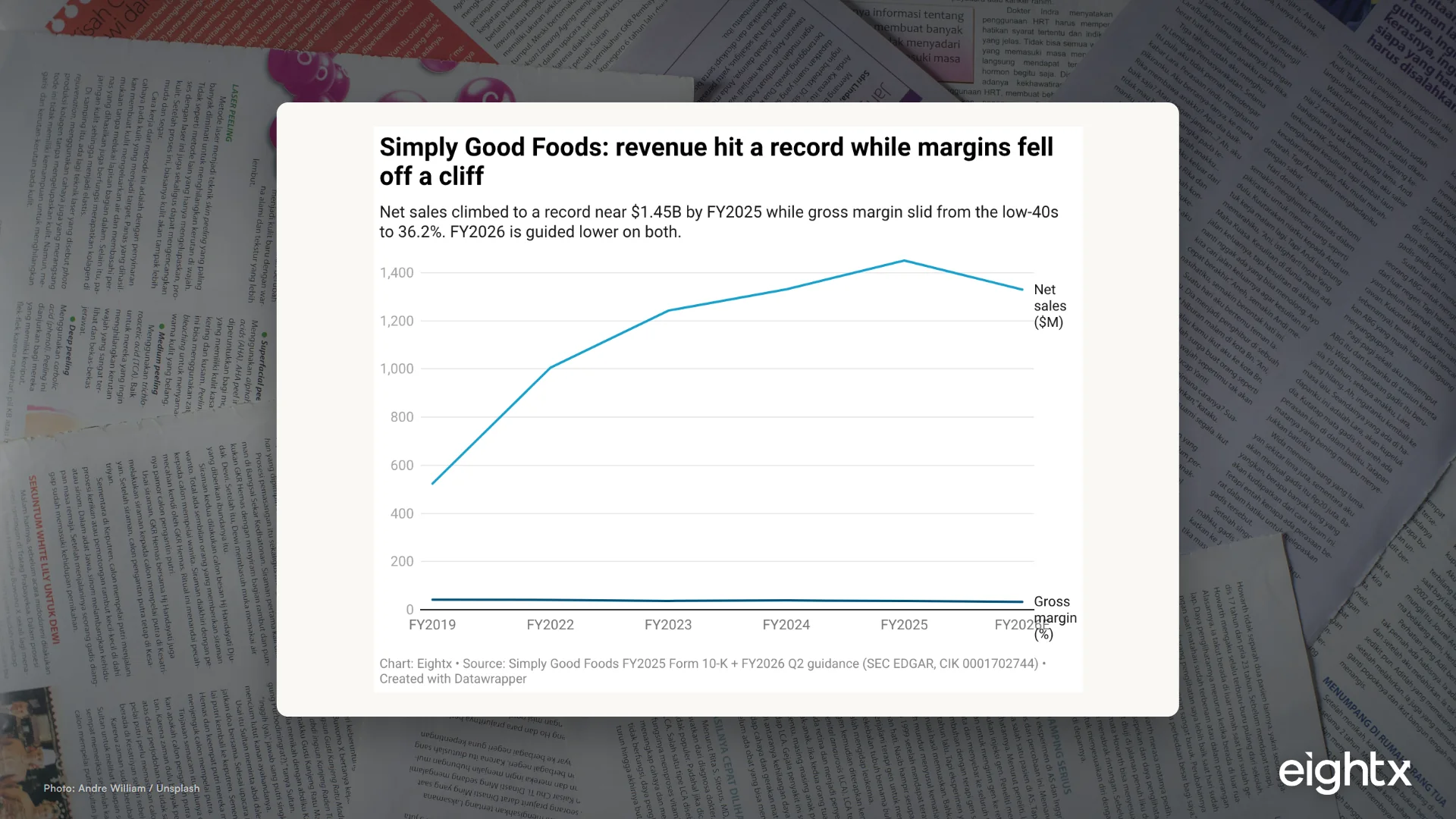
The chart shows the divergence directly: the sales line keeps climbing through FY2025 while the gross-margin line slides from the low-40s toward the mid-30s, and FY2026 guidance points both lower. Revenue and profitability decoupled.
Where the margin actually went
The honest way to read a margin slide is to walk the P&L line by line as a percent of sales, so a bigger revenue base cannot hide the leak. Here is FY2024 against FY2025.
| Line item | FY2024 ($000) | % of sales | FY2025 ($000) | % of sales |
|---|---|---|---|---|
| Net sales | 1,331,321 | 100.0 | 1,450,920 | 100.0 |
| Cost of goods sold | 819,755 | 61.6 | 925,173 | 63.8 |
| Gross profit | 511,566 | 38.4 | 525,747 | 36.2 |
| Selling and marketing | 143,929 | 10.8 | 134,282 | 9.3 |
| General and administrative | 129,699 | 9.7 | 155,930 | 10.7 |
| Loss on impairment | 0 | 0.0 | 60,928 | 4.2 |
| Income from operations | 206,497 | 15.5 | 156,887 | 10.8 |
| Net income | 139,309 | 10.5 | 103,614 | 7.1 |
| Adjusted EBITDA | 269,130 | 20.2 | 278,162 | 19.2 |
Three things stack up against operating income. Cost of goods sold rose from 61.6% to 63.8% of sales, the input-cost story (cocoa, whey, and tariffs on imported ingredients and packaging) plus the lower-margin OWYN mix. G&A climbed from 9.7% to 10.7%, partly acquisition and integration cost. And the FY2025 income statement carries a $60.9M loss-on-impairment line that did not exist the year before, worth 4.2% of sales on its own.
Notice what fell: selling and marketing, from 10.8% to 9.3% of sales. The company cut demand-generation spend into a slowdown. That defends the current-year margin and is a defensible CFO call, but it is the kind of move that can quietly starve the brands and show up two years later as a revenue miss. The pattern we see again and again is that the marketing line is the easiest one to cut and the most expensive one to have cut, once the top line softens.
See your real margin on every order.
Get our Contribution Margin calculator: COGS, shipping, fees, ads, what's left.
Check your inbox. We'll send the Contribution Margin calculator shortly.
The OWYN deal: how growth you buy can become a write-down
This is the part of the teardown that earns the word "teardown." In June 2024 SMPL closed its acquisition of OWYN, a plant-based protein brand, for about $281.9M in cash, roughly 2.3x trailing net sales and 13.3x adjusted EBITDA. It funded the deal partly with a $250M incremental term loan. On paper, a normal bolt-on: buy a faster-growing, on-trend brand, plug it into your distribution, accrete.
By the second quarter of fiscal 2026, management took a $249M non-cash brand impairment, of which $187M was charged against OWYN (the other $62M hit Atkins), citing an OWYN product-quality issue (taste and texture) and poor marketing execution. Put plainly: the company paid about $282M for a brand and, inside two years, wrote down roughly two-thirds of the purchase price. That is not a rounding adjustment. That is the accounting catching up to a deal that did not hold.
Here is why a CFO sees an impairment coming before the press release does. The price you overpay does not vanish. It parks on the balance sheet as goodwill and intangibles, and it sits there until an annual test forces you to admit the asset is worth less than its carrying value. Look at where SMPL's assets actually were.
| Asset category (FY2024 year-end) | Value ($M) |
|---|---|
| Intangible assets | 1,336.5 |
| Goodwill | 591.7 |
| Accounts receivable | 150.7 |
| Inventory | 142.1 |
| Cash and equivalents | 132.5 |
| Other (residual) | 57.8 |
| Property, plant and equipment | 24.8 |
Goodwill plus intangibles came to $1,928M, about 79% of the $2,436M balance sheet. (The concentration is essentially unchanged at FY2025 year-end, with goodwill at $590.0M versus $591.7M a year earlier, so this is not a stale snapshot.) When roughly four-fifths of a company's assets are acquisition accounting, the impairment risk is not a footnote. It is the business risk. When we are diligencing a brand that has rolled up two or three acquisitions, the first thing we do is age the goodwill: what was paid, what the acquired brand is doing now, and how big the gap is between the two. A wide gap is a write-down with a date on it you cannot yet see.
Why free cash flow is the number that still looks fine
Now the nuance that keeps this from being a doom story. Net income fell 26%. The impairment lines look ugly. But cash held up.
| Metric (FY2025) | Value |
|---|---|
| Operating cash flow | $178.5M |
| Capital expenditures | $20.5M |
| Free cash flow | ~$157.9M |
| Cash and equivalents | $132.5M |
| Long-term debt | $397.5M |
| Net debt | ~$265.0M |
| Debt-to-equity | 0.25x |
Free cash flow came in around $158M, operating cash flow of $178.5M less $20.5M of capex. Net debt sat at roughly $265M against a debt-to-equity of 0.25x. The impairments that gutted net income are non-cash, so they never touched the cash-flow statement. The business still converts sales into spendable cash at a healthy clip.
This is the single most important reading skill in the whole teardown. Net income can lie because it absorbs non-cash charges and accounting estimates. Free cash flow is much harder to fake because it is what actually landed in the bank. A brand can post a scary net-income line and be fundamentally fine, or post a clean net-income line and be quietly running out of cash. When we get a P&L and a cash-flow statement that disagree, we believe the cash. SMPL is the version where cash is the reassuring number.
Revenue set a record, net income fell 26%, and free cash flow barely moved. If you only read the top line you would buy the stock, and if you only read net income you would panic. The truth lives between them: a cash engine that still works, wrapped around a margin structure and an acquisition that do not. Read all three statements or you will read the wrong one.
What FY2026 guidance is really telling operators
Management is treating FY2026 as a reset year, and the guidance says so out loud. Net sales are guided to $1.31-1.35B, down 7% to 10% year-over-year. Gross margin is guided down another 300-350 bps. Adjusted EBITDA is guided to $217-225M, down 19% to 22%. Q2 FY2026 already printed gross margin of 31.6%, down 460 bps year-over-year.
Read that as a company choosing to take its medicine in one year: shrink the revenue base by cutting the distribution drag from a declining Atkins, absorb the OWYN write-down, and reset margin expectations rather than stretch to defend a record that was acquisition-inflated to begin with. Whether it works depends on whether Quest and a fixed OWYN can carry organic growth once Atkins stops being a drag. The cash position and the modest debt load buy management the room to try.
The operator read: five things to diligence in your own P&L
You do not run a $1.45B public nutrition company. The lessons still transfer cleanly, because every one of them is a number on your own statements.
First, is your revenue growth organic or bought. SMPL's 9% growth was OWYN. Separate your acquired or one-off revenue from your organic run-rate before you celebrate a record.
Second, what is structurally eating your gross margin. A 220 bps slide is the difference between a fundable brand and a struggling one. Know whether your COGS pressure is temporary (a bad freight quarter) or structural (a permanent input-cost step-up), because you finance those two situations completely differently.
Third, watch your marketing percent of sales. SMPL cut it from 10.8% to 9.3% into a slowdown. Cutting demand spend to protect this quarter's margin is sometimes right and sometimes the start of a slow bleed. Decide it on purpose, not by default.
Fourth, if you have acquired, age your goodwill. The day you overpay for a brand, the overpayment becomes a future write-down sitting on your balance sheet. Concentration in goodwill and intangibles is concentration in impairment risk.
Fifth, treat free cash flow conversion as the real health metric. When we talk to founders whose net income looks alarming, the first question is always what cash actually did. If FCF held while net income fell, you usually have a margin or accounting problem, not a survival problem. If FCF fell while net income held, you have the dangerous kind.
If you are diligencing an acquisition, watching your own gross margin slip, or trying to work out whether a scary net-income line is a real problem or an accounting one, that is exactly the read a fractional CFO does for a living. For the category context, see our food and beverage CPG public-company benchmarks and the sibling BellRing Brands teardown, the nearest public protein peer.
Sources and methodology
The financial line items in this teardown come from The Simply Good Foods Company's filings with the SEC (EDGAR central index key 0001702744, ticker SMPL), pulled via the SEC EDGAR data tools. The primary source is the FY2025 Form 10-K, filed 2025-10-28, with the FY2024 comparative drawn from the same filing and the prior-year 10-K filed 2024-10-29.
The income-statement table reproduces the MD&A results-of-operations figures verbatim: net sales $1,450,920K; cost of goods sold $925,173K; gross profit $525,747K (36.2%); selling and marketing $134,282K (9.3%); G&A $155,930K (10.7%); loss on impairment $60,928K; income from operations $156,887K (10.8%); net income $103,614K (7.1%); adjusted EBITDA $278,162K (19.2%). FY2024 comparatives are from the same table. Valuation metrics (free cash flow $157.9M, debt-to-equity 0.25, current ratio 4.05) were confirmed against the EDGAR valuation-metrics pull.
OWYN deal terms (about $281.9M final cash purchase price, closed June 13, 2024, roughly 2.3x trailing net sales and 13.3x adjusted EBITDA, funded partly via a $250M incremental term loan) are sourced from the company's acquisition press release, the FY2025 10-K, and corroborating transaction summaries. The $249M brand impairment is from the Q2 FY2026 earnings release dated 2026-04-09 and splits $187M against OWYN and $62M against Atkins. Note that this is distinct from the separate $60.9M "loss on impairment" line already recognized in FY2025; the two charges are kept separate throughout.
FY2026 figures are management guidance, not actuals, except the reported Q2 FY2026 results (net sales $326M, down 9.4%; gross margin 31.6%, down 460 bps). The FY2026E point in the first chart uses the midpoint of guided revenue and the high end of the guided 300-350 bps margin decline, and is labeled as guidance.
Several caveats apply. SMPL's fiscal years end in late August; FY2024 was a 53-week year and FY2025 a 52-week year, which adds modest noise to year-over-year reads. Brand-level (Atkins, Quest, OWYN) revenue and margin splits come from management commentary, not audited segment disclosure, since SMPL reports as a single segment. Adjusted EBITDA is a non-GAAP measure as defined by the company. The earlier-year margins in the five-year context were computed from reported gross profit and operating income over net sales and rounded. The OWYN product-quality and marketing-execution narrative is management's stated cause for the impairment, attributed as such.
Frequently asked questions
who owns simply good foods and what brands does it actually have?
The Simply Good Foods Company (Nasdaq: SMPL) is a publicly traded US nutrition company. Its core brands are Atkins (low-carb), Quest (high-protein snacks and bars), and OWYN, a plant-based protein brand it bought in June 2024. It is not owned by a parent conglomerate. Public shareholders own it.
why is simply good foods stock down and why did SMPL guidance drop?
FY2026 guidance was cut to net sales of $1.31-1.35B, down 7% to 10% year-over-year, with gross margin guided down another 300-350 bps. The drivers are legacy Atkins declining double digits, the OWYN acquisition underperforming (a $187M impairment against it was taken in Q2 FY2026, part of a $249M total brand charge), and continued input-cost and tariff pressure on gross margin.
what is simply good foods gross margin and how much has it fallen?
FY2025 gross margin was 36.2%, down 220 bps from 38.4% in FY2024. Q4 FY2025 was 34.3% and Q2 FY2026 fell further to 31.6%. Management attributes the slide to input-cost inflation (cocoa, whey, tariffs) and the lower-margin OWYN mix. FY2026 is guided down another 300-350 bps.
what did simply good foods pay for OWYN and was it worth it?
SMPL paid about $281.9M cash to close OWYN in June 2024, roughly 2.3x trailing net sales and 13.3x adjusted EBITDA, funded partly by a $250M term loan. By Q2 FY2026 it took a $187M impairment against OWYN (part of a $249M total brand charge that also wrote down Atkins by $62M), citing a product-quality issue and weak marketing execution. On the numbers, it has not paid off yet.
what is the $249 million impairment simply good foods took in Q2 FY2026?
An impairment is a non-cash write-down recognizing that an asset is worth less than its carrying value on the balance sheet. SMPL recorded a $249M brand charge in Q2 FY2026, split $187M against the OWYN acquisition and $62M against Atkins, after both brands underperformed. It does not drain cash, but it formally admits the carrying value was too high relative to current performance, and the OWYN portion admits the 2024 deal was overpaid.
why did simply good foods net income fall when revenue hit a record?
Three things hit at once. Gross margin fell 220 bps, G&A rose to 10.7% of sales, and the company booked a $60.9M impairment charge in FY2025 (separate from the later $249M brand write-down, of which $187M was OWYN). Record revenue at a lower margin, minus a one-time charge, produced net income of $103.6M, down 26% even as the top line set a record.
how much does simply good foods spend on marketing as a percent of sales?
FY2025 selling and marketing was $134.3M, or 9.3% of net sales, down from 10.8% in FY2024. The company cut marketing as a share of sales heading into a slowdown. That defends short-term margin but can starve the brands of demand, which is worth watching against the FY2026 revenue reset.
how does simply good foods compare to other protein CPG peers like BellRing?
BellRing Brands (Premier Protein, Dymatize) is the nearest public peer and typically runs a higher and steadier gross margin than SMPL's 36.2%, helped by the fact that it has not absorbed a dilutive acquisition on OWYN's scale. The read is that SMPL's margin compression is partly self-inflicted (the OWYN mix) rather than purely a category problem. See our BellRing teardown for the peer detail.
what can a smaller dtc or cpg brand learn from the simply good foods teardown?
Five things to diligence in your own P&L: is your revenue growth organic or bought; what is structurally eating your gross margin; whether your marketing percent of sales is disciplined or starved; how concentrated your balance sheet is in goodwill if you have acquired; and whether free cash flow conversion confirms or contradicts your net income. SMPL is a clean live example of all five.