
Financial Strategy
What is EBITDA? (eCommerce definition)
EBITDA is Earnings Before Interest, Taxes, Depreciation, and Amortization, a non-GAAP (Generally Accepted Accounting Principles) metric that the SEC requires publicly traded companies to reconcile to net income under Regulation G. For ecommerce M&A and lending, EBITDA is the anchor multiple, with mid-market DTC brands typically valued at 4x to 8x adjusted EBITDA depending on growth rate and channel mix, and lenders using EBITDA as the numerator in DSCR calculations for inventory and working-capital facilities.
Key Takeaways
- EBITDA is not a GAAP (Generally Accepted Accounting Principles) number. The SEC treats it as a non-GAAP financial measure under Regulation G and Item 10(e) of Regulation S-K. Every public filer that quotes EBITDA must reconcile it back to net income, not operating income.
- Two formulas, same answer. From the bottom of the income statement: Net Income + Interest + Taxes + Depreciation + Amortization. From the middle: Operating Income + Depreciation + Amortization. If both routes give different numbers, you have unreconciled adjustments.
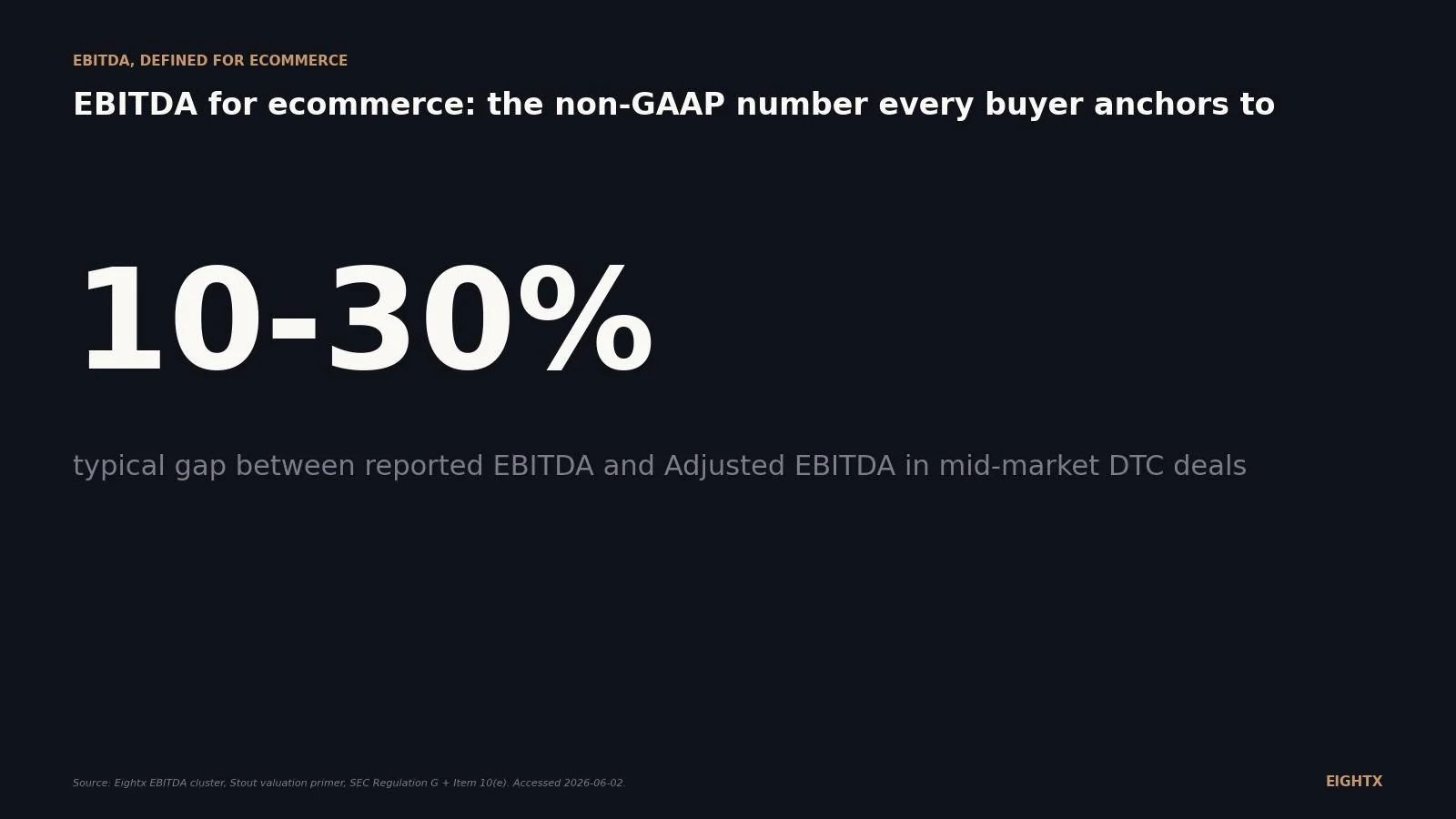
- The Reported-to-Adjusted EBITDA bridge is typically 10 to 30% in mid-market ecommerce deals. Stock-based comp, founder over-salary, M&A advisory, restructuring, and one-time legal are where the bridge gets built.
- EBITDA is not cash flow. It adds back non-cash D&A but ignores capex, working-capital changes (especially inventory build), cash interest, and cash taxes. A profitable EBITDA brand can still run out of money.
- Two reasons EBITDA matters to a private DTC operator. M&A buyers anchor exit valuation at 4 to 8x EBITDA for mid-market DTC. Lenders set covenants at 3.0 to 4.0x Net Debt / EBITDA. Both numbers gate how big you can sell and how much you can borrow.
EBITDA (Earnings Before Interest, Taxes, Depreciation, and Amortization) is the first acronym most ecommerce founders meet when a buyer, lender, or fractional CFO asks "what's your EBITDA?" It is not a line in your books. It is a derived number that strips interest (a capital-structure choice), taxes (a jurisdiction choice), and depreciation and amortization (historical capex accounting) out of net income, so two brands with identical operations but different debt loads and tax addresses can be compared on the same line.
The SEC treats EBITDA as a non-GAAP measure that must be reconciled to net income (not operating income) under Regulation G and Item 10(e) of Regulation S-K. That is why every public DTC 10-K presents an EBITDA reconciliation table. For a private $10M to $150M ecommerce operator the practical reason to understand it is simpler: M&A buyers, PE firms, and asset-based lenders all anchor valuation and debt capacity to EBITDA, and the gap between reported EBITDA, Adjusted EBITDA, and actual free cash flow is where deals get won, lost, or repriced.
What EBITDA actually means
Spell the acronym out and the math falls out of it: Earnings, Before Interest, Taxes, Depreciation, Amortization. Two algebraically equivalent formulas produce the same number when no other adjustments are introduced.
From the bottom of the income statement (the SEC-required reconciliation route for public filers):
EBITDA = Net Income + Interest + Taxes + Depreciation + Amortization
From the middle of the income statement (faster for internal management reporting):
EBITDA = Operating Income + Depreciation + Amortization
The bottom route works because Operating Income already excludes interest and taxes. If you walk net income up through interest and taxes you land at operating income, then add back D&A and you have EBITDA. If both routes give you different numbers, you have an unreconciled adjustment somewhere (often a non-operating gain or loss the operating-income line excluded).
The reconciliation walk below shows the two layers a buyer expects to see on a single page: net income up to Reported EBITDA (the GAAP-anchored number) and Reported EBITDA up to Adjusted EBITDA (the operator-normalized number).
Line item Amount ($M) Net Income (GAAP) 3.8 + Interest expense 0.6 + Income tax expense 1.2 + Depreciation 1.2 + Amortization 0.4 Reported EBITDA 7.2 + Stock-based compensation 0.7 + Founder over-salary normalization 0.4 + One-time M&A advisory fees 0.3 Adjusted EBITDA 8.6
Why EBITDA exists (and why buyers anchor to it)
The whole point of EBITDA is comparability. Imagine two ecommerce brands with identical $5M of operating income. Brand A is debt-free and headquartered in a high-tax state, so it shows net income of $3.5M after interest and taxes. Brand B carries $20M of debt and is structured through a low-tax jurisdiction, so it shows net income of $2.8M after a heavier interest expense but a smaller tax bill. Net income tells you they are different businesses. EBITDA tells you they are running the same operation.
That is exactly the read an M&A buyer wants. The buyer is going to refinance the debt, re-domicile the tax, and impose their own depreciation schedule the day the deal closes. They want to know the operating engine, not the inherited capital structure. So they offer 4 to 8x Adjusted EBITDA for a mid-market DTC brand and back into the equity value from there. (See average ecommerce EBITDA margin by vertical for the multiple math by category.)
The same logic explains why lenders use it. A bank writing a $10M revolver to a DTC brand cares whether the brand generates enough operating cash to cover interest with cushion, not whether the brand's prior owners carried too much debt. Net Debt divided by EBITDA, capped at 3.0 to 4.0x for mid-market, is the standard covenant. It tells the lender the same thing the buyer wants to know: how much operating cash does this thing throw off, before the financing layer.
The catch, which we deal with in the next section, is that EBITDA strips out a lot more than capital structure. It strips out capex, working-capital changes, cash interest, and cash taxes. Useful for comparison, dangerous as a substitute for cash.
Reported vs Adjusted EBITDA
Reported EBITDA is what the formula gives you off the income statement. Adjusted EBITDA is what the operator argues the business "really" earns once one-time and non-operating items are removed. The bridge between the two is where deals get fought.
In mid-market ecommerce, the gap is typically 10 to 30% of reported EBITDA. The biggest line items in that bridge are stock-based compensation (the SEC has flagged this is a real, recurring expense and excluding it can be misleading, but Adjusted EBITDA presentations still routinely add it back), founder over-salary (the difference between what the founder actually pays themselves and a market-rate CEO comp), M&A advisory and one-time legal fees, restructuring charges, and the personal expenses that quietly ran through the business.
A defensible add-back has three properties. It is non-recurring (it will not show up again next year). It is non-operating (it does not reflect how the business makes money). And it is supported by an invoice, a board minute, or a written policy a buyer's quality-of-earnings team can verify. The Stout add-back primer is the practitioner standard.
The depth on this lives in the sister post, which walks each add-back category with defensibility notes. See EBITDA add-backs explained for the full list and the buyer's-side challenges to expect.
How the SEC regulates EBITDA disclosure
If you are private, the SEC rules do not bind you, but the language they impose on public filers is the language every sophisticated buyer and lender uses. Worth understanding even if you never file an S-1.
Regulation G (17 CFR 244) governs the public use of any non-GAAP financial measure. It requires (1) presentation of the most directly comparable GAAP measure with equal or greater prominence, and (2) a quantitative reconciliation from the GAAP measure to the non-GAAP measure.
Item 10(e) of Regulation S-K (17 CFR 229.10(e)) governs non-GAAP measures inside SEC filings (10-K, 10-Q, S-1). It is stricter than Reg G. It prohibits per-share presentation of any non-GAAP liquidity measure (and SEC staff has stated EBITDA can function as a liquidity measure, so per-share EBITDA is out). It requires management to explain why each non-GAAP measure is useful to investors and how management uses it.
SEC staff Compliance and Disclosure Interpretations (C&DIs), updated 2024, are where most of the live guidance sits. The relevant ones for EBITDA: the most directly comparable GAAP line is net income (not operating income, not free cash flow), and excluding normal, recurring, cash operating expenses from a non-GAAP measure can render the presentation misleading.
The practical consequence for a private operator going through a sale: when a strategic or PE buyer's banker drafts the deal documents, they will use the SEC reconciliation format because that is what their public-market muscle memory does. If you present EBITDA inconsistently (sometimes from operating income, sometimes with stock-based comp added back, sometimes without), it slows the process and erodes trust. Standardize on net-income reconciliation from day one of the data room.
Why EBITDA can mislead a DTC operator
EBITDA is not cash flow. It adds back non-cash D&A, which is fine, but it also ignores four things that hit your bank account every month.
Capex. A $50M DTC brand opening two retail stores, rolling out a new 3PL WMS, and replacing a Shopify-Plus app stack might be spending $1M to $3M a year on capitalized infrastructure that shows up as depreciation over five years, not as a current-period expense. EBITDA adds the depreciation back. The cash went out the door this year.
Working-capital changes. This is the killer for inventory-heavy ecommerce. A brand growing 30% year-over-year is funding 30% more inventory, 30% more pre-paid Amazon FBA fees, and 30% more receivables (if it sells wholesale or B2B). None of that is in EBITDA. It is all in the cash flow statement, and it is why high-EBITDA growth brands routinely run out of money.
Cash interest. EBITDA excludes interest entirely. If you have a $5M revolver at SOFR + 400, you are paying real interest in real cash that does not show up in EBITDA but does show up at the bottom of your bank statement.
Cash taxes. EBITDA excludes tax expense. The actual tax bill arrives quarterly (estimated payments) and annually (true-up). Cash taxes and book taxes can differ meaningfully for ecommerce brands using accelerated depreciation, R&D credits, or Sec. 174 R&E capitalization timing.
The shortcut a fractional CFO uses: EBITDA tells you what the business could generate; free cash flow tells you what it actually does generate; the gap between the two is where the working capital, capex, and financing decisions sit. For the public-DTC version of this analysis with company-level FCF margins, see free cash flow margin: public DTC 2026.
EBITDA, valuation, and debt capacity
Two numbers gate most of what EBITDA controls for a private DTC operator.
Exit multiple: 4 to 8x Adjusted EBITDA for mid-market DTC. The multiple bands move with category, growth rate, gross margin, and channel mix. A beauty brand with 70% gross margin, 30% growth, and a healthy subscriber base trades at the top of the range or above. A commodity-category brand at 35% gross margin and flat growth trades at the bottom or on revenue. Cluster details and category multiples sit on the EBITDA margin definition page.
Debt capacity: 3.0 to 4.0x Net Debt / EBITDA covenant ceiling. A brand at $5M Adjusted EBITDA can sustainably support roughly $15M to $20M of total debt before covenant headroom gets thin. Asset-based revolvers (secured by inventory and receivables) can stretch higher; cash-flow term loans rarely do. The covenant is the binding constraint, not the rate.
Both numbers compound on each other. Every $1M of incremental Adjusted EBITDA buys you $4M to $8M of exit value AND $3M to $4M of additional debt capacity. That is why founders we work with focus quarterly board reporting on the Adjusted EBITDA bridge first and revenue second.
EBITDA is not a profit number. It is a comparability tool that strips out capital structure and accounting choices so two operating engines can be measured side-by-side. Run it as the buyer-and-lender lens, run free cash flow as the I-pay-rent-with-this lens, and never use one as a substitute for the other.
Sources and methodology
The primary regulatory references in this post are SEC Regulation G (17 CFR 244) and Item 10(e) of Regulation S-K (17 CFR 229.10(e)), both available on the SEC and eCFR websites. The interpretive layer for the reconciliation-to-net-income rule and the per-share prohibition is the SEC staff Compliance and Disclosure Interpretations for Non-GAAP Financial Measures, last updated 2024. The Deloitte DART Roadmap on Non-GAAP Financial Measures, Section 3.2 (Reconciliation Requirement), and the EY Technical Line on Non-GAAP Financial Measures (April 2023) are the practitioner standards we cross-checked against.
The illustrative $40M-revenue reconciliation walk is constructed for clarity; the line items and approximate magnitudes are consistent with mid-market DTC deals we and our peer firms have advised on, but no single real company is being represented. The 10 to 30% Reported-to-Adjusted EBITDA bridge range is drawn from the Stout EBITDA primer and the Eightx sister post on add-backs (cited inline).
The mid-market DTC median Adjusted EBITDA margin figure of approximately 7 to 8% is from Yotpo's 2026 DTC Brand Comparison report, which surveys Shopify-Plus and equivalent operators in the $10M to $50M revenue band. Yotpo is a vendor report, not an auditor data set, so the figure is directional and should be triangulated against your own peer set before being used as a board-level benchmark.
The exit-multiple range of 4 to 8x Adjusted EBITDA reflects the mid-market DTC band our team observes in current deal flow and the range published in the Eightx EBITDA margin and add-back pages. Beauty and CPG categories with strong gross margin and growth profiles trade above this range; commodity categories and flat-growth brands trade below or are repriced on revenue multiples.
The Net Debt / EBITDA covenant range of 3.0 to 4.0x is the standard mid-market commercial-bank cash-flow ceiling. Asset-based lenders secured against inventory and receivables can stretch the headline ratio higher, but the cash-flow coverage test is what binds.
Limitations. EBITDA is a derived, non-GAAP, opinion-laden number. Two analysts with the same income statement can produce two different Adjusted EBITDA figures. Use this post as a definition and a structure, not as a substitute for a buyer-side quality-of-earnings analysis or a CPA-prepared reconciliation in a real transaction.
Frequently asked questions
what does ebitda actually stand for?
Earnings Before Interest, Taxes, Depreciation, and Amortization. It is a proxy for operating cash generation that strips out capital-structure choices (interest), tax-jurisdiction choices (taxes), and historical accounting for capex (depreciation and amortization).
is ebitda a gaap number?
No. The SEC explicitly treats EBITDA as a non-GAAP financial measure under Regulation G and Item 10(e) of Regulation S-K. If your business is public, any EBITDA you quote in a filing or press release has to be reconciled back to net income.
should i build ebitda from net income or operating income?
For SEC filings you must reconcile from net income because that is the most directly comparable GAAP line per SEC staff guidance. For internal management reporting, starting from operating income and adding back D&A is faster and produces the same number if no other adjustments are introduced.
what is the difference between ebitda, adjusted ebitda, and free cash flow?
Reported EBITDA is the plain formula off the income statement. Adjusted EBITDA layers on add-backs for one-time or non-operating items (stock-based comp, founder over-salary, M&A fees) and typically sits 10 to 30% higher in mid-market DTC deals. Free cash flow takes EBITDA and subtracts capex, working-capital changes, cash interest, and cash taxes, which is what actually shows up in your bank account.
can i show ebitda per share in my deck?
No, if you are public. The SEC prohibits per-share presentation of EBITDA on the basis that EBITDA can function as a liquidity measure rather than a performance measure. If you are private, no one is stopping you, but sophisticated buyers and lenders will read it as a flag that you do not know the rule.
Browse the full ecommerce finance glossary for every metric and money term a DTC operator needs.