
Tax Strategy
What is VAT for ecommerce? UK and EU rules every cross-border DTC operator needs in 2026
UK VAT is 20 percent with a pound-zero registration threshold for non-UK sellers from the first taxable sale, a pound-135 import rule where the seller collects at checkout, and no de minimis exception for overseas DTC operators. EU rules add a euro-10,000 OSS micro-threshold for EU-established sellers only, a euro-150 IOSS ceiling for imports, and a ViDA single-registration reform rolling out through 2028. Any DTC brand shipping cross-border hits these thresholds fast.
Key Takeaways
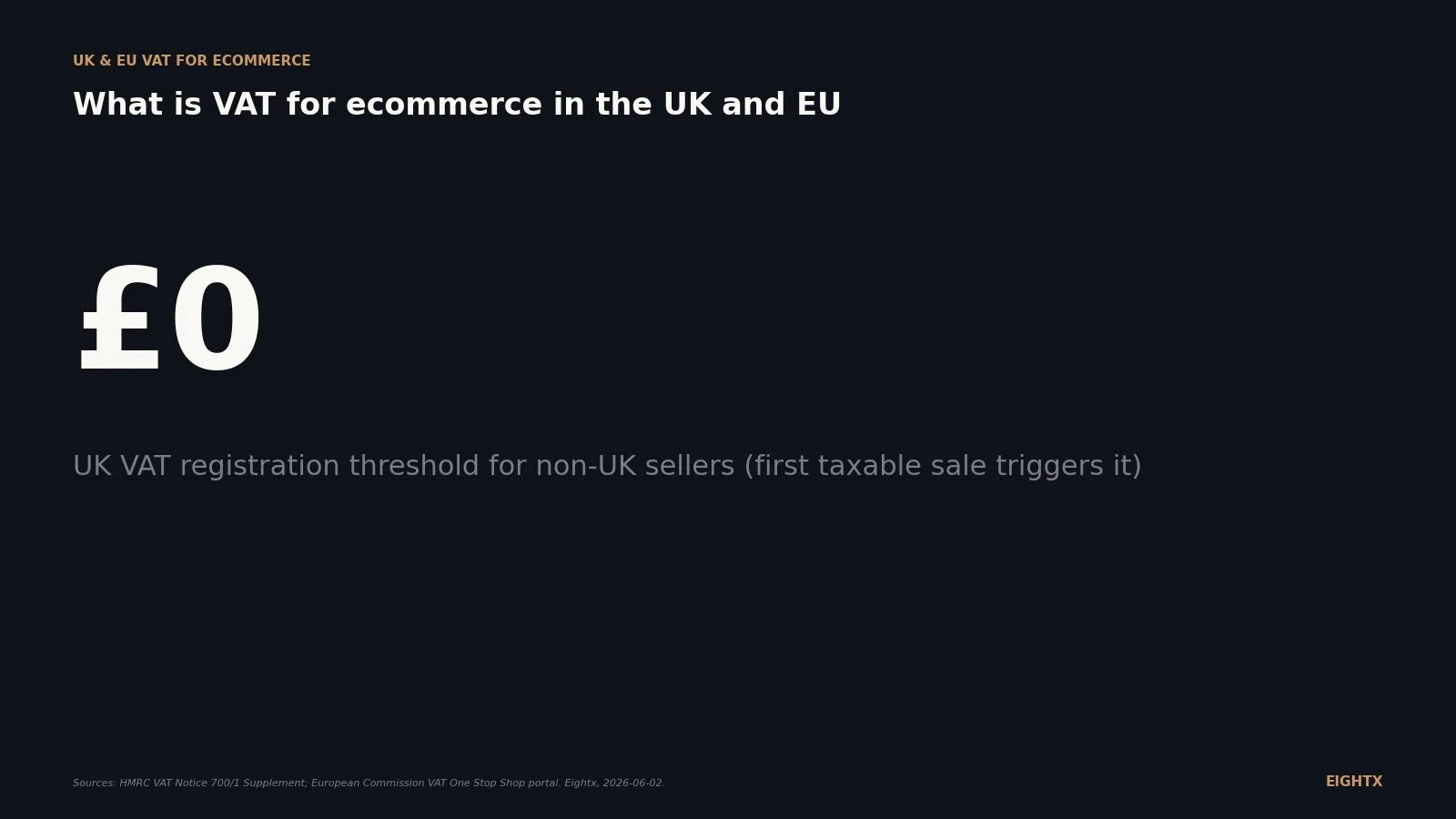
- UK standard VAT rate is 20%. UK-resident sellers register at £90,000 rolling 12-month turnover. Non-UK sellers register from the first taxable UK sale (threshold is £0).
- The UK £135 rule replaces import VAT with supply VAT for low-value B2C consignments into Great Britain. You or the marketplace collect at checkout. Above £135, standard import VAT applies.
- EU OSS micro-threshold is €10,000 EU-wide for intra-EU B2C distance sales (plus TBE services). Below: charge home-country VAT. Above: charge customer-country VAT via OSS.
- EU IOSS ceiling is €150 intrinsic value for imports from outside the EU. Collect destination VAT at checkout, fast-track customs. The old €22 exemption is gone.
- Amazon and eBay are deemed suppliers in defined scenarios; Shopify is not. If you sell direct from your own Shopify store, you're the seller of record and still owe the VAT.
If you sell physical goods into the UK or EU from outside it, VAT is the largest single cost-of-compliance line item you face. It's also the one most US-based founders underestimate, because VAT doesn't behave like US sales tax. The thresholds are lower, the registration triggers are sharper, and the rules diverged sharply post-Brexit so the UK and EU now operate two separate regimes with their own low-value consignment rules and their own marketplace deemed-supplier mechanics. This page is the glossary entry that links to the rest. We define VAT, walk through the four schemes a DTC operator actually touches (UK domestic VAT, UK £135 import rule, EU OSS, EU IOSS), and explain what marketplaces collect versus what the seller still owes.
What is VAT, and how it differs from US sales tax
VAT stands for value-added tax. It's a consumption tax charged at each stage of supply, with input-tax credits along the chain so that the economic cost lands on the end consumer. A UK manufacturer charges 20% VAT to a wholesaler, the wholesaler reclaims that input VAT and charges 20% on its sale to a retailer, the retailer reclaims and charges 20% to the consumer, and the net VAT remitted to HMRC equals the consumer-side 20%. The mechanism is fractional collection along the supply chain, not a one-shot retail-only charge.
US state sales tax works the opposite way. It's charged once, at the final retail sale, and only by the retailer to the end consumer. There are no input credits, no VAT-style invoices through the chain, and the rate is the rate of the destination state and locality only (not the buyer's country). For a US founder selling into the UK or EU, the practical difference is that you can't model VAT the way you model state sales tax: VAT is going to show up on your invoices, on your customer-facing prices, and on your tax-authority returns whether you sell one unit or one thousand, because there's no economic-nexus dollar threshold the way most US states use.
UK standard VAT rate is 20%. EU standard VAT rates range from 17% (Luxembourg) to 27% (Hungary), with most Member States sitting between 19% and 23%. Under OSS and IOSS you charge the rate of the customer's Member State, not your home country's rate.
UK VAT for ecommerce sellers in 2026
The UK regime since Brexit has three pieces ecommerce operators need to understand: the resident registration threshold, the non-resident threshold, and the £135 import rule.
UK-resident sellers. If your business is established in the UK, you must register for VAT once your taxable turnover crosses £90,000 in any rolling 12-month period. HMRC raised that threshold from £85,000 to £90,000 on 1 April 2024 (the deregistration threshold is £88,000). Once registered, you charge 20% UK VAT on most goods and services, file quarterly VAT returns under Making Tax Digital, and reclaim input VAT on UK-business purchases. The threshold is forgiving for small operators but it's a rolling number, so a single big month can pull you over the line even if your trailing annual average is well below.
Non-UK established sellers. This is where most US and AU operators get caught. The UK applies a £0 registration threshold to any business not established in the UK that makes taxable UK supplies. That means from your first taxable UK sale you're required to register. The rule was introduced on 1 December 2012 to close a competitive gap (overseas sellers had been using the £85,000 resident threshold), and it sits in HMRC VAT Notice 700/1 Supplement. There's no grace period, no warning letter, and HMRC has been more aggressive on enforcement since 2021 because of the post-Brexit revenue protection drive.
The £135 consignment rule. For goods imported into Great Britain in consignments of £135 or less, VAT is collected at point of sale as UK supply VAT instead of at the border as import VAT. HMRC introduced this on 1 January 2021 alongside the abolition of the old Low Value Consignment Relief (LVCR). The seller or marketplace charges 20% UK VAT at the customer's checkout, files it through the seller's UK VAT return, and the parcel moves through customs without a second VAT hit. Above £135, standard import VAT applies and either you (as the importer of record) or the customer (via the carrier's deferred payment system) pays it at the border.
EU VAT for ecommerce sellers in 2026: OSS and IOSS
The EU rules since July 2021 sit on three pillars: the €10,000 OSS micro-threshold, the OSS scheme for intra-EU B2C distance sales, and IOSS for low-value imports.
The €10,000 micro-threshold. EU-established sellers that make intra-EU B2C distance sales of goods and TBE (telecommunications, broadcasting, electronic) services totalling under €10,000 across the entire EU in a calendar year can keep charging their home Member State's VAT rate. Above €10,000 (or by voluntary election), they switch to charging the customer's Member State VAT rate via OSS. The threshold is a single EU-wide cap, not a per-country one. Non-EU sellers don't get this threshold at all (you're either on OSS or IOSS from the first sale via the non-Union scheme or local registration).
Northern Ireland's £8,818 sterling equivalent. Northern Ireland sits in a dual-status VAT regime for goods under the Windsor Framework: NI is treated as UK for domestic VAT but as EU for goods moving to and from EU Member States. That's why NI sellers shipping goods to EU consumers use the €10,000 OSS micro-threshold, but expressed in sterling at £8,818. Once an NI seller's intra-EU B2C goods sales cross £8,818 in a calendar year, they switch from UK VAT to customer-country VAT via OSS. Same rule as the €10,000 cap, just denominated in the currency the NI seller actually files in.
OSS (One Stop Shop). OSS lets sellers file a single quarterly return covering all their intra-EU B2C distance sales of goods and TBE services. You register in one Member State (your home state if EU-established, or any Member State you nominate if non-EU under the non-Union scheme), file one return, and the tax authority distributes the VAT to each customer-country. Before OSS, sellers had to register separately in every Member State they crossed the old distance-selling thresholds in. OSS doesn't change what you charge (still the customer's-country rate), just how you file.
IOSS (Import One Stop Shop). IOSS applies to goods imported into the EU from outside the EU with intrinsic value of €150 or less. The seller (or an appointed IOSS intermediary) registers in one Member State, collects destination-country VAT at checkout, and provides the IOSS number to the shipping carrier or customs broker. The parcel clears EU customs without VAT being charged again at the border. IOSS is optional, but skipping it means your customer gets billed VAT plus a carrier handling fee on delivery, which usually means a return. Above €150 intrinsic value, IOSS isn't available and standard import VAT plus customs duty applies. The old €22 small-consignment VAT exemption was abolished on 1 July 2021, so every commercial parcel into the EU now carries VAT regardless of value.
Marketplaces (Amazon, eBay, Shopify): what they collect versus what you still owe
Both the UK and EU have deemed-supplier rules that push VAT collection onto online marketplaces in defined scenarios. The point of the rule is that the platform is in a better position to enforce collection than HMRC or a Member State revenue authority is to chase 100,000 small overseas sellers individually.
In the UK, marketplaces are deemed suppliers for two scenarios: imports into Great Britain in consignments ≤£135, and goods already physically in the UK that are sold by an overseas (non-UK established) seller via the marketplace. In both cases, Amazon (or eBay, or any other marketplace meeting the definition) collects UK VAT at the customer's checkout and remits it through its own UK VAT return. The seller still has to be VAT-registered if it's making taxable UK supplies elsewhere, but the deemed-supplier transaction doesn't add to the seller's own VAT liability.
In the EU, marketplaces are deemed suppliers in the IOSS scenario (imports ≤€150) and for goods already in the EU sold by non-EU established sellers. Same logic: Amazon collects, Amazon remits, and the underlying seller's VAT liability shifts. Outside those defined scenarios (for example, an EU-resident seller selling EU-stock goods through Amazon EU), the marketplace is not the deemed supplier and the seller is still on the hook.
The Shopify trap is the one that catches operators by surprise. Shopify is a hosted ecommerce platform, not a marketplace in the UK or EU technical sense. If you sell from your own Shopify store, you are the seller of record for every order, and you collect and remit VAT yourself (via your UK VAT registration, your OSS return, your IOSS registration, or local Member State registrations as applicable). Shopify provides tax-collection features inside the platform, but it's not acting as a deemed supplier and the legal liability sits with you.
Scenario UK treatment EU treatment Goods ≤ £135 imported from outside UK via marketplace Marketplace collects UK VAT N/A Goods ≤ €150 imported from outside EU via marketplace N/A Marketplace collects EU VAT via IOSS (deemed supplier) Goods already in UK sold by overseas seller via marketplace Marketplace deemed supplier, collects UK VAT N/A Goods already in EU sold by non-EU seller via marketplace N/A Marketplace deemed supplier under 2021 e-commerce package Goods sold direct from own Shopify store (no marketplace) You collect and remit VAT You collect and remit VAT (via OSS, IOSS, or local registration) Goods over £135 imported direct to UK customer Standard import VAT; you may need importer registration N/A Goods over €150 imported direct to EU customer N/A Standard import VAT plus customs duty; IOSS not available
What's changing: ViDA and the 2026 to 2030 roadmap
The EU's VAT in the Digital Age (ViDA) package was adopted on 11 March 2025 (Directive EU 2025/516, Regulation EU 2025/517, Implementing Regulation EU 2025/518) and entered into force on 14 April 2025. It phases in over a decade through 2035. For DTC goods operators, the 2026 reality is unchanged: the rules in this post are the rules.
The headline ViDA dates DTC operators should track:
- 2027: Technical fixes to OSS and IOSS (mostly back-office, no operator-side action).
- 1 July 2028: Single VAT Registration expansion. More cross-border scenarios become eligible for OSS-style consolidated filing instead of local VAT registrations, which reduces compliance overhead for sellers operating in multiple Member States. Also: platform deemed-supplier rules expand, but only for short-term accommodation and passenger transport. Not for general goods. Goods sellers do not get new deemed-supplier coverage in 2028.
- 1 July 2030: Mandatory Digital Reporting Requirements (DRR) for cross-border B2B transactions. Real-time e-invoicing requirements arrive for cross-border B2B only under the adopted ViDA package; no B2C DRR is in scope on this date. DTC operators selling to consumers aren't directly hit by the 2030 mandate, but invoicing-system upgrades made for B2B exposure typically cover B2C flows too.
Nothing in ViDA changes the £135 rule, the €150 IOSS ceiling, the €10,000 OSS micro-threshold, or the 17% to 27% rate range in the next two years. If you're building VAT compliance into your 2026 operating model, build it for today's rules and revisit in 2027.
The mistake we see most often: founders treat UK and EU VAT like US sales tax with a different label. They wait for revenue to hit some imaginary threshold before they register. The thresholds are £0 for non-UK sellers into the UK, and €0 for non-EU sellers into the EU. First sale triggers it. Plan compliance before you plan your first ad spend.
Quick-reference table: thresholds and rules at a glance
Rule Jurisdiction Threshold What it triggers Primary source Standard VAT rate UK 20% Charged on most goods and services HMRC, How VAT works Standard VAT rate range EU (27 Member States) 17% to 27% Rate of customer's Member State applies under OSS/IOSS European Commission VAT registration (UK-resident sellers) UK £90,000 rolling 12 months Must register and charge UK VAT gov.uk/how-vat-works/vat-thresholds VAT registration (non-UK sellers) UK £0 Register from first taxable UK sale HMRC VAT Notice 700/1 Supplement Low-value consignment rule UK £135 Seller or marketplace charges UK VAT at point of sale (not import VAT) HMRC, Alternative VAT treatment of Goods from Overseas OSS micro-threshold EU €10,000 EU-wide Below: home-country VAT. Above: customer-country VAT via OSS vat-one-stop-shop.ec.europa.eu IOSS consignment ceiling EU €150 intrinsic value Collect destination-country VAT at checkout; fast-track customs European Commission OSS portal OSS threshold (Northern Ireland sellers) NI £8,818 Sterling equivalent of €10,000 for NI distance sales into EU gov.uk EU VAT e-commerce package ViDA Single VAT Registration expansion EU 1 July 2028 More cross-border scenarios eligible for consolidated OSS filing Directive EU 2025/516
What to do this week
If you're already selling into the UK or EU and any of the four scheme triggers apply (UK taxable sale, intra-EU distance sale, imports ≤£135, imports ≤€150), check that you're registered in the right scheme. Pull the last three months of orders by ship-to country, sum by destination, and compare against the thresholds in the table above. If you're a US-based brand shipping to the UK without a UK VAT number, you're already in arrears and the right next step is a back-registration conversation with a UK VAT advisor.
If you're not yet selling into UK or EU but plan to in 2026, build VAT registration into the launch checklist alongside the carrier, customs broker, and IOSS intermediary decisions. The non-resident UK threshold is £0 and the non-EU seller threshold under OSS is effectively zero, so there's no soft-launch window. The cost of getting registered before your first sale is small; the cost of fixing it after HMRC writes a letter is not.
For more on how cross-border tax interacts with DTC unit economics, see our AU vs US ecommerce finance comparison and the fractional CFO services overview for what cross-border tax planning looks like as a CFO conversation rather than a compliance one.
Sources and methodology
This glossary entry is built from primary HMRC and European Commission sources, accessed 2026-06-02. UK threshold and rate figures come from HMRC's "How VAT works" guidance and the VAT thresholds page (gov.uk/how-vat-works/vat-thresholds). The £0 non-resident threshold rule sits in HMRC VAT Notice 700/1 Supplement, in force since 1 December 2012. The £135 consignment rule mechanics and marketplace deemed-supplier provisions come from HMRC's "Alternative VAT treatment of Goods from Overseas" published alongside the 1 January 2021 LVCR abolition.
EU figures come from the European Commission's VAT One Stop Shop portal (vat-one-stop-shop.ec.europa.eu), which is the canonical source for the €10,000 OSS micro-threshold and the €150 IOSS consignment ceiling. The 17% to 27% EU standard VAT rate range reflects the position as of 2026: Luxembourg at 17%, Hungary at 27%, most Member States between 19% and 23%. Per-country rates change occasionally (Estonia raised its standard rate to 22% in 2024 and 24% from July 2025), so this post quotes the range rather than per-country rates. The Commission maintains the canonical per-country list.
ViDA references (Directive EU 2025/516, Regulation EU 2025/517, Implementing Regulation EU 2025/518) cite the European Commission's "Adoption of the VAT in the Digital Age package" summary page and the "VAT in the Digital Age" overview, both at taxation-customs.ec.europa.eu. We have not pulled the consolidated Directive text; the Commission summary is the working primary source for the phased timeline.
Chart choice. We considered a Datawrapper threshold-comparison chart but mixed currencies (GBP and EUR) and order-of-magnitude differences across the threshold set (£0, £135, €150, £8,818, €10,000, £90,000) would mislead more than illuminate on a single axis. The inline tables in the marketplaces section and the quick-reference section are the canonical data view; a chart would add visual weight without adding precision.
Limitations. This is a definition-first reference page, not a tax-advisory document. Per-country EU VAT rates are not listed because they go stale; the 17% to 27% range is sufficient for an operator-level scope. Marketplace deemed-supplier policies sit in platform-specific seller-help documentation and change periodically; the structural rules in this post are the legislative position, but the platform-by-platform application may shift between editions. Switzerland, Norway, and other non-EU European countries have their own VAT regimes outside this post's scope.
Update cadence. This glossary entry is refreshed quarterly when HMRC or the European Commission publishes a threshold or rate change. Next update target: September 2026.
Frequently asked questions
what is vat and why do i have to charge it on ecommerce sales?
VAT (value-added tax) is a consumption tax charged at each stage of supply, with input-tax credits along the way so the cost is ultimately borne by the end consumer. If your customer is in the UK or EU and you cross a registration threshold, you have to charge it on the sale, file returns, and remit it to the tax authority. It is not optional, it is not the same as US sales tax, and the registration thresholds are low enough that any DTC brand shipping cross-border will hit them quickly.
do i need a uk vat number if i'm a us seller shipping to uk customers?
Yes, from the first taxable UK sale. The UK gives resident businesses a £90,000 turnover threshold before they have to register, but non-UK established sellers get a £0 threshold. That rule has been in force since 1 December 2012 and HMRC enforces it via VAT Notice 700/1 Supplement. If you sell direct to UK consumers from a US-based operation, you need a UK VAT number. The one exception is if you only sell through a marketplace that is acting as the deemed supplier (Amazon for ≤£135 imports), in which case the marketplace collects.
what is the £135 rule and does shopify or amazon handle it for me?
The £135 rule says that for goods imported into Great Britain in consignments of £135 or less, VAT is charged as a UK supply at point of sale instead of as import VAT at the border. Amazon and eBay are deemed suppliers under this rule and collect on your behalf when the goods are ≤ £135. Shopify is not a marketplace in the UK technical sense, so if you sell from your own Shopify store, you collect the £135-rule VAT yourself and remit it via your UK VAT return.
what's the difference between oss and ioss?
OSS (One Stop Shop) is for intra-EU B2C distance sales of goods and TBE services: you ship from one EU country to a customer in another, file a single OSS return, and the tax gets distributed. IOSS (Import One Stop Shop) is for goods imported into the EU from outside the EU with intrinsic value ≤€150: you collect destination-country VAT at checkout and the parcel clears customs faster. OSS is for goods already inside the EU. IOSS is for goods arriving into the EU.
do i have to register for vat in every eu country i sell to?
No, that is exactly what OSS solved in July 2021. You register for OSS once, in one EU Member State (or via the non-Union scheme if you're outside the EU), and file a single quarterly return covering all your intra-EU B2C distance sales. You still have to charge the customer's country's VAT rate, but you only file once. Without OSS you would have to register in every Member State you cross the old distance-selling thresholds in.
Browse the full ecommerce finance glossary for every metric and money term a DTC operator needs.