
eCommerce
Xero vs QuickBooks Online for ecommerce 2026: pricing, seat caps, A2X, and the $10M ceiling
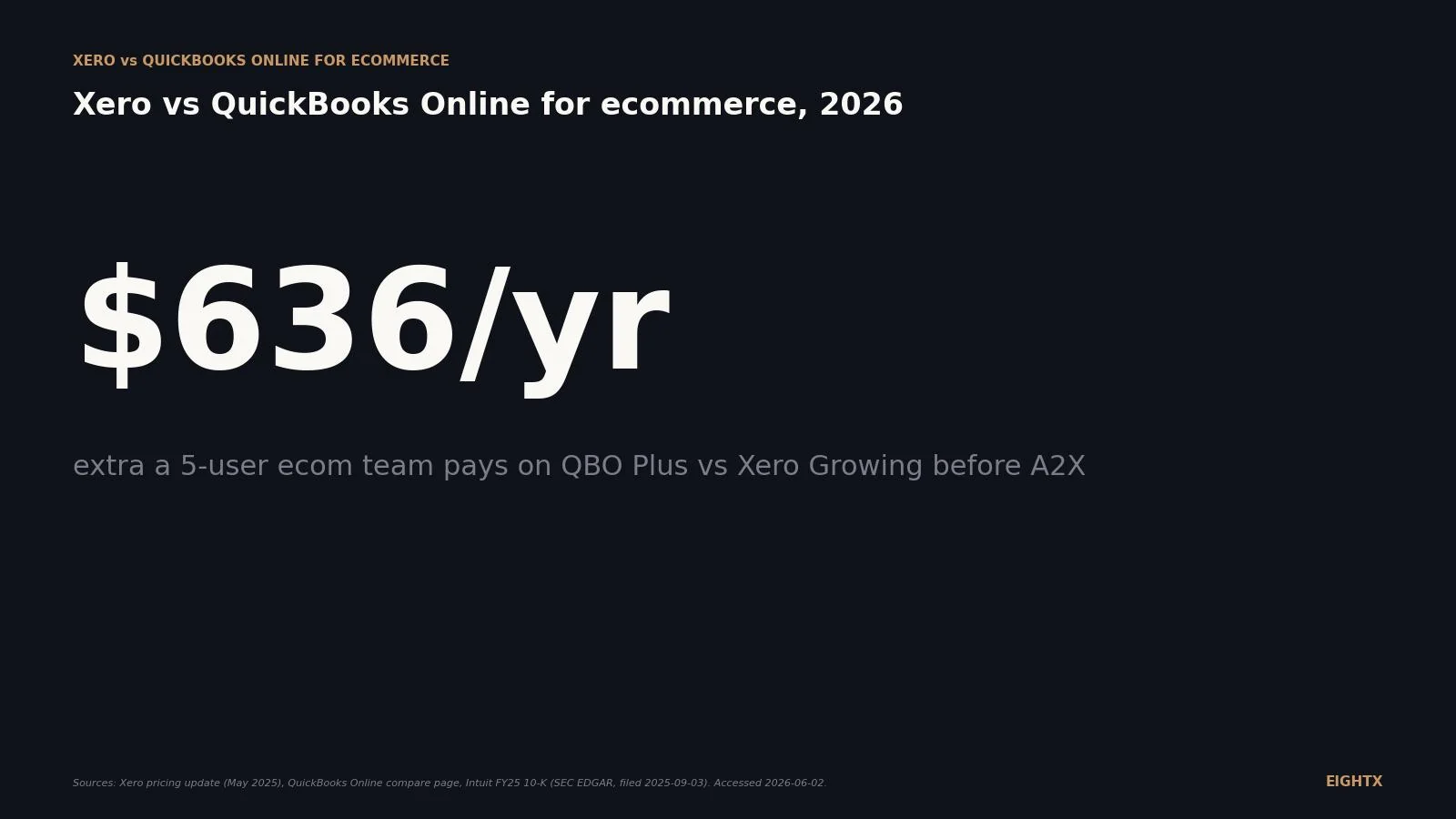
A five-user ecommerce team pays $588 per year more on QuickBooks Online Plus than on Xero Growing in 2026. Both platforms integrate identically with A2X for Shopify and Amazon settlement accounting. QBO is the safer default for US-only sellers under $10M because of local accountant pool and bank-feed depth. Xero wins for AU and UK operators, multi-currency needs, and teams that hit the five-seat QBO cap before $10M revenue.
Key Takeaways
- A 5-user ecom team pays $588/year more on QBO Plus ($1,188) than Xero Growing ($600) for comparable functionality, before A2X. User-seat caps are the largest total-cost-of-ownership driver between the two platforms.
- QuickBooks Online caps users at 1, 3, 5, and 25 across Simple Start, Essentials, Plus, and Advanced. Xero gives unlimited users on every tier (Early, Growing, Established). That single line item is the most-cited reason ecom CFOs switch from QBO to Xero.
- Intuit's QuickBooks Online Accounting revenue grew $741M (+22%) in fiscal 2025, on Intuit total revenue of $18.831B (FY25 10-K, filed 2025-09-03). Xero reports approximately 4M subscribers globally (Xero FY25 annual report). Intuit stopped disclosing QBO subscriber counts in 2024; third-party estimates put QBO at roughly 7M+, but the larger of the two bases is QBO.
- Once A2X is in front of the ledger, Xero and QBO are functionally equivalent for $1M to $20M Shopify and Amazon sellers. The native inventory gap most reviews argue about disappears. Choose on price, regional accountant pool, and where you plan to be at $50M.
- Both platforms quietly break around $10M GMV when multi-entity consolidation hits. Brands above $10M typically migrate to NetSuite for inter-company eliminations and granular inventory valuation, even if the ledger itself is still running fine.
If you are running a Shopify and Amazon brand between $1M and $20M in revenue, the Xero vs QuickBooks Online question is almost never decided on the ledger itself. It is decided on three things: where you sell, how many people need access, and whether you are going to use A2X. Almost every other line in the feature-comparison tables is noise at this revenue band.
This post walks the actual decision tree the way an interim chief financial officer (CFO) would on a 30-minute call. We use 2026 list pricing in USD, the Intuit FY25 10-K for the parent-company numbers, and the published Xero pricing update from May 2025. A2X stands for "Amazon to Xero" historically; it now bridges Shopify, Amazon, eBay, Etsy, Walmart, and PayPal into either ledger. GMV is gross merchandise value, the top-line sales number before refunds.
The actual decision, not the feature checklist
If you read the Intuit comparison page, the Xero pricing page, and ten independent reviews back-to-back, you end up with a 40-row feature grid that does not help you pick. The grid hides the three drivers that actually matter for an ecommerce operator at $1M to $20M.
Driver one is country. QuickBooks Online is the US and Canada default. Xero is the Australia and New Zealand default. The UK is contested, but ecommerce-focused UK accountants lean Xero. If your accountant works in QBO and you switch to Xero, you are dragging them and yourself through three months of friction for a saving that might be $50 a month.
Driver two is seat count. Xero gives unlimited users on every plan. QBO caps you at 1, 3, 5, and 25 across Simple Start, Essentials, Plus, and Advanced. Once you need a sixth person in the ledger (owner, bookkeeper, accountant, ops lead, finance contractor, and a virtual assistant for AP), you are on QBO Advanced at $200 a month, or you are on Xero Growing at $50 a month.
Driver three is whether you are committing to A2X. Once A2X is in front of the ledger, both platforms post the same clean journals, the same reconciled fees, and the same COGS treatment. The native inventory gap that QBO sales reps and Xero sales reps each argue about disappears.
If your answer on the three drivers is "US, 1 to 3 users, no A2X yet," the answer is QBO Simple Start or Essentials. If your answer is "anywhere, more than 3 users, yes A2X," the answer is Xero Growing or Established. Almost every other recommendation in the wild is overfitting.
Pricing head-to-head: where the $588/year gap comes from
The cleanest way to see the gap is to hold the team size constant and compare like-for-like plans. A 5-user team is the most common ecommerce setup at $2M to $15M revenue: owner, bookkeeper, outside accountant, ops or inventory lead, and one finance contractor or controller.
QBO Plus at $1,188 a year is the lowest QBO tier that fits 5 users and native inventory. Xero Growing at $600 a year fits 5 users (and 50, and 500). The gap is $588 a year before A2X, before payroll, before any premium support add-on. Move to a 10-person team and the gap widens because QBO forces you to Advanced at $2,700 a year while Xero stays on Growing.
Attribute Xero Early Xero Growing Xero Established QBO Simple Start QBO Essentials QBO Plus QBO Advanced Monthly price (USD) $29 $50 $75 $30 $60 $99 $200 User seats Unlimited Unlimited Unlimited 1 3 5 25 Invoices per month 20 Unlimited Unlimited Unlimited Unlimited Unlimited Unlimited Multi-currency No No Yes No Yes Yes Yes Native inventory No No Basic No No Yes Advanced Shopify connect Limited Yes Yes 1 channel 3 channels Unlimited Unlimited Amazon via A2X Yes Yes Yes Yes Yes Yes Yes Advanced reporting No No Yes No No Limited Yes
The other line that gets missed in spreadsheet comparisons: Xero Early caps you at 20 invoices a month. That is fine for a side business. It is not fine for any real ecommerce brand, because even after A2X collapses your daily Shopify orders into one summary journal, you still issue 20 to 50 invoices for wholesale, B2B, returns, and one-off services. Plan on Growing as the entry point.
What each platform actually does well for Shopify and Amazon sellers
Stripping out the marketing copy, here is what each platform genuinely does better than the other.
QuickBooks Online does better. US bank-feed coverage and auto-categorization. The native inventory module on Plus and Advanced (average-cost layering, reorder points, project profitability). Reporting customization on Advanced, including the batch invoicing and workflow automation that bigger teams use to compress month-end. US accountant availability: most US-based ecommerce bookkeeping firms are QBO-first.
Xero does better. Unlimited users on every plan. Multi-currency on Established (better automatic conversion than QBO Essentials). AU, UK, and NZ bank-feed depth. The bank-reconciliation workflow itself, which most accountants prefer over QBO's. Recurring invoicing on lower price points than equivalent QBO tiers. App marketplace breadth (roughly 1,000+ apps versus QBO's 750), especially outside the US.
The honest read on inventory is that neither native module is sufficient for a serious multi-channel ecommerce business above $1M. You will end up running Cin7 or Inventory Planner or Katana in front of either ledger, and you will use A2X to summarize the marketplace settlements. So the "QBO has better native inventory" point matters for a $300K single-channel Shopify store, not for a $5M Shopify-plus-Amazon brand.
The integration story: A2X, Link My Books, Synder, Bookkeep
The biggest myth in the Xero vs QBO debate for ecommerce is that one ledger integrates better with Shopify or Amazon. In 2026, the question is which connector you use, not which ledger you connect to. Four connectors handle almost all of the market.
Connector Xero QBO NetSuite Best for Starter price (USD/mo) A2X Yes Yes Yes Multi-marketplace sellers $1M+ $29 Link My Books Yes Yes No UK and EU VAT-heavy sellers $17 Synder Yes Yes Yes Multi-channel plus Stripe and PayPal heavy $52 Bookkeep Yes Yes No Shopify-only or POS-heavy $75
A2X is the practitioner default at $1M+ in marketplace revenue and the option most ecommerce-focused bookkeepers will quote you first. Link My Books is cheaper and the VAT handling is excellent if you sell into the UK or EU. Synder is what you want if Stripe and PayPal are larger than Shopify or Amazon in your stack. Bookkeep is the cleanest fit for Shopify-only stores that also use a Shopify POS or a separate physical-retail tool.
All four work on both ledgers. The choice is regional, vertical, and a function of your accountant's preferences, not of the ledger itself.
Parent-company direction of travel: Intuit vs Xero
The Xero vs QBO platform choice for the next 18 months is rarely affected by what each parent company is doing. But for a 3-to-5-year decision, the direction of travel matters.
Intuit reported $18.831B in FY25 revenue (fiscal year ended 2025-07-31), per the 10-K filed 2025-09-03. QuickBooks Online Accounting revenue alone grew $741 million (+22%) in FY25, on the back of price increases and seat expansion rather than net-new SMB wins. Xero reports approximately 4M global subscribers as of its FY25 annual report (year ended 2025-03-31), growing from about 2.4M in FY20. Intuit no longer discloses QBO subscriber counts; third-party estimates put QBO at roughly 7M+, so QBO's installed base is the larger of the two, but neither vendor publishes a directly comparable number on the same cadence.
Two reads. First, Intuit's revenue base is roughly 8-9x Xero's revenue base, but that includes TurboTax, Mailchimp, Credit Karma, and ProConnect. The QuickBooks Online product alone is closer in size to Xero, and both are growing. Neither platform is going anywhere. Second, Intuit's pricing power keeps showing up in the financials. QBO list prices have stepped up year-over-year while Xero (after its May 2025 step-up) has held flat. Plan for both ledgers to raise prices roughly 5 to 10% a year through the rest of the decade.
Where each platform breaks at scale
Below ~$1M revenue, both work fine. Between $1M and $10M, both work fine with A2X. Above $10M, both start breaking in predictable places, and brands typically migrate to NetSuite.
Revenue band Xero failure mode QBO failure mode Typical resolution $1M to $5M Inventory tracking thin without A2X User-seat costs climb Add A2X $5M to $10M Multi-entity consolidation gets manual Plus plan reporting limits hit Upgrade to Established or move to QBO Advanced plus Fathom $10M to $25M Both platforms slow at high transaction volume Advanced reporting still misses by-channel P&L Migrate to NetSuite or stay on Xero plus Fathom plus A2X $25M to $50M No native consolidation across entities No native inter-company eliminations Migrate to NetSuite
The "$10M ceiling" is a real pattern across the brands we work with, but the trigger is usually a structural change (a holding company, a foreign subsidiary, an Amazon FBA entity in a different jurisdiction) more than a transaction-volume issue. Some brands stay on Xero plus Fathom plus A2X through $25M because they only ever run one entity.
The 2026 picks by operator profile
Three clean defaults that cover most of the question space.
US-based Shopify seller, under $5M revenue, 1 to 5 users, single entity. QuickBooks Online Plus at $99/month plus A2X. Best US accountant availability, native inventory good enough for one channel, and you stay inside the most-integrated US tool stack.
Any region, 5+ users, A2X-centric, $1M to $20M. Xero Growing at $50/month plus A2X. Unlimited users wins on cost, the Growing tier covers reporting needs for most ecom operators, and A2X handles the marketplace summaries that would otherwise stress the ledger.
International, multi-currency, $5M+ revenue, planning toward $50M. Xero Established at $75/month plus A2X today, with NetSuite on the 18-month watch list. Multi-currency works, and you build your team and your accountant's processes on Xero so that the eventual NetSuite migration has clean source-of-truth data.
If your brand operates across regions (US-domiciled with an AU subsidiary, for example), pick the ledger that matches your accountant's primary office. The cost of mismatched-platform accountants is bigger than the $588/year subscription gap.
The Xero vs QuickBooks Online debate for ecommerce gets argued on feature checklists. The decision is actually three lines: where you sell, how many people need access, and whether you are going to use A2X. Get those right and the rest of the comparison stops mattering.
Sources and methodology
Intuit FY25 10-K. Total revenue and QuickBooks Online Accounting growth come from the Intuit Inc. Form 10-K filed 2025-09-03 on SEC EDGAR (accession 0000896878-25-000035, fiscal year ended 2025-07-31). Total revenue of $18.831 billion and QBO Accounting revenue growth of $741 million (+22%) are stated in the management's discussion and analysis section. Historical Intuit revenue (FY20 through FY25) was pulled from the comparable 10-K filings under CIK 896878.
Xero pricing. Plan prices come from the Xero May 2025 pricing update page. Xero uses two naming conventions: Starter, Standard, Premium in some regions, and Early, Growing, Established elsewhere. This post uses Early, Growing, Established because that matches independent US-facing reviews and operator language. AUD and GBP equivalents differ slightly and can be cross-checked on the regional Xero pricing pages.
QBO pricing. Plan prices come from the QuickBooks Online compare page maintained by Intuit. Promotional discounts (commonly 50% off for three months on Simple Start and Essentials) are not included in the comparison. The Advanced tier price ranges from $200 to $235 depending on promotion, region, and bundle selection.
Subscriber estimates. Xero global subscribers are reported as approximately 4M in the Xero FY25 annual report (year ended 2025-03-31). Intuit stopped disclosing QBO subscriber counts in 2024, so the "~7M+" figure for QBO is a third-party estimate (beancount.io, johngalt-finance.com, taxstra.com) extrapolated from older Intuit disclosures, not a current filed number.
Connector pricing. A2X, Link My Books, Synder, and Bookkeep starter prices were pulled from each vendor's public pricing page in June 2026. Starter tiers do not reflect the cost a $10M-plus seller will pay; mid and enterprise tiers typically run 3-10x the starter price.
Limitations. Regional share estimates are directional, not census-grade. The "$10M ceiling" is a pattern across the Eightx client base and the practitioner literature, not a rule. Plenty of brands stay on Xero or QBO through $25M when they run a single entity and a clean A2X setup. Most NetSuite migrations are triggered by a structural change (a holding company, a new foreign subsidiary), not by transaction volume alone.
Update cadence. This post is refreshed quarterly as pricing pages and parent-company filings update. Next update target: September 2026 (after Intuit's FY26 Q4 earnings and the post-EOFY pricing cycle in AU and the UK).
For more on the cost stack around your ledger, see our interim CFO services overview and the related read on Shopify finance stacks for $10M brands.
Frequently asked questions
is xero or quickbooks online cheaper for a 5-person ecommerce team in 2026?
Xero, by about $588 per year. A 5-user team on Xero Growing pays $600 per year ($50/month). The comparable QBO tier is Plus at $1,188 per year ($99/month), because Plus is the lowest QBO tier that includes 5 user seats and native inventory. Both prices are USD list, before A2X. Once your team needs more than 5 seats, QBO pushes you to Advanced at $200/month and the gap widens further.
does xero or quickbooks integrate better with a2x for shopify and amazon?
They are functionally equivalent. A2X treats Xero and QBO as first-class integrations and supports Shopify, Amazon, eBay, Etsy, Walmart, and PayPal on both. You map sales, refunds, fees, and payouts to the same account structure either way. Choose your ledger on price, seat count, and where your accountant works, not on the A2X integration itself.
when should an ecommerce brand move off quickbooks online to netsuite?
Around $10M GMV when multi-entity structure shows up. Below that, QBO Plus with A2X handles a single-entity Shopify and Amazon brand cleanly. Above $10M, the issues are usually inter-company eliminations, consolidated reporting across multiple legal entities, and granular inventory valuation (FIFO and LIFO at SKU level). Those are NetSuite problems, not QBO problems.
does xero handle multi-currency better than quickbooks for international ecommerce?
Yes, in two ways. First, Xero's Established tier ($75/month USD) is the only Xero plan with multi-currency and has stronger automatic conversion than QBO Essentials. Second, Xero's bank-feed coverage is deeper in AU, UK, and NZ, which matters if you have local entities or are shipping into those markets. For a US-only seller with one currency, the multi-currency edge is irrelevant.
can i run a $10m dtc brand on quickbooks online plus or do i need advanced?
Plus runs out before $10M, usually because of the 5-user seat cap and the reporting ceiling. By $10M revenue most brands have an owner, a bookkeeper, an outside accountant, an ops or inventory lead, and at least one finance contractor. That fills the 5 seats. The next step is Advanced at $200/month with 25 users, or switching to Xero Growing at $50/month with unlimited users. The Xero math wins unless you depend on QBO Advanced's batch invoicing or custom roles.
is xero's inventory tracking good enough for an amazon fba seller?
Not on its own. Xero's native inventory is light. For an Amazon FBA seller, you need A2X (or Link My Books or Synder) in front of the ledger to translate Amazon settlements into clean sales, refunds, fees, and COGS journals. Once A2X is in place, Xero is fine. The same is true for QBO, by the way, because nobody runs Amazon FBA off raw QBO journals at scale.
why do most australian and uk ecommerce accountants default to xero?
Local market share and unlimited users. Xero is NZ-founded and has strong AU adoption (the advisor default in AU and NZ in 2026). UK is contested but tilts Xero among ecommerce-focused firms because of multi-currency and VAT handling. Unlimited users also matter more in markets where the accountant, the bookkeeper, and the founder are usually three different firms all logging in.
should a us-based shopify seller doing $2m revenue use xero or quickbooks online?
QBO Plus is the safer default at that size. A $2M US-only Shopify seller benefits from QBO's larger US accountant pool, the deeper US bank-feed catalog, and the fact that most US-specific tools (POS, payroll, sales tax) integrate with QBO first. Pair with A2X for the Shopify summaries. Consider Xero only if you already have a Xero-fluent accountant or you expect to add a second currency soon.
how much does a2x actually cost when you add it on top of xero or quickbooks?
Starter A2X tiers begin around $29 per month for a single low-volume channel. Mid-tier sits at $49 to $89 depending on order count and number of marketplaces (Shopify plus Amazon US, for example, is two connections). Above ~$10M in marketplace volume the price climbs further. Budget $50 to $100 per month for most $1M to $10M ecom brands, on top of whichever ledger you choose.
what breaks first in quickbooks online when an ecommerce brand passes $10m in revenue?
Three things, in this order. First, the Plus reporting ceiling: you cannot get a clean by-channel P&L without manual rebuilds or third-party tools. Second, the 5-user seat cap forces an upgrade to Advanced at $200/month. Third, multi-entity consolidation if you have a second legal entity (a parent holding company, an AU subsidiary, a separate FBA entity) because QBO does not handle inter-company eliminations natively. That third one is usually the NetSuite trigger.