
Insights
Average ecommerce wholesale revenue share by vertical 2026: 0% to 90% across 9 public consumer brands
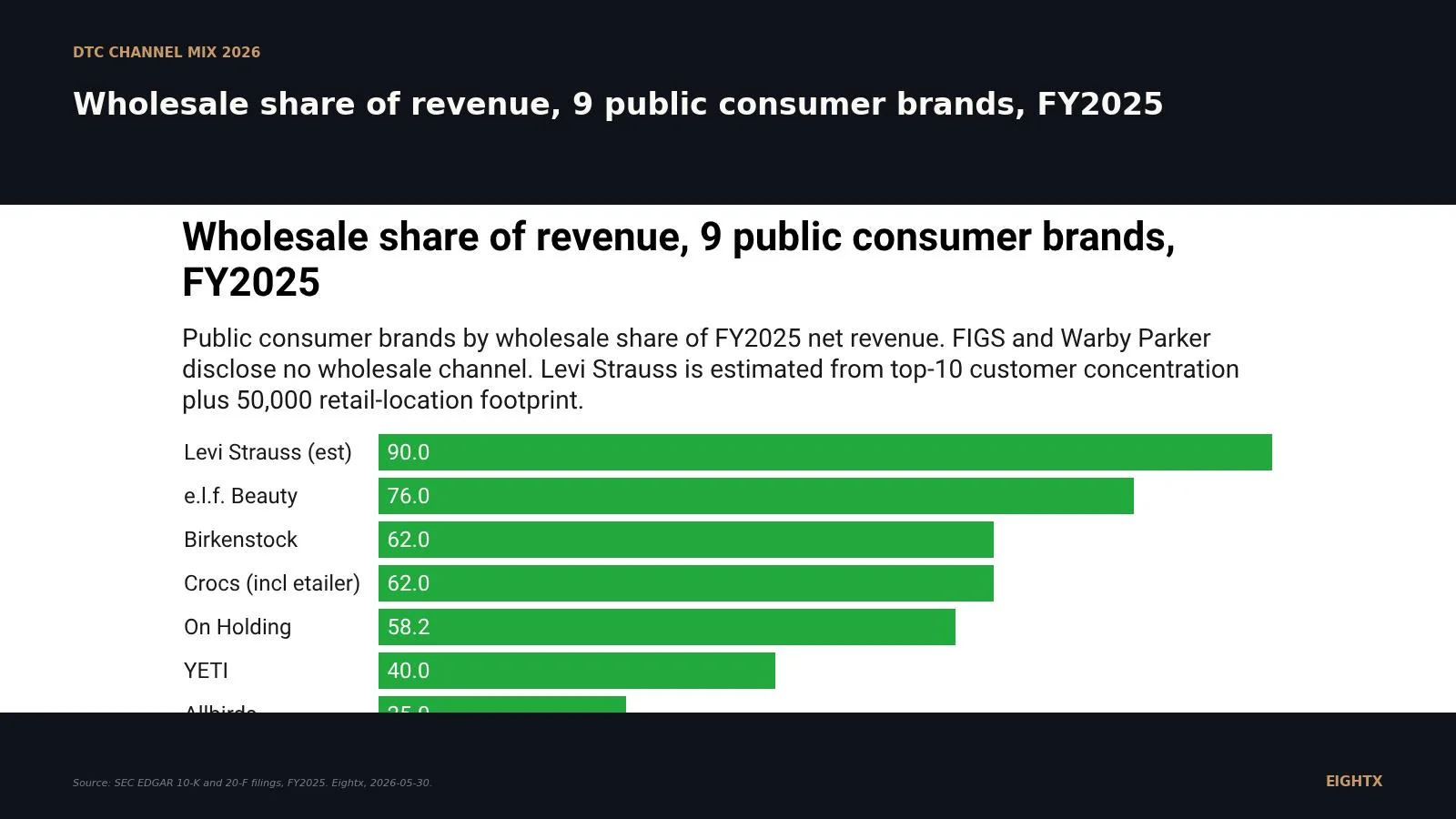
Wholesale share of net revenue runs 0% to 90% across public consumer brands in 2026, based on FY2025 10-K and 20-F filings. FIGS and Warby Parker sit at pure DTC, YETI at 40%, On Running at 58%, Birkenstock at 62%, e.l.f. Beauty at 76%, and Levi's near 90%. The channel you use sets your margin structure, so benchmark against brands with a similar wholesale mix, not the sector average.
Key Takeaways
- Two public DTC brands (FIGS and Warby Parker) still ran 100% direct-to-consumer in FY2025. Every other brand in the sample disclosed material wholesale revenue. Across the 6 brands with cleanly disclosed numeric splits, the pooled median wholesale share is roughly 49%; across the 8 brands with any numeric value (including the two zeros and the Levi's estimate), the median sits near 60%.
- Premium footwear is the cluster that lands at 58 to 62% wholesale. On Holding 58.2%, Birkenstock 62%. Mass beauty (e.l.f.) sits higher at 76%. Denim apparel (Levi's) runs near 90% on the estimated total share.
- YETI moved DTC up one point year-over-year (59% to 60%), and On Holding's DTC grew 33.7% versus wholesale's 27.5%. For brands not in distress, the mix is shifting toward DTC at roughly 100 to 110 basis points per year. Allbirds is the counter-case.
- Allbirds is going the other way. The brand closed every remaining US full-price retail store in Q1 2026 to lean into wholesale partnerships and international distributorships, with a going-concern doubt flagged in the FY2025 10-K.
- The right wholesale share for your brand depends on the category, not the trend. Healthcare apparel and prescription eyewear can stay 100% DTC. Premium footwear at scale almost always adds wholesale. Mass beauty and packaged CPG cannot scale without it.
In our practice across DTC operators, channel-mix plans are usually run from gut feel. The FY2025 10-K and 20-F filings from public consumer brands now tell a much sharper story. Across nine brands we pulled from SEC EDGAR, wholesale share of net revenue ranges from 0% (FIGS, Warby Parker, both pure DTC) through 40% (YETI), 58.2% (On Holding), 62% (Birkenstock), 76% (e.l.f. Beauty), up to roughly 90% (Levi Strauss, estimated). Pooled median across the 6 brands with cleanly disclosed numeric splits is ~49%; the premium-footwear cluster median is 58 to 62%. Vertical matters more than scale: premium footwear lands at 58 to 62% wholesale, healthcare apparel and prescription eyewear stay at 0%, mass beauty and denim run 75 to 90%. This page is the operator benchmark for where your channel mix should sit for your category, sourced from filings rather than vendor surveys, refreshed quarterly when new 10-Ks land.
What the public 10-Ks actually disclose
The benchmark below is built from the nine brands whose FY2025 annual reports explicitly disaggregate revenue by wholesale and direct-to-consumer channels (or which disclose enough adjacent detail to estimate the split). Reporting dates vary: most use a December year-end, Birkenstock closes September, Levi's closes late November, YETI closes early January, and e.l.f. closes March, so each row reflects the latest filed annual disclosure as of 2026-05-30.
Brand Ticker Vertical Fiscal year end Wholesale share DTC share Total revenue (m) On Holding AG ONON Performance footwear Dec 31, 2025 58.2% 41.8% CHF 3,014.0 Birkenstock Holding BIRK Footwear Sept 30, 2025 62% 38% EUR 2,097.4 YETI Holdings YETI Drinkware / outdoor Jan 3, 2026 40% 60% Not split in USD e.l.f. Beauty ELF Mass beauty March 31, 2026 76% (retailers) 24% (ecom) Not split in USD FIGS FIGS Healthcare apparel Dec 31, 2025 0% 100% USD 534.5 (est) † Warby Parker WRBY Eyewear Dec 31, 2025 0% 100% Not disclosed Allbirds BIRD Sustainable footwear Dec 31, 2025 Not split (pivoting up) Not split USD 152.5 Levi Strauss LEVI Denim apparel Nov 30, 2025 ~85-90% (est) † ~10-15% (est) † Not split by channel Crocs Inc. CROX Footwear Dec 31, 2025 Not cleanly disclosed † Not cleanly disclosed USD 4,040.6
Two patterns jump off the table. First, FIGS and Warby Parker are the only two brands in the set with zero wholesale revenue. Both categories have a structural reason: FIGS runs a repeat-purchase scrubs model for a defined audience of healthcare workers, Warby Parker handles prescriptions that force a direct relationship for fitting and insurance. Second, the rest of the public DTC universe is majority wholesale. The narrative that "DTC brands eventually pivot to wholesale" understates the reality: most of them were always majority wholesale once they crossed $500M in revenue.
The vertical pattern: why footwear sits at 60% wholesale and healthcare apparel sits at 0%
Group the brands by vertical and the pattern gets cleaner. Premium and performance footwear clusters tightly at 58 to 62% wholesale: On at 58.2%, Birkenstock at 62%. Drinkware and outdoor lifestyle (YETI) sits one tier down at 40%. Mass beauty (e.l.f., 76% retailers) sits one tier up. Denim (Levi's, ~85-90% est) tops the chart.
The category logic is consistent. Footwear lives or dies on physical try-on. Even with strong online return policies, the discovery and trial pattern still runs through wholesale partners (Dick's, REI, Foot Locker, Nordstrom) at a scale that owned retail cannot match without billions in capex. Mass beauty lives or dies on shelf placement at Target, Walmart, Ulta, and Sephora because that is where new-customer trial happens. Denim has eighty years of distribution embedded in 50,000 retail locations worldwide and a brand-equity moat that makes the wholesale relationship cheap to maintain.
The two zeros sit at the opposite pole for the opposite reason. The customer relationship is repeating and defined: FIGS sells scrubs to nurses, doctors, and dental hygienists who buy a new set every three to six months, and Warby Parker sells prescription frames that require an eye exam every one to two years. The repeat-purchase and prescription tether makes the direct relationship more valuable than any wholesale shelf, so the channel never opens.
On Holding's MD&A flags both forces at once: "sustained strong demand from our wholesale partners and our continued selective door expansion, particularly with global key accounts." Translation: wholesale is where the scale comes from, but the wholesale partner mix matters more than the wholesale count. On is curating, not flooding. That is the new wholesale playbook for premium DTC brands at scale.
The Allbirds pivot: when DTC-only becomes a survival problem
Allbirds is the case study in the set. The FY2025 10-K (accession 0001628280-26-022192) reports $152.5M in net revenue, down from $189.8M in FY2024, a $77.3M net loss, and a going-concern doubt flagged by management. In Q1 2026 the company closed all remaining US full-price retail stores, with the filing stating the closures are "intended to allow us to focus on dedicating resources toward our e-commerce platform, wholesale partnerships and international distributorships."
That is a real pivot, not a press release. Allbirds spent five years as a DTC-first brand with owned retail as the secondary channel. The numbers say that combination did not produce enough gross profit per dollar to cover the operating cost, and the only remaining lever was to push more volume through wholesale partners and international distributors where Allbirds does not carry the store cost.
The lesson for private operators: pure DTC works where the unit economics are structurally fat (healthcare apparel, prescription eyewear). It does not work in commodity footwear at $90 AOV with a 50% gross margin and Meta ads at a $40 CAC. If your margin math looks like Allbirds' margin math, wholesale is not a brand decision; it is a survival decision. Birkenstock's "engineered distribution" framework (B2B 62%, DTC 38%, tightly curated partner mix) is the model to study before you sign your first wholesale deal. The marketing-spend mix shifts with the channel mix too; see our marketing spend by DTC vertical 2026 breakdown for the wholesale-vs-DTC ad budget split by category.
What this means for your channel mix in 2026
Three calls to make this quarter if you run a $5M to $100M DTC brand.
Benchmark to your vertical, not the median. The pooled median across the six cleanly disclosed brands is ~49%; the premium-footwear cluster sits at 58 to 62%. Neither number is meaningful if you sell healthcare apparel or prescription eyewear. Pull the two or three closest public comps for your category. If you sell drinkware, the YETI benchmark (40% wholesale, 60% DTC) is your North Star. If you sell premium footwear, On Holding (58.2%) and Birkenstock (62%) bracket the range. If you sell mass beauty, e.l.f.'s 76% retailer share is the structural target by year three.
Treat wholesale entry as a margin decision, not a revenue decision. Wholesale typically takes 40 to 55 points of your retail price (typical apparel, footwear, and beauty wholesale margin per industry standard). If your DTC contribution margin is below 30%, wholesale is not additive; it is dilutive in the short term and will break your cash plan. Before you sign the first Faire account or pitch the first Nordstrom buyer, model the contribution margin per channel and the cash conversion cycle on net-60 wholesale terms versus the day-one DTC settlement.
Read the channel mix shift, not the level. YETI moved DTC from 59% to 60% in a single year. On moved wholesale from 59.3% to 58.2%. Allbirds went the other way and closed every store. The direction of travel for your category tells you whether wholesale is opening up or closing down. Matt has coached operators through this on weekly calls for years: "as long as people know who you are, there are brands doing less than 10 million that are in retail and doing really well. So it's not about that, mind you." Awareness drives sell-through. Sell-through drives whether wholesale partners reorder. If you do not have the brand awareness yet, build it before you ship the first PO.
The wholesale-versus-DTC mix is a vertical question, not a stage question. Footwear and beauty go majority wholesale because the category discovery happens at retail. Healthcare apparel and prescription eyewear stay 100% DTC because the customer relationship is structurally defined. Pick your benchmark by category, not by revenue band.
Sources and methodology
Primary source. SEC EDGAR full-text search for the FY2025 10-K and 20-F filings of 11 US and foreign-private-issuer consumer brands. Two of the eleven (Vita Coco and Honest Co) were excluded from the table because their FY2025 filings did not disaggregate a clean wholesale-versus-DTC split: Vita Coco discloses its largest distributor plus largest retail-direct customer combined at 44% of net sales but no channel-mix line, and Honest Co exited Honest.com as a shipping channel effective Dec 31 2025 and the FY2025 channel disaggregation note did not break out the new mix. The remaining 9 brands appear in the table.
Wholesale-channel net-sales disclosures were pulled from each company's MD&A and revenue-disaggregation footnotes. Verbatim disclosure quotes were captured for On Holding (accession 0001858985-26-000008), YETI (0001670592-26-000013), Birkenstock (0001193125-25-323599), e.l.f. Beauty (0001600033-26-000020), and Levi Strauss (0000094845-26-000008). FIGS (0001628280-26-012333) and Warby Parker (0001504776-26-000006) channel splits were inferred from the absence of any wholesale-channel revenue disclosure in the disaggregation note.
Accounting standards. On Holding and Birkenstock report under IFRS as foreign private issuers; everyone else in the table reports under US-GAAP. IFRS and US-GAAP treat wholesale returns, sales discounts, and variable consideration slightly differently, so the channel-share percentages are directionally comparable but not perfectly normalized. We have not adjusted for this; the leaderboard sister post public DTC margin leaderboard 2026 carries the same caveat.
Fiscal-year normalization. On Holding, FIGS, Warby Parker, Allbirds, and Crocs report a December 31 year-end. Birkenstock closes September 30. YETI closes around January 3 (so "FY2025" is essentially calendar 2025). Levi Strauss closes late November. e.l.f. Beauty closes March 31, so the e.l.f. figure shown here is FY2026. Where possible we used the latest 10-K or 20-F filed as of 2026-05-30.
Currency. On Holding reports in Swiss francs (CHF), Birkenstock reports in euros (EUR), all others in US dollars. Channel-share percentages are not currency-normalized but are directly comparable because they are share-of-total figures within each filer.
Triangulation. Pinecone retrieval across the Eightx founder-call library surfaced a 2026-02-05 call where Leandro flagged a client brand whose wholesale share "is pretty big" once Black Friday seasonality is stripped out. A separate client in apparel reported a 95.5% DTC mix and treated retail as brand-awareness only. Matt's counter on that call: "as long as people know who you are, there are brands doing less than 10 million that are in retail and doing really well." Perplexity confirmed a third-party reference to Allbirds' "62% direct" figure but the FY2025 10-K does not explicitly state this, so we cite the channel pivot narrative instead.
Limitations. Allbirds does not break out wholesale dollars in the FY2025 revenue disaggregation note; the channel exists but cannot be quantified from the filing. Levi Strauss discloses top-10 wholesale customer concentration (24% of net revenues) but not total wholesale-versus-DTC share; the 85-90% estimate is inferred from the 50,000-retail-location distribution footprint and the legacy denim distribution model. Crocs blends e-tailer wholesale partners (Amazon, Zappos) into a single "digital sales" line at 37.8% of total revenue; the 10-K does not let us cleanly disaggregate brand-owned DTC from e-tailer wholesale, so we list Crocs as "Not cleanly disclosed" rather than publish an unverified estimate. e.l.f. Beauty does not use the word "wholesale" in its filings; the 76% figure is the company's disclosed "national and international retailers" share, which is structurally the same line.
Update cadence. This page is refreshed quarterly as new 10-K and 20-F filings land. Next planned refresh: late August 2026, after the Q2 earnings cycle. For private-company benchmarks below the public threshold, see our public DTC margin leaderboard 2026.
Frequently asked questions
what's the average wholesale percentage of revenue for a public dtc brand in 2026?
Across the 9 public consumer brands we pulled from FY2025 10-K and 20-F filings, the pooled median depends on how you treat the two pure-DTC brands. Across the 6 brands with cleanly disclosed numeric splits (FIGS, Warby Parker, YETI, On Holding, Birkenstock, e.l.f. Beauty), the median wholesale share is roughly 49%. If you include the Levi's estimate at ~90%, it moves toward 60%. The 58 to 62% band is the premium-footwear cluster specifically: On at 58.2% and Birkenstock at 62%. Mass beauty runs higher at 76% (e.l.f.) and denim sits near 90% (Levi's, estimate). FIGS and Warby Parker report no wholesale revenue at all.
should i be opening a wholesale channel if i'm at $10m dtc?
Depends on your category. If you sell healthcare apparel or prescription eyewear, the public-company evidence says you can stay 100% DTC well past $500M revenue. If you sell footwear, beverage, or beauty, wholesale becomes structural. In our practice across DTC operators, most $10M brands in those categories should be planning their wholesale entry by year three, not avoiding it. Allbirds is the cautionary case for waiting too long.
is allbirds really shutting down all their stores to go wholesale?
Yes. The FY2025 10-K says Allbirds closed all remaining US full-price retail stores in Q1 2026 to focus resources on e-commerce, wholesale partnerships, and international distributorships. The company also flagged going-concern doubt on $152.5M of FY2025 revenue and a $77.3M net loss. It is the clearest case in the public set of a DTC-first brand pivoting back to wholesale as a survival move.
what percentage of yeti's revenue is wholesale vs dtc?
YETI ran 40% wholesale and 60% DTC in FY2025, versus 41% wholesale and 59% DTC in FY2024. The wholesale base is roughly 5,300 retail partners worldwide including Dick's, REI, Academy, Bass Pro, Ace Hardware, Scheels, and Tractor Supply.
how much of on running's revenue comes from wholesale?
On Holding's FY2025 wholesale revenue was CHF 1,753.4M, which is 58.2% of CHF 3,014.0M in total net sales. DTC was CHF 1,260.6M (41.8%). DTC grew 33.7% versus wholesale's 27.5%, so the mix is shifting roughly one percentage point per year toward DTC.
if i sell at target or amazon does that count as wholesale or dtc in the public 10-ks?
Wholesale, almost always. Public filers treat sales to Target, Walmart, Amazon Vendor Central, and Sephora as wholesale because the retailer takes title to the inventory. Crocs is the notable exception: their 10-K bundles e-tailer wholesale (including Amazon) into a single 'digital sales' line at 37.8%, which overstates true brand-owned DTC. Read the disaggregation footnote carefully.
which dtc brands are still pure direct-to-consumer in 2026?
In our 9-brand public sample, only FIGS (healthcare apparel) and Warby Parker (prescription eyewear) report zero wholesale revenue. Both categories have structural reasons to stay direct: FIGS runs a repeat-purchase scrubs model for a defined healthcare professional audience, and Warby Parker handles prescriptions, which forces a direct relationship for fitting and insurance.
what wholesale revenue share should i be targeting by year 3?
Use the public-company medians as a ceiling, not a target. In our practice across premium-footwear operators at $40M-plus, we typically see 30 to 50% wholesale by year three (this is Eightx coaching, not a public-filing benchmark). In mass beauty we have seen brands hit majority-wholesale faster because shelf placement at Target, Walmart, Ulta, and Sephora is structurally where new-customer trial happens; e.l.f. at 76% is the public-company anchor. Healthcare apparel and direct eyewear can stay near zero. The right number is whatever lets you hit your margin and cash targets, not the median.