
eCommerce
Australian ecommerce 3PL cost by state, 2026: pick-pack A$2-A$5 per order, pallet storage A$25-A$45/month
Australian ecommerce 3PL pick-pack costs for 2026 are typically A$2-A$5 per order, while pallet storage ranges from A$25-A$45 per month. Pallet rates can vary by state, with NSW, VIC, and QLD showing differences. Additionally, the AusPost fuel surcharge has recently increased to 19.5%.
Key Takeaways
- AU 3PL pick-pack sits at A$2.00 to A$5.00 per order in 2026, typically structured as A$2-A$3 base for the first item plus A$0.30-A$0.75 per additional pick. Three AU-published pricing guides (Effective Logistics, NP Fulfilment, Fulfilment Australia) triangulate to this band.
- Pallet storage runs A$25-A$45 per pallet per month. NP Fulfilment is the only AU 3PL publishing per-state pallet rates: NSW A$4.70/week, VIC A$3.75/week, QLD A$4.00/week. The headline NSW-to-VIC gap is roughly A$50 per pallet per year, smaller than most operators assume.
- Australia Post hiked the contract fuel surcharge from 12% to 19.5% on parcels and from 22.7% to 30.2% on StarTrack Express in 2026. That is a 7.5-point hit on your effective shipping cost that was not there in 2025. Retail Parcel Post and MyPost Business customers are not affected.
- Sendle shut down in Australia in January 2026, removing one of the two cheap aggregator options. Aramex and Couriers Please (via brokers like Shippit) are the remaining metro-lane alternatives at roughly A$7.61 and A$8.10 per parcel from.
- East-coast industrial vacancy rose to 4.8% in Q2 2025 (JLL), with incentives crossing 20% in Sydney Outer West and Melbourne West/North. Your 3PL's landlord just got squeezed, which is the negotiating window to push for lower storage and base-rate terms.
If you run an Australian ecommerce brand between A$2 million and A$50 million in revenue, your 3PL line item is one of the three largest costs on your profit and loss after cost of goods and paid media. The market does not publish rate cards, the contracts are confidential, and most operators have no reliable way to know whether the quote in front of them is a good one. This post lays out the 2026 working benchmarks we use when we sit on the operator side of that conversation.
We pulled the published AU 3PL pricing guides (NP Fulfilment, PikPak, Effective Logistics, Fulfilment Australia), the Australia Post retail and contract framework (MS11 Post Charges Booklet, Z9 eParcel Pricing Guide, the April 2025 retail update, the 2026 fuel-surcharge announcement), and JLL's Q2 2025 industrial property data into one comparable view. Where the underlying numbers are confidential (eParcel zone matrices, most per-state pick-pack rates), we say so and use the published anchors to triangulate.
The headline: pick-pack A$2 to A$5, storage A$25 to A$45 per pallet per month
There is no single public "average" AU 3PL rate, because contracts are negotiated per-customer and the published pricing pages stop at headline bands. The defensible working ranges for 2026:
Pick-pack. A$2.00 to A$5.00 per order. Effective Logistics quotes A$2 to A$5 per order picking-plus-packing. NP Fulfilment and Worldwide Logistics quote A$2 to A$5 base plus A$0.30 to A$0.75 per additional item. Fulfilment Australia puts the typical AU ecommerce-scale 3PL at A$2.00 to A$4.00 per order for a simple single-item DTC profile. (For structural reference only, the global ecom 3PL ShipBob publishes US$2.50 to US$3.50 with first four picks included; AU figures above are what we anchor the rest of this post on.)
Pallet storage. A$25 to A$45 per pallet per month across the working AU 3PL band. NP Fulfilment is the only AU provider publishing per-state weekly rates: NSW A$4.70, VIC A$3.75, QLD A$4.00. Converted to monthly that is roughly NSW A$20.40, VIC A$16.25, QLD A$17.33 per pallet per month at the NP level. Other AU 3PLs (PikPak, Effective Logistics, Fulfilment Australia) sit higher in the A$25 to A$45 monthly band.
All-in 3PL cost per order (pick plus pack plus storage allocation plus packaging, excluding carrier postage) lands in the A$3 to A$10 range for low-complexity brands and A$10 to A$17 range for low-volume or complex brands per AU provider Malpa's published synthesis. Layer Australia Post eParcel pass-through on top to get to the all-in shipped-cost per parcel.
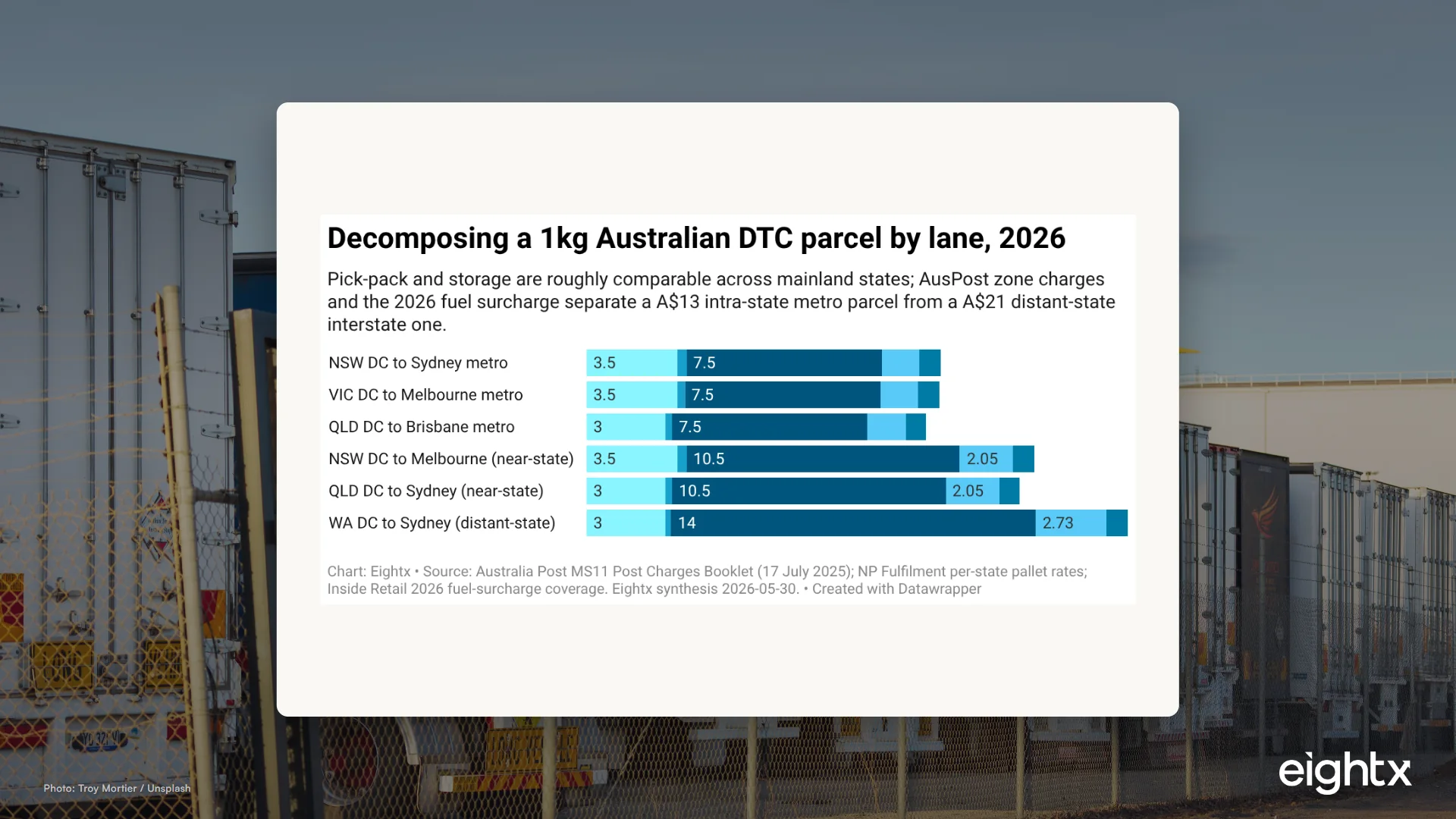
The chart above stacks the components for six representative scenarios from a NSW DC, a VIC DC, a QLD DC, and an interstate WA send. The pattern: pick-pack and storage are roughly comparable across mainland states. Australia Post zone charges and the 2026 fuel surcharge are what separate a A$13 intra-state metro parcel from a A$21 distant-state interstate one.
The four components of an Australian 3PL invoice
Every AU 3PL invoice resolves to four lines: pick-and-pack, storage, freight pass-through, and surcharges. Each has its own driver and its own negotiation point.
Pick-and-pack is typically the largest single per-order line on an AU 3PL invoice for most DTC brands we work with. The driver is warehouse labour: NSW and VIC sit at the top of the band because Sydney and Melbourne pay the highest warehouse wages, with QLD and WA sitting 10-15% below on labour cost. Most contracts structure pick-pack as a base fee for the first item plus a smaller fee for each additional pick.
Storage is the second meaningful per-order line for brands turning inventory at a typical AU DTC cadence (operators we work with usually report four to eight turns per year). The drivers are warehouse rent (the upstream industrial property market) and your bin-versus-pallet mix. NP Fulfilment's per-state published rates give us the only disclosed state-level gradient: NSW most expensive, VIC cheapest, QLD between. Bin storage runs A$2.50 to A$5.00 per bin per month for SKUs under 0.1 cubic metres.
Freight pass-through is the Australia Post eParcel cost (or Aramex, Couriers Please, StarTrack equivalent) charged through to your invoice at the negotiated rate. The retail Parcel Post ceiling is A$11.15 for 500g, A$15.25 for 1kg, A$19.30 for 3kg, nationally flat. eParcel contract rates for volume senders are typically 20-40% below those ceilings, zone-based across the 9 published zones.
Surcharges include the 2026 fuel surcharge (19.5% on parcels, 30.2% on StarTrack Express), dimensional weight uplifts on bulky items, regional delivery surcharges for postcodes outside metro Sydney, Melbourne, and Brisbane, and seasonal peak surcharges. These are usually unmovable individually but their aggregate is what drives the gap between your headline contract rate and your effective shipped cost per parcel.
| Component | Low (A$) | Midpoint (A$) | High (A$) | Unit |
|---|---|---|---|---|
| Pick fee (first item) | 2.50 | 3.00 | 3.50 | per order |
| Additional pick fee | 0.30 | 0.50 | 0.75 | per extra pick |
| Receiving fee | 15 | 35 | 50 | per pallet inbound |
| Pallet storage | 25 | 32 | 45 | per pallet per month |
| Bin storage (SKU under 0.1m³) | 2.50 | 3.50 | 5.00 | per bin per month |
| Australia Post eParcel base (1kg intra-state) | 5.50 | 7.50 | 9.00 | per parcel |
| Australia Post eParcel base (1kg near-state) | 9.00 | 11.80 | 14.00 | per parcel |
| Australia Post fuel surcharge (parcels) | 19.5 | 19.5 | 19.5 | % of freight (2026) |
| StarTrack Express fuel surcharge | 30.2 | 30.2 | 30.2 | % of freight (2026) |
| Returns processing | 2.50 | 3.50 | 5.00 | per item returned |
| Account minimum | 200 | 275 | 400 | per month |
One line item operators routinely miss: returns processing. An apparel brand with a 20% return rate pays the returns fee plus the pick-pack on the outbound replacement, which can lift effective 3PL cost per order by 30-40% in returns-heavy categories. If your category is apparel, accessories, or footwear, your real per-order 3PL cost is meaningfully higher than the invoice line suggests. See our average Australian ecommerce return rate by vertical breakdown for the category benchmarks.
NSW vs VIC vs QLD vs WA: why state choice matters less than network design
The state-by-state cost gradient is real but smaller than most operators assume. The right operating decision is rarely "fulfil out of the cheapest state." It is usually "single DC plus AusPost 9-zone matrix plus aggregator overlay on metro lanes, priced against your actual order destination mix."
NSW (Sydney). Highest published storage rate (NP A$4.70/week, ~A$20.40/month). Highest labour cost. The densest east-coast demand node and the default fall-through destination for any national AusPost zone matrix. Industrial vacancy is loosening in Sydney Outer West (incentives crossed 20% in Q2 2025), which is the supply-side condition giving you negotiation room at renewal. Default DC location for any brand whose order destination mix skews east coast and north of Melbourne.
VIC (Melbourne). Cheapest published storage rate (NP A$3.75/week, ~A$16.25/month). Labour roughly comparable to Sydney. Demand density similar. Melbourne West and North incentives crossed 20% in Q2 2025 (JLL), pushing the supply-side advantage further in tenants' favour. For brands with a southern-skewed destination mix (lots of VIC, SA, TAS), Melbourne is the cleanest single-DC choice in 2026.
QLD (Brisbane and Trade Coast). Storage at A$4.00/week per pallet per the NP gradient (~A$17.33/month), in the middle of the band. Brisbane Southern industrial precinct at 17.5% incentives. Brisbane Trade Coast is the tightest QLD node and one of the tightest east-coast nodes overall, which limits storage savings. Brisbane makes sense as a primary DC when your destination mix skews north and you need shorter delivery times into Brisbane, Gold Coast, and regional QLD.
WA (Perth). Cheapest pallet storage (typically 15-25% below east coast) and cheapest labour, but interstate Australia Post freight charges from WA back to the east coast erase the saving on most orders. Perth as a primary DC only makes sense for brands with a west-skewed customer base (rare for national DTC).
SA (Adelaide). Smaller market, smaller 3PL ecosystem, rarely operationally relevant for a single-DC ecommerce brand unless you also have a wholesale arm.
| State / capital | Pick-pack per order (A$) | NP pallet/week (A$ disclosed) | Pallet/month range (A$) | Demand density (rank) |
|---|---|---|---|---|
| NSW (Sydney) | 3.00-5.00 | 4.70 | 25-45 | 1 (highest) |
| VIC (Melbourne) | 2.80-5.00 | 3.75 | 25-40 | 2 |
| QLD (Brisbane) | 2.80-4.50 | 4.00 | 20-35 | 3 |
| WA (Perth) | 2.50-4.00 | n/d | 15-30 | 5 (lowest mainland) |
| SA (Adelaide) | 2.50-4.00 | n/d | 15-28 | 4 |
The disclosed NSW-to-VIC pallet gap at the NP level is roughly A$1 per pallet per week. For a brand storing 50 pallets, that is A$2,500 per year. Real, but not the line that decides your fulfilment strategy. The line that decides your strategy is your destination mix: how many of your orders go to NSW, VIC, QLD, WA, and regional postcodes, and what the eParcel zone matrix charges for each lane.
Australia Post 2025 retail rates and the 2026 contract fuel-surcharge jump
There are two parallel Australia Post worlds: retail (flat-rate, public, capped) and contract (zone-based, confidential, volume-discounted). The retail rates are the ceiling on what any AU 3PL can pass through before they lose the customer to MyPost Business.
The July 2025 retail Parcel Post update set the current ceiling: A$9.70 for a parcel up to 250g, A$11.15 for 500g, A$15.25 for 1kg, A$19.30 for 3kg, and A$23.30 for 5kg. Express Post equivalents run roughly 25-35% higher across all five bands. These rates are nationally flat: same price for a Sydney metro delivery as for a Perth regional one.
The 2026 contract fuel surcharge is the bigger story for any brand on eParcel. Inside Retail reported in May 2026 that Australia Post raised contract fuel surcharges sharply: domestic parcels and StarTrack Courier from 12% to 19.5%, and StarTrack Express and Premium from 22.7% to 30.2%. These surcharges apply only to contract customers, so MyPost Business and retail customers are unaffected. For a brand on eParcel paying A$7.50 per parcel base before surcharge (the midpoint 1kg intra-state rate in Table 1), the 2025 fuel cost was A$0.90 and the 2026 cost is A$1.46. Across 100,000 parcels per year that is an additional A$56,250 of all-in shipping cost with no service change.
Sendle shut down in Australia in January 2026, removing one of the two cheap aggregator options for small DTC brands. The remaining options for metro lanes are Aramex (typical small-parcel from rates around A$7.61) and Couriers Please (~A$8.10), both typically accessed through shipping platforms like Shippit, which adds A$1 and above per delivery for transit protection. The Sendle gap is real for sub-A$5 million revenue brands, who used Sendle as the cheapest path to a tracked delivery; the practical replacement is Aramex via Shippit for metro lanes, with Australia Post eParcel still doing the regional and remote work.
The negotiation move at 3PL renewal in 2026: lock the eParcel zone matrix first (or the equivalent zone matrix for whichever carrier your 3PL passes through), push for a fuel-surcharge cap or a discount carve-out on a defined volume tier, and layer Aramex or Couriers Please via Shippit on metro lanes where the broker rate beats AusPost zone. The destination mix you are pricing against, not the headline pick-pack rate, is what determines whether the contract is good.
The negotiating window: why 2026 is the right year to renegotiate your 3PL contract
The supply side of the AU industrial property market has shifted materially in your favour over the past 12 months, and most 3PL customers have not pressed the advantage yet.
JLL's Q2 2025 Australian logistics and industrial market report shows east-coast vacancy at 4.8%, up from 3.9% in Q1 2025. Vacancy rose in 10 of 13 tracked precincts. Sydney Outer West and Melbourne West and North incentives both crossed 20% (an incentive is the effective discount baked into a lease deal, typically a rent-free period as a percentage of contract value). Brisbane Southern sits at 17.5%. Rents have plateaued as vacancy rose: CBRE Q3 2025 noted Sydney Outer Central West rents up 8.0% year-on-year and South Sydney up just 1.0%, with the sub-precinct gap widening as supply caught up.
That is the leading indicator that 3PL operators have less landlord-side pressure to pass on than they did 18 months ago, and have room to give back to customers who push for it. A 3PL that signed or renewed a Sydney Outer West lease in 2024-25 (when incentives crossed 20%) may have the cushion to lower your pallet rate by 5-10% or to waive an account minimum at renewal. The condition matters: a 3PL still mid-term on a lease signed in the tight 2022-23 market has less room to move.
The recruiter-style script ("we will move volume to a competitor if you don't move on rate") works best when you can show your 3PL the data they already know: east-coast vacancy is up, incentives are crossing 20%, your volume has grown 15% year-on-year, and the competitor quote in your hand is 10% below your incumbent's renewal proposal. That is the conversation the supply-side market has been setting up for two quarters.
The operator playbook for the next renewal: get a fresh benchmark quote from one credible competitor 60 days before your current contract ends. Use the published pick-pack and storage bands above to anchor the conversation. Target an 8-12% reduction on storage and base pick-pack rates, or push for a minimum waived. For brands above A$5 million in annual revenue, also push for an annual review clause tied to AusPost surcharge changes so the 2027 surcharge round (if it comes) does not blindside your unit economics.
Two cross-links worth opening before you sit down with your 3PL: our global DTC 3PL cost index for the labour and capacity backdrop, and the Australian online retail spend by state breakdown so you can match your destination mix against the published demand density numbers.
Sources and methodology
Primary Australia Post disclosures. Retail Parcel Post and Express Post rates effective 1 July 2025 from Australia Post's April 2025 pricing update page. eParcel and StarTrack contract structure from the MS11 Post Charges Booklet (17 July 2025), which documents the A$23.30 basic charge for all destinations (5kg included) plus a distance charge per kg by zone. The 9-zone destination framework from the Z9 eParcel Pricing Guide PDF, which names the zones (Same State, Near State, Distant State, each split into Local/Capital, Metro, Remote). The 2026 contract fuel-surcharge update from Inside Retail's May 2026 coverage: domestic parcels 12% to 19.5%, StarTrack Express 22.7% to 30.2%, retail and MyPost Business customers unaffected.
AU 3PL provider pricing guides. NP Fulfilment's "3PL Pricing in Australia: Complete Cost Breakdown 2026" is the only AU 3PL we found that publishes per-state pallet storage rates: NSW A$4.70, VIC A$3.75, QLD A$4.00 per pallet per week. PikPak's "How Much Does 3PL Cost in Australia? A 2026 Pricing Guide" confirms the A$25-A$45 monthly pallet band and pick-pack at A$2.50-A$4.00 first item plus A$0.50 per additional. Effective Logistics quotes A$2-A$5 per order for picking-plus-packing and A$25-A$45 per pallet per month. Fulfilment Australia puts the typical AU ecommerce-scale 3PL at A$2.00-A$4.00 per order.
Industrial property data. JLL's Q2 2025 Australian Logistics and Industrial Market overview supplied the east-coast vacancy print (4.8%, up from 3.9% in Q1 2025), the sub-precinct incentive levels (Sydney Outer West and Melbourne West and North above 20%, Brisbane Southern at 17.5%), and the qualitative "rents have plateaued" framing. CBRE's Q3 2025 Figures: Sydney Industrial and Logistics PDF supplied the precinct-level year-on-year growth rates (Outer Central West +8.0%, South Sydney +1.0%, Brisbane Trade Coast +6.3%). Statista's prime industrial rent series gives the NSW Q3 2024 level of roughly A$252 per square metre per year. Other state-level rent levels are paywalled and not used.
Cross-check benchmarks (USD, structural only). ShipBob's published pricing structure (US$2.50-US$3.50 base pick fee with first 4 picks included, US$0.20-US$0.25 additional pick, US$40 per pallet per month, US$5 per bin per month, US$975 setup, US$275 monthly minimum) is included as a global ecom 3PL structural reference, not as an AU rate benchmark. Currency is USD in the original sources, and the AU-published guides take precedence for AU figures.
Limitations. Per-state pick-pack rates are not disclosed by any AU 3PL; only NP Fulfilment publishes per-state storage. Pick-pack state bands in our comparison table are triangulated from labour and rent gradients, not primary disclosure. Australia Post eParcel zone matrices remain confidential per customer; the 9-zone framework is public but the specific cents per kg per zone is not. WA and SA per-state numbers are inferred from JLL qualitative commentary. Sub-precinct rent levels for Sydney Outer West, South Sydney, and Brisbane Trade Coast are gated behind CBRE and JLL PDFs; we use the growth rates from the public snippets and avoid quoting specific rent levels.
Update cadence. This page is refreshed quarterly. Next refresh checkpoints: (a) Australia Post July 2026 retail pricing update, (b) Inside Retail for any mid-year 2026 fuel-surcharge change, (c) JLL Q4 2025 industrial market report for the next vacancy print, (d) AU 3PL providers' 2026 pricing guide refreshes.
Frequently asked questions
what's the average pick-and-pack cost per order from an australian 3pl in 2026?
A$2.00 to A$5.00 per order, depending on SKU complexity and volume. Three AU-published pricing guides (Effective Logistics, NP Fulfilment, Fulfilment Australia) triangulate to this band. Most contracts structure it as A$2-A$3 base for the first item plus A$0.30-A$0.75 per additional pick. Below 200-300 orders per month, expect to be on the higher end or to hit account minimums of around A$200-A$400 per month.
how much should i budget for 3pl storage per pallet per month in sydney vs brisbane?
Plan on A$25-A$45 per pallet per month across the working AU 3PL band. NP Fulfilment is the only AU provider publishing per-state weekly rates: NSW A$4.70 per pallet per week (~A$20.40 per month), VIC A$3.75 (~A$16.25), QLD A$4.00 (~A$17.33). VIC is the cheapest published level. The Sydney-to-Brisbane gap at the NP level is real but only roughly A$1 per pallet per week, which is about A$50 per pallet per year.
how much did australia post fuel surcharges go up in 2026 and is it negotiable?
Contract fuel surcharges jumped from 12% to 19.5% on domestic parcels and StarTrack Courier, and from 22.7% to 30.2% on StarTrack Express and Premium. That is a 7.5-point hit on your effective shipping cost. Retail Parcel Post and MyPost Business customers are not affected. The surcharge itself is not easily negotiable down (it is energy-cost pass-through) but the base eParcel zone matrix is, and that is where you should push at renewal.
since sendle shut down in jan 2026, who's the cheapest aussie metro courier alternative?
Aramex (typical small-parcel from rates around A$7.61) and Couriers Please (~A$8.10) are the remaining aggregator-cheap options for metro lanes. Both are typically accessed through shipping platforms like Shippit, which adds transit protection at A$1 and above per delivery (GST-exclusive). For most DTC brands the right answer is Australia Post eParcel for 70-90% of volume and Aramex or Couriers Please as a metro overlay where the broker rate beats AusPost zone.
should i split inventory across two states or run one dc with express post?
Under roughly 5,000 orders per month, single distribution centre plus Express Post for distant-state customers usually wins. Splitting inventory between a NSW DC and a VIC DC (or NSW plus QLD) requires enough volume that the freight savings on each lane beat the duplicated 3PL minimums, storage, and receiving cost. Operators we work with consistently report single-DC as the right answer until roughly A$10-A$15 million in revenue.
how do i benchmark my current 3pl quote against the market without sharing my actual rate card?
Use the published bands as your anchor. If your pick-pack is above A$5 per order for a simple single-item DTC profile, your storage is above A$45 per pallet per month, or your account minimum is above A$400 per month at sub-1,000 orders per month, you are likely paying a premium. Get a fresh benchmark quote from one competitor, take it to your incumbent, and target 8-12% rate reduction at renewal. The east-coast industrial vacancy signal (4.8% in Q2 2025) gives your 3PL room to move that they did not have 18 months ago.
what does eparcel zone actually mean and where do i find my rate matrix?
Australia Post eParcel contract is structured across 9 destination zones: Same State, Near State, and Distant State, each split into Local/Capital, Metro, and Remote. The zone framework is public (see the Z9 Pricing Guide). The specific cents per kg per zone applied to your account is confidential and lives with your AusPost account manager. The MS11 Post Charges Booklet confirms the structure: A$23.30 basic charge for all destinations (5kg included) plus a distance charge per kg by zone.
how much cheaper is a queensland or perth 3pl than a sydney one for the same volume?
On storage, the published NP Fulfilment gradient is roughly A$1 per pallet per week cheaper in VIC versus NSW, with QLD sitting between the two. WA storage is typically 15-25% below east coast on labour and rent. The catch: interstate Australia Post freight charges from WA back to the east coast erase most of the saving on any order destined for NSW or VIC. WA only makes sense as a primary DC if your customer base skews heavily west, which is rare.