
eCommerce
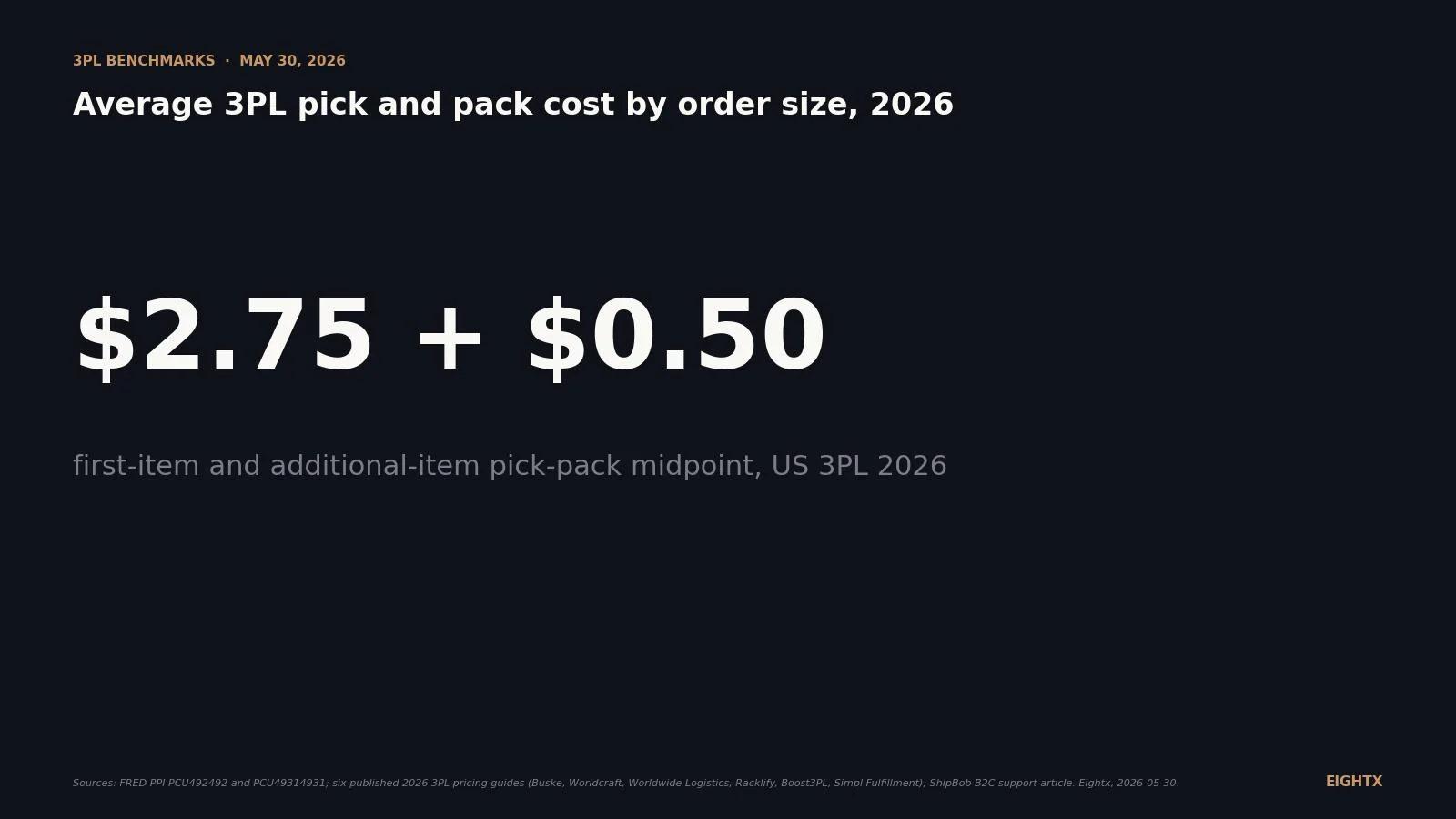
Average ecommerce 3PL pick and pack cost by order size, 2026: $2.75 first item, $0.50 each additional
Ecommerce 3PL pick and pack costs average $2.75 for the first item and $0.50 for each additional item in 2026, based on six published rate guides. The published range is $1.50 to $3.00 for the first pick and $0.30 to $0.75 per add-on. The real 2026 shock is the BLS Couriers Producer Price Index rising 12.3 percent year-over-year, which is repricing carrier surcharges faster than base pick fees.
Key Takeaways
- The published 2026 US 3PL pick-pack consensus is $1.50-$3.00 for the first item plus $0.30-$0.75 per additional item. Six independent pricing guides (Buske, Worldcraft, Worldwide Logistics, Racklify, Boost3PL, Simpl Fulfillment / ShipBob breakdown) agree to within $1 at the midpoint. Working number for 2026: $2.75 first item, $0.50 each additional.
- Couriers and messengers PPI hit +12.3% YoY in April 2026 (FRED PCU492492), the highest reading since August 2023. Warehousing PPI ran at +4.0% YoY in the same month (PCU49314931). Carrier inflation is 3x warehousing inflation. That is where your 2026 cost shock is landing.
- Warehousing employment is down 2.6% YoY and 5.7% below the December 2024 peak (FRED CEU4349300001, NAICS 493). Wages are up 5.1% YoY ($25.88/hr, production workers). Your 3PL is squeezed and has room to give on rate, but the carrier surcharge sitting on the same invoice is not movable.
- Multi-SKU order economics scale with picks, not just SKUs. A six-item order runs $3.30-$6.75 in pick-pack ($5.03 midpoint); a ten-item order runs $4.50-$9.75 ($7.13 midpoint). If your AOV depends on basket size, the 3PL line moves more than the rate card suggests.
- Renegotiate in this order: carrier first, storage second, pick-pack third. The pick-pack line is the smallest dollar item on a 2026 fulfillment invoice ($2.50-$4.00 per order). The carrier line is $5.50-$11.00. Chasing $0.25 on pick-pack while leaving carrier surcharges on autopilot is the most common mistake on a 2026 renewal.
If you run a US DTC brand turning more than a few thousand orders a month, the 3PL line item is one of the three biggest costs on your profit and loss after cost of goods and paid media. The market does not publish standardized rate cards, contracts are confidential, and most operators have no clean way to know whether the quote in front of them is reasonable. This post lays out the 2026 working benchmarks we use on the operator side of that conversation.
We pulled the published 2026 3PL pricing guides (Buske, Worldcraft, Worldwide Logistics, Racklify, Boost3PL, Simpl Fulfillment / ShipBob breakdown), the only primary-source ShipBob disclosure we could find (the B2C support article confirming $0.35 per unit), a March 2026 industry fee survey, and the BLS Producer Price Index series for warehousing and couriers into one comparable view. Where rates are confidential (most contract pricing above 25,000 orders per month), we say so and use the published anchors to triangulate.
What pick and pack actually costs in 2026: the published-guide consensus
There is no single public "average" 3PL pick-pack rate because contracts are negotiated per customer and the published pricing pages stop at headline bands. The defensible 2026 working ranges:
First item. $1.50 to $3.00 per order on the lower-cost end (Buske, Worldcraft, Worldwide Logistics, Racklify), $2.50 to $5.00 on the higher-end and Tier-1 facility end (Boost3PL). Working midpoint: $2.75.
Each additional item. $0.30 to $0.75 per additional pick (Buske, Worldcraft, Worldwide Logistics consensus). Boost3PL frames it as 40-60% off the first-item fee, which on a higher base lands in the $0.55 to $1.15 range. Working midpoint: $0.50.
ShipBob primary. $0.35 per unit ($0.36 with the credit card surcharge) is the only primary 2026 ShipBob number we could find, disclosed in their B2C Fulfillment Center Pricing support article. That is the per-unit add-on, not the per-order base fee. Independent breakdowns from Simpl Fulfillment and CheckThat.ai reverse-engineer the ShipBob tier table at $3.50 to $4.00 per order at 5,000 orders per month, $3.00 at 25,000, and $2.50 at 100,000-plus. We include those numbers with a clear "reverse-engineered from independent breakdowns" attribution because ShipBob does not publish a rate card.
2026 industry fee survey. The March 2026 survey pegs the average US ecommerce pick-and-pack service fee at $4.05 per item (industry mean). B2B pick-pack runs 49.2% higher than DTC. That sits at the upper end of the published-guide consensus and reflects all-in per-item handling.
One inline caveat for high-volume operators before you read the rest: contract rates negotiated above 25,000 orders per month typically run 10 to 25% below these published bands. The ranges below describe published-guide quote-on-the-wall numbers, not the 25,000-plus contract reality. If you are at 30,000-plus orders per month and your rate sits at the published midpoint, that is the band, not a bargain.
The chart shows where the range widens. Single-SKU single-item stays in a tight $1.50 to $3.00 band. Add a second item and the band stretches to $2.10 to $3.75. By six items the high end has more than doubled to $6.75 and the spread between low-cost and high-cost facilities is $3.45 per order. If your AOV depends on basket size, the 3PL line moves more than the headline rate card suggests.
Source First item Additional item Notes Buske (2026) $1.50-$3.00 $0.30-$0.75 Single-SKU pick-pack Worldcraft (2026) $2.00-$3.00 $0.30-$0.75 Standard ecommerce profile Worldwide Logistics (2026) $2.00-$3.00 $0.30-$0.75 Per order Racklify (2026) $1.25-$2.50 Combined model Volume-dependent Boost3PL (2026) $2.50-$5.00 $0.55-$1.15 Tier-1 facility; 40-60% off first item Simpl Fulfillment / ShipBob breakdown $2.50-$4.00 by tier $0.20-$0.30 First 4 picks historically included ShipBob (primary, B2C support article) Quote-only $0.35/unit Only primary 2026 ShipBob disclosure ShipMonk (multi-source synthesis) $2.50-$3.00 $0.50-$0.75 Volume discount to ~$1.80/order at scale Industry fee survey (Mar 2026) $4.05/item (all-in) n/a B2C industry mean; B2B +49.2% Eightx 2026 working midpoint $2.75 $0.50 Single-SKU, mid-volume DTC profile
Why the rate card is flat in 2026 while warehouse wages are up 5%
The 2026 cost-pressure picture has split into two stories that look contradictory until you separate the warehouse from the carrier. The BLS Producer Price Index makes the gap obvious.
Warehousing and storage PPI (FRED PCU49314931) is up 4.0% year-over-year in April 2026 (167.9 index, up from 161.4 in April 2025). After almost flat YoY readings through mid-2025, warehousing prices to shippers are climbing again, but at one third the pace of couriers. This is the floor under your 3PL pick-pack quote, not the ceiling.
Couriers and messengers PPI (FRED PCU492492) is up 12.3% year-over-year in April 2026 (383.9 index, up from 341.9). That is the highest YoY reading since August 2023, and the cumulative move since January 2022 is +37.3%. Parcel pricing is re-inflating, not normalizing.
Why the divergence shows up in the rate card the way it does: 3PLs are absorbing warehousing wage growth through headcount discipline (warehousing employment is down 2.6% YoY and 5.7% below the December 2024 peak per BLS NAICS 493), so they are not yet passing the labor pressure through in headline pick-pack rates. Couriers, by contrast, have moved the cost shock straight into surcharges and base rates that show up on your 3PL invoice as a separate line.
Series Latest reading Period YoY % Cumulative since Jan 2022 Couriers and messengers PPI (PCU492492) 383.9 Apr 2026 +12.3% +37.3% Warehousing and storage PPI (PCU49314931) 167.9 Apr 2026 +4.0% +28.4% Warehousing employment (CEU4349300001, NSA) 1,814,500 Apr 2026 -2.6% -3.6% Warehousing wage, production worker (CES4349300008) $25.88/hr Mar 2026 +5.1% +20.5% Warehousing wage, all employees (CES4349300003) $26.59/hr Mar 2026 +5.4% +16.5%
The practical read for operators: the per-order 3PL handling fee is negotiable in 2026 because the 3PL is squeezed on margin from two sides (wages up, headcount cushion gone) without yet recovering in the rate card. The carrier surcharge embedded in the same invoice is not negotiable, because that is the line the carriers have already moved.
Decomposing the order: single-SKU, multi-SKU, and oversized profiles
Pick-pack scales with picks, not just SKUs. The working bands by profile, anchored against the published-guide midpoints:
Single-SKU single-item. The cleanest profile. $1.50 to $3.00 per order, $2.25 midpoint. This is the math behind most DTC supplement, apparel, or beauty single-product checkout orders. Most published guides describe this as their base rate.
Single-SKU two items. Still simple: same SKU, same bin, just picked twice. $2.10 to $3.75 per order, $2.93 midpoint. The additional-pick line is doing the work.
Multi-SKU four items. Mixed basket, two to three bins to walk. $2.70 to $4.50 per order, $3.60 midpoint. This is the typical apparel-plus-accessory or skincare-routine order.
Multi-SKU six items. $3.30 to $6.75 per order, $5.03 midpoint. The high end is more than double the low end here, which is where 3PL facility choice starts to matter materially.
Multi-SKU ten items. $4.50 to $9.75 per order, $7.13 midpoint. Subscription-box and bundle profiles live here.
Oversized or fragile single-item. $3.50 to $8.00 per order, $5.75 midpoint. Furniture, glassware, or hazmat. The pick is one item but the handling premium is what moves the number.
A 1,000-orders-per-month brand with a mostly single-SKU profile lands around $4,000 per month in all-in 3PL handling (storage plus pick-pack plus receiving, before carrier and packaging), per the Buske 2026 worked example. The published-guide consensus is roughly $4 per order before the carrier and packaging stack. The all-in cost-per-order math changes meaningfully once basket size moves above three items.
The 3PL renewal playbook: where to push and where you will lose
Operators consistently describe 3PL switching as a six- to ten-week project: inventory transfer, SKU sync, integration cutover, parallel running. 3PLs know it. They are not afraid of a $0.25-per-pick renegotiation. Real room to push comes from stacking the request across multiple lines.
Lead with carrier, not pick-pack. The pick-pack line is the smallest dollar item on a 2026 fulfillment invoice ($2.50 to $4.00 per order). The carrier line is $5.50 to $11.00. Re-bid the carrier piece separately at renewal. If your 3PL passes through the carrier rate on a markup, ask for the markup to drop or for the carrier choice to come back to you on a quarterly review.
Push on storage and aging inventory. Storage runs $18 to $40 per pallet per month in the published guides. Aging-inventory surcharges at 180 and 240 days are the negotiable line operators most often miss; ask for the breakpoint to push to 270 or 365 days, or for the surcharge percentage to drop. A senior partner on our team frames the pre-renewal checklist as: number of orders, do they have a pick and pack fee, do they have anything more than 180 or 240 days storage fee, do they have capacity.
Treat pick-pack as the secondary lever. Target $0.25 to $0.50 per order on the first-item fee, $0.10 to $0.20 on each additional pick. The dollar move per order is small but it compounds across volume. At 5,000 orders per month a $0.30 reduction is $18,000 per year.
Stack the asks at 8 to 15% combined. Operators we work with consistently land 8 to 15% in combined concessions across storage, pick-pack, receiving, and aging-inventory surcharges at renewal in 2026. Single-line asks land at 2 to 4%; the supply-side condition (warehousing employment down 2.6% YoY, headcount cushion gone) is what makes the stacked-ask number land.
The pick-pack rate is the question every operator asks first and the line that moves the all-in fulfillment cost the least. Couriers PPI is running 3x hotter than warehousing PPI. The 3PL is the squeezed party in 2026, the carrier is the line that already moved the cost shock onto you. Renegotiate in that order: carrier first, storage second, pick-pack third.
The other practical move: get a fresh benchmark quote from one credible competitor 60 days before your contract ends. Use the published bands above as your anchor. The 3PL knows their renewal book is at risk; bring a number to the conversation rather than asking what they will do for you. For more on how labor and capacity feed into your 3PL's quote-side math, see our DTC labor and 3PL pressure tracker. For the per-vertical fulfillment cost stack that pairs with this per-order-profile decomposition, see what is fulfillment cost per order.
What we are watching next quarter
Three signals will shape the next refresh of this index:
Q3 2026 BLS JOLTS for warehousing. If warehousing job openings stay below 80,000 and quits stay below 2.0%, the labor cushion stays gone and operator room to push holds. If openings turn up materially, expect 3PLs to start re-pricing.
The PCU492492 / PCU49314931 ratio. Couriers PPI running 3x warehousing PPI is the 2026 wedge. If the gap closes to 2x or less, the cost shock is starting to ease. If it widens to 4x, expect another round of UPS and FedEx general rate increase announcements ahead of peak season.
Next-round carrier surcharge announcements. UPS and FedEx typically announce general rate increases in October. The 2026-into-2027 announcement is the one to watch for residential, fuel, and additional-handling surcharges that re-set the carrier-side line for the following year.
This is a living index. We refresh quarterly, with the next target around late August 2026 when Q2 BLS data lands alongside the back-half carrier surcharge news.
Sources and methodology
Primary data, BLS via FRED. The Producer Price Index by Industry for Couriers and Messengers (FRED series PCU492492) and Warehousing and Storage (PCU49314931) are monthly NSA series running from 1985 and 2008 respectively to April 2026. We pull both series from January 2022 forward and compute year-over-year percentage change at each monthly observation. The warehousing employment series (CEU4349300001) is the BLS Current Employment Statistics All Employees, Warehousing and Storage, NSA, in thousands of persons. Wage series are CES4349300003 (all employees, $/hr, SA) and CES4349300008 (production and nonsupervisory, $/hr, SA), both reading March 2026 as the most recent point.
Secondary data, six published 2026 3PL pricing guides. The rate-card triangulation comes from Buske's "3PL Pricing Guide 2026," Worldcraft Logistics' "3PL Pricing Guide 2026," Worldwide Logistics Group's "3PL Cost Guide: Actual Pricing Breakdown for 2026," Racklify's "3PL Pricing in 2026," Boost3PL's "Average Pick and Pack Fees 2026," and Simpl Fulfillment's "ShipBob Pricing 2026" breakdown. We treat these as independent triangulation sources rather than primary truth because each is a published estimate by a 3PL or aggregator, not a contract disclosure.
ShipBob primary disclosure. ShipBob's US B2C Fulfillment Center Pricing support article confirms the $0.35 per unit pick fee ($0.36 with credit card surcharge) as the only primary-source 2026 ShipBob number. ShipBob, ShipMonk, Red Stag, and Flowspace all removed published rate cards from their main websites by 2024-2025, so the Simpl Fulfillment and CheckThat.ai aggregator breakdowns are the closest thing to a 2026 ShipBob rate card available publicly. We include their reverse-engineered tier table ($3.50-$4.00 at 5,000 orders per month dropping to $2.50 at 100,000-plus) with explicit "reverse-engineered from independent breakdowns" attribution.
Industry survey anchor. A 2026 fulfillment-fee statistics release (published March 29, 2026) pegs the US average pick-and-pack service fee at $4.05 per item, with B2B 49.2% higher than B2C. We treat this as the upper-bound anchor against which the published-guide consensus sits.
Limitations. The published-guide bands are an upper bound for transparent rates. Actual contract rates negotiated at 25,000-plus orders per month run 10 to 25% below the published bands per the volume-tier data in the Simpl Fulfillment breakdown. BLS NAICS 493 covers all warehousing and storage, not just ecommerce 3PL specifically, so the headline number moves modestly with the share of pure-play DTC fulfillment versus broader storage in the underlying mix. The PPI series measure prices charged to all customers, not specifically to ecommerce shippers, who tend to see a steeper effective increase because parcel surcharges (residential, fuel, additional handling) compound on top of the index. Wage series last point is one month behind the PPI series.
Update cadence. Living index, refreshed quarterly. Next refresh target: late August 2026 when Q2 BLS JOLTS data lands alongside Q2 2026 carrier surcharge announcements. Refresh trigger conditions: (a) any 200-bp move in PCU492492 YoY, (b) NAICS 493 employment crossing back above 1,850,000 (sign of capacity rebuild), or (c) any of the six pricing-guide sources publishing a 2026 H2 update.
Frequently asked questions
how much should i be paying my 3pl for pick and pack in 2026?
$1.50 to $3.00 for the first item plus $0.30 to $0.75 per additional item is the published-guide consensus across six independent 2026 sources. The working midpoint we use on operator calls is $2.75 first item, $0.50 each additional. If you are above $4 per order on a simple single-item DTC profile, you are paying a premium and have room to push at renewal.
what is a normal pick and pack fee for a single-sku shopify order in 2026?
$1.50 to $3.00 per order. That is the all-in fee for picking and packing a single-SKU, single-item, standard-size order from a shelf to a poly mailer or small box. ShipMonk's published first-pick range is $2.50 to $3.00. ShipBob's reverse-engineered base tier (from independent breakdowns) is $2.50 at 100,000+ orders per month rising to $3.50 to $4.00 at 5,000 orders per month.
how much extra should my 3pl charge per additional item in the same order?
$0.30 to $0.75 per additional pick. That is the published range across Buske, Worldcraft, and Worldwide Logistics. Boost3PL frames it as 40-60% off the first-item fee, which puts a typical additional pick in the $0.55 to $1.15 range on a higher first-item base. Below $0.30 you are getting a strong rate; above $0.75 you should benchmark.
is my 3pl overcharging me at $4 per order for single-item picks?
Likely yes if you are above 5,000 orders per month, no if you are below that. The March 2026 industry fee survey puts the average US ecommerce pick-and-pack service fee at $4.05 per item (industry mean). For a single-SKU single-item DTC profile at scale that number is on the high end of the band. Volume tier matters: at 5,000 orders per month the published ShipBob band is $3.50 to $4.00, dropping toward $2.50 at 100,000-plus.
how should i negotiate 3pl pick and pack rates at my 2026 renewal?
Renegotiate in this order: carrier surcharge first, storage second, pick-pack third. The pick-pack line is the smallest dollar item on a 2026 fulfillment invoice ($2.50 to $4.00 per order across published guides). The carrier line is $5.50 to $11.00 and the embedded fuel-and-residential surcharges have moved the most in 2026 (couriers PPI +12.3% YoY). Stack your asks (8 to 15% across storage, pick-pack, receiving, and aging-inventory surcharges) rather than chasing $0.25 on pick-pack alone.
do 3pl pick and pack rates drop at higher order volume, and at what tiers?
Yes. The reverse-engineered ShipBob tier table from independent breakdowns: $3.50 to $4.00 per order at 5,000 orders per month, $3.00 at 25,000, $2.50 at 100,000-plus. ShipMonk reportedly drops to roughly $1.80 per order at high volume. The tier breakpoints that matter most are 5,000, 25,000, and 100,000 orders per month. If you cross a tier between renewals, ask for a mid-term price review.
why are 3pl rates flat in 2026 when warehouse wages are up 5%?
Two reasons. First, warehousing employment is down 2.6% year-over-year and 5.7% below the December 2024 peak (BLS NAICS 493), so 3PLs are absorbing wage growth through headcount discipline rather than rate hikes to customers. Second, the rate cards in published guides are quote-on-the-wall numbers and lag the actual margin pressure by 6 to 12 months. The 4% warehousing PPI YoY tells you the pressure is starting to show up; expect 2027 renewal asks to be tighter.
what hidden fees should i look for in a 2026 3pl contract beyond pick and pack?
Six lines: packaging materials ($0.20 to $1.35 per box), peak-season labor surcharges ($0.50 to $1.50 per order in Q4), fragile or oversize handling ($1.00 to $3.00 per order), TikTok Shop or channel-specific surcharges ($0.50 to $1.00), account management ($150 to $450 per month), and WMS / technology access ($100 to $500 per month). The aggregate adds 6 to 9% on top of the headline pick-pack line. Aging-inventory storage surcharges at 180 and 240 days are the other category to negotiate.
should i worry more about my pick and pack line or my parcel shipping line at renewal?
Parcel shipping, by a wide margin. Couriers PPI was up 12.3% year-over-year in April 2026, the highest reading since August 2023. Warehousing PPI was up 4.0%. Rate-shopping carriers and re-bidding zone-skipping moves the all-in number two to four times more than re-negotiating the 3PL per-pick fee. Negotiate the carrier separately; do not let your incumbent 3PL pass through whatever they have on the desk.