
Insights
Average ecommerce payment processing fee by platform 2026: Stripe 2.9%, Shopify Payments 2.33%, Affirm 2.40%, Klarna 2.74%
Shopify Payments at 2.33% beats Stripe's 2.9% by more than half a point, which adds up fast at scale. On $5M GMV that gap is $28,500 per year. Affirm and Klarna sit between them, but BNPL fee structures include volume tiers and chargeback terms that the headline rate hides.
Key Takeaways
- Shopify reported a 2.33% blended merchant-solutions take-rate on $378.4B of GMV in FY2025 ($8.8B revenue). That is the closest single proxy for what a Shopify merchant pays per dollar of GMV across cards, Shop Pay Installments, capital, and shipping labels combined.
- Affirm and Klarna run at 2.40% and 2.74% all-in. Affirm's merchant network revenue was $882.7M on $36.7B of GMV in FY2025. Klarna's first 20-F shows total revenue of $3.509B on $128B of GMV, with transaction-and-service revenue alone at 1.95%.
- PayPal looks cheapest on the 10-K (1.50% transaction revenue / TPV) but expensive at the checkout (3.49% + $0.49 published). The gap is mix-blended Braintree enterprise volume and large strategic-merchant deals you cannot replicate as a $10M to $50M DTC brand.
- The Shopify third-party gateway trap is real. A Basic-plan store routing through Stripe instead of Shopify Payments pays 4.9% + $0.30, a roughly 70% premium on the headline 2.9%. The fee gets waived on Plus and shrinks to 0.6% on Advanced.
- Operator reality: your effective rate is closer to 4.4% than 2.9% once Shop Pay Installments, PayPal, Klarna, BNPL pass-through, FX surcharges, Amex blend, and refund-not-refunded fees stack. The negotiated floor we have seen in 2026 on Shopify Plus is 1.15% + $0.15.
Most operators we work with quote their processing rate as "2.9% plus 30 cents," because that is the headline number Stripe and Shopify Payments charge on a US online card. The number on your P&L is rarely close. Public-company filings disclose blended take-rates in the 1.5% to 2.74% range depending on the platform, and operator P&L lines land closer to 4% to 5% once Shop Pay Installments, PayPal, Klarna, FX, Amex, and refund-not-refunded fees stack. This post pulls the 2026 numbers from the Shopify, PayPal, Affirm, Klarna, and Block filings, sets them next to the published rack rates from Stripe and Shopify, and shows where the operator gap usually opens.
What the 10-Ks actually show (the blended take-rates)
Shopify, PayPal, Affirm, and Klarna all disclose enough in their fiscal-year-2025 filings to compute a blended take-rate. The four numbers do not measure the same thing, which is why they look different.
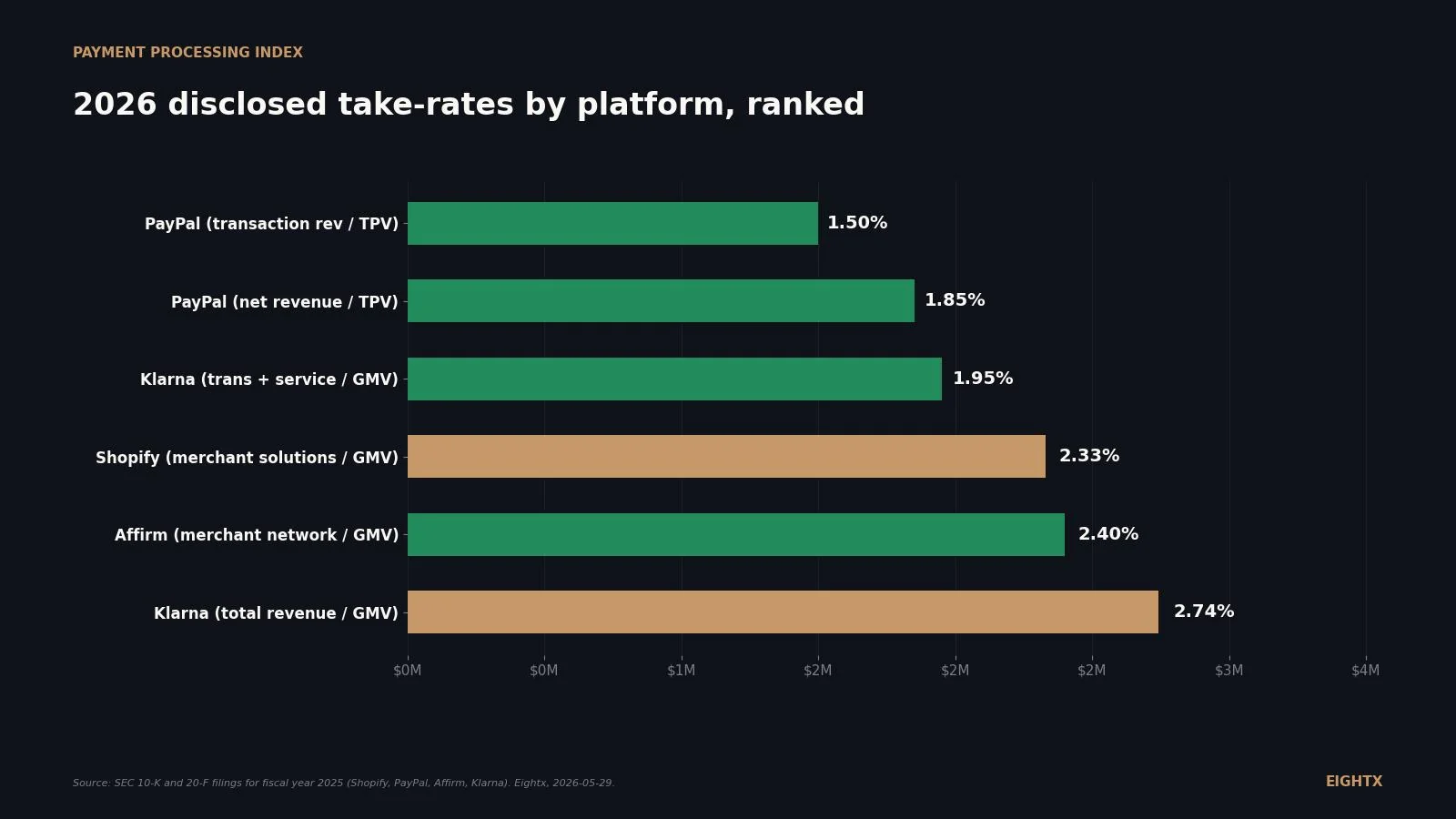
Shopify's FY2025 10-K reports gross merchandise volume (GMV) of $378.4 billion and merchant solutions revenue of $8.8 billion. That is a 2.33% blended take-rate. Merchant solutions covers Shopify Payments processing, Shop Pay Installments, Shopify Capital, Shopify Audiences, and shipping labels, so it overstates "card processing" and understates "what Shopify holistically extracts per GMV dollar." Merchant solutions grew 35% year-over-year while GMV grew 29%, which means Shopify's attach rate on its non-payments products keeps climbing.
PayPal's FY2025 10-K reports total payment volume (TPV) of $1.79 trillion and net revenues of $33.172 billion, a 1.85% blended rate. Transaction revenues specifically (PayPal's processing-only line, calculated as net revenues minus other value-added services) come in at roughly $26.8 billion or 1.50% of TPV. The PayPal number looks misleadingly low because Braintree (PayPal's enterprise processing arm) handles massive volume at sub-1% rates for the largest merchants, and the consumer-facing 3.49% + $0.49 published rate is a small share of total TPV. Translation: the 1.50% number is real for PayPal as a business, but not for a $20 million DTC brand using PayPal Checkout.
Affirm's FY2025 10-K (year ended June 30, 2025) reports merchant network revenue of $882.7 million on $36.7 billion of GMV, a 2.40% disclosed merchant fee. Affirm explicitly explains the driver: "merchant network revenue as a percentage of GMV typically increases with longer-term, non interest-bearing loans with higher AOVs, and decreases with shorter-term, interest-bearing loans with lower AOVs." Their take-rate has been declining over three years as the loan book has shifted.
Klarna's first 20-F as a public company (filed February 2026) reports $128 billion of GMV and $3.509 billion of total revenue, a 2.74% all-in take. Transaction-and-service revenue alone (the closest analog to "merchant fees") was $2.500 billion or 1.95% of GMV. Klarna grew revenue 25% versus GMV growth of 21%, "primarily driven by higher take rates in various geographies" including the US, UK, and Germany.
The numbers behind the chart, with the volume and revenue lines that produced each rate.
Platform Volume metric Volume (FY2025) Revenue line Revenue (FY2025) Implied take-rate Shopify GMV $378.4B Merchant solutions $8.8B 2.33% PayPal TPV $1.79T Transaction revenue (calc) ~$26.8B ~1.50% PayPal TPV $1.79T Net revenues $33.172B 1.85% Affirm GMV (Jun yr-end) $36.7B Merchant network revenue $882.7M 2.40% Klarna GMV $128B Transaction and service revenue $2.500B 1.95% Klarna GMV $128B Total revenue $3.509B 2.74% Block (Square) Square GPV $250B Not disclosed cleanly n.d. n.d.
These numbers are why an AI search like ChatGPT or Perplexity often cites Klarna at 2.74% or Shopify at 2.33%. They are the disclosed, defensible, primary-source rates for each platform's business. They are also not what you pay per transaction, which is the next section.
The published price-tag, by platform
Headline 2026 rack rates from the actual pricing pages, ranked from cheapest to most expensive on a $100 online card transaction.
Platform Plan or tier Rate Fixed fee Notes Stripe ACH Direct Debit 0.8% $0 (cap $5) Slow settlement, high-AOV B2B mostly Shopify Payments Plus (negotiated) ~2.15% $0.30 Third-party gateway fee waived; varies by country Shopify Payments Advanced 2.50% $0.30 0.6% third-party gateway fee Shopify Payments Grow 2.70% $0.30 1.0% third-party gateway fee Stripe Standard US online card 2.90% $0.30 +1.5% international, +1% FX, +0.5% manual entry Shopify Payments Basic 2.90% $0.30 2.0% third-party gateway fee PayPal Online checkout (rack) 3.49% $0.49 Negotiable above $100M TPV Klarna (via Stripe) BNPL pass-through 5.99% $0.30 Direct deals often 50-100 bps lower Afterpay (via Stripe) BNPL pass-through 6.00% $0.30 Direct rate may be lower, NDA Affirm (via Stripe) BNPL pass-through 6.00% $0.30 Direct rate negotiated, often 3-5%
Three things to read out of this table. Stripe has not moved its US online card rate in roughly a decade. Shopify Payments is the cheapest mass-market option below the Plus tier as long as you stay inside Shopify's ecosystem. And the BNPL rack rates via Stripe pass-through are 200% to 250% of a normal card transaction, which is what makes BNPL a deliberate margin trade-off, not a default option.
Why your effective rate is higher than the headline
The four leakage sources that take a 2.9% headline to 4.4% on your P&L, in roughly the order they bite.
BNPL mix. If 10% of your revenue goes through Klarna at 5.99% or Affirm at 6%, the BNPL slice alone adds about 30 basis points to your blended rate before anything else. Operators offering BNPL at the cart with no friction often see 15% to 25% of revenue route through it.
FX and cross-border. Stripe charges +1.5% on international cards and +1% on currency conversion on top of the base 2.9%. So a Canadian customer paying with a Canadian card on your US store can cost you 5.4% + $0.30. If you sell into AU/UK/EU from a US Shopify store and route 20% of revenue cross-border, you are looking at another 50 basis points of blended drag.
Amex blend. Amex is typically 30 to 50 basis points more expensive than Visa/Mastercard at the same processor. If your customer base skews older or higher-income, Amex penetration above 15% adds another 10 basis points to your blended rate.
Refund-not-refunded fees. Most processors (Stripe and Shopify Payments included) keep the $0.30 fixed fee on refunded transactions. At high-return categories like apparel or shoes (return rates of 20% to 30%), that fee gets eaten twice on roughly a quarter of orders. It is small in basis points but real on the P&L.
Add them up and the operator reality from a mid-market apparel CFO we listened to in late 2025 lands: "If I look at merchant fees only and divide by Shopify net revenue, it's still 4.4%." That is one apparel CFO's blended rate, not a universal benchmark. Other categories run lower (electronics, where BNPL share is small) or higher (footwear, where return rates compound the fixed-fee leak). The directional gap (effective ~150 basis points above headline) is the read; the exact number depends on your category mix.
The Shopify third-party gateway trap
The single most expensive mistake we see in DTC processing is a Basic-plan store routing card volume through Stripe instead of Shopify Payments. Shopify charges a 2.0% third-party gateway fee on top of whatever the gateway itself charges on Basic. With Stripe at 2.9%, the total comes out to 4.9% + $0.30. That is a 70% premium on the headline rate for no operational benefit.
The surcharge falls as you upgrade Shopify plans: 1.0% on Grow, 0.6% on Advanced, and waived on Plus. The math therefore changes by tier. On Basic and Grow, Shopify Payments is the right answer unless you have a recurring-billing or marketplace requirement Shopify cannot serve. On Advanced, the 0.6% surcharge is small enough that Stripe with better fraud tooling or better international coverage can sometimes justify the spread. On Plus the surcharge is zero, which means you can use Stripe (or Adyen, or Braintree) for free and Shopify will not charge you for the routing decision.
The corollary: if you are on Shopify Basic and your processor is anything other than Shopify Payments, you are paying a 2% tax on every order. Switching is a one-day project. We have seen it close a 150 to 200 basis-point gap on a $5M brand inside a single calendar month.
Should you offer BNPL at 4 to 7 percent?
BNPL works as a profit centre only if the AOV lift or the conversion lift covers the take-rate hit. The math is clean.
If your gross margin is 50% and BNPL adds 350 basis points to your processing cost on that order (6% BNPL vs the 2.5% card rate it displaces), you need that order to be at least 7% larger than baseline just to break even. If your gross margin is 35% (apparel, beauty pure-play, mass CPG), you need a 10% AOV lift to break even. Below those numbers BNPL is a margin leak.
Klarna and Affirm pitch 20%+ AOV lifts and 10%+ conversion lifts in their public case studies. The number we see in real operator data is closer to 8% to 15% AOV lift on the BNPL transaction itself, not site-wide. The right way to test is to A/B the option on and off for a control cohort, not run BNPL across 100% of traffic and trust the in-platform reporting that always shows a lift.
The three-year merchant-rate trajectory shows the structural read. Affirm's rate is falling because their loan book is shifting toward longer-term, larger-AOV financing where the per-transaction take is structurally lower. Klarna's rate is roughly flat because their mix is more stable. For an operator that means BNPL fees are unlikely to compress much further in 2026, and you should plan around the 5% to 6% rack rate for the foreseeable future.
The headline 2.9% rate is the most-quoted, least-relevant number in DTC finance. The disclosed 10-K take-rates (Shopify 2.33%, Affirm 2.40%, Klarna 2.74%) are what each platform actually collects per dollar of volume. The operator effective rate (3.5% to 5%) is what your P&L actually shows. Pick the right rail, kill the third-party gateway tax, run BNPL only where the AOV math clears, and you can usually claw back 100 to 200 basis points without negotiating a single new contract.
What an operator actually does this quarter
Three plays that do not require a new processor contract.
Confirm you are on the right rail. If you are on Shopify Basic, Grow, or Advanced and your processor field shows anything other than Shopify Payments, you are paying the 2.0% / 1.0% / 0.6% third-party gateway tax. Fix this first. It is the single largest non-negotiated saving on the table for sub-Plus stores.
Audit your effective rate. Pull twelve months of P&L. Add every line item that touches a processor (Shopify Payments, Stripe, PayPal, Klarna, Afterpay, FX surcharges, chargeback fees, Amex blend). Divide by net revenue. If your effective rate is more than 80 basis points above your headline rate, you have a mix problem worth investigating. The most common offender: BNPL share over 15% with no compensating AOV lift.
Request a rate review once a year. On Stripe, the threshold for moving is roughly $1 million per month in card volume. On Shopify Plus, the finance team will not move unless you walk in with a competing offer in hand (we have heard this directly from a Shopify rep). Get a Stripe or Adyen quote first, then bring it to your Shopify rep. The negotiated floor we have seen in 2026 on Plus is 1.15% + $0.15 per transaction, which is a 100 basis-point save on the variable rate alone (2.15% to 1.15%). The fixed-fee compression ($0.30 to $0.15) adds another ~19 basis points on an $80 AOV, so the blended saving lands closer to 120 basis points. That is real margin, especially at $20M+ in card volume.
What we are watching next
Three signals that move the index over the next twelve months.
Klarna's FY2026 20-F. Klarna explicitly flagged "higher take rates in various geographies" as a 2025 revenue driver. If FY2026 shows continued take-rate expansion, BNPL gets structurally more expensive for merchants. If take-rates compress (the more likely path given Affirm's three-year trajectory), the cost gap between BNPL and cards narrows and BNPL becomes more defensible.
Adyen's 2026 enterprise wins. Adyen is enterprise-only at roughly 20 basis points net take-rate on $1T+ of processed volume. As the largest DTC brands (Vuori, SKIMS, Glossier-tier) keep migrating from Stripe/Braintree to Adyen, the rack-rate / negotiated-rate gap for the $50M to $500M revenue band keeps widening. If Adyen launches a mid-market product (which has been rumored), the Plus-tier negotiation floor moves further down.
Shopify's payments attach rate. Merchant solutions grew 35% on 29% GMV growth in FY2025, which means Shopify is selling more non-payment products (Shopify Capital, Audiences, shipping labels) into the same GMV base. This is not card-rate inflation; per-transaction processing rates have not moved. If the trend continues into FY2026, the disclosed 2.33% blended rate climbs while the underlying card rate stays flat.
For more on margin and unit-economic decisions for $5M to $50M DTC operators, see our interim CFO services overview and the average ecommerce gross margin by revenue band benchmark.
Sources and methodology
Shopify Inc. Form 10-K for fiscal year ended December 31, 2025, filed 2026-02-11, accession 0001594805-26-000007. GMV $378,441M and merchant solutions revenue $8.8B taken from the MD&A KPI table. Shopify Payments rates pulled from shopify.com/pricing (accessed 2026-05-29).
PayPal Holdings, Inc. Form 10-K for fiscal year ended December 31, 2025, filed 2026-02-03, accession 0001633917-26-000024. TPV of $1.79 trillion verbatim from the MD&A and the FY2025 net-revenue analysis. Transaction revenues derived as net revenues ($33.172B) minus revenues from other value-added services (~$6.4B), yielding approximately $26.8B and an implied 1.50% take-rate. The exact transaction-revenue figure should be re-pulled from the segment data table on page 35 of the 10-K to remove the calc-derived estimate before next refresh.
Affirm Holdings, Inc. Form 10-K for fiscal year ended June 30, 2025, filed 2025-08-28, accession 0001820953-25-000080. Merchant network revenue of $882,658 thousand and GMV of $36.7 billion taken verbatim from Note 3 Revenue and the MD&A. FY2023 and FY2024 take-rate figures recomputed from the same filing's three-year financial highlights.
Klarna Group plc. Form 20-F for fiscal year ended December 31, 2025, filed 2026-02-26, accession 0002003292-26-000007. Total revenue $3,509M, transaction-and-service revenue $2,500M, GMV $128B (verbatim from the MD&A: "our average consumer receivables in the year ended December 31, 2025 were $9.3 billion, compared to our GMV of $128 billion"). YoY: total revenue grew 25% vs GMV growth of 21%. FY2023 and FY2024 GMV figures are derived from disclosed growth rates and should be re-pulled from the selected-financial-data table at the next refresh.
Block, Inc. Form 10-K for fiscal year ended December 31, 2025, filed 2026-02-26, accession 0001628280-26-012254. Square GPV of $250 billion verbatim from the MD&A. Block does not disclose a clean Square-only take-rate against GPV, so we show GPV only and exclude Block from the take-rate ranking.
Stripe pricing. stripe.com/pricing, accessed 2026-05-29. US online card 2.9% + $0.30; +1.5% international; +1% FX; +0.5% manual entry; ACH Direct Debit 0.8% (cap $5); Instant Bank Payments 2.6% + $0.30; BNPL pass-through Klarna 5.99% + $0.30, Afterpay 6% + $0.30, Affirm 6% + $0.30.
Shopify pricing. shopify.com/pricing and shopify.com/payments, accessed 2026-05-29. Basic 2.9% + $0.30, Grow 2.7%, Advanced 2.5%, Plus negotiated (~2.15% observed on 2026 deals; varies by country). Third-party gateway fees: 2.0% Basic, 1.0% Grow, 0.6% Advanced, waived on Plus.
Operator benchmarks. Negotiated rate floor (1.15% + $0.15 per transaction) and "merchant fees / Shopify net revenue = 4.4%" benchmark are anonymized references from Eightx recorded client calls (5,400+ over 2018-2026).
Methodology notes. Blended take-rates are calculated as (revenue line ÷ volume line) using the revenue concept each filing emphasizes (merchant solutions for Shopify, merchant network for Affirm, transaction-and-service for Klarna, transaction revenues for PayPal). These are not directly comparable to a merchant's per-transaction rate because they include FX revenue, BNPL interchange share, partnership economics, and (for Shopify) non-payments products. We surface both the "tightest" rate (transaction-and-service for Klarna; transaction revenue for PayPal) and the "all-in" rate (total revenue / volume) where the company discloses both.
Limitations. Stripe is private and discloses no GMV or take-rate, so the chart and tables rely on Stripe's published rack rates and operator-reported negotiated rates. Block does not disclose a Square-segment take-rate cleanly, so it is excluded from the take-rate ranking. Klarna's FY2023 and FY2024 GMV figures are derived from disclosed growth rates and should be re-pulled verbatim from the 20-F's selected-financial-data table at the next refresh. PayPal's transaction-revenue figure is calculated from segment data and should be replaced with the exact reported number from page 35 of the FY2025 10-K.
Update cadence. This benchmark is refreshed quarterly when the next round of SEC filings lands (Q2 in early August, Q3 in early November, Q4 in late February). Next update target: August 2026.
Frequently asked questions
what is the average payment processing fee for ecommerce in 2026?
The rack rate is still 2.9% + $0.30 on a US online card via Stripe or Shopify Payments Basic. But the disclosed blended take-rates from 10-Ks show what each platform actually collects per dollar of volume, which is what you should benchmark against. Shopify is 2.33% on GMV, Affirm is 2.40%, Klarna is 2.74% all-in, and PayPal is 1.50% transaction-only. Operators we work with typically land in the 3.5% to 4.5% range on their blended P&L line.
is shopify payments cheaper than stripe on shopify?
Yes, in almost every case. Shopify Payments at Basic is 2.9% + $0.30 with no surcharge. Stripe (or any third-party gateway) on Basic adds a 2% surcharge on top, which makes the effective rate 4.9% + $0.30. The surcharge drops to 1% on Grow, 0.6% on Advanced, and zero on Plus. Unless you have a very specific reason to use Stripe (recurring-billing tooling, multi-platform routing) the math points to Shopify Payments below the Plus tier.
what's the real blended take rate for paypal in 2026?
Two answers, both true. On the 10-K, PayPal's transaction revenue divided by total payment volume is roughly 1.50%, and total net revenue divided by TPV is 1.85%. That blends massive Braintree enterprise deals and BNPL volume into the average. At the checkout, the published US online card rate is 3.49% + $0.49, which is what a typical small-merchant integration pays. Bigger DTC operators with $100M+ TPV regularly compress this to 2.5% or below in direct negotiations.
how much do klarna and afterpay actually charge merchants in 2026?
If you integrate BNPL through Stripe (most common for SMB and mid-market) the pass-through rates are Klarna 5.99% + $0.30, Afterpay 6% + $0.30, and Affirm 6% + $0.30. Direct deals with Klarna, Afterpay, and Affirm sales reps are typically 50 to 100 basis points lower for high-volume merchants and come with placement commitments (cart-page widgets, sponsored slots). The 10-K blended numbers (Klarna 1.95% transaction-and-service, Affirm 2.40%) include longer-term loans, FX revenue, and partner economics that you do not see at the merchant level.
can i negotiate stripe or shopify payments rates?
Stripe negotiates from roughly $1M per month in card volume. The realistic move is 10 to 50 basis points off the rack rate plus interchange-plus pricing if you can model it cleanly. Shopify Payments only negotiates on Plus, and our experience matches what a Shopify rep told us directly: their finance team will not do a rate review unless you have a competing offer in hand. Get a Stripe or Adyen quote first, then bring it to Shopify. The best Plus rate we have seen on a real deal in 2026 is 1.15% + $0.15 per transaction.
when is the shopify third-party gateway surcharge worth paying?
Almost never on Basic or Grow. The surcharge plus the third-party rate (2% + 2.9% = 4.9% on Basic, 1% + 2.9% = 3.9% on Grow) blows past Shopify Payments at 2.9%. The only cases where the math works: (a) you are running a marketplace or recurring-billing model that Shopify Payments cannot serve, (b) you operate in a country where Shopify Payments is not available, or (c) you are on Plus where the surcharge is zero so you can use Stripe for free. Outside those three, the surcharge is a 70% premium for nothing.
why is my effective processing rate higher than the published rate?
Four leakage sources. First, BNPL mix: if 10% of revenue is Klarna at 5.99%, your blended rate climbs about 30 basis points before anything else. Second, FX and cross-border: Stripe charges +1.5% international and +1% currency conversion on top of the base rate. Third, Amex blend: Amex is typically 30 to 50 basis points more expensive than Visa/Mastercard at the same processor. Fourth, refund-not-refunded fees: most processors keep the $0.30 fixed fee on refunds, which compounds at high-return categories. The aggregate operator reality on Shopify is about 4.4% of net revenue going to merchant fees, not 2.9%.
should i offer bnpl if it costs 4 to 7 percent?
Only if the AOV lift or conversion lift covers the take-rate hit. Klarna and Affirm both pitch 20%+ AOV lifts and 10%+ conversion lifts in their case studies. The number we see in real operator data is closer to 8% to 15% AOV lift on the BNPL transaction itself, not site-wide. The math: if your gross margin is 50% and BNPL adds 350 basis points to your processing cost on that order, you need that order to be at least 7% larger than baseline just to break even. Run the test as an A/B with the option turned off for a control cohort, not as a vibes call.
how do i calculate my real all-in payment processing cost?
Pull twelve months of P&L. Add up every line item that touches a processor: Shopify Payments fees, Stripe fees, PayPal fees, Klarna and Afterpay fees, FX surcharges, chargeback fees, and Amex blend. Divide by net revenue (gross sales minus refunds and discounts). That number is your all-in rate. Operators we work with land in three bands: clean Shopify-only stack with no BNPL at 2.9% to 3.4%, mixed Shopify Payments + PayPal + one BNPL at 3.5% to 4.4%, and full multi-rail (Shopify + Stripe + PayPal + 2+ BNPLs + Amex heavy) at 4.5% to 5.5%.