
eCommerce
Average Shopify app spend by revenue band, 2026: from $175/mo under $1M to $50K+/mo above $20M
Only 1.82 percent of Shopify's 3.59 million tracked stores spend over $100 per month on apps. Typical monthly app spend by band runs $175 under $1M revenue, $1,000 to $3,500 at $1 to $5M, $5,000 to $15,000 at $5 to $20M, and $20,000 to $80,000 at $20 to $100M. Klaviyo drives the biggest single line at mid-market. One cleanup pass on zombie apps typically recovers $500 to $2,000 per month at the $1 to $5M band.
Key Takeaways
- Only 1.82% of Shopify stores spend over $100/mo on apps (65,441 of 3,593,277 active stores, Storeleads May 2026; modeled estimates, directional ±25%). Only 0.22% spend over $500/mo and only 0.04% spend over $1,000/mo. The sitewide app-spend average is dominated by free-tier and under-$1M stores, so it is useless as a benchmark for any single brand.
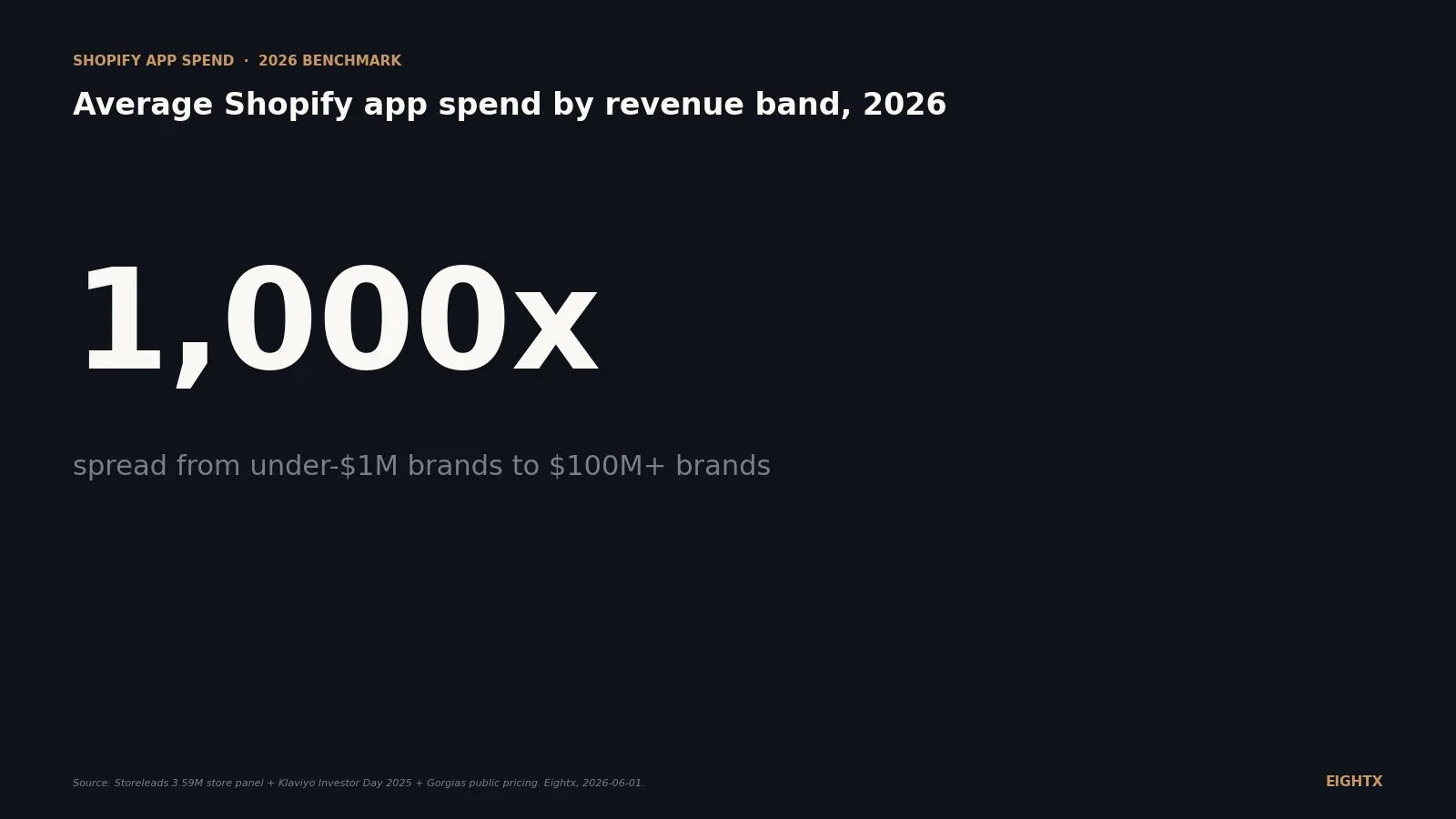
- App spend climbs 1,000x from the smallest band to the largest. Under $1M ARR: $50-300/mo. $1-5M: $1,000-3,500/mo. $5-20M: $5,000-15,000/mo. $20-100M: $20,000-80,000/mo. $100M+: six figures monthly. Each band has its own stack-bloat problem and its own audit conversation.
- Klaviyo's annualized average revenue per customer rose from $5,200 in Q3 2023 to $6,700 in Q2 2025 (a 29% jump in 7 quarters, per Klaviyo Investor Day 2025). Net revenue retention sits at 108%, which means existing brands grow their Klaviyo bill 8%/yr without doing anything different. This is the per-customer ARPU inflation showing up on every operator's P&L.
- Hard cap = $100/mo per app at the operator level. Founder calls consistently treat $100/mo as the per-app spend ceiling before it requires an approval conversation. Anything above that without a clear ROI lands in the next audit as a delete candidate.
- At $50M GMV the conversation shifts from cut to negotiate. Under $20M brands cut apps. $20-100M brands negotiate volume discounts with the same vendors. $100M+ brands replace SaaS with custom builds or quote-based enterprise contracts. Know which conversation your stage is actually in before you start the audit.
If you run a Shopify brand and you are trying to figure out whether your app stack is bloated or about right for your revenue, the sitewide average ($42-58/mo per various platform-wide estimates) is useless because 98.2% of stores stay under $100/mo (Storeleads modeled estimates, directional ±25%, see methodology). The signal that matters is app spend by revenue band, because the stack that is right at $2M GMV is wrong at $20M and wrong again at $100M. Pulling Storeleads' 3.59M-store panel as of May 2026, Klaviyo's 10-K plus Investor Day disclosures, Gorgias and Recharge public pricing, and three independent Shopify Plus agency benchmarks (Ask Phill, 20North), the working benchmark ladder is: under $1M ARR pays $50-300/mo; $1-5M pays $1.0-3.0K/mo; $5-20M pays $5-15K/mo; $20-100M pays $20-80K/mo; $100M+ clears six figures monthly. Here is the band ladder, what it means for your business, and how to audit your own stack against it. Watch the Klaviyo per-customer ARPU number in particular: it is a directional ceiling for the per-customer SaaS inflation showing up on every operator's bill (Klaviyo's ARPU includes non-Shopify customers, so treat it as a ceiling rather than a Shopify-specific stat).
The sitewide app-spend average is useless. Here is the band ladder that is not.
Storeleads tracks 3,593,277 active Shopify stores as of May 2026. Only 65,441 of those (1.82%) spend over $100/mo on apps. Only 7,966 (0.22%) spend over $500/mo. Only 1,602 (0.04%) spend over $1,000/mo. These are Storeleads' modeled estimates derived from installed app pricing tiers (not billed amounts), so treat the percentages as directional within roughly ±25% rather than as audited stats. Even at the wide end of that tolerance, the distribution is so skewed that any sitewide app-spend average ($42-58/mo in the published estimates we have seen) is dominated by free-tier stores and one-product side projects, which makes it a worthless benchmark for any actual operating brand.
The signal worth tracking is what brands at your revenue stage actually pay. Below is the five-band ladder we use in audits.
The chart is on a log scale because the spread from the bottom band ($175/mo midpoint) to the top ($250,000/mo midpoint) is roughly 1,000x, and a linear chart would flatten the bottom four bars into a single pixel. The 1,000x spread itself is the headline: every conversation about "average Shopify app spend" without specifying a revenue band is noise. The same chart on linear scale would show only the top band, and that is the wrong takeaway.
A few patterns the band ladder makes obvious. From the under-$1M midpoint ($175/mo) to the $1-5M midpoint ($2,000/mo), app spend climbs roughly 10x while the band's nominal revenue ceiling moves from $1M to $5M (about 5x). The exact multiplier depends on where inside each band you actually sit (a $500K brand vs a $4M brand sees a different ratio), but the direction is consistent: app spend grows faster than revenue between the smallest brands and the first paid-tier band. The $1-5M to $5-20M jump follows the same pattern, roughly 5x in app spend on a similar revenue step. By the $20M+ bands, app spend grows roughly in line with revenue because the marginal app is enterprise quote-based and scales with usage, not seats. Knowing where your brand sits on that curve tells you whether your next stack decision is "add a vendor" or "negotiate the existing one."
What an under-$1M Shopify brand actually spends on apps ($50-300/mo)
The under-$1M ARR band runs three to five apps total and pays between $50 and $300 per month. The representative stack is Klaviyo on the free or starter tier, Gorgias Starter or Shopify Inbox for support, and one or two free reviews and UGC apps. Recharge typically does not appear unless subscriptions are core to the product (consumables, supplements, pet).
At this band the optimization conversation is not "which vendor" but "do I need this at all." Klaviyo Free covers up to 500 profiles, which is enough for a brand under $200K GMV to test email economics without paying anything. Shopify Inbox is free and handles the support volume of a sub-$1M brand cleanly. Yotpo's free tier covers reviews at a level most brands at this stage need. The brands at this band that get into bloat trouble do it by installing five free or trial apps for testing, never deleting any of them, and waking up to a $400/mo bill they cannot explain.
The two paid apps most worth the $50-100/mo at this band, in order: an inventory or operations tool (Stocky, Cogsy entry tier) once you carry more than $20K of inventory, and a paid Klaviyo tier once your list crosses 500 profiles. Both pay back at the unit-economics level. Almost nothing else does at this stage.
The $1-5M band is where the stack lock-in happens ($1,000-3,500/mo)
This is the band where most brands sign their first annual contracts and the stack stops being reversible. The representative installed stack: Klaviyo paid (typically $500-1,000/mo at this list size), Gorgias Basic at $50/mo, Recharge if subscriptions are core (~$300/mo plus a transaction percentage on subscription GMV), Postscript or Attentive for SMS ($200-800/mo platform plus $0.01 per send), Yotpo or Okendo for reviews ($150-300/mo), and a small spend on search, loyalty, or fraud. App count typically lands between six and nine. Total monthly app spend at the midpoint runs $2,000.
The decision to make at this band is structural. Most brands install Klaviyo on a 12-month annual contract for the discount, which locks in price and commits you to the platform. Recharge and Gorgias often follow. By the time the brand crosses $5M, the stack is hard to change without 6 months of migration work. The lesson from operator calls: pick your two or three apps that have to be right at this band carefully (email, support, subs if applicable), and stay on month-to-month for everything else until you are sure it earns its keep.
Postscript versus Attentive becomes a real decision around $2-3M GMV. Carrier cost is identical at $0.01 per SMS, so the choice is feature-gap and contract structure. Most brands under $5M get more from Postscript because the self-serve flexibility matches a small team, but if your SMS list is over 50K and growing fast, Attentive's enterprise stack pays back sooner.
At $5-20M the bill clears five figures ($5,000-15,000/mo) and the audit conversation starts
This is the band where dues and subscriptions becomes a meaningful P&L line item, and where the first formal app audit usually happens. The installed stack runs Klaviyo on advanced tier ($1,500-3,500/mo at this list size), Gorgias Pro at $300/mo or Advanced at $750/mo with overage, Recharge mid-tier with GMV percentage ($500-1,500/mo), Postscript or Attentive scaling on volume ($1,500-3,000/mo for a 100K-subscriber program sending 2-3 times a month), Yotpo or Okendo on a higher tier ($300-1,000/mo), loyalty (Smile or LoyaltyLion, $200-800/mo), entry-level search (Searchanise or Algolia, $200-1,000/mo), and analytics (Triple Whale or Polar, $500-1,500/mo). App count typically lands at 10-12.
The stack composition shifts visibly between bands. At $1-5M, email and SMS dominate the bill (Klaviyo plus Postscript or Attentive together are about 40% of total app spend). By $5-20M, the SMS-volume line grows fastest because carrier fees scale with sends and engaged-list size, and support starts costing real money as ticket volume crosses 2,000 per month. By $20-100M, the "other" bucket (search, loyalty, fraud, BI, custom integrations) overtakes the original DTC core apps because the brand is operating in multiple categories the early-stage stack never touched.
Revenue band App spend (typical) App count Stack core (representative) Under $1M ARR $50-$300/mo 3-5 Klaviyo (free or starter), Gorgias Starter or Shopify Inbox, 1-2 free reviews and UGC apps $1M-$5M ARR $1,000-$3,500/mo 6-9 Klaviyo paid, Gorgias Basic, Recharge if subs, Postscript SMS, Yotpo or Okendo reviews $5M-$20M ARR $5,000-$15,000/mo 10-12 Klaviyo advanced, Gorgias Pro, Recharge mid + GMV%, Postscript scaling, loyalty (Smile), search entry, BI (Triple Whale or Polar) $20M-$100M ARR $20,000-$80,000/mo 12-18 Enterprise tiers across all vendors; Attentive often replaces Postscript; multiple BI and analytics platforms $100M+ ARR $100,000-$1M+/mo 15-25+ Quote-based enterprise contracts; custom integrations; often multi-vendor per category
The first formal audit at this band usually finds two patterns. First, two or three apps installed during a 2022-2023 test that nobody on the current team can name a ROI case for. Second, Klaviyo creeping up 8-10% year-over-year on profile growth and price-tier escalators, which is the 108% net revenue retention Klaviyo discloses in its 10-K showing up on every customer's bill. A quarterly suppression-and-cleanup pass on Klaviyo plus a delete-old-apps sweep typically pulls $1,500-3,000 a month back out of the stack at this band.
The $20-100M band: enterprise contracts replace published pricing ($20,000-80,000/mo)
Above $20M GMV the conversation shifts from cutting apps to negotiating contracts with the same vendors. Klaviyo, Gorgias, Recharge, Postscript, Attentive, and Yotpo all transition to quote-based enterprise pricing somewhere in this band, and the published pricing pages stop applying. App count climbs to 12-18 because the brand adds enterprise modules (B2B layer, multi-region, multi-currency, custom analytics) the smaller bands never needed.
The Klaviyo data anchors this. Klaviyo discloses a 38% year-over-year increase in customers generating over $50,000 of ARR, with 4,175 such customers as of Q1 2026, up from 2,850 at end of 2024 and 1,958 at end of 2023. That cohort is exactly the $20-100M+ Shopify band buying Klaviyo at enterprise scale. The annualized average revenue per customer (across all Klaviyo customers, not just the $50K+ cohort) rose from $5,200 in Q3 2023 to $6,700 in Q2 2025. The $50K+ cohort is, by Klaviyo's own definition, paying north of $4,167/mo on Klaviyo alone before any usage overages; the top of that cohort lands on the quote-based enterprise contract ladder and is where the high end of this band's $20-80K/mo total app spend gets set.
Period Total Klaviyo customers Customers over $50K ARR Annualized revenue per customer Q3 2023 ~135,000 n/a $5,200 12/31/2023 ~144,000 (implied) 1,958 n/a 12/31/2024 over 167,000 2,850 n/a Q2 2025 over 176,000 n/a $6,700 Q3 2025 over 183,000 n/a n/a Q1 2026 over 196,000 4,175 n/a
The negotiating position operators in this band have is volume. A $50M brand auditing Klaviyo, Recharge, and Stripe is the conversation that's actually happening on calls in late 2025 and 2026. None of these vendors want to lose a $50M Shopify brand, and most will negotiate 15-30% off list when threatened with a credible replacement bid. The audit conversation here is not "should we cancel Klaviyo" (you cannot, the migration cost is too high) but "what is the actual rate card we are paying versus the list price and the negotiated price of comparable brands." A CFO who has the rate-card comparison ready pulls $5-15K a month back at the $50M band.
$100M+: custom builds replace SaaS, but the bill goes up not down ($100K-1M+/mo)
At $100M+ ARR the stack stops being a SaaS conversation and becomes a build-versus-buy conversation. Enterprise modules across every category. Multiple vendors per category in many cases (one Klaviyo for transactional, a custom-built campaign tool for promotional). Custom integrations between every system. Dedicated BI and data platforms running on Snowflake or BigQuery underneath the app layer. App count climbs to 15-25+ but the meaningful spend lives in five or six enterprise contracts plus a custom-software development line that does not show up in the Shopify app billing at all.
The bill at this band rarely goes down. Brands that replace SaaS modules with custom builds usually save 30-50% on the SaaS line but add an equivalent or larger engineering and infrastructure line. The point of the build is not cost; it is feature control and data ownership. The brands we have seen do this well treat it as a strategic infrastructure investment with a 24-36 month payback, not a cost-cut. The brands that do it badly treat it as a SaaS replacement, underestimate the maintenance load, and end up with both the custom build and a backup SaaS subscription running in parallel.
How to use this benchmark on your own P&L
Five steps to audit your stack against the band ladder, and you can do this in about an hour with your last three months of Shopify billing.
Pull the data. Export the last 3 months of Shopify app charges from your billing settings. Add any non-Shopify-channel app charges (Klaviyo billed direct, Gorgias billed direct, Attentive on its own invoice). Sum to a monthly average.
Tag each line by category. Email and SMS, support, subscriptions, reviews and UGC, SMS platform, search, loyalty, fraud, BI, other. Anything that doesn't fit a category gets flagged as "other" and reviewed individually.
Locate your revenue band. Find your annual revenue on the table above. Pull your band's high-low range and midpoint.
Check the gap. If you are inside the high-low range and the category mix matches the representative stack at your band, you are normal. If you are 30%+ above the midpoint without an obvious structural reason (B2B layer, multi-region, subscription program), you are bloated. If you are 30%+ below the midpoint, you are probably under-investing in email, SMS, or reviews and leaving revenue on the table.
Run the $100 rule. Sort your app list by monthly cost. For any app over $100/mo, write the ROI case in one sentence. Anything you cannot finish that sentence on goes to the delete-after-30-days list. This single rule, applied honestly, pulls back $500-3,000 a month at most brands between $1M and $20M.
For brands at $20M+, the audit is different: it is not "cut apps" but "negotiate contracts." Build a rate-card comparison across your top 5 enterprise SaaS contracts and ask each vendor for the multi-year commitment in exchange for a 15-25% discount. Most will say yes.
The sitewide app-spend average is dominated by free-tier stores. The signal that matters is what brands at your revenue stage actually pay. Under-$1M brands run a 3-5 app stack at $50-300/mo. $1-5M brands lock in at $1-3.5K/mo. $5-20M brands clear five figures. $20-100M brands negotiate enterprise contracts. $100M+ brands replace SaaS with custom builds and pay more for the privilege. Pick the right audit conversation for your band before you delete anything.
Sources and methodology
Storeleads (primary panel data). 3,593,277 active Shopify stores as of the May 2026 snapshot. The store-search API was queried with the Shopify platform filter plus min_app_spend bands at $100, $500, and $1,000 per month. Top-500 Plus brand per-store app inventory came from the store-details endpoint. The limitation worth flagging: Storeleads' app-spend bands are modeled estimates derived from installed app pricing tiers, not actual billed amounts. Treat the percentages as directional within roughly plus-or-minus 25%, not as audited statistics. The same data is cited on our Shopify app bloat report 2026, which is the upstream sibling of this post.
Klaviyo (primary SaaS-vendor disclosures). Form 10-K for fiscal year 2024 (accession kvyo-20241231) provides customer count and the $50K+ ARR cohort definition. Klaviyo Investor Day 2025 Presentation gives the annualized average revenue per customer figures ($5,200 in Q3 2023, $6,700 in Q2 2025). The FY2024 earnings release confirms $937.5M FY24 revenue, 108% net revenue retention, and 2,850 customers above $50K ARR. The Q1 2026 results add the >196,000 customer count and 4,175 above $50K ARR (+38% year-over-year). The per-customer figure is across all Klaviyo customers including BigCommerce, WooCommerce, and custom-platform brands, so treat it as a directional ceiling for "per Shopify brand" math, not an exact figure.
Gorgias and Recharge (public pricing ladders). Gorgias public pricing page accessed 2026-05-30: Starter $10/mo (50 tickets), Basic $50/mo (300 tickets), Pro $300/mo (2,000 tickets), Advanced $750/mo (5,000 tickets), Enterprise custom. Overage runs $0.32-$0.40 per ticket. AI Agent runs $0.90-$1.00 per resolved conversation. Recharge public pricing page lists Starter and Pro plans but obscures enterprise pricing, which is quote-based plus a transaction percentage on subscription GMV. Both are the cleanest publicly disclosed tier ladders in their categories and serve as the anchor for the band-by-band math.
Postscript, Attentive, and Yotpo. All three are quote-based at scale and do not publish enterprise pricing. Carrier cost is universally $0.01 per SMS in 2026 across both Postscript and Attentive, per multiple 2026 third-party sources. Postscript publishes a Starter tier around $25/mo for small lists; serious DTC SMS programs clear $1,500-5,000/mo. Attentive is positioned for mid-market and enterprise with "several thousand per month minimum" budgets per 2026 vendor guides. Yotpo Reviews module runs Free to $15 to $119+/mo on published plans; enterprise loyalty and UGC bundles run $300-1,000+/mo per 2026 audits.
Shopify Plus agency benchmarks. Ask Phill's 2026 Shopify Plus pricing analysis gives roughly EUR 1,500/mo at small Plus brands ($1-3M ARR), EUR 3,500/mo at mid-market Plus ($5-15M ARR), and EUR 7,000+/mo at enterprise Plus ($25M+ ARR), which converts to roughly $1,600-$7,500+ at current rates. 20North gives $500-$2,000/mo for "typical" Plus. Published 2026 Shopify Plus statistics give 11.4 apps per Plus merchant on average. All are independent reads that converge on the $5-20M band of this benchmark.
Update cadence. This page refreshes quarterly when Storeleads runs its next panel update, when Klaviyo files its next 10-Q, and when the vendor pricing pages we cite change. Next planned update: September 2026, after Q2 2026 Klaviyo results and the August Storeleads panel refresh.
Triangulation sourcing. We cross-referenced this benchmark against a Pinecone retrieval over 5,400+ Eightx founder-call segments where app spend and software costs were discussed. The operator-voice patterns confirmed five things consistent with the band math: software cuts are almost always the first lever before headcount; $100/mo is the de facto per-app spend ceiling that requires an approval conversation; dues and subscriptions is the P&L line where zombie apps hide; app spend grows even when revenue does not because of usage-based pricing escalators (consistent with Klaviyo's disclosed 108% NRR); and above $50M GMV the conversation shifts from cutting apps to negotiating volume discounts with the same vendors.
For related benchmarks, see our Shopify app bloat report 2026 for the named top-500 Plus brand per-store app inventory, and our DTC tech stack cost benchmarks for adjacent infrastructure cost data. For the strategic read on using this benchmark to size your 2026 software budget, see fractional CFO services for ecommerce.
Frequently asked questions
how much should a $5m shopify brand actually be spending on apps each month?
Between $1,000 and $3,500 per month is the typical band based on Storeleads panel data, Ask Phill agency benchmarks, and Klaviyo + Gorgias public pricing. The median is closer to $2,000. If you are spending over $3,500 at $5M, you probably have zombie apps. If you are spending under $1,000 at $5M, you are probably under-investing in email, SMS, or reviews and leaving revenue on the table.
is klaviyo really worth $2k+ a month or should i switch to shopify email?
Depends on your email and SMS revenue contribution. Klaviyo bills based on profile count and SMS volume. At $5-20M GMV with email driving 25%+ of revenue, the math usually clears even at $2,000-$2,500 per month. If email is under 15% of revenue and you are paying $2,000+ for Klaviyo, you have a list-quality or campaign problem, not a vendor problem. Shopify Email is a real option under $1M GMV but tops out fast on flow logic.
what does the average shopify plus brand spend on apps in 2026?
About 11-12 apps installed, per published 2026 Plus statistics. The published agency benchmarks (Ask Phill, 20North) cluster on the narrow definition of "Plus app stack" (email/SMS, support, subs, reviews) at roughly $500-$5,000 per month. The fuller P&L view, which adds BI and analytics (Triple Whale or Polar), loyalty, search, and fraud, runs higher: a mid-market Plus brand at $5-20M ARR typically lands $5,000-$15,000 per month in total app subscriptions, with the midpoint around $10,000. Enterprise Plus brands at $20-100M ARR clear $20,000-$80,000 per month once quote-based enterprise contracts kick in on Klaviyo, Attentive, Recharge, and the BI layer. The right number depends on whether you are benchmarking only the published Plus app stack or the full dues-and-subscriptions line on your P&L; the body table uses the full P&L view.
how do i know if my shopify app stack is bloated or normal for my revenue?
Pull last 3 months of Shopify app billing, tag each line by category (email/SMS, support, subs, reviews, SMS platform, search, loyalty, BI, fraud, other). Sum the total and divide by your revenue band midpoint. If you are 30%+ above the midpoint without an obvious reason (subscription brand, B2B layer, multi-region), you are bloated. If you have any app over $100/mo that nobody on the team can name a clear ROI for, that is your first delete.
why does my klaviyo bill keep climbing when my contact list barely grows?
Two reasons. First, Klaviyo bills on active profiles, so unsubscribes are not the same as deletions and your billable list can climb even when your engaged list flattens. Second, Klaviyo runs at 108% net revenue retention, which means existing customers grow their bill 8% per year on average from price increases, SMS volume, and tier upgrades. The fix is a quarterly suppression-and-cleanup pass on cold profiles. Most brands recover 10-20% of their Klaviyo bill from this alone.
should i pay for gorgias or just use shopify inbox at $2m gmv?
Shopify Inbox is free and fine until your ticket volume gets past about 200 per month. Gorgias starts at $10 a month and gets serious at $50 a month for 300 tickets, which is where most $1-5M brands land. The conversion isn't the app cost, it is the staff hours per ticket. Gorgias macros and rules cut handle time enough that the $50-$300 a month pays back at any ticket volume above 200. Below that, stay on Inbox.
is paying $5k+/mo for attentive sms worth it vs postscript at half the cost?
Carrier cost is the same ($0.01 per SMS at scale on both). The platform fee is what differs. Attentive prices for mid-market and enterprise with quote-based contracts; Postscript stays self-serve longer. Most brands under $20M GMV get more value from Postscript because the feature ceiling is similar and the contract is more flexible. Above $20M, Attentive often wins on enterprise SLAs, multi-region, and revenue-share programs. The decision is more about contract structure than feature gap.
how do i benchmark my dues and subscriptions line vs other shopify brands my size?
Use the band table in this post. Map your monthly software spend to your revenue band midpoint. If you are inside the high-low range, you are normal. The line item to watch is dues and subscriptions on your P&L. Founder calls consistently treat this line as the first place to audit when cash gets tight. One cleanup pass typically pulls back $500-$2,000 a month at $1-5M GMV and several thousand at $5-20M, mostly from apps installed for a one-off test and never deleted.