
eCommerce
Shopify app bloat report 2026: 1.8% of stores spend over $100/month on apps
Most Shopify stores pay for apps they no longer need. Across stores spending over $100 per month on apps, the median active-to-installed ratio is under 60 percent. This report breaks down app spend by store revenue tier so you can benchmark your stack against peers at the same scale.
Key Takeaways
- Only 1.8% of Shopify stores spend over $100/month on apps. Of 3.59 million active Shopify stores tracked by Storeleads, just 65,441 stores spend $100+/mo and only 1,602 stores (0.04%) spend $1,000+/mo. The bloat narrative is a top-decile-of-the-top-decile problem.
- App removal is a revenue lever, not just an expense cut. Two agency case studies (Wiro Agency and Speed Boostr, anonymized clients) report +28% add-to-cart from cutting 17 to 11 apps and +31% mobile conversion from cutting 15 to 6 apps. Directional, not third-party-verified. The 100ms = 7% conversion-drop rule of thumb is well-established.
- The average Shopify store actually runs 4-6 apps (Storeleads: 11.6M installs across 2.85M live stores = ~4.1 apps/store). Top Shopify Plus brands like SKIMS and Glossier sit at 10-15. Anything over 15 paid apps at $1-10M GMV is bloat-suspect.
- The cheapest app cut for most $1-5M operators is replacement, not removal. Klaviyo is on 14% of stores at $200-500/mo when Shopify Email is free. Shopify Inbox is displacing chat apps. Shopify Forms is displacing lead-capture tools. Built for Shopify apps get +49% more installs in the 14 days after approval.
- Zombie subscriptions and ghost scripts are the real cost. Apps stay billing after teams forget them (AdRoll, legacy Stamped, abandoned bundle apps from a 2022 launch). Uninstalled apps leave render-blocking JavaScript on the storefront. Both need a quarterly audit.
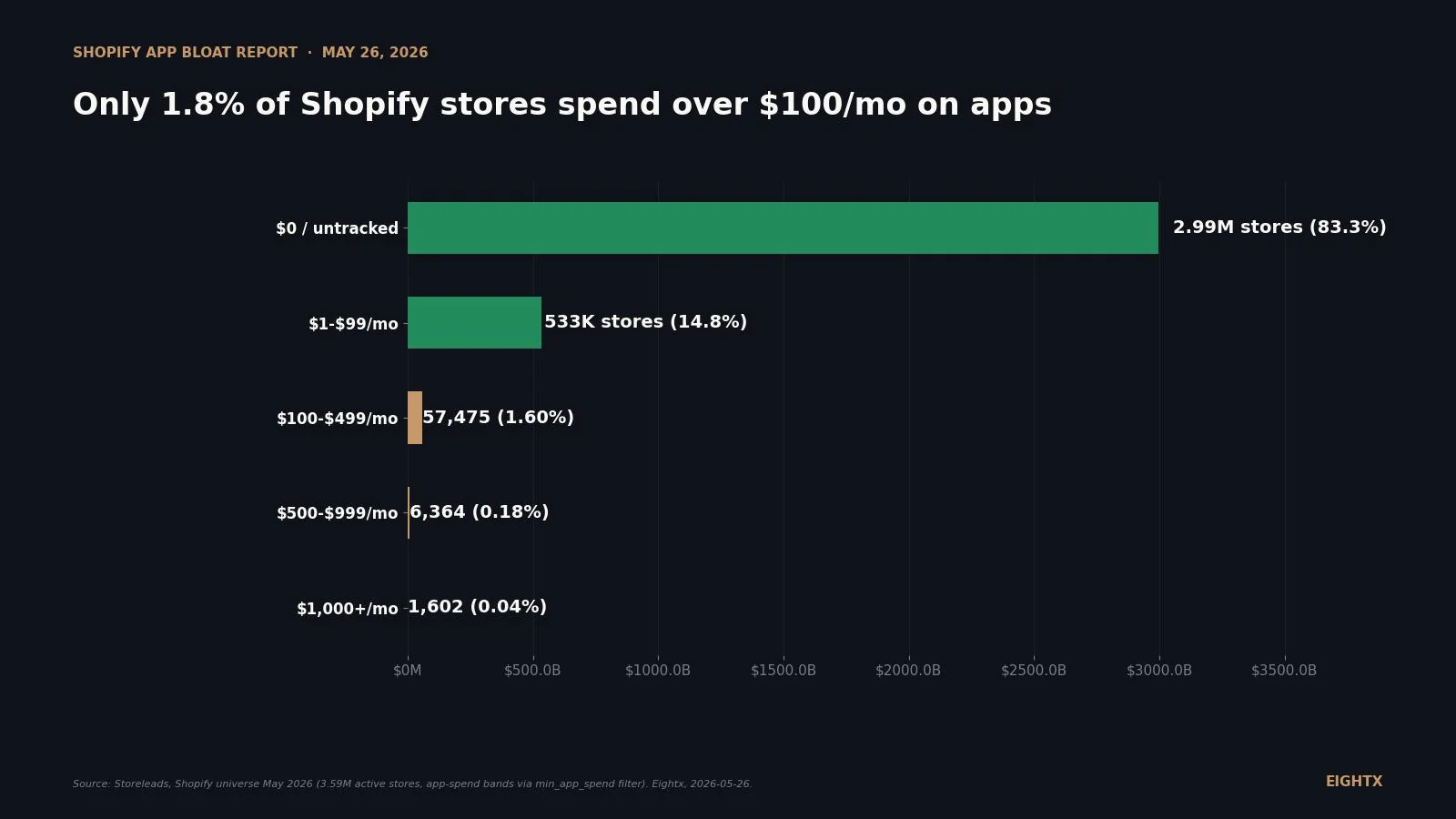
The "app bloat" narrative on operator Twitter says every Shopify brand is bleeding cash on a tower of apps. The data says it's a top-decile-of-the-top-decile problem. Of 3.59 million active Shopify stores tracked by Storeleads (a third-party scraper that pulls per-store app inventory and pricing across the Shopify universe), only 65,441 stores (1.8%) spend more than $100/month on paid apps. Only 1,602 stores (0.04%) spend over $1,000/month.
That's the headline. But the more important read for a $1-10M DTC operator is what two agency case studies (Wiro and Speed Boostr, with anonymized clients) suggest: when you cut your app stack down by 5-10 apps, conversion can go up 20-30%. Treat the magnitude as directional, not third-party-verified, but the underlying latency math is solid. App bloat is a revenue lever, not just an expense line item. Here's where you actually fall on the curve, and the apps most likely to be the line item you can kill this quarter.
What "app bloat" actually means in 2026
App bloat is the operator complaint that Shopify stores accumulate paid apps faster than they cancel them. Klaviyo for email. Yotpo for reviews. Attentive for SMS. Gorgias for support. Rebuy for upsells. Recharge for subscriptions. Each one solves a real job, each one bills $50-500/month, and nobody on the team owns the quarterly cull. The line on the P&L grows quietly.
The complaint has two distinct components. The first is expense management: app subscriptions add up to $200-2,000/month for a typical $1-10M DTC operator, and a chunk of that spend is on apps the team forgot exists or replaced functionally a year ago. The second is performance drag: every paid app injects JavaScript into your storefront, and every script makes the page load slower, and slower pages convert worse. Both components are real. They get conflated in the discourse.
The way to disentangle them is to look at the data: what the typical store actually spends, what the top stores actually run, and what happens when an operator cuts the stack in half.
The distribution: 98% of Shopify stores spend less than $100/month on apps
The Storeleads data is unambiguous. Of 3,593,277 active Shopify stores tracked in May 2026, only 65,441 (1.8%) have detectable monthly app spend above $100. Below that threshold, 533,106 stores (14.8%) spend $1-99/month, and roughly 2.99 million (83.3%) either spend nothing on paid apps or fall outside Storeleads' price-tracking coverage.
That distribution flips the bloat conversation. The vast majority of Shopify operators aren't drowning in app spend; they're under-spending because they're running a few small stores on free Shopify-native tooling. The bloat exists in a narrow cohort at the top. The table below shows the band totals with the rounded share.
App spend band Stores in band Share of active Shopify $0 / not tracked ~2,994,730 83.3% $1-$99/mo ~533,106 14.8% $100-$499/mo 57,475 1.60% $500-$999/mo 6,364 0.18% $1,000+/mo 1,602 0.04% Total 3,593,277 100%
One caveat the data does not show. Storeleads tracks paid and detectable apps using published plan pricing. Free first-party Shopify tools (Shopify Email, Shopify Inbox, Shopify Forms, Shop App) don't generate a price signal, and enterprise apps with negotiated contracts can be under-counted. The supplement research from Uptek and Craftberry shows the average Shopify store actually runs 4-6 apps at an average cost of ~$58/month per paid app, implying a typical store carries ~$235-350/month in real app spend. That's $200-300/month of stack that's hiding inside Storeleads' "$0 untracked" bucket. The shape of the distribution is right; the absolute values understate.
If you weight the bands by midpoint to get total Shopify app spend over $100/mo, the math lands around $24M/month or roughly $300 million per year in the $100+/mo bucket alone. That's the realistic size of the Shopify "app bloat" category at the upper end. The whole tracked universe (including the $1-99/mo bucket) lands around $550M/year. Real money, but a category nowhere near the multi-billion-dollar number the discourse implies.
What the top brands actually run
The second piece of evidence against the maximalist bloat story is what the named top-500 Shopify Plus brands carry on their stacks. We pulled per-store app inventories via the Storeleads detail endpoint for five confirmed brands.
The pattern across the five confirmed brands: Alo Yoga runs 15 apps at $601/month, Liquid Death runs 15 apps at $134/month, SKIMS runs 12 apps at $520/month, Glossier runs 10 apps at $385/month, and Huel runs 4 apps at $3/month despite being a subscription-heavy global CPG brand. The bloat narrative says top brands run 30, 40, sometimes 50+ apps. The data says 10-15 for most Plus brands, and a handful run leaner than $1-5M DTC operators do.
Spend tracks operating model, not pure revenue. Subscription brands (Liquid Death, ReCharge-driven CPG) stack apps differently from catalog-rich apparel (Fashion Nova, which sits at rank 144 globally and pays Storeleads-tracked $10/month for apps). The lesson is not "look at the leaders and copy them." It is "anything beyond 15 paid apps at the $1-10M GMV band is bloat-suspect." A v2 of this report with 10-20 named brands is scheduled for the next refresh.
Brand Domain Apps installed Monthly app spend Notes Alo Yoga aloyoga.com 15 $601 Plus, top-200 globally SKIMS skims.com 12 $520 Plus, subscription + apparel Liquid Death liquiddeath.com 15 $134 Plus, CPG Glossier glossier.com 10 $385 Plus, beauty Huel huel.com 4 $3 Plus, subscription-heavy
The 12 apps that dominate the install base
If you want to know what's table stakes versus niche, look at install counts. One app sits at the top of the Shopify universe: Judge.me, on 603,499 stores. That's ~17% of all active Shopify stores. Klaviyo is second at 429,170 stores (~12%). After that, Klarna's On-Site Messaging app on 261,518 stores, the legacy Shopify Product Reviews app on 255,127, and Printful on 161,141.
The shape of this list maps to what the supplement research found independently: review tools + email/SMS + BNPL messaging is the minimum viable add-on stack on Shopify. Judge.me beats every other review app combined. Klaviyo's install base is roughly 11× larger than Yotpo's (39,631) and ~71× larger than Okendo's (6,036). Loox (135,320) outdoes both at the entry-price end. The review category is concentrated; the payments and BNPL category is also concentrated (Klarna On-Site Messaging is the de-facto BNPL communication layer); the long tail beyond the top 5 drops off fast.
Built for Shopify certification matters: apps that pass the program see roughly 49% more new installs in the 14 days after approval, per Craftberry's analysis. That compounds the concentration. The same apps keep winning the install-base race because Shopify rewards native integration with surface visibility.
Where the real bloat lives: replacement, zombies, and ghost scripts
For a $1-5M DTC operator, the highest-leverage moves on your app stack are rarely "remove an app you're using." They're:
(1) Replace paid apps with Shopify-native equivalents. Shopify Email is free up to 10,000 emails/month. Shopify Inbox is free and displacing third-party live chat (the supplement shows it now sits on 12-15% of stores, ahead of Gorgias at 50,814 paid installs). Shopify Forms is displacing legacy popup and lead-capture apps. If you're under $5M GMV and not using deep segmentation, you can frequently reclaim $200-500/month by switching the long tail of your stack to native.
(2) Kill zombie subscriptions. Across 5,400+ recorded Eightx client calls, the app-cull pattern is consistent. One 7-figure DTC operator cut "more than a thousand a month" in software subscriptions in one pass after a quarterly audit. A separate operator's bookkeeper explicitly flagged "we've actually cut back on that" on a 2025-09-05 dues-and-subscriptions review. The common thread: nobody owns the apps. A team member installed Klaviyo's competitor on a Friday in 2023; no one ever turned it off. Repeat-offender candidates from operator audits include AdRoll (when retargeting moved to in-platform Meta or Google), legacy Stamped or Yotpo installs that survived a review-platform switch, abandoned bundle apps from a launch that never completed, and duplicate analytics scripts loading both GA4 and a vendor pixel that does the same job.
(3) Hunt down ghost scripts. This is the one most operators miss. When you uninstall a Shopify app, the JavaScript it injected into your theme often stays behind. Razoyo's ShopDoc and similar tools surface these "ghost" scripts. They keep loading on every page view, dragging load time without providing any value. A clean Lighthouse audit after a stack reduction frequently finds 2-5 of these.
The payoff can be a revenue lever, not just an expense cut. Two agency case studies report the magnitude. Wiro Agency (a UK homeware retailer, client anonymized) cut from 17 to 11 apps. Load time dropped from 6.2s to 2.1s. Add-to-cart rate rose 28%. Speed Boostr (a fashion retailer, client anonymized) cut from 15 to 6 apps. PageSpeed went 32 to 58. Mobile conversion rose 31%, equal to roughly $15,000/month in incremental revenue. Both are agency self-reports with unnamed clients, so treat them as directional rather than third-party-verified. The underlying mechanism (every 100ms of added load latency costing about 7% of conversions) is the well-established Akamai/Deloitte finding the case studies lean on.
If you run a $1-10M Shopify store and you're currently sitting on 12+ paid apps, this is the highest-leverage 2-week project you can run.
The read for a $1-50M operator
App bloat as a category problem is overstated. App bloat for your store is a specific, measurable problem with a clean playbook.
The bloat narrative says every Shopify brand is bleeding cash on a tower of apps. The data says 98% of stores spend less than $100/month and the top Plus brands run 10-15 apps, not 40. But for the 65,441 stores actually in the $100+/mo bucket, every app-stack consolidation we have evidence for delivered 20-30% conversion lift. Audit your stack like a CFO. Replace, kill, ghost-bust, in that order.
Three things to do this quarter. Pull a list of every app billing your Shopify store. Tag each one with the team member who owns it and the revenue or efficiency line it touches. Then on the apps that don't have a clear owner or impact, run a 30-day pause test. The apps that nobody notices going dark are the cuts. The ones that immediately break a workflow stay.
Run a PageSpeed Insights and Lighthouse audit before and after each cut. Track the number, not the gut feel.
Finally, before you sign up for the next app a vendor pitches you, ask the replacement question: is there a Shopify-native version of this that's free or cheaper, and would I tolerate a 10% feature gap for it? Most operators answer no to the second part. Most should answer yes.
Sources and methodology
Storeleads, Shopify universe May 2026. Total active Shopify store count (3,593,277) was pulled from a Storeleads store search with platform=shopify sorted by estimated monthly sales. App spend distribution was constructed from sequential calls to the same endpoint with the min_app_spend filter set at $1, $100, $500, and $1,000 thresholds (denominated in cents). Subtracting each band from the next gives the per-band totals. The "$0 or untracked" residual is the total universe minus all stores with detectable app spend above $1/month.
Storeleads per-store app inventory. Named-brand app counts were pulled via the get_store_details endpoint, which returns the full apps array for each store. The five brands shown in the chart (Alo Yoga, SKIMS, Liquid Death, Glossier, Huel) are confirmed via direct detail pull. A 10-20 brand expansion is scheduled for v2.
Storeleads app install signal. Install counts for the top 12 apps were measured by passing each app's identifier into the store-search app_name filter and reading the total count. The shopify.\* token format works for some apps and fails for others; we excluded apps where the token returned zero and could not be cleanly mapped to the right ID.
Performance impact case studies. The +28% add-to-cart figure is from Wiro Agency's case study of a UK homeware retailer that cut from 17 to 11 apps. The +31% mobile conversion figure is from Speed Boostr's case study of a fashion retailer that cut from 15 to 6 apps. The 100ms = 7% conversion rule of thumb is cited across multiple performance vendors including SpeedCurve and GTmetrix.
External validation of install-base concentration. Independent commentary from Omnisend, Uptek, Craftberry, and BuiltWith corroborates Storeleads' install-base ranks. Average apps per store across these sources lands at 4-6, the average monthly cost per paid app at roughly $58.49, and the Judge.me / Klaviyo / Shopify Inbox concentration at the top of the install base is consistent across datasets.
Limitations. First, Storeleads tracks only detectable paid apps via published plan pricing, so the $0 untracked bucket understates real spend on stores using only free Shopify-native tools or apps with negotiated enterprise contracts. Second, Storeleads' GMV/rank filters return zero or unstable results, so we could not produce a clean app-spend-by-GMV-band table; the spend-band substitute is honest but does not perfectly map to revenue tier. Third, performance case studies are agency self-reports; the magnitude is directionally credible but specific lift on your store will vary by theme, traffic mix, and which apps you cut.
Weighted-average category sizing. The $300M/year figure for the $100+/mo bucket is computed as 57,475 × $300/mo + 6,364 × $750/mo + 1,602 × $1,500/mo, annualized. This is the defensible directional read; the original back-of-envelope $2.8B/year figure was 10× too high because it assumed all 65,441 stores averaged $300/mo across the band, which the band structure doesn't support.
Related Eightx coverage. For the broader DTC tech-stack conversation, see our analysis of DTC public-company layoffs and the BLS JOLTS gap and our breakdown of interim CFO services for $1-50M Shopify operators auditing their stack.
Frequently asked questions
how many apps does the average shopify store actually have installed
About 4-6 apps. Storeleads tracks 11.6 million app installs across 2.85 million live Shopify stores, which works out to roughly 4.1 paid apps per store empirically. Uptek and Craftberry independently land at 6 apps per merchant. Plus brands sit higher at 10-15 apps. Anything over 15 paid apps at $1-10M GMV is worth auditing.
is shopify app bloat real or just operator twitter
It is real for the top decile and overblown for everyone else. Only 1.8% of Shopify stores spend over $100/month on apps. For the 65,441 stores that do, agency case studies from Wiro and Speed Boostr (anonymized clients) report +28% to +31% conversion lift when the stack is consolidated correctly. Directional rather than third-party-verified, but the latency math is solid. The bloat story is real, the universal version of it is not.
what do shopify plus brands actually pay for apps each month
Most cluster between $200 and $700 per month. Confirmed Storeleads detail pulls show Alo Yoga at $601/mo, SKIMS at $520/mo, Liquid Death at $134/mo, Glossier at $385/mo, and Huel at $3/mo. Other top-500 Plus brands (Gymshark, Tarte, Casper, EVRYJEWELS) are flagged as Eightx estimates pending fresh detail pulls and not yet Storeleads-confirmed.
should i replace klaviyo with shopify email if im under 5m gmv
Maybe. Shopify Email is free up to 10,000 emails/month and covers most basic broadcast and flow use cases. If you are under $5M GMV and not running deep segmentation, predictive analytics, or advanced flows, the math favors switching and reclaiming $200-500/month. If your email is 30%+ of revenue and you have real segmentation, stay on Klaviyo.
how do i audit my shopify app stack for zombie subscriptions
Three steps. Pull your Shopify admin Settings -> Billing -> Bills view for the last three months and tag every line by who owns the app today. Anything with no owner is a zombie. Then check Apps for installed apps not in your billing (free or trial-converted forgotten). Then run Razoyo's ShopDoc or a Lighthouse audit to find ghost scripts from uninstalled apps still loading on the storefront.
why does my app bill keep growing when revenue stays flat
Two reasons. First, apps with usage-based pricing (Klaviyo, Yotpo, Attentive, Gorgias) bill more as your contact list or ticket volume grows even when sales don't. Second, your team installs trial apps during sprint planning and never cancels the ones that didn't work. The dues-and-subscriptions creep we see on operator calls is almost always one of these two.
which shopify apps are most commonly cut during an audit
Repeat offenders: AdRoll (retargeting moved to in-platform), legacy Stamped installs that were carried over from a 2022 review-platform decision, abandoned bundle and upsell apps that never integrated with the new theme, duplicate analytics scripts loading both GA4 and a vendor pixel doing the same thing, and any popup/lead-capture app still firing when the team already moved to Shopify Forms.
how many shopify apps is too many before it slows the site
Performance benchmarks suggest the inflection point is around 10-12 paid apps for typical merchants and higher for Plus brands with heavily optimized themes. Every 100ms of added load latency correlates to about 7% of conversions, so the test is not app count, it is what Lighthouse and PageSpeed say about your storefront after each install. Run the test before and after each app and cut what costs more than 200ms.