
M&A
The Data Room: What to Prepare Before You Sell
A sell-side data room is the organized document set a buyer's diligence team works through to verify your brand. A buyer-ready DTC room runs roughly 180 files across eight sections: financials, tax, legal, contracts, customer and cohort data, operations, IP, and HR. Clean organization can cut the diligence timeline by 30 to 40 percent.
Key Takeaways
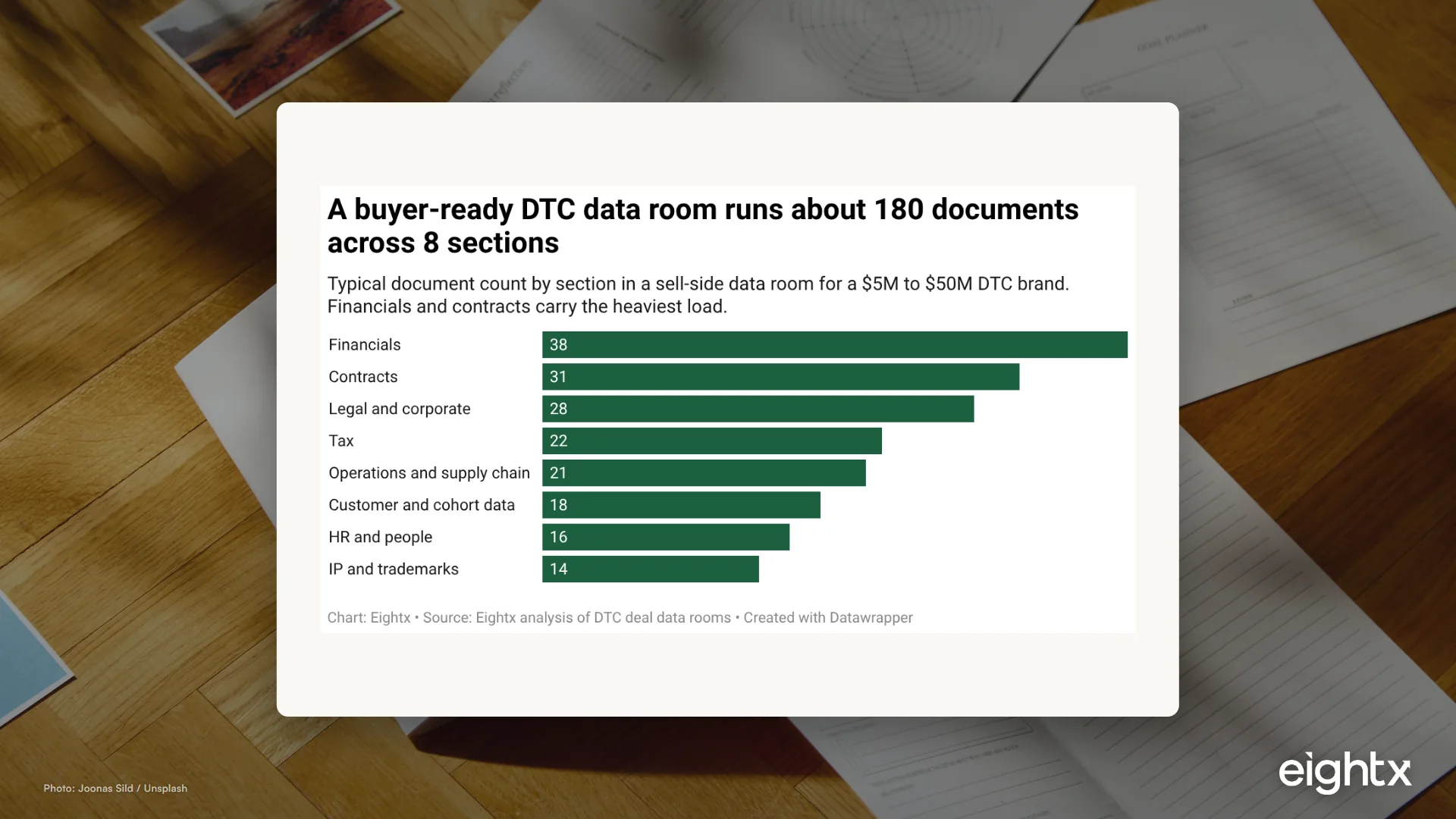
- A buyer-ready DTC data room runs about 180 documents across 8 sections, with financials (around 38 files) and contracts (around 31) carrying the heaviest load.
- Full ecommerce diligence runs 60 to 90 days; a clean, prepared data room can cut that timeline by 30 to 40 percent.
- Buyers walk from a meaningful share of deals over financial ops issues that surface in diligence, most of which a prepared room would have flagged first.
- Build the room 12 to 24 months before exclusivity, not after the LOI. Scrambling during diligence routinely costs 10 to 25 percent of headline value.
- Lead each section with the documents buyers always ask for: 36 months of monthly P&L by channel, customer concentration, inventory aging, and cohort retention.
Most founders think the hard part of selling is finding a buyer. It is not. The hard part is surviving what happens after the LOI, when the buyer's diligence team starts asking for dozens of specific documents per category and you have eight weeks to produce them. Brands that scramble at that stage routinely lose 10 to 25 percent of headline value (Eightx M&A due diligence checklist). Brands with a clean data room negotiate instead of dig through email.
I have prepared data rooms on the sell side and run diligence on the buy side after deploying over $500M as a PE investor. The pattern is consistent: the room is the deal. A well-built data room moves diligence fast and signals that the rest of the business is run the same way. A messy one tells the buyer to start discounting. This is the build-the-room checklist, organized the way a buyer's team actually works through it.
What a data room is, and why it decides your deal
A data room is the access-controlled document set the buyer's team uses to verify everything you have claimed. In a modern deal it is a virtual data room: cloud folders with role-based permissions, version control, and a clear top-level structure. Best practice across M&A advisors is a function-based folder tree with the most material document at the top of each folder so buyers find core items fast (EthosData, Virtual Data Room for M&A).
Why it matters in dollars: full ecommerce diligence runs 60 to 90 days, and starting with clean, well-organized records can cut that by 30 to 40 percent (Eightx due diligence checklist). Complex multi-channel or cross-border brands run 90 to 120 days. More important than speed, buyers walk from a meaningful share of deals over financial ops issues discovered in diligence, the central lesson of our ecommerce exit guide. Most of those would have been caught and fixed if the seller had built the room first.
When I talk to founders preparing to sell a brand this size, the framing that lands is simple: building the room is the engagement, not an afterthought. You build the data room, you get the deck and the term sheet in order, and then you hit the go button when you are ready. The buyers I have sat across from on the buy side open the room and form an opinion in the first hour, and that opinion sets the tone for the entire 60-to-90-day negotiation.
The eight sections, by document load
A buyer-ready DTC data room for a $5M to $50M brand runs roughly 180 documents across eight sections. Financials and contracts carry the heaviest load. Here is how the document count breaks down.
The counts are a planning guide, not a quota. A wholesale-heavy brand will have more contracts; a vertically integrated brand more operations and supply chain. The point is to know the shape of the work before exclusivity compresses your timeline.
Section by section: what buyers always ask for
Financials (about 38 docs). The core. Three years of monthly P&L by channel, balance sheet, and cash flow; tax returns; 12 months of bank statements; a clean trial balance; budgets and forecasts; the financial model; cap table; and debt schedules. Buyers break the P&L apart by channel because a $20M brand can look healthy consolidated while Amazon runs at breakeven on DTC's margin. Get this section right before anything else, and see how to prepare financials for due diligence.
Tax (about 22 docs). Corporate tax returns, sales tax and VAT/GST filings, any audit correspondence, deferred tax schedules. Sales tax nexus exposure is a classic late-discovery item that surfaces cold in diligence. When founders ask me how nexus works, the short version is that it is a rolling four-quarters test, run state by state, not federally. If your last few quarters of sales into a state crossed its threshold, you now have nexus and a filing obligation there, and a buyer's tax advisor will find the gap fast.
Legal and corporate (about 28 docs). Articles of incorporation and amendments, shareholder register, board and shareholder minutes, subsidiary agreements, litigation files, licenses, and permits.
Contracts (about 31 docs). Customer and supplier agreements, distribution and reseller deals, 3PL and warehouse contracts, leases, loan and credit agreements, and SLAs. The reality I walk founders through is that buyers want every contract, full stop: employee and director agreements, every consultant and contractor agreement, and any MSA with your manufacturers or your 3PL. This section is where owner-dependent relationships hide. If one wholesale account is 30 percent of wholesale revenue, the buyer will find it here.
Customer and cohort data (about 18 docs). Cohort retention curves, repeat purchase rates, customer concentration (top 10 as a percent of revenue), CAC and LTV by channel, return and refund rates. This is what separates durable revenue from bought revenue. The bar buyers measure against is repeatability: when we model cohorts well, we can show that by month three a cohort has returned roughly 1.47x its first-order revenue and by month eight it has doubled, with the new cohorts tracking the old ones closely enough to forecast forward. That kind of curve is what tells a buyer the revenue is durable, not bought.
Operations and supply chain (about 21 docs). Inventory aging report, valuation method, prepaid PO deposits, SOPs, supplier list, and lead times. Working capital is mostly inventory plus accounts receivable, and inventory is the silent deal killer: brands routinely overstate working capital by 20 to 40 percent on seasonal builds and slow-moving stock. I have watched a seven-figure incremental order require finding the working capital for roughly $2.5M of inventory on 180-day terms, and that is exactly the kind of strain a buyer prices in.
IP and trademarks (about 14 docs). Trademark registrations, domain ownership, key creative and brand assets, software licenses, IP assignments from contractors and agencies. Missing contractor IP assignments are a common, fixable gap.
HR and people (about 16 docs). Org chart, headcount and comp, employment and contractor agreements, benefits, and any equity or incentive plans. Employee misclassification is another late-discovery item buyers price in.
Buyers do not move through these sections at the same speed. They open with a small pack of documents that tells them whether the rest of the room is worth their time.
| Document | Why buyers open with it |
|---|---|
| 36 months of monthly P&L by channel | Tests whether one channel subsidizes a weak one |
| Top-10 customer concentration (% of revenue) | Flags revenue durability and key-account risk |
| Inventory aging report | Surfaces overstated working capital and dead stock |
| Trailing-12-month gross margin trend | Detects margin erosion that triggers a haircut |
| Clean trial balance | Signals whether the books survive a QoE |
| Customer cohort data | Separates durable revenue from bought revenue |
Quality of Earnings: the section behind the section
Before you hand over financials, understand how a buyer will use them. The Quality of Earnings analysis is a third-party review, typically 3 to 4 weeks, that tests whether your EBITDA is real and sustainable (Eightx due diligence checklist). Typical reported-to-adjusted EBITDA reductions run 10 to 30 percent during diligence (Eightx M&A checklist). Your data room should pre-empt the QoE: documented, defensible add-backs and a revenue recognition policy that survives scrutiny.
The way I explain add-backs to founders is plain. You pull the last 12 months or two years, start at net income, work to EBITDA, and then back out the things that are genuinely abnormal. If you spent $50K on lawyers because you got sued once, that is a legitimate add-back. The goal is to get to a normalized, owner-adjusted number (an SDE-style view for smaller brands) rather than the strict bottom line, and you usually only need to do that exercise for the most recent year or two. The discipline is documentation: a $50K add-back at a 5x multiple is $250K of value, but only if it survives the QoE.
What a finding costs you is concentrated and quantifiable. The table below shows the typical impact of the red flags buyers price in. Treat these as advisory ranges, not a measured dataset.
| Diligence finding | Typical impact |
|---|---|
| Single-channel dependency (>60% of revenue) | 0.5x to 1.5x multiple reduction |
| Customer concentration (>15% of revenue) | 0.5x to 1x multiple reduction |
| Declining TTM gross margin | 1x to 2x reduction or deal termination |
| Dead stock / inventory aged past 6 months | Written down 50% to 100% of carrying value |
| Working capital overstatement (inventory-heavy) | 20% to 40%, a dollar-for-dollar price cut |
The room is the deal. A clean, function-organized data room does not just move diligence 30 to 40 percent faster, it tells the buyer the rest of the business is run the same way. A messy room tells them to start discounting, and the discount lands as turns off your multiple, not a rounding error.
What to do about it
- Map the eight sections now. Build the folder tree (Financials, Tax, Legal, Contracts, Customer Data, Operations, IP, HR) and a master document list against the roughly 180 items above. Knowing the shape removes the panic.
- Lead with the first-48-hours pack. Buyers open with the six requests in the table above: 36 months of monthly P&L by channel, customer concentration, inventory aging, the trailing-12-month gross margin trend, a clean trial balance, and cohort data. Have these ready first.
- Start 12 to 24 months out. Tax structure changes need 18-plus months; accounting cleanup and add-back documentation need 12. Below 6 months of prep almost always costs value. Do this with intent: if you have not actually decided to sell, do not torch a year of operating focus on diligence prep you may not use.
- Document every add-back. A $50K adjustment at a 5x multiple is $250K of value, but only if it survives the QoE. Keep the receipts.
- Use version control and access tiers. Final versions only, dated and named consistently. Restrict payroll, litigation, and board materials to need-to-know.
- Pre-run your own diligence. Hand the room to someone who will tear it apart before the buyer does. Every issue you find first is one you control, and it is one less turn the buyer can argue off your multiple.
Sources and methodology
Document counts by section are Eightx planning estimates for a $5M to $50M DTC brand's sell-side data room, built from our experience preparing rooms and running buy-side diligence, and cross-checked against published M&A data room checklists (EthosData, FirmRoom, Ansarada). The counts sum to about 188 and round to "about 180." Treat them as a planning guide that varies by channel mix: wholesale-heavy brands carry more contracts, vertically integrated brands more operations and supply chain.
Section structure follows standard function-based virtual data room best practice, with the most material document placed at the top of each folder so a buyer's team finds core items fast.
Diligence timelines (60 to 90 days, 90 to 120 for complex brands), the 3 to 4 week Quality of Earnings window, the 30 to 40 percent timeline reduction from a clean room, reported-to-adjusted EBITDA reductions of 10 to 30 percent, and the 10 to 25 percent value-at-risk under compressed prep are drawn from the Eightx due diligence checklist, M&A due diligence checklist, and exit guide.
The multiple-haircut ranges (channel dependency, customer concentration, declining gross margin, dead stock, working capital overstatement) and the 20 to 40 percent working capital overstatement figure come from a Parallel.ai synthesis of M&A advisory commentary (Eaton Square, Consero Global). These are advisory estimates aggregated from deal experience, not a single measured dataset, and are presented as illustrative ranges.
Operator observations throughout are anonymized and drawn from Eightx's own founder calls and engagements. Figures cited (cohort multiples, working capital amounts, add-back examples) are real but the brands are never identified.
The headline deal-failure framing deserves a note. There is no authoritative small-and-mid-market-specific "financial diligence failure rate." Broad studies show roughly half of M&A deals fail overall (Consero Global) and academic work puts underperformance at 70 to 90 percent (Wharton). We frame the diligence risk as "a meaningful share of deals die over financial ops issues" rather than a precise percentage.
Frequently Asked Questions
what is a data room in an m&a deal?
A data room is the organized, access-controlled document set a buyer's diligence team uses to verify your business before closing. In a modern deal it is a virtual data room: cloud folders with role-based permissions covering financials, tax, legal, contracts, customer data, operations, IP, and HR.
what documents go in a data room to sell an ecommerce business?
Eight sections: financials (36 months of monthly P&L by channel, balance sheet, cash flow, tax returns, bank statements), tax filings, legal and corporate records, material contracts, customer and cohort data, operations and supply chain, IP and trademarks, and HR. A buyer-ready DTC room runs around 180 documents.
when should i start building my data room before selling?
Start 12 to 24 months before exclusivity. That window lets you clean up accounting, document add-backs, optimize working capital, and review key contracts before a buyer sees them. Building the room after the LOI, during exclusivity, routinely costs 10 to 25 percent of headline value.
how long does ecommerce due diligence take?
Full ecommerce diligence typically runs 60 to 90 days, with the Quality of Earnings analysis taking 3 to 4 weeks. Complex multi-channel brands can need 90 to 120 days. A clean, prepared data room can cut the timeline by 30 to 40 percent.
what is a quality of earnings review and how long does it take?
A Quality of Earnings (QoE) review is a third-party analysis that tests whether your EBITDA is real, normalized, and sustainable. It typically takes 3 to 4 weeks inside the diligence window. A messy data room can stretch it materially, because the analyst has to reconstruct what your books should already show.
does a clean data room increase my sale price?
Indirectly, yes. A clean room speeds diligence, prevents surprises that trigger price reductions, and signals professional operations. A prepared room flags most financial-ops issues before they become deal killers, and the issues that surface cold in diligence are the ones that cost you turns on the multiple.
how do buyers treat inventory and working capital in a sale?
Inventory is the silent deal killer. Buyers re-test your inventory valuation and working capital, and inventory-heavy brands routinely overstate working capital by 20 to 40 percent on seasonal builds and slow stock. Overstatements and dead stock get written down dollar-for-dollar, straight off the purchase price at closing.
what customer data do buyers want in the data room?
Cohort retention curves, repeat purchase rates, customer concentration (top 10 customers as a percent of revenue), CAC and LTV trends by channel, and return and refund rates. Buyers use this to test whether revenue is durable or bought, which directly affects the multiple.