
M&A
Preparing Your Financials for Due Diligence: A CFO Readiness Checklist
Get your books due-diligence ready 6 to 12 months before a sale by switching to accrual accounting, closing every month in under 10 days, building a documented add-back schedule, and producing channel and cohort profitability. Surprises in the data room, not low numbers, are what kill deals and erode the multiple.
Key Takeaways
- Reported EBITDA of $5M almost never survives a quality of earnings analysis intact: the typical adjustment is a 10 to 30 percent reduction, and the buyer values off the adjusted number.
- A clean monthly close in under 10 days on accrual basis is the foundation buyers want, and it can cut the full diligence timeline by 30 to 40 percent.
- Undocumented or aggressive add-backs are the most common gap in diligence, and each disputed adjustment moves valuation by the add-back times the multiple.
- Inventory-heavy brands routinely overstate working capital by 20 to 40 percent, the single most common silent price reduction.
- Start 6 to 12 months out at minimum: you cannot manufacture clean monthly history the week before a letter of intent.
I have been on both sides of this table. The thing I tell every founder is the same: the deal does not die on the revenue number. It dies the moment a buyer's accounting team opens your books and starts asking questions your bookkeeper cannot answer. A buyer is not really buying your last year. They are buying their confidence in your next five, and every line in your financials is a proxy for one question: can I trust these numbers?
The good news is that the work that makes a brand diligence-ready is known, finite, and mostly about discipline rather than genius. The catch is timing. You cannot manufacture clean monthly history the week before a letter of intent (LOI). Below is the readiness checklist I run through with founders, starting 6 to 12 months out.
Why the books, not the business, decide the deal
When the answer to "can I trust these numbers" is yes, the deal moves fast and the multiple holds. When the answer is "let me check," you bleed time, and time in exclusivity is where value leaks out.
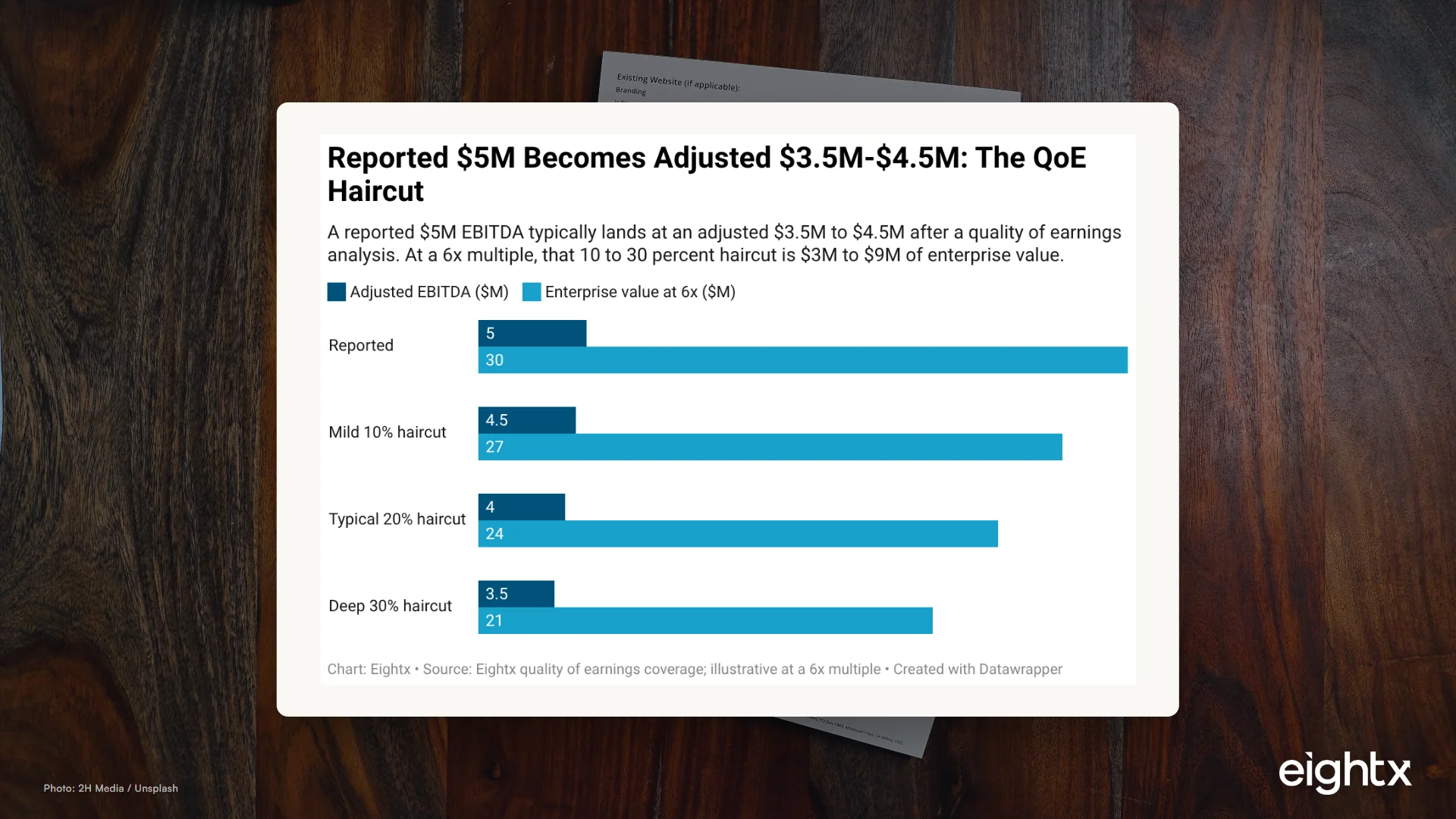
The pattern is consistent. Reported EBITDA almost never survives a quality of earnings analysis (QoE) intact. The typical adjustment is a 10 to 30 percent reduction, with the market-central band closer to 10 to 25 percent and anything past 30 percent read by buyers as aggressive. So a reported $5M becomes an adjusted $3.5M to $4.5M, and the buyer values off the adjusted number. At a 6x multiple, that swing is $3M to $9M of enterprise value.
When I talk to founders running a brand this size, the reflex is to chase a higher reported number in the final months. That is exactly backwards. The QoE team finds aggressive accounting faster than sellers expect, and the moment the books look engineered, every other number gets a harder look. The work below is about protecting that adjusted range before someone else decides it for you. It is also worth knowing the prize you are protecting: clean financials are what move a brand from the bottom of its multiple band toward the top.
| Revenue band | Metric | Typical multiple range |
|---|---|---|
| $0.5M to $1M | SDE | 2.5x to 3.5x |
| $1M to $3M | SDE / EBITDA | 3.0x to 4.5x |
| $3M to $10M | EBITDA | 3.5x to 6.0x |
| $10M to $50M | EBITDA | 4.5x to 8.0x |
The gaps that actually surface
Across ecommerce diligence, the same financial gaps come up over and over. The chart below ranks them by how often they appear in our engagements. Read it as a directional ranking, not a survey.
Notice that none of these are exotic. They are all blocking-and-tackling items that compound when ignored. The top two, weak add-back documentation and cash-basis books, are also the two that are fully in your control before you ever go to market. When I talk to founders this size, the pattern we see again and again is that the brand is genuinely good and the books are the only thing standing between them and a clean process.
Switch to accrual and close fast
If you are still on cash basis, or running incomplete accruals, fix that first. Buyers and their lenders generally require GAAP-compliant accrual financials, because cash-basis books cannot tell you what a given month actually earned. As the team at Plante Moran puts it for sell-side prep, diligence teams expect to drill to monthly accrual detail at minimum.
The way this shows up in the data is subtle but consistent. The first thing operators notice when they review cash-basis books is gross margin that swings month to month for no real reason, usually because spend and the revenue it produced landed in different periods. Ad spend is the classic offender. The accounting standards are clear that you recognize the expense when you spend it. You cannot inventory ad spend and apply it against the revenue it eventually drives, and a buyer will unwind any attempt to.
Then close every month, fast and the same way each time. My target for a diligence-ready brand is a close in under 10 days. That is comfortably inside best practice: in a Trintech survey of finance teams, 71 percent close their books in one to six days. A 45-day close, a chart of accounts that changed mid-year, or a messy trial balance all read as risk to a buyer even when the underlying business is fine. The reason we want monthly books, analyzed every month, is not bureaucracy. It is that consistency is the signal a buyer is buying.
Normalize the P&L and document every add-back
Every seller has a list of "one-time" expenses they want added back to EBITDA, and the bridge from reported to adjusted is where most of the negotiation happens. The discipline that separates a clean add-back schedule from a disputed one is simple: if you are pushing adjustments through over a handful of months, you have to normalize them very clearly and document each one internally, somewhere a QoE team can follow the trail. When you have backup, you win those line items. When you do not, the buyer strikes the add-back and you lose the value plus a little trust on top.
The math is unforgiving. A $50K adjustment at a 4x multiple is $200K of valuation, and at 6x it is $300K. Buyers also watch total adjustments as a percentage of EBITDA as a red-flag metric, so a bridge stacked with thin add-backs invites scrutiny on all of them. The table below is how the common ecommerce add-backs tend to land.
| Add-back | Buyer treatment | Why |
|---|---|---|
| Owner compensation above market | Usually accepted | Documented and replaceable with a market hire |
| Resolved one-time legal settlement | Accepted with backup | Invoices and a clear non-recurring rationale |
| Personal expenses run through the business | Accepted if documented | Must tie to receipts and be truly non-operating |
| "Non-recurring" marketing test or influencer campaign | Often struck | Buyers assume you will spend it again |
| Recent 3PL or Amazon fee step-up framed as one-time | Often recast | Structural cost change normalized to steady state |
| Speculative run-rate savings not yet executed | Struck on sell-side | Treated as buyer-side, not seller-side |
If you run an add-back-heavy structure, expect to defend the bigger items at the seller's discretionary earnings (SDE) level rather than strict bottom line, and to do that for the most recent two years at least, where it matters most.
Fix working capital before it costs you
Normalized net working capital (NWC) quietly kills more ecommerce deals than any other line. Inventory-heavy brands routinely overstate working capital by 20 to 40 percent, and the difference comes out of the purchase price dollar for dollar at close.
The traps are specific: inventory valued above what it will actually sell for, a holiday build that inflates the November balance versus a March one, and prepaid inventory deposits that tie up cash the buyer inherits. There is a quieter version too. When inventory on hand is higher than what the books show, COGS looks artificially low and margins look favorable, which feels great until a QoE team revalues the stock and the favorable margin evaporates. Smart buyers normalize to a trailing-twelve-month average and true up the final NWC statement 60 to 90 days post-close, so you want to manage to that average well before you go to market: tighten aged stock, document your deposits, and smooth the seasonal swings. This is the same working capital discipline a buyer scrutinizes in the data room.
The deal-killer is almost never a number that is too low. It is a number nobody can trace back to source on demand. Clean monthly books, a documented add-back schedule, and a normalized working capital peg are what turn "let me check" into "let's close." That is the whole job between now and your LOI.
Build the channel and cohort story, then do the work
A consolidated P&L hides the truth a buyer is paying for. A brand doing $20M can look healthy until you split it by channel and find Amazon running near breakeven, subsidized by DTC margin. The pattern we see again and again is exactly that: Amazon is the less profitable channel, and the blended number papers over it. Produce profitability by channel and cohort: revenue and contribution margin by channel, repeat purchase rate by acquisition cohort, and LTV to CAC by channel rather than blended. This is the detail buyers dig into, and it ties directly to how ecommerce brands are valued. When you can show which growth is profitable, you control the narrative instead of defending it.
All of this funnels into a short list of documents a buyer opens with. If these are ready and reconcile to source, you are most of the way there.
| Document | Why buyers open with it |
|---|---|
| Clean trial balance | Signals whether the books survive a QoE at all |
| 24 to 36 months monthly P&L on accrual basis | The QoE validation window |
| EBITDA add-back schedule with backup | Tests the bridge from reported to adjusted EBITDA |
| Inventory aging report | Surfaces overstated working capital and dead stock |
| Trailing-12-month working capital roll-forward | Sets the NWC peg buyers true up at close |
| Channel and cohort profitability | Separates durable profit from subsidized channels |
Here is the sequence, in order, starting 6 to 12 months before you go to market.
- Convert to accrual accounting if you are not already, and rebuild any incomplete accruals for bonuses, returns, sales tax, and payroll.
- Get the monthly close under 10 days and lock the chart of accounts so periods are comparable across the trailing 24 to 36 months.
- Build the EBITDA add-back schedule line by line, with a receipt or memo behind every single adjustment. If you cannot document it, do not claim it.
- Normalize working capital to a trailing-twelve-month average: clear aged inventory, document prepaid deposits, and stop letting working capital drift.
- Produce channel and cohort profitability so contribution margin by channel and repeat behavior by cohort are ready, not reconstructed under deadline.
- Reconcile everything to source so any number ties to the general ledger, bank statements, and your ecommerce platform on demand.
- Consider a seller-side QoE if you are at $5M-plus of EBITDA. It usually pays for itself by surfacing issues on your terms instead of the buyer's.
This is the core of what our interim CFO team does in the year before a sale, and it sits inside the broader roadmap for how to increase your exit multiple.
Sources and methodology
Benchmarks are drawn from Eightx ecommerce M&A diligence engagements and published guidance, cross-checked against external practitioner and advisory sources. The 10 to 30 percent EBITDA adjustment range and the 24 to 36 month validation window come from our quality of earnings coverage; the market-central view of roughly 10 to 25 percent, with anything past 30 percent read as aggressive, is consistent with QoE practitioner sources including Guardian Due Diligence, Bonadio, and Auxo Capital Advisors.
Working capital overstatement, the first-48-hours request list, and the channel-mix examples come from our ecommerce due diligence checklist. Sell-side best practice on monthly accrual financials, documented add-backs, and reconciliation to source data is consistent with Plante Moran's sell-side diligence guidance.
The full sell-side financial due diligence timeline of 60 to 90 days is confirmed by BPM. The 30 to 40 percent reduction in that timeline from clean books and a prepared data room is an Eightx engagement estimate, not a third-party measurement, and should be read that way. The close-speed figure, 71 percent of teams closing in one to six days, is from a Trintech survey of finance professionals; treat it as supporting color for the "under 10 days is normal" target rather than a precise current benchmark.
The reported-versus-adjusted EBITDA chart is illustrative, modeling a 10 to 30 percent haircut on a $5M base at a 6x multiple. The gap-frequency chart and its percentages reflect how often each item appears in Eightx engagements rather than a formal survey, and should be read as a directional ranking. The valuation-multiple ranges synthesize advisory sources (FE International, CT Acquisitions, Phoenix Strategy, ClearlyAcquired, 2025 to 2026) and are applied to the adjusted number, which is the entire point of this checklist.
Frequently Asked Questions
how do i prepare my financials for due diligence?
Start 6 to 12 months out. Switch to accrual accounting, close every month in under 10 days, build a documented EBITDA add-back schedule with receipts, normalize working capital to a trailing-twelve-month average, and produce channel and cohort profitability. The goal is that every number traces back to source data fast.
how far in advance should i get my books ready to sell?
Minimum 6 to 12 months for the financial work, and ideally 12 to 24 months for the full picture including tax structure and contracts. Conservative monthly accounting over time beats sale-time clean-up, which buyers spot quickly and discount for.
what is the most common financial gap that surfaces in due diligence?
Undocumented or aggressive EBITDA add-backs. Every seller has a list of one-time expenses they want added back, but the quality of earnings team rejects the ones without backup. Each disputed add-back moves valuation by the amount times the multiple.
do i need accrual accounting to sell my business?
Effectively yes. Buyers and their financing sources generally require GAAP-compliant accrual financials. Cash-basis books are one of the most common reasons a deal slows down or a buyer demands a discount, because they cannot trust the period-by-period numbers.
why does reported ebitda shrink during diligence?
A quality of earnings team normalizes for under-accruals, owner compensation, non-recurring items, inventory write-downs, and working capital. Reported EBITDA of $5M typically becomes adjusted EBITDA of $3.5M to $4.5M, a 10 to 30 percent reduction, and the buyer values off the adjusted number.
what is a quality of earnings analysis and how long does it take?
It is the independent accounting deep-dive a buyer commissions in diligence. The team validates 24 to 36 months of financials, normalizes EBITDA, and produces the adjusted EBITDA the buyer is willing to value off. For ecommerce it typically takes 3 to 4 weeks, inside a full sell-side process of 60 to 90 days.
how do buyers treat inventory and working capital when i sell?
They normalize net working capital to a trailing-twelve-month average and peg the deal to it, then true up the final number 60 to 90 days after close. Overstated inventory comes out of the purchase price dollar for dollar, so aged stock and seasonal swings cost you cash directly.
should i pay for my own sell-side quality of earnings report?
If you are at roughly $5M or more of EBITDA, usually yes. A seller-side QoE surfaces the issues on your terms, before a buyer's team finds them and uses them to re-trade the price, and it usually pays for itself in the multiple you protect.