
Tax Strategy
EU VAT for ecom in 2026: the 10,000 EUR OSS and 150 EUR IOSS rules every cross-border seller is still getting wrong
EU DTC VAT compliance turns on two numbers: the 10,000 EUR Union-wide OSS threshold that pushes place of supply to the customer's member state, and the 150 EUR IOSS cap below which sellers charge VAT at checkout. The 150 EUR customs-duty exemption disappears 1 July 2026, replaced by a transitional 3 EUR flat duty per item.
Key Takeaways
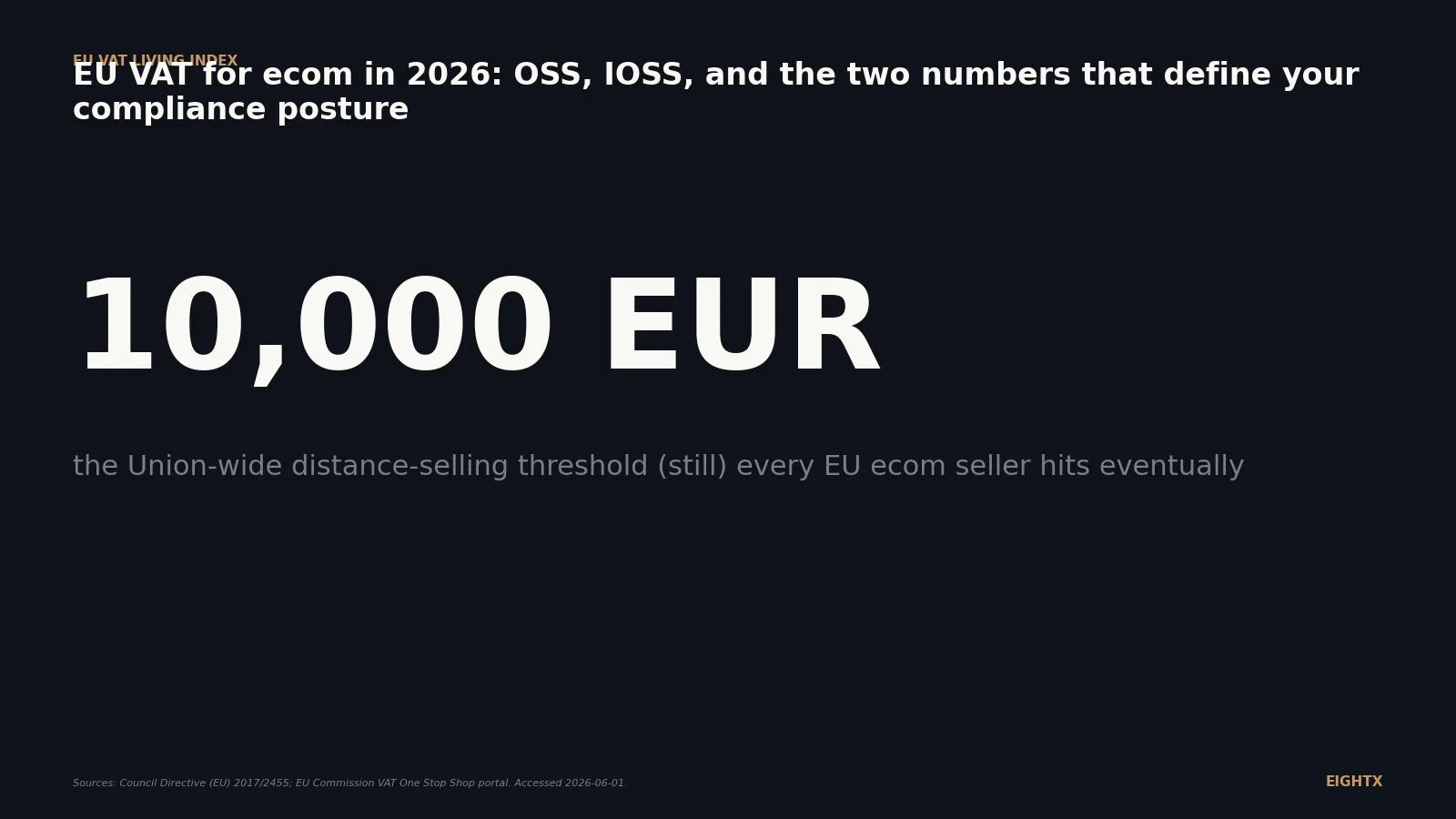
- The 10,000 EUR Union-wide distance-selling threshold is unchanged in 2026. Combined cross-border B2C sales above that level push the place of supply to the customer's Member State. Below it, you can keep charging home-country VAT (codified in Council Directive (EU) 2017/2455).
- The 150 EUR IOSS consignment cap also stays in 2026, but the matching customs-duty exemption disappears on 1 July 2026. A transitional flat 3 EUR customs duty per customs-line item replaces it until the full Customs Reform goes live around 1 March 2028.
- Compliance cost spread is structural, not platform-driven. Passport Global benchmarks the 2026 range at roughly 5,000 EUR for IOSS-only, 5k to 20k EUR for an EU-established mid-market DTC using OSS, and over 215,000 EUR for full 27-country individual VAT registrations.
- Three traps void the 10k threshold even at low revenue: storing stock in more than one EU Member State (pan-EU FBA), being established outside the EU, or selling excise goods. Any of these forces local VAT registrations and OSS from the first euro.
- ViDA was adopted on 11 March 2025, in force from 14 April 2025. Single VAT Registration and platform deemed-supplier rules go live 1 July 2028. Most operator-facing summaries still citing a 1 January 2026 effective date are reading earlier draft compromises that the final adopted text superseded.
If you sell into the EU as a DTC brand, your entire VAT compliance posture turns on two numbers: 10,000 EUR and 150 EUR. The first sets when you have to start charging VAT at destination-country rates instead of your home-country rate. The second draws the line between simplified Import One Stop Shop reporting and full customs entry. Both numbers were set between 2017 and 2021. Both are now actively eroding: the 150 EUR customs-duty exemption disappears on 1 July 2026, and the 150 EUR IOSS VAT cap is scheduled for removal around 1 March 2028 as part of the EU Customs Reform plus ViDA package.
This post is the living reference. We update it when the 3 EUR transitional duty kicks in, when Member State transposition reports land in 2027, and again when the full Customs Reform goes live in 2028.
What OSS and IOSS actually are (and why 10k and 150 are the only two numbers most operators need to know in 2026)
The EU's ecommerce VAT regime has two pieces.
OSS (One Stop Shop) is the simplified VAT return you file in your own Member State to cover cross-border B2C sales of goods and digital services to consumers in any other Member State. Union OSS lets an EU-established seller file one quarterly return instead of registering separately in every destination country. The 10,000 EUR threshold is the trigger: combined cross-border sales above that level in a calendar year flip the place of supply from your home country to the destination country, and you either use OSS or register locally in each destination state.
IOSS (Import One Stop Shop) covers B2C imports of goods from outside the EU at or below 150 EUR intrinsic value. The seller (or marketplace) charges VAT at checkout, files a monthly IOSS return through an EU-established intermediary, and the parcel clears customs without VAT being collected at the border. Above 150 EUR intrinsic value, IOSS does not apply and the parcel goes through standard import procedures.
The visual context for why this matters: 78% of EU internet users bought online in 2025, up from 62% in 2015. The penetration is what makes the OSS / IOSS volume sensitive. A growing share of cross-border parcels means more compliance load per percentage point of cross-border share, not less.
The headline penetration number understates the practical pressure on cross-border sellers. Once a non-trivial share of those buyers shop outside their home country, your low-volume nuisance VAT exposure scales fast.
The 10,000 EUR distance-selling threshold: who it applies to, who it does not, and the three traps that void it
The 10k threshold is generous on paper. In practice, three structural conditions void it instantly.
Trap 1: stock in more than one EU Member State. The moment you hold inventory in a second EU country, you need a local VAT registration in that country for domestic supplies, regardless of cross-border sales volume. Pan-EU FBA is the classic example. A Shopify brand that adds a Dutch 3PL to shorten transit times has just signed up for an NL VAT registration. The 10k threshold no longer protects you.
Trap 2: established outside the EU. If your company is not established in the EU, the 10k threshold does not apply at all. You need either IOSS (for parcels at or below 150 EUR) or local registrations from the first euro of sale.
Trap 3: excise goods. Harmonised excise goods (alcohol, tobacco, energy products) are excluded from OSS. If you sell into the EU in any of those categories, you need a local VAT registration in each destination Member State from sale 1, no matter how small your volume.
Your situation EU B2C sales below 10k EUR EU B2C sales above 10k EUR EU-established, single country of stock, no excise Charge home-country VAT; OSS optional Charge destination-country VAT; use Union OSS or register locally in each destination EU-established, stock in multiple EU countries Local VAT registration required in each stock country from sale 1; OSS optional for cross-border Local VAT in each stock country plus Union OSS for cross-border B2C Non-EU established, shipping direct to EU consumers 10k threshold does not apply; use IOSS (at or below 150 EUR) or local registrations / appoint intermediary Same. 10k threshold does not apply; IOSS for at or below 150 EUR imports, normal VAT for larger Selling harmonised excise goods (alcohol, tobacco, energy products) Local VAT registration required in each destination from sale 1; OSS does not cover excise Same
If any of trap 1, 2, or 3 applies to you, the operator question is not "should I register OSS." It is "which Member States do I need local registrations in, and is OSS the right wrapper around them."
The 150 EUR IOSS rule in 2026, and what changes on 1 July 2026
The 150 EUR IOSS intrinsic-value cap is still in force throughout 2026. Below it, you can use IOSS to charge VAT at checkout and clear customs simply. Above it, the parcel goes through standard customs entry and import VAT is collected at the border (or under deferment, depending on the importer of record setup).
What changes on 1 July 2026 is the customs-duty side, not the VAT side. The 150 EUR customs-duty de minimis under Council Regulation (EC) No 1186/2009 (the EU's customs duty relief regime) is repealed. In its place, a transitional flat 3 EUR customs duty applies per customs-line item with intrinsic value at or below 150 EUR. Note that "per customs-line item" is doing real work here and sources differ on whether it means per HS code, per piece, or per declaration line; model the worst case for low-AOV bundles until your customs broker confirms how the relevant Member State will process it. Finnish Customs and several other national administrations have published 1 July 2026 implementation notes. The Council political agreement landed 13 November 2025; final adoption 11 February 2026.
Practically, this means a 75 EUR DTC parcel arriving in the EU from a non-EU seller after 1 July 2026 will carry: VAT (collected at checkout via IOSS as before) plus a 3 EUR transitional duty. For a 30 EUR parcel, the 3 EUR is 10% of intrinsic value. For a high-frequency low-AOV brand, that is margin pressure that has to be modelled, not absorbed by accident.
The transitional 3 EUR per customs-line item runs until the full Customs Reform goes live around 1 March 2028, at which point the IOSS 150 EUR cap is also removed and marketplaces become deemed importers liable for both VAT and customs.
What it costs: Passport Global's 2026 spread from 5,000 to 215,000+ EUR
Compliance cost is structural, not platform-driven. Shopify or BigCommerce or WooCommerce do not move this number. The cost is registrations, intermediaries, advisors, and internal ops time.
Structural choice Use case First-year cost (EUR) Ongoing burden Home-country VAT only EU-based, sub-10k cross-border ~1,500 to 3,000 Low (one VAT return) IOSS-only Non-EU brand, B2C imports at or below 150 EUR 5,000 to 10,000 Medium (monthly IOSS, 10-year records, intermediary fee) EU entity plus Union OSS EU mid-market DTC, one stock country, above 10k 5,000 to 20,000 Medium (quarterly OSS plus home VAT) Multi-country local VAT (all 27 states) Large brand with pan-EU stock 215,000+ Very high (27 local filings plus audit exposure)
The gap between 20,000 EUR and 215,000+ EUR is not a function of how big your brand is in revenue terms. It is a function of how many Member States you hold stock in. A 50M EUR brand selling cross-border from one Polish warehouse pays under 20k EUR a year. A 30M EUR brand on pan-EU FBA pays multiples of that. Warehouse footprint is the cost driver. Treat the 3PL decision as a tax decision, not a logistics one.
What ViDA changes in 2028 (Single VAT Registration and platform deemed supplier)
The VAT in the Digital Age package was formally adopted by the Council on 11 March 2025 and entered into force on 14 April 2025. Most operator-facing summaries that still cite a 1 January 2026 effective date for ViDA's substantive rules are reading earlier draft compromises that the final adopted text superseded. Nothing operational changes for you in 2026 because of ViDA. The 2026 change is the customs-duty piece on 1 July.
What changes in 2028:
Single VAT Registration goes live 1 July 2028. This extends OSS scope so that EU-established sellers can avoid local VAT registrations in Member States where they hold stock, by handling the whole bundle through one OSS return. If you have local registrations today because of warehouses in NL, FR, and DE, this is the rule that lets you collapse them.
Platform deemed-supplier rules go live 1 July 2028 for short-term accommodation and road passenger transport. Member States may defer platform rules to 1 January 2030.
The 150 EUR IOSS cap is removed around 1 March 2028 under the Customs Reform package. IOSS will extend to all B2C imports regardless of value, marketplaces become deemed importers liable for both VAT and customs.
If you are planning a 2027 EU expansion, build the structural assumptions around the 2028 Single VAT Registration rules. Do not commit to multi-country local registrations that you will unwind in 18 months.
The two numbers that define EU VAT for ecom in 2026 are 10,000 EUR and 150 EUR. The first determines whether you charge home VAT or destination VAT. The second determines whether IOSS or standard customs entry applies. Both are eroding. Plan your 2026 structure for the rules in force today and your 2027 to 2028 structure for the Single VAT Registration world.
The CFO read: structural decision framework for 2026
Three branches.
Branch A: EU-established, sub-10k EUR cross-border, single country of stock, no excise. Charge home-country VAT, no OSS, keep your records clean. First-year cost roughly 1,500 to 3,000 EUR. If you expect to breach 10k mid-year, register OSS proactively to avoid the mid-quarter switch.
Branch B: EU-established, above 10k EUR cross-border, single country of stock. Use Union OSS. Quarterly filings cover all cross-border B2C in goods and digital services. First-year cost 5,000 to 20,000 EUR. Plan around the 2028 Single VAT Registration go-live before committing to additional warehouse locations.
Branch C: pan-EU stock, or non-EU seller. Local VAT registrations in every stock country plus Union OSS for cross-border (if EU-established), or IOSS via an EU-established intermediary plus local registrations where applicable (if non-EU). First-year cost 20,000 EUR to 215,000+ EUR depending on Member State count. Model the 1 July 2026 3 EUR per-item duty into your low-AOV DTC unit economics and plan the 2028 unwind of redundant local registrations as part of your 2027 budget cycle.
In every case, the warehouse footprint is the structural decision. The 3PL choice is a tax choice. Get that right and OSS or IOSS reporting is mechanical paperwork. Get it wrong and you carry a 200k+ EUR per year compliance load you did not have to take on.
The pattern we see most on founder calls: a DTC brand adds a Dutch 3PL for faster Benelux transit, ships from NL stock to NL customers for six months, then discovers at year-end that those NL-to-NL supplies are domestic Dutch sales requiring an NL VAT registration that nobody filed. The OSS return was clean because it only covers cross-border. The domestic piece was invisible. Remediation usually lands in five-figure territory once back-filed returns, penalties, and interest are stacked. Catch this on the way in, not at year-end audit.
What we are watching
Three signals between now and mid-2027.
First, 1 July 2026 implementation reality. The 3 EUR transitional duty has to be operationally applied by 27 national customs administrations. Expect early carrier confusion, particularly in postal channels, in July and August 2026. We will update the table above with the first six weeks of operational data once Finnish Customs, the Dutch Tax Authority, and the German BZSt publish enforcement notes.
Second, Member State transposition status for ViDA. The package is adopted at EU level. National implementing legislation has to follow before 1 July 2028. We will check transposition progress quarterly through 2027.
Third, the EU Customs Data Hub timeline. The Data Hub is the technical infrastructure that has to be in place before the full Customs Reform goes live around 1 March 2028. If the Data Hub slips, the IOSS 150 EUR cap removal and the platform-deemed-importer rules slip with it.
For the macro side of EU DTC unit economics in 2026, see our ECB rate versus EU DTC cost of capital and the Fed funds versus DTC cost of capital tracker. For ongoing structural advice on cross-border tax decisions, see our interim CFO services.
Sources and methodology
This post is the synthesis of EU Commission primary materials and authoritative specialist sources, cross-referenced. The triangulation bundle draws on Pinecone (4 queries, 16 unique segments from Eightx founder calls 2023 to 2026), Perplexity (5 queries covering OSS, IOSS, ViDA, cost benchmarks, and the 2028 reform), and Parallel.ai deep research (1 query, processor base, run id trun_6bebc15578ef4c38bac511b1557dd010).
Primary EU sources. Council Directive (EU) 2017/2455 codifies the 10,000 EUR Union-wide distance-selling threshold (https://eur-lex.europa.eu/eli/dir/2017/2455/oj/eng). The VAT Implementing Regulation (EU) 282/2011 consolidated text covers the operational mechanics of OSS and IOSS (https://eur-lex.europa.eu/eli/reg_impl/2011/282/2022-07-01/eng). The EU VAT One Stop Shop portal (https://vat-one-stop-shop.ec.europa.eu/index_en) is the canonical operator-facing reference. The ViDA Commission page (https://taxation-customs.ec.europa.eu/taxation/vat/vat-digital-age-vida_en) and the EU Customs Reform page (https://taxation-customs.ec.europa.eu/customs/eu-customs-reform_en) cover the 2025 to 2028 reform package.
Eurostat penetration data. Chart 1 uses the Eurostat "E-commerce statistics for individuals" series (https://ec.europa.eu/eurostat/statistics-explained/index.php?title=E-commerce_statistics_for_individuals). The 2025 value (78% of EU internet users buying online) is the latest published headline. The cross-border series under code isoc_ec_ibgs was reviewed; we ship the headline single series here.
Cost benchmarks. The structural cost spread in chart 2 and table 2 comes from Passport Global's 2026 EU VAT compliance benchmark (https://passportglobal.com/blog/eu-vat-compliance-what-ecommerce-brands-need-to-know-for-b2c-imports/). The cost bands are reported as first-year compliance cost including registrations, intermediary fees, advisor fees, and internal ops time. Passport Global's methodology aggregates client data across DTC and B2C importers; treat the bands as well-supported estimates, not audited line items.
2026-07-01 customs-duty mechanics. The 3 EUR transitional flat duty is sourced from Finnish Customs (Tulli) announcement (https://tulli.fi/en/-/starting-july-1-2026-customs-duties-must-also-be-paid-on-shipments-arriving-from-outside-the-eu-with-a-value-of-up-to-150-euros), the FedEx LAC 2026 customs changes guide, and specialist commentary from Grant Thornton NL, Alvarez and Marsal, and VATCalc. Sources differ slightly on whether "per customs-line item" means per HS code, per piece, or per declaration. We have flagged the ambiguity in the body.
Limitations. The Parallel.ai run noted it could not surface the specific Commission Impact Assessment attached to the ViDA legislative proposal. Numerical estimates of cross-border seller participation in OSS / IOSS from the IA would strengthen this post; we plan to pull them in the next refresh.
Update cadence. This is a living-index post. Refresh targets: (1) 1 July 2026 (3 EUR duty operational reality versus regulation), (2) Q3 2027 (Member State transposition status check), (3) 1 March 2028 (full Customs Reform go-live).
Frequently asked questions
what is the eu vat 10000 euro threshold and when does it kick in?
The 10,000 EUR threshold is the Union-wide distance-selling threshold codified in Council Directive (EU) 2017/2455. It applies to your combined cross-border B2C sales of goods plus telecommunications, broadcasting and electronic services to consumers in all EU Member States, in a calendar year. The sale that breaches the threshold flips the place of supply from your home country to the destination country, and from that sale onward you either register VAT in every destination state or use Union OSS.
is the oss optional if i am under 10000 euros of cross-border eu sales?
Yes, if you are EU-established, hold stock in only one Member State, and do not sell excise goods, you can keep charging home-country VAT and skip OSS until you breach the 10k threshold. Some operators register OSS proactively anyway so they do not have to switch mid-year. If you store stock outside your home country or operate from outside the EU, the threshold does not protect you.
do i still need ioss if i sell from outside the eu in 2026?
IOSS is still optional in 2026 for low-value imports at or below 150 EUR intrinsic value, but skipping it usually pushes VAT collection to the carrier or the consumer at delivery, which kills conversion and adds chargebacks. Most non-EU DTC brands use IOSS via an EU-established intermediary. The 150 EUR cap stays for 2026, and the customs-duty side decouples on 1 July 2026 (see next question).
what is actually changing on 1 july 2026 for low-value parcels into the eu?
The 150 EUR customs-duty de minimis under Council Regulation (EC) No 1186/2009 (the EU's customs duty relief regime) is repealed. From 1 July 2026, a transitional flat 3 EUR customs duty per customs-line item applies to any parcel under 150 EUR intrinsic value. VAT mechanics through IOSS are unchanged. The 3 EUR is a customs-duty piece on top, not a VAT change.
is the 150 euro ioss cap going away in 2028?
Yes. The 150 EUR IOSS cap removal sits in the EU Customs Reform package (finalised 11 February 2026), not in ViDA. Under Customs Reform, the cap goes around 1 March 2028: IOSS extends to all B2C imports regardless of value, marketplaces become deemed importers liable for both VAT and customs, and the transitional 3 EUR flat-rate duty ends once the EU Customs Data Hub goes live for ecommerce. Single VAT Registration on 1 July 2028 is the separate ViDA track.
does shopify handle eu vat for me or do i still need an accountant?
Shopify's built-in tax engine handles the calculation and invoice-side mechanics at no incremental fee. It does not file your OSS or IOSS returns, register you in destination Member States, or appoint an IOSS intermediary if you are non-EU. The calculation layer is the easy 5% of the work. Registrations, filings, and structural decisions still sit with you and your tax advisor.
how much does eu vat compliance actually cost for a 5 to 20 million dollar dtc brand?
Passport Global's 2026 benchmarks land most EU-established mid-market DTC brands in the 5,000 to 20,000 EUR first-year range (roughly $5,400 to $22,000 USD) using home VAT plus Union OSS. Non-EU brands using IOSS-only sit around 5,000 EUR plus the intermediary fee. The big jump is to multi-country local registrations, which Passport Global benchmarks at over 215,000 EUR first-year for a brand holding stock across all 27 Member States.
do i need to register for vat in every country where i hold inventory?
Yes. OSS does not replace local VAT registrations where you hold stock. A seller using Union OSS for cross-border B2C reporting still needs a local VAT number in every Member State where inventory is stored, to handle domestic supplies from that stock. This is the most common compliance gap we see in Shopify DTC brands going pan-EU on 3PL footprints (a Dutch warehouse is a Dutch registration).