
Financial Strategy
ECB rate vs EU DTC cost of capital, June 2026: the 200 bps cut, the 50 bps you actually feel
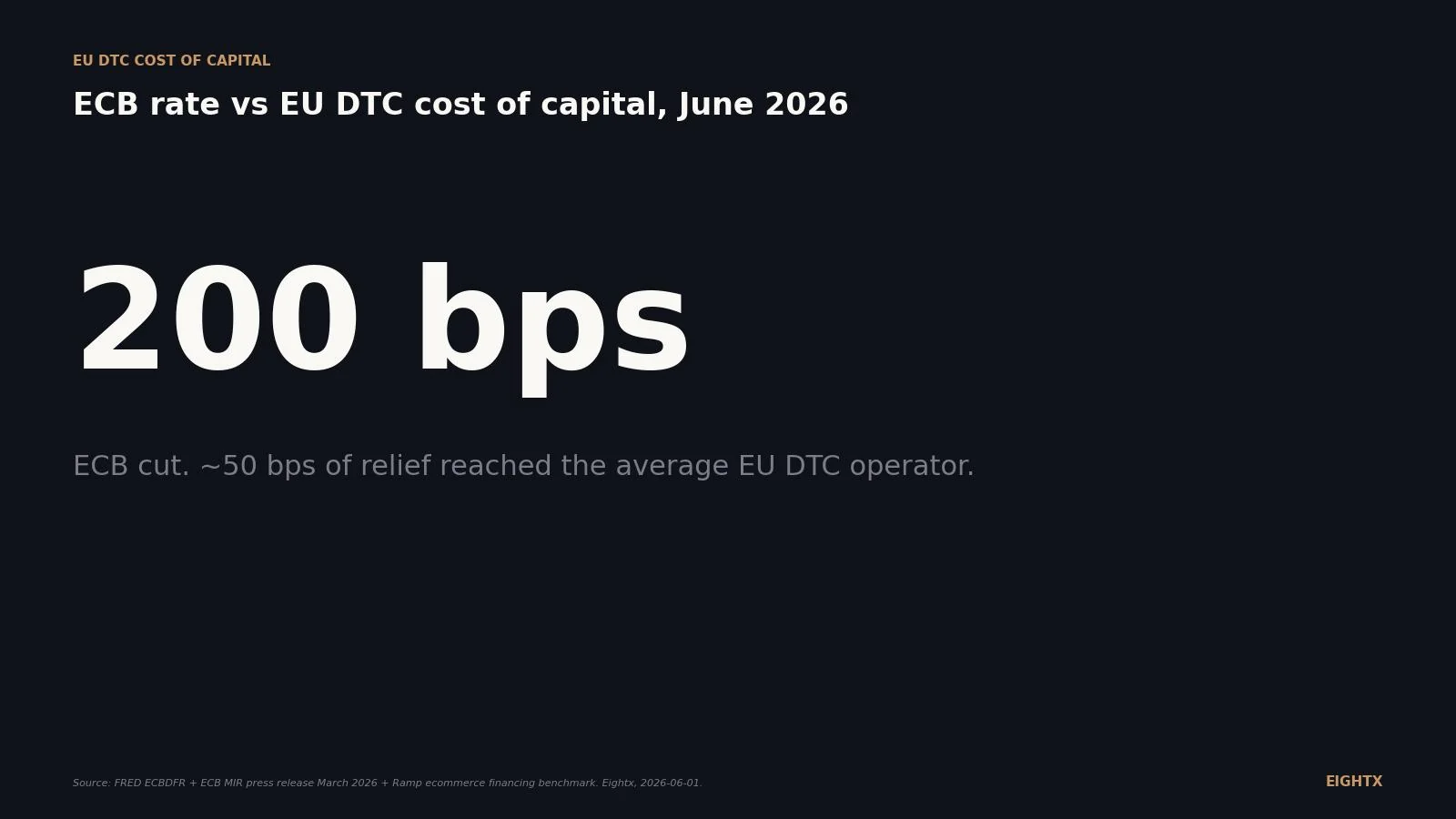
The ECB cut the deposit facility rate 200 basis points to 2.00% by June 2025 and has held there for 12 months, but EU DTC blended cost of capital fell only about 50 basis points. Bank SME loans still price 3.5 to 3.75%, RBF stays at 20 to 40% equivalent APR, and the ECB SAFE Q1 2026 survey shows a net 26% of firms reporting tighter loan conditions. The cheap leg already happened.
Key Takeaways
- The ECB deposit facility rate is 2.00% as of June 1, 2026, down 200 basis points from the 4.00% peak (mid-2023 to June 2024) and held flat for 12 months since June 11, 2025. Major analysts call this the ECB's neutral stance through 2026.
- Pass-through to euro-area SME bank loans is only about 125 basis points. The ECB MIR press release for March 2026 puts new bank loans to non-financial corporations (loans up to EUR 1 million) at roughly 3.5 to 3.75 percent. Cheaper than 2024, still about 150 bps above the 2019 average.
- Non-bank working-capital instruments barely moved. Revenue-based financing is still 20 to 40 percent equivalent APR. Merchant cash advances are 40 to 150 percent. Klarna monthly financing is 0 to 35.99 percent consumer-side. Policy rate is a misleading anchor.
- Blended EU DTC cost of capital fell only about 50 basis points. If you weight a typical mid-tier brand's mix across bank lines, RBF, and BNPL fees, you get roughly a quarter of the policy-rate move. The cheap leg already happened.
- Do not wait for more cuts. The ECB SAFE Q1 2026 survey shows a net 26% of firms report tightening loan rates even at a 2% policy rate. Reprice your 2023 bank line now, audit your blended cost across instruments, and push your RBF lender for a renegotiation since their funding cost dropped.
The European Central Bank cut the deposit facility rate from a 4.00% peak (held from September 2023 through May 2024) to 2.00% by June 2025 and has held there for 12 months. That is 200 basis points of policy easing. The blended cost of capital for a typical EU DTC operator has fallen only about 50 basis points over the same window, because bank pass-through has been partial and lagged and non-bank instruments (RBF, BNPL fees, lines of credit, merchant cash advances) barely moved. This matters for any brand renegotiating financing in 2026, because the cheap leg of this cycle already happened and the spread leg is structurally stickier than it was in 2019. What to watch next: the June and September 2026 ECB meetings, the next SAFE survey release, and whether HICP inflation settles back below 2.5%.
What the ECB has actually done with rates since June 2024
The deposit facility rate (the rate banks earn on overnight deposits at the ECB, and the de facto policy floor) peaked at 4.00% from September 2023 through May 2024. The ECB then cut to 3.75% in June 2024, to 3.50% in September, to 3.25% in October, to 3.00% in December, then a faster cadence through the first half of 2025: 2.75% in February, 2.50% in March, 2.25% in April, 2.00% in June 2025. Since June 11, 2025 the deposit rate has been held at 2.00%.
The main refinancing operations rate (MRO, the rate at which the ECB lends to banks against collateral on a weekly basis) tracks the deposit rate at a spread that the ECB narrowed in September 2024: 50 bps above the deposit rate at the peak (4.50% vs 4.00%) and 15 bps above it today (2.15% vs 2.00%). The MRO peaked at 4.50% (September 2023 through June 2024) and now sits at 2.15% as of May 2026. Net 235 basis points of MRO cuts across the easing cycle.
Euro-area HICP inflation collapsed from a 10.62% peak in October 2022 to a 1.94% reading in December 2025. April 2026 printed at 3.00% on energy base effects. The pause at 2.00% is no longer inflation-forced. DNB, SocGen, and Morningstar all read it as the ECB's neutral stance through 2026, with cuts possible only on a clear demand shock.
The per-month detail behind the chart is in the table below.
Month Deposit rate % MRO rate % HICP YoY % 2024-06 3.75 4.25 2.50 2024-09 3.50 3.65 1.73 2024-12 3.00 3.15 2.43 2025-03 2.50 2.65 2.17 2025-06 2.00 2.15 1.96 2025-09 2.00 2.15 2.22 2025-12 2.00 2.15 1.93 2026-03 2.00 2.15 2.53 2026-04 2.00 2.15 3.00 2026-05 2.00 2.15 n/a
Why your borrowing costs didn't fall the same amount
Pass-through from the ECB policy rate into actual SME borrowing costs is partial and lagged. Three structural reasons.
First, the bank credit spread for euro-area SMEs widened materially during the 2022 to 2023 tightening cycle and has not narrowed back. The ECB MIR press release for March 2026 puts the rate on new euro-area MFI loans to non-financial corporations up to EUR 1 million at roughly 3.5 to 3.75 percent. That is about 150 bps above the 2019 pre-pandemic average even though the policy rate now sits where it was in mid-2022. Banks are repricing wider for the same policy rate.
Second, the ECB SAFE survey for Q1 2026 (38th round) shows a net 26% of euro-area firms report tightening bank loan interest rates over the previous three months. That is at a 2.00% policy rate. Access-to-finance perceptions across the SME base are getting worse on net even though the headline rate has dropped 200 bps in a year. SocGen's read in their euro-area weekly is that lending rates will stay "persistently high" relative to policy and will keep pressuring the ECB to cut further later in 2026.
Third, non-bank working-capital channels are not policy-rate-sensitive in any clean way. Revenue-based financing in euro-area DTC is still 20 to 40 percent equivalent APR. Merchant cash advances are 40 to 150 percent. Online short-term loans are 10 to 30 percent. These price off underwriting risk and lender funding cost, not the ECB rate. Klarna's wholesale funding (for example the $26B Nelnet forward-flow deal disclosed by Fintech Futures) is not publicly priced and the merchant-side cost is embedded in discount fees, not a quotable APR.
The DTC cost-of-capital ladder in June 2026
If you map out the actual instruments a EUR 1M to EUR 50M DTC operator can access, the rate fan looks like this.
Facility APR (low) APR (high) Practical use ECB deposit facility rate 2.00% 2.00% Policy floor (not available to you) EU bank loan to NFC up to EUR 1M 3.5% 3.75% Term loans, working-capital lines (best collateral) Long-term bank loan (SME) 7% 15% Equipment, fit-out, long-tenor inventory Business line of credit 10% 25% Revolving working capital, AP buffering Short-term online lender 10% 30% Inventory pre-orders, ad-spend bridges Klarna monthly financing 0% 35.99% Consumer-side; merchant pays a discount fee Revenue-based financing 20% 40% Growth ad spend, inventory; no equity dilution Merchant cash advance 40% 150% Last resort; avoid unless desperate
The takeaway: ECB at 2.00% does not mean 2.00% for you. Even the cheapest channel a healthy DTC brand can practically access (the EU bank loan band) sits at 3.5 percent or higher. The instruments most operators actually use day to day (lines of credit, online lenders, RBF) sit between 10 and 40 percent. A clean policy-rate read leads to the wrong financing decision.
What the ECB SAFE Q1 2026 survey says about access to finance
The Survey on the Access to Finance of Enterprises (SAFE) is the ECB's quarterly read on what euro-area firms are actually experiencing on the borrowing side. The 38th round, released in Q1 2026, has two signals that matter for ecommerce operators.
The first is the +26 net percent of firms reporting tightening bank loan interest rates. That is, more firms saw rates go up over the previous three months than down, on net, even though the policy rate was unchanged and the year-on-year comparison is well below the 2023 peak. This is the structural-spread story showing up in survey data.
The second is the weakness in equity finance availability. European Series A funding has compressed to roughly $8 to $12 million on average per round, against $15 to $20 million in the US (Mean.ceo Global Startup Funding 2026). DTC pure-plays are harder to fund as equity stories in 2026 than in 2024. That pushes more brands toward debt and RBF, which then encounters the same spread-widening story. The funnel collapses.
For ecommerce operators, the practical read: assume the cost of marginal capital for DTC pure-plays in the EU is mid-teens or higher on a blended basis. Even if your headline bank line repriced to 6 percent, the ad-spend dollar you need in Q3 is more likely funded out of an RBF or BNPL channel that prices much higher.
Three moves we are telling EU DTC operators to make this quarter
Reprice your 2023-vintage bank lines now. If your existing line or term loan was originated in 2023, the bank set the spread off a 4%+ policy rate and a higher credit-risk environment. Both have moved. Ask for a fresh quote against today's MIR series. If your effective rate is more than 200 bps above 3.5%, push for a renegotiation or take the offer to a competitor bank. The lender's cost of funds has dropped; you should capture some of that.
Audit your blended cost of capital across every instrument. Weight each capital source (bank line, term loan, RBF, BNPL fees if you treat them as financing, supplier early-pay discounts) by the principal it is funding, then take the weighted average APR. Most EU DTC operators we work with discover their real blended rate is 10 to 14 percent, not the 3.5 to 7 percent their bank line implies. Make decisions off the blended number, not the cheapest single instrument.
Renegotiate your RBF deal. Revenue-based financiers funded themselves with capital that was meaningfully more expensive in 2023. Their cost of funds has dropped. Their pricing has not, in most cases, dropped to match. Push for a 200 to 400 bps reduction on your next tranche, or threaten to walk to a competitor. Most RBF books in 2026 are competing harder for deal flow than in 2023, and the lender does not want to lose a current customer.
The ECB cut 200 basis points. The EU bank channel passed through roughly 125. The blended EU DTC channel passed through roughly 50. The headline number is the worst guide to your financing strategy you can use, because it is the only number that fell by the full amount. Plan to your blended cost, not the policy rate.
For more on how this interacts with broader DTC unit economics right now, see our global DTC cost-of-capital benchmarks and the US comparator on Fed funds vs DTC cost of capital. For the customer-acquisition side of the EU picture, our average EU ecommerce CAC by country, 2026 walks the country splits.
Sources and methodology
FRED time series. Three primary series were pulled from FRED on 2026-06-01: ECBDFR (ECB Deposit Facility Rate, daily, monthly end-of-period aggregation), ECBMRRFR (ECB Main Refinancing Operations Rate, Fixed Rate Tenders, daily, monthly EOP), and CP0000EZ19M086NEST (Eurostat HICP Total, Euro Area 19, year-over-year percent change). All three series mirror official ECB and Eurostat releases.
ECB MIR (bank interest rate statistics). The euro-area aggregate rate on new MFI loans to non-financial corporations (loans up to EUR 1 million, "MIR A2I new business") was taken from the ECB press release "Euro area bank interest rate statistics: March 2026" dated 6 May 2026. The ECB does not publish a single euro-area aggregate point for this series on FRED; we cite the ECB press-release central tendency at roughly 3.5 to 3.75 percent.
ECB SAFE survey. The Survey on the Access to Finance of Enterprises 38th round (Q1 2026) was published by the ECB in Q2 2026. The net 26 percent figure for firms reporting tightening loan interest rates is the published summary indicator.
Non-bank working-capital APR bands. Ramp's 2026 ecommerce financing benchmark provides the APR ranges for revenue-based financing, merchant cash advances, online short-term loans, and bank lines of credit. These bands are US-centric but operator-relevant in the EU because most of the same lenders (or near-clones) operate cross-Atlantic. Klarna consumer financing rates (0 percent on Pay-in-4 and Pay-in-30, 0 to 35.99 percent on monthly financing) come from NerdWallet's 2026 Klarna review.
DTC blended estimate. The "blended EU DTC cost of capital" basis-point change in the third chart is modeled, not measured. We synthesized it by weighting the bank, RBF, and BNPL-fee channels against an indicative mix for a EUR 5M to EUR 20M DTC operator (roughly 50% bank, 30% RBF or short-term lender, 20% BNPL discount fees). The result is meant to illustrate the spread between policy-rate moves and operator-experienced moves, not to be a precise industry benchmark.
Limitations. FRED does not host a euro-area aggregate MIR series for "new loans to NFCs up to EUR 1M"; the central-tendency figure from the ECB press release was used. No primary-source DTC-specific working-capital APR benchmark exists for the EU; the Ramp bands are the closest available proxy. Klarna's wholesale funding cost is not publicly disclosed and merchant-equivalent APR is not published.
Update cadence. This tracker is refreshed quarterly when the ECB MIR press release and the SAFE survey land together. Next update target: September 2026 after the Q2 SAFE release.
Frequently asked questions
is the ecb done cutting rates in 2026 or are more cuts coming?
Probably done for now. The deposit facility rate has been held at 2.00% for 12 consecutive months since June 11, 2025, and the major euro-area sell-side notes (DNB, SocGen, Morningstar) call this the neutral stance through 2026. Inflation rebounding to 3.0% in April 2026 makes a near-term cut harder, not easier. Plan as if 2.00% is the floor through year-end.
why hasn't my bank line repriced even though the ecb cut 200 bps?
Three reasons. Existing fixed-rate lines do not reprice automatically. Variable lines tied to Euribor reprice but with a spread that banks widened during the 2022 to 2023 tightening and have not given back. And bank credit risk premia for SMEs are structurally wider than 2019. Call your relationship manager and ask for a fresh quote against today's MIR series. If the gap to ECB MIR (about 3.5% for loans up to EUR 1M) is more than 200 bps, you are overpaying.
what's the actual interest rate on a euro-area sme loan right now?
Around 3.5 to 3.75 percent for new bank loans to non-financial corporations under EUR 1 million, per the ECB MIR press release for March 2026. That is the cheapest SME bank money since mid-2022 but still around 150 basis points above the 2019 average. Larger loans price slightly lower, longer tenors slightly higher.
how should i think about klarna as working capital for my dtc brand?
Do not think of it as working capital. Klarna is a sales-channel cost. Consumer Pay-in-4 and Pay-in-30 are 0% APR to the shopper, and the merchant pays a discount fee similar to a card-network fee. Monthly financing options price 0 to 35.99% APR consumer-side, but again, that is the shopper's APR, not yours. If you are running BNPL to boost AOV, model it as a marketing cost (the discount fee) plus a return-rate impact, not as a sub-2% capital source because policy rates are low.
is revenue-based financing still worth it at a 2% ecb rate?
Sometimes, but the math is tighter now. RBF still prices 20 to 40 percent equivalent APR for euro-area DTC. That made sense when bank lines were 8 to 12 percent and equity was scarce. With bank SME loans at 3.5 to 7 percent for well-collateralised brands, the bank path is materially cheaper if you can qualify. Use RBF for the marginal ad-spend bridge you cannot get a bank to fund, not as your primary working-capital line.
should i refinance my 2023 bank loan now or wait for more ecb cuts?
Refinance now. The 200 bps of ECB cuts has already mostly passed into bank pricing. The forward path implied by Euribor and the consensus sell-side view is roughly flat through 2026. Waiting buys you maybe 25 to 50 bps of optionality against a real risk that the SAFE survey trend (tightening loan rates at a 2% policy rate) bites you next quarter. Lock in the structure now.
what does the ecb safe survey say about access to finance for ecommerce in 2026?
The Q1 2026 round (the 38th) shows a net 26% of euro-area firms report tightening bank loan interest rates, and a net negative read on access to bank finance overall. Even at a 2% policy rate, more firms see borrowing getting harder than easier. That is the leading indicator. The headline policy-rate number is misleading by itself.
how do i calculate my real blended cost of capital across bank + rbf + bnpl?
Weight each instrument by the principal it is funding in your business, then take the weighted average APR. A worked example: a EUR 5M brand with a EUR 500K bank line at 7%, a EUR 200K RBF advance at 30% equivalent APR, and BNPL discount fees adding the equivalent of EUR 100K per year against a EUR 1M BNPL volume runs a blended rate around 11 to 12 percent on that EUR 800K of capital. The ECB at 2% is irrelevant to your decision. Your blended rate is.
what's the cheapest source of working capital for a 5m euro shopify brand?
In rank order for most EU DTC brands at EUR 5M revenue: a secured bank line of credit (3.5 to 10 percent if you can qualify), then a long-term bank term loan (7 to 15 percent), then a short-term online lender or RBF (20 to 40 percent), then merchant cash advance (40 to 150 percent, avoid unless desperate). The qualifying constraint is usually collateral and revenue history, not rate.