
M&A
How Ecommerce Brands Are Valued (Multiples Explained) 2026
Ecommerce brands are valued on a multiple of profit, not revenue. Small owner-run brands sell at about 2.5x to 3.5x SDE, scaled brands at 4x to 10x EBITDA, and only high-growth brands get a revenue multiple. Size, growth, margin, channel mix and concentration move the number.
Key Takeaways
- Brands under $5M in revenue sell on 2.5x to 3.5x SDE; brands above $10M sell on EBITDA, climbing from about 3.5x to 5.5x at $5M to $15M up to 6x to 10x or more above $30M.
- BizBuySell's median earnings multiple for Websites and Ecommerce businesses was 3.43x through Q4 2025: the small-brand reality check under all the advisor ranges.
- Revenue multiples (roughly 1x to 2x sales) only apply to genuinely high-growth brands, and even then the buyer is still pricing future profit.
- Same DTC label, very different worth: public comps run from Warby Parker near breakeven to FIGS at about 6% operating margin. Buyers price the profit, not the label.
- Concentration is the silent multiple killer: one customer or channel above 25% to 30% of revenue can cut 1 to 3 turns off the price.
Every founder I work with eventually asks the same question: what is my brand actually worth? The honest answer is that ecommerce brands are valued on a multiple of profit, almost never on revenue. The two things that change are which profit number the buyer uses, and how many turns of that number they are willing to pay.
Get those two things wrong and you walk into a sale anchored to a revenue multiple you read in a headline, then watch a buyer reprice you to a fraction of it. This is the real mechanics: SDE for small brands, EBITDA as you scale, revenue multiples only for genuine high growth, and the five levers that move the number. If you want the moves that lift the number before you sell, see our guide to increase your exit multiple; this post is the valuation math underneath it.
The three valuation methods, and when each applies
There are three multiple bases in ecommerce M&A, and which one a buyer uses is mostly a function of your size and how dependent the business is on you.
SDE (sellers discretionary earnings) is used for small, owner-operated brands, generally under $5M in revenue. SDE takes net income and adds back the owner's full salary, personal expenses run through the business, interest, depreciation and amortization. The logic: a new owner will not replicate the seller's exact comp and perks, so the buyer normalizes earnings to what the business throws off before owner choices. Across the small owner-run deals our team and peer firms advise on, the typical band lands at 2.5x to 3.5x SDE.
EBITDA takes over once you are a real business with a management team, generally above $10M in revenue. EBITDA strips interest, taxes, depreciation and amortization out of profit so two brands with different debt loads and tax addresses can be compared on the same operating line. Mid-market DTC brands trade at roughly 4x to 8x adjusted EBITDA, and the buyer is paying for the operating engine, not your inherited capital structure. Worth saying plainly: the EBITDA multiple is a shortcut, not how the most sophisticated buyers actually think. The pattern we see again and again is that once you cross about $10M, a PE buyer is really running a present value of future cash flows. They arrive at a number, then back into the multiple. The multiple is the output, not the model.
Revenue multiples are the exception, not the rule. They apply only to genuinely high-growth brands, usually in a venture or strategic context where profit is being deliberately reinvested into growth. As I tell founders: you would not get a revenue-based valuation unless you are raising venture capital, and even then they are still looking at profitability. A revenue multiple offered to a slow-growth brand is usually a polite way of saying the profit is not there.
The $5M to $10M revenue zone is the messy middle. Whether a buyer uses SDE or EBITDA there depends entirely on how much the business still runs on the founder. Build a team and you move to EBITDA, which is almost always the higher-value basis. We break down exactly which earnings basis a buyer applies to you and why the switch matters for your number.
What the multiples actually look like by size in 2026
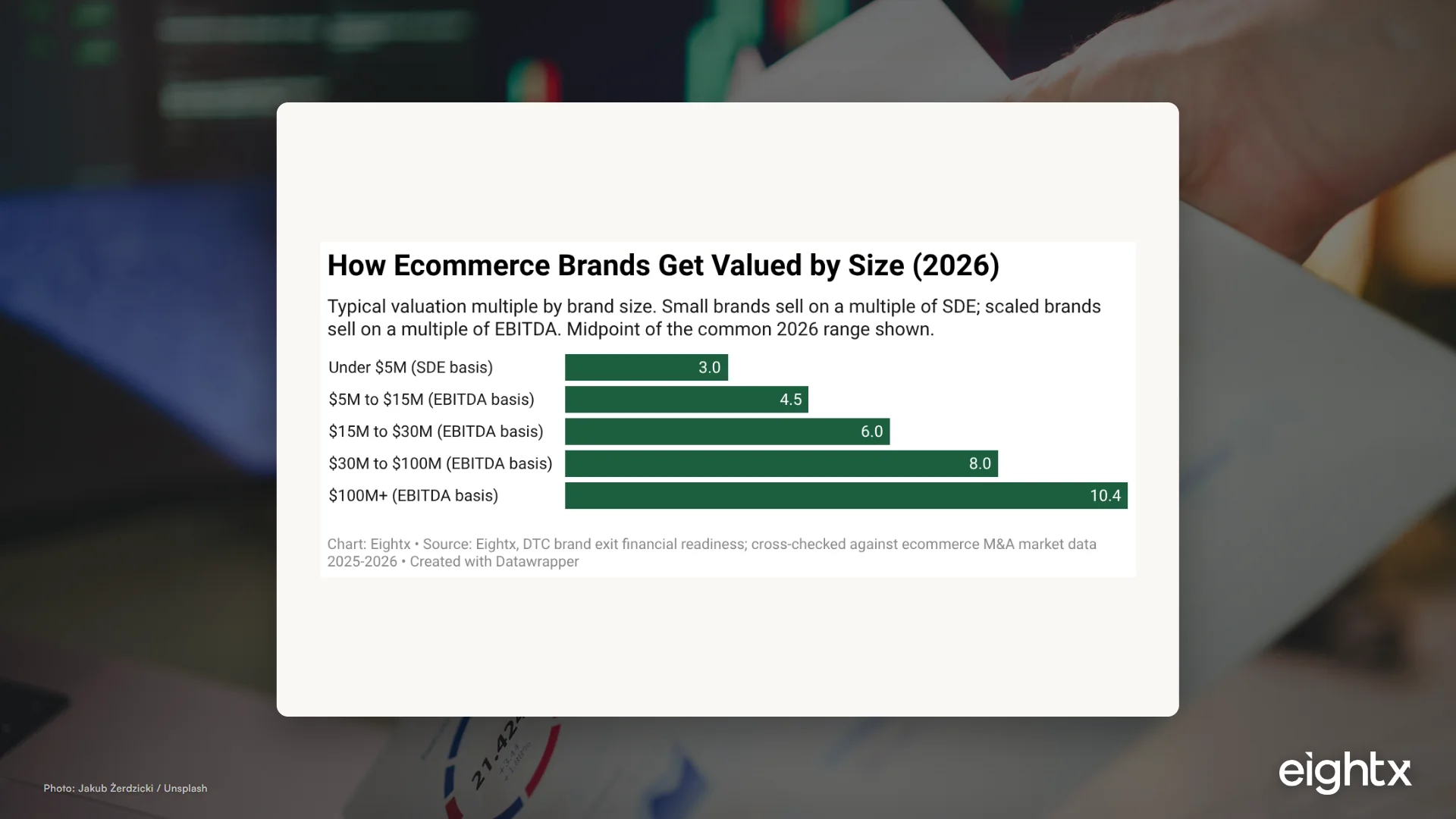
Here is the size-by-multiple picture for 2026. The pattern is consistent: bigger brands get more turns, and the basis shifts from SDE to EBITDA as you scale.
The full range, by revenue band:
| Revenue range | Typical multiple | What gets you to the top | What keeps you at the bottom |
|---|---|---|---|
| Under $5M | 2.5x to 3.5x SDE | Subscription revenue, niche dominance, 40%+ growth | Owner-operator model, single channel, flat growth |
| $5M to $15M | 3.5x to 5.5x EBITDA | Channel diversification, 25%+ repeat rate, clean books | Amazon dependency, declining margins, no team |
| $15M to $30M | 4.5x to 7.5x EBITDA | Category leadership, strategic fit, brand defensibility | Customer concentration, slowing growth |
| $30M to $100M | 6x to 10x+ EBITDA | PE competition, health and wellness premium, platform potential | Margin compression, key-person risk |
These bands line up with the hard public data at the small end. BizBuySell's median earnings multiple for "Websites and Ecommerce" businesses was 3.43x through Q4 2025. That is a real marketplace median across actual closed deals, not an advisor estimate, and it sits right inside the under-$5M band above. Treat it as the reality check: half of small ecommerce businesses sell below 3.43x, and you have to earn your way past it.
These bands also line up with the broader market direction. Larger ecommerce deals cleared roughly 10x EBITDA in 2025, with strategic buyers driving the volume (per the deal evidence in our ecommerce sale data room guide and independent reporting from Capstone Partners). The general direction in 2026 is steady but compressing: the consumer and retail mid-market band is drifting from about 8x to 12x in 2025 to roughly 7x to 10x, a 10% to 15% squeeze driven by CAC pressure and softer consumer spend. Profitable, clean, diversified brands hold their multiples; everyone else gets repriced.
Same "DTC" label, very different worth
The word "DTC" tells a buyer almost nothing about what your brand is worth. To see why, look at three public DTC brands from their most recent SEC filings. Same label, wildly different profitability.
| Brand | Revenue | Revenue growth YoY | Gross margin | Operating margin | Net margin |
|---|---|---|---|---|---|
| e.l.f. Beauty | $1.64B | n/a (acq-distorted) | 70.7% | 4.5% | 1.6% |
| Warby Parker | $872M | 13.0% | 54.0% | -0.6% | -6.4% |
| FIGS | $631M | 13.6% | 66.5% | 6.0% | 7.9% |
Three brands, all "DTC," all between $631M and $1.64B in revenue, all growing. But Warby Parker is still roughly breakeven at the operating line, e.l.f. runs a 70.7% gross margin with a slim operating margin, and FIGS converts a 66.5% gross margin into a real 6% operating margin and a 7.9% net margin. A buyer is not paying for the "DTC" label or even the revenue. They are paying for the profit underneath it, and these three would price very differently per dollar of sales. These are billion-dollar public companies, not exit comps for a brand your size, so read them for the profit-versus-label point they make, not as multiples you would be offered.
This is exactly why margin is the spine of the category hierarchy. When I talk to founders weighing beauty against apparel, the math is brutal and simple: with beauty you can run 70% to 85% gross margin, and apparel, by the time you have done wholesale, is at 50% at best. The brand with the higher margin has more money to market with than anyone else in the category, which compounds into stickier revenue and a higher multiple. That is why beauty and personal care clears roughly 8x to 11x EV/EBITDA, supplements sit around 6x to 9x, and apparel lands nearer 5x to 8x. Apparel is a structurally hard game. I have watched operators flame out on it firsthand.
What moves the number
The size band sets the range. Five levers decide where inside that range you land, and they can stack.
Size. Bigger is simply worth more per turn. A larger brand has more durable systems, less key-person risk and a deeper pool of buyers, including PE firms that cannot deploy capital into small deals. That competition alone lifts the multiple.
Growth rate. This is the lever that reaches across bands. Revenue velocity changes the multiple a buyer pays on profit. When we model this with founders, the rule of thumb that holds up is roughly 20% EBITDA margin with 40% year-on-year growth in the right category, which is where 8x to 10x lives. A brand at 20% EBITDA growing 40% in a hot category can pull 8x to 10x where a flat brand at the same size gets 5x. As I tell founders: hold a double-digit EBITDA margin while you keep revenue growing, and you give a buyer something to pay up for. For a growing brand, buyers are pricing next year, not last year. The reason velocity matters is payback: high-velocity revenue at healthy margins means the buyer's payback period is shorter, and they will pay more turns for that.
Margin profile. EBITDA margin above 20% commands a premium; below 10% makes buyers nervous unless you are very large. Do not let margin slide below 10% heading into a sale. The reason beauty and wellness clear the top of the range is structural gross margin, which protects EBITDA.
Channel mix. Diversified beats concentrated. A brand that is 90% Amazon is, in a buyer's eyes, renting its customer base from a platform that can change the rules. A healthy DTC and wholesale and marketplace blend, with owned customer data, is worth materially more turns than the same profit trapped on one channel.
Concentration. This is the silent killer. One customer or one channel above 25% to 30% of revenue is a risk a buyer prices directly into the multiple, often cutting 1 to 3 turns. Stacked concentration and growth problems can move a $20M deal to $10M. Diversify before you sell, not during diligence.
What to do about it
If you want a defensible multiple instead of a hopeful one, here is the work, in order.
- Know which basis applies to you. If you are under $5M and run the business yourself, you are an SDE deal. Build a team and cross $10M and you become an EBITDA deal, which is the higher-value basis. Do not pitch a revenue multiple unless you can actually defend high growth.
- Normalize your earnings now. Clean up the add-backs, stop running personal expenses through the business, and build a defensible SDE or adjusted EBITDA bridge a buyer's quality-of-earnings team can verify. When we have struggled with this on the sell side, the fix that worked was cleaning up the books early enough to know your real gross margin before a buyer's diligence team finds it for you. Surprises in the data room cost turns.
- Protect margin while you grow. Do not buy growth by destroying EBITDA. Hold margin in the 10 to 15%+ range and let growth do the work on the multiple.
- Break your concentration, and watch your inventory. Get any single customer or channel under 25 to 30% of revenue. And free up the cash a buyer would otherwise discount: the pattern we see is brands sitting on around 250 days of inventory when 90 to 120 days would do, with a cash conversion cycle that buries liquidity. Tightening that is often the single highest-return pre-sale project there is.
- Start 18 months out. The levers above take time to move, and the difference between preparing well ahead and scrambling once a buyer is at the table is often the difference between the floor and the premium of your band.
For the levers in depth, see our companion piece on the specific moves to increase your exit multiple.
Methodology
The SDE and EBITDA bands by revenue range reflect the deals our team and peer firms advise on across $5M to $150M ecommerce, DTC and CPG brands, and are cross-checked against the published advisor ranges below. The 4x to 8x mid-market DTC EBITDA range and the SDE-versus-EBITDA threshold are consistent with the same advisor synthesis.
The hardest small-brand anchor in this post is BizBuySell's median earnings multiple of 3.43x for "Websites and Ecommerce" businesses through Q4 2025, a marketplace median across closed deals rather than an advisor estimate. The advisor ranges that frame the rest of the bands are synthesized from published 2025-2026 ecommerce valuation guidance (Windsor Drake, QuantPillar, Virtue CPAs, EcomSwap, CT Acquisitions, Clearly Acquired), which disagree at the edges; the bands shown are central estimates, not single authoritative figures.
The public-comp table and operating-margin chart are pulled from US SEC EDGAR annual report filings for Warby Parker, e.l.f. Beauty and FIGS, using each company's most recent annual filing (FY ending December 2025 or March 2026). Margins are as reported, not adjusted. These are public companies, not exit comps, so they illustrate what the market pays for profit versus the lack of it, not private-deal multiples. EBITDA was not available in the XBRL facts for the three filers, so no EV/EBITDA is asserted from SEC data. e.l.f.'s reported revenue growth reflects an acquisition-distorted comparison period and is omitted rather than presented as organic.
The 2025 larger-deal figure of roughly 10x EBITDA and the strategic-buyer volume trend come from our ecommerce sale data room guide and are corroborated by Capstone Partners' April 2026 E-Commerce Sector Update, which independently reports strategics driving ecommerce dealmaking and 2025 activity up. The consumer and retail compression figure (about 10% to 15% from 2025 into 2026) and the category hierarchy bands are advisor and broker synthesis, labeled as approximate ranges rather than deal-disclosed data.
Figures are typical midpoints and ranges, not guarantees; every brand is priced on its own growth, margin, channel mix and concentration. These are directional benchmarks, not a substitute for a buyer-side quality-of-earnings analysis.
Frequently Asked Questions
how are ecommerce brands valued?
On a multiple of profit, not revenue. Small owner-run brands are valued at 2.5x to 3.5x sellers discretionary earnings (SDE). Once a brand passes about $10M in revenue with a real team, buyers switch to EBITDA, paying roughly 4x to 10x depending on size, growth, margin and channel mix. Only high-growth brands get a revenue multiple.
what is the difference between sde, ebitda and revenue multiples?
SDE adds the owner's full compensation and personal expenses back to profit and is used for sub-$5M owner-operated brands. EBITDA is used for $10M+ brands with a management team. A revenue multiple is applied only to high-growth brands where profit is being reinvested, and even then the buyer is pricing future profit.
what is the average multiple an ecommerce business sells for?
At the small end, BizBuySell's marketplace median for Websites and Ecommerce was 3.43x earnings through Q4 2025. That is a median, not a ceiling: scaled, diversified, profitable brands sell well above it on EBITDA, and a thin owner-run single-channel brand can sell below it.
what ebitda multiple do dtc brands sell for in 2026?
Mid-market DTC brands typically sell for 4x to 8x adjusted EBITDA in 2026. The band runs from about 3.5x to 5.5x at $5M to $15M revenue up to 6x to 10x or more above $30M. Beauty and wellness with strong margin and growth trade above the range; the broader consumer and retail band is compressing about 10% to 15% from 2025.
what moves an ecommerce valuation multiple up or down?
Five levers: size (bigger brands get higher multiples), growth rate (30% to 40%+ commands a premium), EBITDA margin (20%+ is premium), channel mix (diversified beats Amazon-only), and concentration (one customer or channel above 25% to 30% of revenue cuts the multiple).
why do beauty brands sell for higher multiples than apparel brands?
Margin and stickiness. Beauty can run 70% to 85% gross margin with high repeat purchase, so there is more money to market with and more durable revenue. Apparel carries fashion risk, heavy returns and inventory, and often 50% gross margin after wholesale. That is why beauty clears roughly 8x to 11x EV/EBITDA and apparel sits nearer 5x to 8x.
do ecommerce brands ever get valued on revenue?
Only genuinely high-growth brands get a revenue multiple, roughly 1x to 2x sales, and usually in a venture or strategic context. For everyone else a revenue multiple is a red flag that the brand is not yet profitable. Most ecommerce M&A is priced on SDE or EBITDA, not revenue.
at what revenue do buyers switch from sde to ebitda?
The switch usually happens between $5M and $10M in revenue. Under $5M, with a hands-on owner, buyers use SDE. Above $10M, with a real management team running the business, they use EBITDA. In the $5M to $10M zone it depends on how dependent the business is on the founder.