
Inventory
Inventory Write-Downs: When and How to Take Them (2026 CFO Guide)
An inventory write-down lowers the carrying value of stock to its net realizable value when that value drops below cost. US GAAP (ASC 330, lower of cost or net realizable value) makes it mandatory at each reporting date. The loss hits your P&L through COGS in the period you recognize it, and under US GAAP it cannot be reversed later.
Key Takeaways
- GAAP requires the write-down the moment net realizable value drops below cost. The median public DTC issuer wrote down 1.2% of revenue in FY2025.
- Plan 1 to 2% of revenue as an annual write-down budget. For a $50M brand that is roughly $500K to $1M every year, not a one-off.
- A write-down lowers the value of stock you still plan to sell. A write-off removes stock that has zero value. Write-downs are far more common.
- Under US GAAP the write-down is permanent. Once you mark it down, that lower number becomes the new cost basis and you cannot write it back up.
- A book write-down is generally not an automatic same-year tax deduction. The tax loss lands when the goods actually move. Confirm the treatment with your accountant.
Most founders I work with do not budget for inventory write-downs at all. They treat the markdown like weather: something that hits sometimes, that you deal with when it shows up. That is the wrong model. The discrete write-down tag in public DTC filings shows up almost every year for the brands that disclose it, and the typical write-down was about 1.2% of revenue in FY2025. For a $50M brand that is $500K to $1M of value you should expect to lose every year to obsolescence, season turn, and one accounting rule that does not care how you feel about it.
The rule is lower of cost or net realizable value, and it is not optional. Your auditor will not let you carry $100 jackets at $100 once the market clears them at $60. They force the markdown. The only real question is whether you take it on your terms, spread across the year, or whether it ambushes you as a single ugly adjustment in the year-end audit.
What an inventory write-down actually is
An inventory write-down lowers the carrying value of inventory on your balance sheet to match what you can realistically sell it for. That realistic number is net realizable value (NRV): the cash you would collect from selling the stock minus every cost to move it, including liquidation discounts, freight, platform fees, and return costs.
US GAAP requires the write-down whenever NRV drops below what you paid. The technical name is lower of cost or net realizable value, abbreviated LCNRV, codified in FASB ASC 330 (post-ASU 2015-11 for FIFO and average-cost inventory; LIFO and the retail method still use the older lower-of-cost-or-market test). The test runs at every reporting date, and the loss is recognized in the period the value drops, full stop.
Why does the auditor get to force it? Because the balance sheet has to tell the truth about what your stock is worth. When I talk to founders this size, the part that surprises them is how unsentimental that logic is. If you scrap a pallet because of a mistake or a count error, the auditor will not just take your word that it vanished. They assume you either sold it or lost it, and either way the books have to come down to match reality. The write-down is not a punishment, it is the books catching up to the market.
When you must take one
The trigger is mechanical: NRV below cost. In practice that shows up as a handful of recurring situations. Aged stock past its sell-through window. A category-wide price decline, where input prices fall and inventory you bought at peak now sits above market. Damaged, returned, or off-season goods. A product you over-ordered against demand that never showed up.
The leading indicator is almost always days of inventory. When we look at a brand carrying 250 days of stock, that is super, super high, and it is usually the first sign of a write-down forming. The healthy range for most DTC brands is something like three to four months at the outside, and getting back to that range frees up real cash. High days of inventory means slow sell-through, slow sell-through means aging, and aging is what eventually trips the NRV test. The pattern we see again and again starts upstream: all the extra cash flow goes into inventory, the operator quietly over-buys, and twelve months later the long tail of that buy is the exact stock the auditor marks down.
You do not get to wait for a buyer or a fundraise to force the issue. But that is exactly when the worst-case version happens. The minute a buyer's Quality of Earnings team starts diligence, they run the LCNRV calculation themselves, flag your aged inventory, and lower your EBITDA. Lower EBITDA means a lower valuation, directly. Taking the write-down early, on a clean quarterly cadence, removes that ammunition.
The P&L and tax impact
The write-down hits your P&L as an expense, almost always inside cost of goods sold. It compresses gross margin and net income in the period you recognize it. There is no way to capitalize it away or push it to next year once the NRV test fails.
On tax, the picture is more nuanced than founders expect, and this is where the existing advice online tends to oversell the benefit. US inventory is governed by IRC section 471, which requires a method that clearly reflects income. A GAAP write-down, which is really an obsolescence reserve, is generally not a standalone tax deduction in the period you book it. The tax loss is usually realized later, when the inventory is actually sold, disposed of, or destroyed. There are exceptions: smaller brands under the section 471(c) small-business threshold ($32M of three-year-average gross receipts for tax years beginning in 2026) that conform to their financial statements may be able to mirror the book write-down for tax. But the safe default is this: do not assume the full book write-down lands as a same-year tax shield. The timing and size of the adjustment is a real tax event, so confirm the treatment with your accountant before you model any cash benefit.
One more thing that surprises people: under US GAAP the write-down is permanent. Once you mark it down, that lower number becomes the new cost basis. If the value recovers, you cannot write it back up. KPMG is explicit that US GAAP write-downs to NRV are not reversed when values recover, except for foreign-exchange movements. IFRS allows limited reversals; US GAAP does not. Size it right the first time.
How write-downs differ from write-offs
These get used interchangeably and they are not the same thing.
| Dimension | Write-down | Write-off |
|---|---|---|
| What happens | Carrying value reduced to NRV | Inventory removed entirely |
| Do you keep the stock | Yes, you still plan to sell it | No, it has zero value |
| Typical cause | Aging, price decline, over-order | Destroyed, stolen, expired, donated |
| Frequency | Common, often annual | Rarer |
| Reversible (US GAAP) | No | No |
The distinction matters because the cash story is different. A write-down still leaves you sellable units at a discount, so the real exercise is recovery: liquidate now versus hold and carry. A write-off is pure loss. Most aging DTC inventory is a write-down problem, not a write-off problem, which is why your liquidation strategy matters more than your disposal logistics.
What the public cohort actually writes down
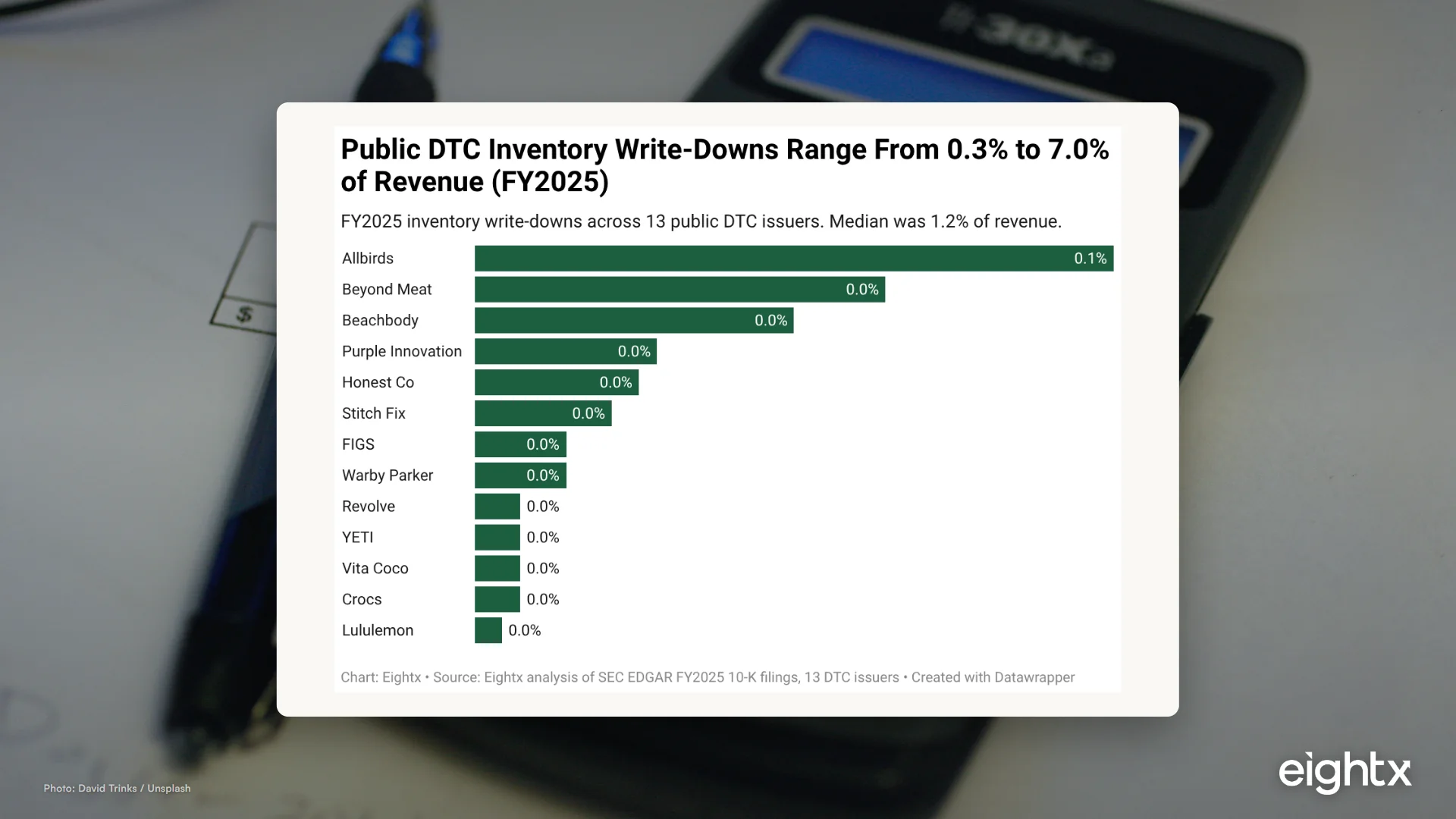
Here is the FY2025 benchmark across 13 public DTC issuers. The median was 1.2% of revenue, but the spread is brutal: a roughly 20x gap between the cleanest operator and the worst inside one cohort.
The high end tells the over-order story. Allbirds, Beyond Meat, Beachbody, and Purple Innovation were all working through a 2021 to 2022 over-order cycle against demand that never materialized. One important caveat on that chart: the Allbirds bar is an inventory-basis number. Pulled straight from SEC EDGAR, Allbirds' FY2025 discrete write-down was $2.75M, which is 7.1% of its year-end inventory ($38.875M) but only 1.8% of its $152.466M in revenue. So "7%" is the share of its stock it marked down, not the share of revenue. The disciplined end, Lululemon near 0.3% and Crocs, Vita Coco and YETI under 0.5%, shows what pricing power and tight SKU planning buy you. (Lululemon's discrete tag actually read $0 in FY2025 because it runs the provision through a COGS reserve, so its 0.3% is a proxy.)
The verified names are worth pulling out on their own, because the discrete XBRL tag is the cleanest evidence here.
| Brand | Ticker | FY2025 write-down | % of revenue | % of year-end inventory | Basis |
|---|---|---|---|---|---|
| Allbirds | BIRD | $2.75M | 1.8% | 7.1% | Direct XBRL tag |
| The Honest Company | HNST | $15.9M | 4.3% | 21.9% | Direct XBRL tag |
| Beyond Meat | BYND | $57.4M (FY2023; no FY24/25 tag) | n/a | n/a | Direct XBRL tag (FY2023) |
| Lululemon | LULU | $0 in discrete tag | ~0.3% (proxy) | n/a | Analytical proxy |
The most useful single exhibit, though, is The Honest Company. It reported $0 of inventory write-down in both FY2023 and FY2024, then booked $15.9M in FY2025: 21.9% of its year-end inventory in one shot.
That is the exact year-end ambush this post is about. Two years of nothing, then a 22%-of-inventory hit that no aging report would have hidden if anyone had been reading it monthly. When operators run a fire sale every month and call it inventory management, this is what it eventually looks like on an audited balance sheet: the reactive clearance never caught up, and the reserve catch-up arrived all at once.
What to do about it
- Budget for it. Put a line in your annual plan for 1 to 2% of revenue. Treat it as a known cost of doing business, not a surprise. If you have never modeled it, start at 1.2% and adjust to your category, using the bands below.
- Read the aging report monthly. Most year-end ambushes are aging reports nobody opened until the audit. We count inventory every month and do a full proper count at year-end, and that discipline once surfaced a $1M error that would otherwise have sat undetected until the audit. Age bands plus sell-through rate tell you what is going bad before the auditor does.
- Set a mechanical trigger. Tie the write-down to objective rules: stock past X days with sell-through below Y gets marked to its expected liquidation recovery. Mechanical beats negotiated every time.
- Take it quarterly. Book the reserve as the data moves, in four smaller recognitions, not one December lump. Smooth beats spiky for your margin line and your board's nerves.
- Run the hold-versus-liquidate math. Be honest about recovery. When a lender values aged DTC stock, the numbers are sobering: net orderly liquidation value can be around 57 cents on the dollar for branded goods and 49 cents for private label. A broker at 50 cents today usually beats a deteriorating position you mark down again next year, and an off-price retailer is a real channel for offloading stock that is not turning. Use a dead-stock clearing strategy to recover cash before the carry compounds.
- Fix the upstream cause. A high write-down rate is a forecasting and ordering problem. Rank your SKUs A, B, C and treat them differently: drop-ship the C's, hold maybe eight weeks of the B's and twelve of the A's. Holding inventory is one of the biggest reasons brands get into trouble, and over-ordering the long tail is what manufactures the write-down. Tightening your buy and improving turns, the same discipline that drives inventory days, is what moves you from the 3%+ club toward the sub-1% operators.
Your category sets the floor. Seasonal and trend-driven stock carries more write-down risk than evergreen hard goods, and the planning bands below reflect that.
| Category | Suggested write-down budget (% of revenue) | Why |
|---|---|---|
| Seasonal apparel / footwear / trend beauty | 1.5 to 2.0%+ | Can lose 30-60% of value once the season turns |
| Short-shelf-life CPG (food, supplements, actives) | 1.0 to 2.0% | Last 30-60 days of shelf life often unsellable through normal channels |
| Durable / evergreen hard goods | 0.5 to 1.0% | Low seasonal and fashion risk; top performers run 0.3 to 0.5% |
| Warning zone (any category) | >3% sustained | A forecasting and SKU-discipline problem, not category inevitability |
The write-down is not the disaster. The disaster is the over-order that created it and the year-end audit that surfaces it all at once. Budget 1 to 2% of revenue, read your aging report monthly, set a mechanical age-and-sell-through trigger, and recognize the reserve quarterly. Do that and the markdown arrives on your terms, sized by you, instead of as a 22%-of-inventory ambush in December or an EBITDA haircut in diligence.
Related reading. For the year-end count that surfaces the stock worth writing down, see the year-end inventory-count SOP.
Sources and methodology
The public-company figures are built on a direct SEC EDGAR XBRL pull, not a secondary summary. For the verifiable names we read the InventoryWriteDown company-concept tag, plus revenue and net inventory, straight from each issuer's filings. Allbirds (CIK 1653909) reported a FY2025 write-down of $2.75M on $152.466M of revenue and $38.875M of year-end inventory (10-K accn 0001628280-26-022192), and tagged a write-down in seven of its last eight fiscal years ($14.44M in FY2022, $8.25M in FY2023, $2.69M in FY2024). The Honest Company (CIK 1530979) reported $15.9M in FY2025 on $371.317M of revenue and $72.501M of year-end inventory after $0 in both FY2023 and FY2024 (accn 0001628280-26-011634).
Beyond Meat (CIK 1655210) tagged a write-down every year through FY2023, when it hit $57.4M, with no discrete FY2024 or FY2025 tag. That is why the chart's "Beyond Meat 4.5%" figure, and Lululemon's 0.3%, are analytical proxies rather than direct reads of the line: both companies either stopped tagging the discrete item or run the provision through a COGS reserve. The cohort benchmark of 13 DTC issuers, combined revenue near $23.5B, gives a FY2025 median of 1.2% of revenue and a range of 0.3% to 7.0%, with the high-end figures on an inventory basis where noted (most importantly Allbirds).
The accounting standard is ASC 330 lower of cost or net realizable value (post-ASU 2015-11) for FIFO and average-cost inventory; LIFO and the retail method use lower-of-cost-or-market. Under US GAAP, write-downs to NRV are permanent (ASC 330-10-35-14); IFRS (IAS 2) allows reversal. NRV is the estimated selling price in the ordinary course of business less the reasonably predictable costs of completion, disposal, and transportation. The treatment summary draws on KPMG's 2026 IFRS-versus-US-GAAP inventory guide.
On tax, IRC section 471 requires an inventory method that clearly reflects income (IRS Publication 538). A book write-down (an obsolescence reserve) is generally not deductible when booked; the loss is realized when the goods are sold, disposed of, or destroyed. Small businesses under the section 471(c) threshold ($32M of three-year-average gross receipts for tax years beginning in 2026, per Rev. Proc. 2025-32) that follow their financial statements may be able to mirror book treatment. Sources disagree on the permissive edge of this, so plan around the conservative reading and confirm with your own accountant. Carrying-cost and liquidation-recovery figures reflect Eightx DTC benchmarks: 20 to 30% blended annual carrying cost, and net orderly liquidation values in the high-40s to high-50s cents on the dollar for aged stock.
Frequently Asked Questions
when do you have to take an inventory write-down?
You have to take it the moment net realizable value, what you can sell the stock for after all costs to move it, drops below what you paid. Under US GAAP (ASC 330, lower of cost or net realizable value) this test is run at every reporting date, and the loss is recognized in that period. There is no option to defer it.
what is the difference between an inventory write-down and a write-off?
A write-down lowers the carrying value of inventory you still plan to sell, so it stays on the books at a lower number. A write-off removes inventory entirely because it has zero value: donated, destroyed, stolen, or expired beyond recovery. Write-downs are far more common; most aging stock still clears at a discount, not at zero.
how does an inventory write-down affect the p&l and taxes?
On the P&L the write-down lands as an expense inside cost of goods sold, so it cuts gross margin and net income in the period you take it. On tax it is messier: a book write-down is generally not a standalone deduction under IRC section 471. The tax loss usually lands when the goods are actually sold, disposed of, or destroyed, so do not assume a same-year cash shield.
is an inventory write-down tax deductible in the year i take it?
Usually not on its own. A GAAP obsolescence reserve is generally not deductible when you book it; the loss is realized for tax when the inventory actually moves. Small businesses under the section 471(c) threshold ($32M of three-year-average gross receipts for tax years beginning in 2026) that follow their financial statements may be able to mirror the book treatment. Confirm with your accountant before you model any tax benefit.
can you reverse an inventory write-down later?
Not under US GAAP. Once you write inventory down, that lower figure becomes the new cost basis. If the value later recovers, you do not write it back up. This is the opposite of IFRS, which does allow limited reversals. The permanence is exactly why you want the write-down sized correctly the first time, not padded or deferred.
how much should a dtc brand budget for inventory write-downs?
Plan 1 to 2% of revenue per year. The median public DTC issuer wrote down 1.2% of revenue in FY2025, with a cohort range from 0.3% to 7.0%. For a $50M brand that is roughly $500K to $1M annually. If you are consistently running above 3%, the problem is your forecasting and SKU discipline, not your category.
how do i avoid a surprise write-down at year-end?
Review inventory aging quarterly and book the reserve as the data tells you to, not in one December lump. Tie a write-down trigger to age bands and sell-through rate so the markdown is mechanical, not a negotiation with your auditor. A year-end ambush almost always means the aging report was not being read until the audit forced it.