
Fundraising
How to Negotiate a Term Sheet: A Founder's Guide to the Terms That Actually Matter
Valuation is the headline, not the deal. The terms that move your real outcome are liquidation preference (insist on 1x non-participating), the option pool and where it sits in the pre-money shuffle, board composition, pro-rata, anti-dilution and vesting. Negotiate economics and control, not just the number.
Key Takeaways
- A 1x participating preference can move about $7.5M from founders to investors on a $40M exit that looks identical on paper. 1x non-participating is the 2026 standard: Cooley's Q1 2026 report puts 96.4 percent of rounds non-participating and 98.2 percent at a 1x preference.
- A 15 percent pre-money option pool quietly cuts your effective pre-money to about 85 percent of the headline number. Negotiate the pool down and tie it to a real 18 to 24 month hiring plan.
- Carta's Q1 2025 median Series A dilution was 17.9 percent, down from about 20 percent, but structured terms now do the work markdowns used to. Read the structure, not just the percentage.
- Push hardest on liquidation preference, option pool size and board seats. Give on pro-rata and standard 4-year, 1-year-cliff vesting, which are reasonable and not worth burning capital over.
- Broad-based weighted-average anti-dilution is standard and fine. Full ratchet is a red flag that can wipe out common stock in a down round.
Every founder fixates on valuation. It is the number you tell your co-founder, the number that ends up in the press release, the number that makes the round feel like a win. It is also the most negotiable and least important number on the page.
When I talk to founders running their first priced round, the pattern is always the same: they have memorized the post-money and have barely read the rest. The valuation is the bait. The economics and control live in the clauses underneath it, the liquidation preference, the option pool, the board, anti-dilution, pro-rata and vesting. Those terms decide what you actually keep when you sell, and who decides whether you sell at all. This is how to negotiate the deal, not just the headline.
Valuation is the headline, not the deal
A clean $30M pre-money term sheet can beat a $40M pre-money term sheet that carries a participating preference and a fat pre-money option pool. The higher number can leave you with less money and less control. Investors know this, which is why they will often happily give you the valuation you want in exchange for structure you do not fully understand.
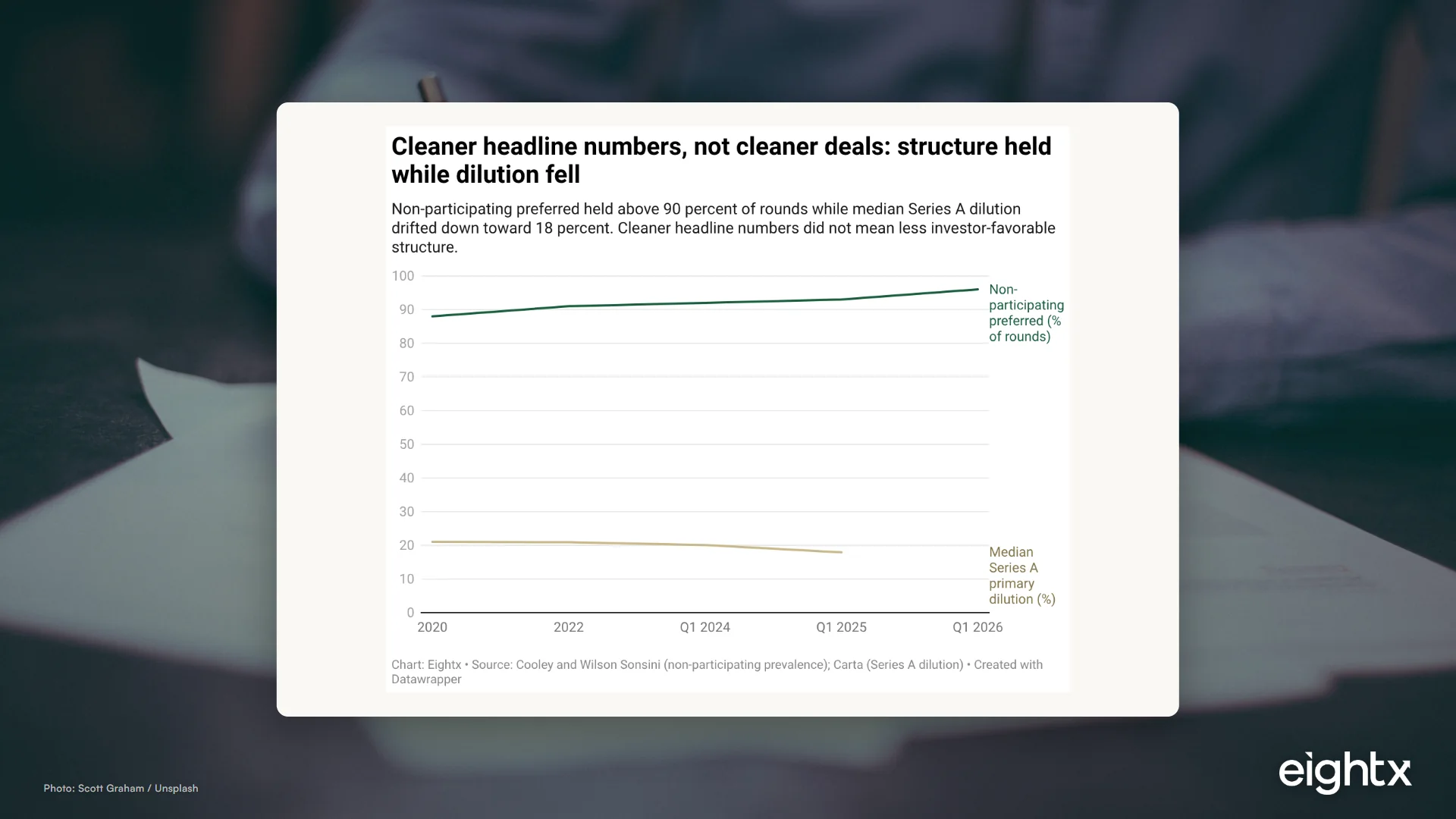
For context on what a normal round even looks like, our average ecommerce funding round size by stage breakdown puts a realistic DTC Series A around $10M to $12M at a $40M to $60M post-money. Carta's Q1 2025 median primary dilution was 17.9 percent, down from roughly 20 percent a year earlier. Here is the trap: that headline dilution dropped while founder outcomes did not necessarily improve, because structured terms now do the work that down-round markdowns used to. The chart below puts the two trends side by side. Non-participating preferred kept climbing while median dilution drifted down, which looks founder-friendly until you read what replaced the markdowns.
Read the structure, not just the percentage. The way an operator does that is the same way you would read any deal: stop looking at the sticker and start modeling what you net.
Liquidation preference: the single biggest lever
Liquidation preference decides who gets paid first in a sale, and how much. There are two dials: the multiple (1x, 2x) and whether it is participating or non-participating.
- 1x non-participating is the founder-friendly standard. The investor takes the greater of their money back or their ownership percentage of the proceeds, not both. This is what the market overwhelmingly uses: Cooley's Q1 2026 report found 96.4 percent of rounds non-participating and 98.2 percent at a 1x preference, and Wilson Sonsini's data shows non-participating climbing from 88 percent in 2020 to 93 percent in H1 2025.
- Participating means the investor takes their money back first, then also takes their ownership percentage of whatever is left. They double-dip.
- A multiple above 1x means they take two or three times their money off the top before anyone else sees a dollar.
So when a fund leads with participating or a multiple above 1x, they are asking you to accept something 96 percent of the market does not require. The chart below is the same $40M exit, the same $10M raised for 25 percent, with only the preference structure changing. Watch $15M walk from the founder column to the investor column.
Where to push: insist on 1x non-participating, because the market gives it to you. If a fund leads with participating, the most common compromise is a cap, for example participating up to 2x or 3x of invested capital, then it converts to common. The pattern we see again and again is that founders who lead with the market data ("96 percent of rounds are non-participating") win this one without spending much capital, because the investor knows the data too. One more thing worth grounding: preferred shares sit on your balance sheet like debt, and at an exit five years out they convert to common to take their share of proceeds. The preference is the rule for how that conversion pays out.
The option pool and the pre-money shuffle
This is the term that costs founders the most while flying under the radar. Investors want an option pool to hire the team, which is fair. The fight is over size and timing.
Over 95 percent of the time (Carta), the pool is created or expanded out of the pre-money valuation, before the round closes. That means you, the existing holders, eat the entire dilution and the new investor's stated ownership is protected. A 15 percent pre-money pool reduces your effective pre-money to roughly 85 percent of the headline number. On a $20M pre-money, that is about $3M of value handed over before the new money even hits the bank.
When I talk to founders about the pool, I tell them what it is actually for: it exists so the long-standing employees who helped you get here, plus a few advisors, have equity to vest into. That framing matters, because once you size the pool to the real people you plan to hire, the number is almost never 15 percent. Here is where to push:
- Shrink the pool to a real plan. Ask for a bottoms-up hiring plan for the next 18 to 24 months. Most rounds do not need 15 percent; many need 8 to 12 percent. Every point you cut is a point of dilution you keep.
- Negotiate timing. Argue that hires made for growth after the round should be partly funded by everyone post-money, not entirely by you pre-money.
- Reframe it as price. Tell the investor that a 15 percent pre-money pool is a price cut, and you would rather they raise the pre-money to compensate. Now it is a valuation conversation, where you have room to move.
Board composition and control
Economics are what you keep. Control is what you decide. At seed, the board is often just the founders, or founders plus one investor, and you keep control. At Series A, expect the lead to want a seat.
The structure to aim for early is a small board where founders are not outnumbered. A common founder-friendly Series A board is two founders, one investor and one mutually agreed independent, which keeps the balance with you. Watch for protective provisions, the list of decisions that need investor consent. A short, standard list (selling the company, issuing senior stock, changing the charter) is normal. A long one that requires investor sign-off on budgets, hires or ordinary spending is creeping operational control. Negotiate that list down.
The control fights that look small on paper end up being the ones that hurt. The worst situations we see are not bad preference terms, they are governance deadlocks: a company we work with nearly came apart because two holders with equal say had a falling-out and could not agree on anything. Decide who controls what before you sign, not after the relationship sours. The same goes for shareholder-update and consent thresholds: agree to keep holders above a certain stake informed, but do not hand a consent right to every decision you make.
Pro-rata, anti-dilution and vesting: know what is standard
These three are where founders waste negotiating capital fighting reasonable terms. The table below splits the standard version of each from the red-flag version worth a fight.
| Term | Standard (accept) | Red flag (push back) |
|---|---|---|
| Pro-rata rights | Investor can maintain their percentage in future rounds | Super pro-rata that lets them take more than their share of the next round |
| Anti-dilution | Broad-based weighted average | Full ratchet, which reprices as if they always paid the lower price |
| Founder vesting | 4 years with a 1-year cliff | Resetting your existing time, no acceleration on a sale, unusually long cliffs |
Pro-rata is fine and signals commitment. The way I explain it to founders: anyone above a set ownership threshold gets the right to buy into your next round so they do not get diluted. If they own 5 percent today and you raise a Series B in two years, they can buy enough of it to stay at 5 percent. It is not free to them, they have to write the check, so it is reasonable. You just have to let them know.
Broad-based weighted-average anti-dilution is the NVCA norm and reasonable. Full ratchet can wipe out common stock in a down round and should be a hard no outside genuine distress financings. Standard 4-year vesting with a 1-year cliff is fair, but make sure you get credit for time already served and negotiate at least single-trigger or double-trigger acceleration so a sale does not cost you unvested equity.
What to do about it
- Model the exit waterfall before you respond. Run the term sheet at three exit values (a soft $40M, a base case, a strong outcome) and see what you net under the actual terms. When a founder asks whether they even need a fractional CFO to get through a round, my honest answer is that with a good lawyer you can, but the one piece of real work you cannot skip is the dilution modeling. The deal you should care about is the dollars in your pocket, not the post-money.
- Rank your asks. Liquidation preference, option pool size and board seats first. Concede pro-rata and standard vesting to buy goodwill.
- Convert structure into price. Any time an investor adds structure (a bigger pool, a participating preference), put a dollar value on it and ask for valuation to compensate. Make them choose.
- Get clean term comparisons. If you are weighing equity against alternatives, our debt vs equity financing guide walks through when not to take the venture money at all.
- Use a lawyer who does this weekly. When the documents arrive, you get ten of them at once, and the skill is knowing which two or three actually matter. A startup-financing specialist will catch the quiet ones (a 1.5x preference buried mid-document, a pay-to-play, a redemption right). Pay for the hour.
If you are still earlier and deciding instruments, our SAFE explainer covers the terms that matter one round earlier. For the wider picture of how a raise fits your capital plan, start with our guide to funding an ecommerce brand.
Sources and methodology
Market-norm figures on liquidation preference come from Cooley's Q1 2026 Venture Financing Report (98.2 percent of rounds at a 1x preference, 96.4 percent non-participating), which is the freshest and highest-authority dataset here. Wilson Sonsini's Entrepreneurs Report supplies the multi-year non-participating time series (88 percent in 2020, 91 percent in 2022, 93 percent in H1 2025), so the trend and the latest point come from two reinforcing sources rather than one.
Dilution and round-structure benchmarks are from Carta cap-table data: median Series A primary dilution of 17.9 percent in Q1 2025 (down from roughly 20 percent a year earlier), median founder ownership of about 36 percent after Series A, and the finding that over 95 percent of term sheets price the option pool out of the pre-money. Some of the Carta dilution and ownership figures are reported via secondary analyses citing Carta's 2025 dataset of roughly 2,000 US software startups rather than a single first-party page, so treat them as directional benchmarks.
The liquidation preference chart is an illustrative model, not observed deal data: a $10M investment at a $40M post-money (25 percent ownership) against a $40M exit, on a clean cap table with no prior preferences and no debt. The 1x non-participating case pays the investor the greater of $10M or 25 percent of $40M, both $10M. The 1x participating case pays $10M off the top, then 25 percent of the remaining $30M ($7.5M), for $17.5M. The 2x participating case pays $20M off the top, then 25 percent of the remaining $20M ($5M), for $25M. The $7.5M gap between non-participating and participating is the double-dip.
Anti-dilution, pro-rata and vesting norms are drawn from the NVCA Model Legal Documents (updated October 2025), the canonical baseline for broad-based weighted-average anti-dilution and 4-year, 1-year-cliff vesting. As international corroboration, HSBC Innovation Banking's 2025 UK data shows 90 percent of UK preference shares non-participating and 96 percent of those at 1x, so the clean-terms pattern holds on both sides of the Atlantic.
One limitation worth flagging: no government statistical series tracks venture term-sheet norms, so every figure here is law-firm or Carta survey data. Those samples skew toward institutional, VC-backed deals and may understate structure in angel, regional or distressed financings. Carta also reports that structured terms cluster in weak rounds: roughly 8 percent of new rounds carried structure in Q1 2024, concentrated in down rounds and recaps. In a competitive round you have the room to refuse structure. Term sheet outcomes are deal-specific, so treat all of this as benchmarks, not legal advice.
Frequently Asked Questions
what terms in a term sheet matter more than valuation?
Liquidation preference, the option pool and where it sits in the pre-money shuffle, board composition, pro-rata rights, anti-dilution and vesting. These decide your real economics and your control. A high valuation paired with a participating preference or full ratchet can leave you worse off than a lower valuation with clean terms.
is a 1x non-participating liquidation preference still standard in 2026?
Yes, more than ever. Cooley's Q1 2026 report found 98.2 percent of rounds carried a 1x preference and 96.4 percent were non-participating. Wilson Sonsini's data shows non-participating climbing from 88 percent in 2020 to 93 percent in H1 2025. Participating or a multiple above 1x is now a clear outlier you can push back on with market data.
what is the option pool shuffle and why does it come out of my pre-money?
Investors usually require the option pool to be created or topped up before the round closes, out of the pre-money valuation. Over 95 percent of term sheets do it this way (Carta), so existing holders, mostly founders, absorb the dilution before the new money arrives. A 15 percent pre-money pool reduces your effective pre-money to about 85 percent of the headline number.
how much should i push back on a term sheet without blowing up the deal?
Push hardest on liquidation preference, option pool size and board seats, because those drive economics and control. Be reasonable on pro-rata and standard 4-year vesting with a 1-year cliff. Pick two or three battles and win them rather than fighting every line. A term sheet is a starting position you negotiate from, not a take-it-or-leave-it.
full ratchet vs weighted average anti-dilution, which one do i fight?
Fight full ratchet. Broad-based weighted average adjusts the conversion price modestly based on how much you raise at the lower price and is the NVCA standard. Full ratchet reprices the investor as if they had always invested at the lower price, which can massively dilute common stock in a down round. Insist on broad-based weighted average.
should i give my investors pro-rata rights?
Usually yes. Pro-rata lets an existing investor maintain their ownership percentage by buying into future rounds. It is standard, signals commitment, and rarely hurts you, and it is not free to them, they pay to participate. The thing to watch is super pro-rata that lets them take more than their share of your next round and crowd out a new lead.
what board composition should i aim for at a seed or series a round?
At seed, keep the board to founders or founders plus one investor. At Series A, a founder-friendly board is two founders, one investor and one mutually agreed independent, which keeps the balance with you. Watch protective provisions creeping onto operating decisions like budgets and hires.
do i need a lawyer or a fractional cfo to negotiate a term sheet?
You need a startup-financing specialist lawyer who reads these weekly to catch the quiet clauses. The big piece of work beyond that is dilution modeling: running the term sheet through an exit waterfall so you know what each clause pays you. A fractional CFO is useful for the modeling, but a strong lawyer is the non-negotiable.