
Compliance
Amazon FBA Sales Tax: Marketplace Facilitator Rules
Under marketplace facilitator laws in all 45 sales-tax states plus DC, Amazon collects and remits sales tax on your FBA orders. You are not off the hook. FBA inventory creates physical nexus, your own Shopify and DTC sales are not covered, and many states still require registration, filings and income tax.
Key Takeaways
- All 45 sales-tax states plus DC have marketplace facilitator laws, so Amazon collects and remits sales tax on every FBA marketplace order.
- FBA inventory creates physical nexus in a state regardless of revenue, even one pallet, which the economic threshold does not protect against.
- Your own Shopify, website and wholesale sales are not covered. You collect and remit those yourself in every nexus state.
- Many states still want you registered and filing zero-dollar or marketplace-deduction returns even when Amazon collects 100 percent of the tax.
- Marketplace laws only touch sales tax. Income, franchise and gross-receipts tax from FBA inventory are entirely on you.
You launched on Amazon, sales took off, and a friend told you "Amazon handles the sales tax now, you are covered." That is half true, and the half that is wrong is the half that shows up in M&A diligence or a state notice three years later.
At Eightx we work with Amazon sellers from $2M to $130M, and this is the single most misunderstood tax topic we see. When I talk to founders running a brand this size, the thing they keep saying is "Amazon handles it now," and that one sentence is hiding a registration list a dozen states long. Marketplace facilitator laws are real and they do a lot of the heavy lifting. But they cover one channel, one tax, and they do nothing about the nexus your FBA inventory quietly created in a dozen states. Let me clear up exactly what Amazon does for you and what is still sitting on your desk.
What marketplace facilitator laws actually do
A marketplace facilitator law makes the marketplace, not the seller, responsible for collecting and remitting sales tax on third-party orders. As of 2026, all 45 states with a general sales tax, plus the District of Columbia, have one on the books (Avalara). Missouri was the last to come online. Five states have no general sales tax at all: Alaska, Delaware, Montana, New Hampshire and Oregon.
So for an order that flows through Amazon's checkout and ships from FBA, Amazon calculates the tax, charges the customer, and sends it to the state. You do not touch it. That is genuine, and it removed a real operational burden that used to fall on sellers.
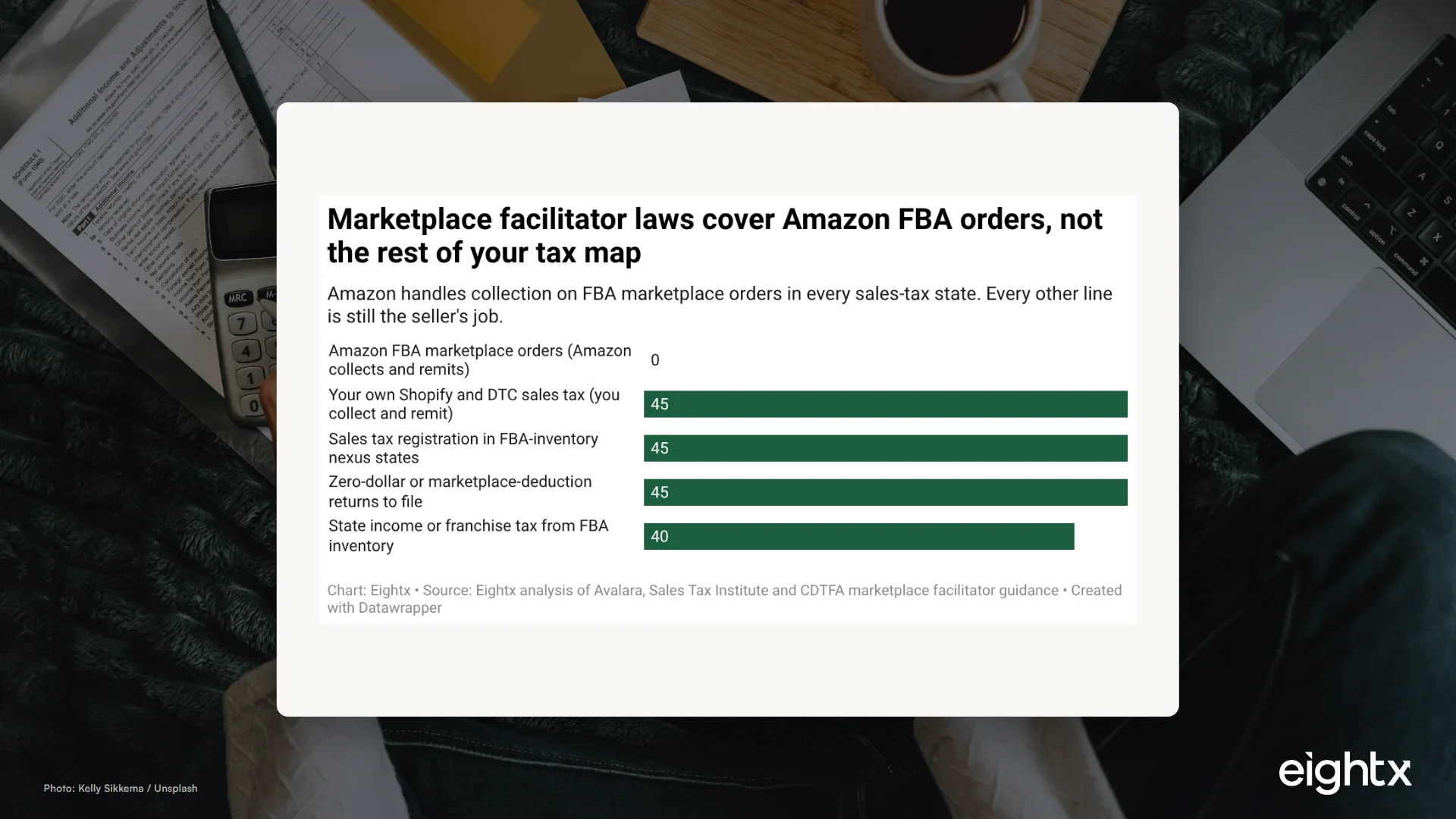
The trap is assuming that because Amazon handles collection on that one channel, your sales tax life is over. It is not. The chart below shows what marketplace laws clear off your plate versus what stays.
One bar is at zero. Every other bar is at 40 or 45. That gap is the whole story.
The FBA inventory trap: physical nexus you did not choose
Here is the part that catches sellers off guard. There are two ways to get sales tax nexus in a state. Economic nexus is triggered by sales volume, usually $100,000 in revenue. Physical nexus is triggered by a presence: an employee, an office, or inventory stored in the state.
Amazon FBA is the classic physical-nexus gotcha. Amazon's algorithm distributes your inventory across its fulfillment network based on demand forecasting, and you do not pick the warehouses. The moment one pallet of your product lands in a California, Texas, Pennsylvania or Florida fulfillment center, you have physical nexus in that state, regardless of how little revenue you do there. A $500K brand can have physical nexus in a dozen states because FBA decided to stage inventory there for faster delivery. The pattern we see again and again is a founder who is certain they are in three states pulling the inventory report and finding their product has touched eleven.
The economic threshold does not save you here. As our economic nexus thresholds guide puts it: economic-nexus thresholds protect you from low-revenue states, but physical nexus blows right through them. Storage equals presence, presence equals nexus, no minimum applies.
Two things to do this week if you are FBA-heavy:
- Pull your Amazon FBA Inventory Event Detail report. It shows every warehouse your inventory has passed through. The list will probably be longer than you expect.
- Treat every state where FBA stored inventory as a state you may need to be registered in, separate from any revenue math.
What Amazon does NOT handle for you
This is the list that turns "I am covered" into "I have exposure." Marketplace facilitator collection leaves all of this on the seller:
- Your own non-marketplace sales. Shopify, your DTC website, wholesale invoices, in-person sales. Marketplace laws only cover marketplace-facilitated orders. Everywhere you have nexus, you collect and remit on these yourself (Sales Tax Institute). This is where multi-channel sellers get burned.
- Registration in nexus states. Marketplace collection does not register you. In many states FBA inventory alone creates a registration obligation; others may relax sales-tax registration but still pull you in on income or business-license grounds. The treatment varies state by state, so check each one rather than assuming.
- Return filing. Many states require a registered seller to file even when Amazon collected everything. You report gross sales, deduct the marketplace-collected portion, and file a zero or near-zero return. Miss it and you eat late-filing penalties.
- Income, franchise and gross-receipts tax. Marketplace laws only touch sales tax. FBA inventory can trigger state income tax apportioned by your in-state sales. California is the most aggressive: an FBA seller "doing business" there faces the $800 annual LLC fee.
- Property tax on inventory. A handful of states tax business personal property, including inventory sitting in a warehouse within their borders.
When I talk to founders running multi-channel brands at this size, the pattern we see again and again is identical. Amazon collects on FBA orders like clockwork, so the founder assumes the whole sales-tax question is handled. Meanwhile their growing Shopify channel is collecting nothing in the 15-plus states where FBA inventory already created nexus. By the time someone catches it the back-tax exposure is sitting in the mid-five figures and compounding every quarter. The fix is voluntary disclosure filings across multiple states plus a full overhaul of the tax software stack. That is the real cost of believing marketplace collection covered everything. Our sales tax nexus guide walks through the full nexus-to-remediation playbook.
Do Amazon sales count toward your own threshold? It is split.
When you also sell direct, you have to know whether your Amazon volume counts toward your own economic nexus threshold for those direct sales. The rules are genuinely split, so do not guess:
| Treatment | States (examples) | What it means for you |
|---|---|---|
| INCLUDE marketplace sales in your threshold | California ($500K), Louisiana ($100K), Alaska Remote Seller Commission ($100K, local sales tax only since Alaska has no statewide tax) | Your Amazon volume can push you over. $300K direct plus $250K Amazon into California hits the $500K mark. |
| EXCLUDE marketplace sales from your threshold | Alabama, Arizona, Arkansas, Colorado, Illinois | Only your direct sales count toward registering for your own collection. |
California is explicit: per the CDTFA Marketplace Facilitator Act guide, you include sales facilitated through a marketplace when computing your $500,000 threshold. When a state's language is ambiguous, default to including marketplace sales, then back it out once you have a clear answer from the state. This split is one reason our multistate sales tax registration guide treats nexus as a per-state question, not a single national number.
How to reconcile marketplace-collected tax
The reconciliation step is where clean books separate the calm sellers from the panicked ones. The mechanics:
- Pull Amazon's marketplace tax collection report, not just the settlement deposit. You need tax collected by state, by month.
- In each state where you file, report gross sales including Amazon orders, then deduct the marketplace-facilitated portion as "tax collected by marketplace." Your taxable sales line then equals only your non-marketplace sales in that state.
- Tie the deducted figure to Amazon's report so the number on your return matches what Amazon actually remitted. If a state ever asks, this is your proof.
- Keep the documentation: Amazon's tax reports, sales by ship-to state, the marketplace certification, and your filed returns. Recordkeeping is the difference between a five-minute response to a notice and a panic.
If your bookkeeper is booking the Amazon settlement as a single "sales" line with no fee or tax breakout, none of this is possible, and you are also overstating revenue and missing deductions. Getting the books audit-ready is the foundation that makes the tax filing work.
What to do about it
In Matt's words, here is the order of operations:
- Run the inventory report first. You cannot map exposure you cannot see. Pull the FBA Inventory Event Detail and list every state.
- Layer in your channel mix. Mark which states have FBA inventory, which have direct sales, and which have both. The both-channel states are your highest risk.
- Check the threshold treatment per state. Include-versus-exclude changes whether your direct-sales registration is even triggered.
- Register before you collect, not after. Sequence the permit before you flip on collection in your own checkout to avoid penalties.
- Put a software layer underneath it. Avalara, TaxJar, Numeral or Anrok handle the mechanics. Entry plans start as low as around $20 a month for tiny volume, and in our experience a multi-channel brand filing across a handful to a dozen states typically lands in the low-to-mid hundreds per month depending on order volume and state count. You pay a CFO or CPA far more to do it by hand.
- Use voluntary disclosure for past exposure. Most states offer a 3-to-4-year look-back with reduced penalties if you come forward. It is almost always cheaper than waiting for the state to find you, and far cheaper than surfacing it during M&A diligence.
For the broader framework across all channels and stages, start with our economic nexus thresholds guide, then drill into the mechanics with our Shopify sales tax setup walkthrough and the sales tax nexus guide.
Methodology
State counts in the chart and dataset reflect the 45 US states plus DC that levy a general sales tax and have enacted marketplace facilitator laws as of 2026, confirmed against Avalara's state-by-state marketplace facilitator guide and the Sales Tax Institute. "States where the seller still has work" reflects that DTC collection, registration and return-filing obligations apply across essentially all 45 sales-tax states, while income or franchise tax from FBA inventory applies in the roughly 40 states with a corporate income or franchise tax. Threshold and inclusion-versus-exclusion treatment is drawn from the CDTFA Marketplace Facilitator Act guide and the Sales Tax Institute economic nexus chart. Figures are framed as state counts and ranges, not precise per-seller liability, which depends on your inventory footprint and channel mix.
Frequently Asked Questions
do i still need to collect sales tax if amazon already does it for fba?
For Amazon FBA marketplace orders, no. Amazon collects and remits under marketplace facilitator laws in all 45 sales-tax states plus DC. But you still collect and remit on your own Shopify, website and wholesale sales, and many states still want you registered and filing returns.
does amazon fba inventory create sales tax nexus?
Yes, it can create physical nexus. The moment Amazon stores even one unit of your product in a state, you may have physical presence there regardless of revenue. The economic threshold does not protect you because physical nexus is a separate trigger.
do i have to file sales tax returns if amazon collects everything?
Often yes. Many states require a registered seller to file even when Amazon collected 100 percent of the tax. You report gross sales, deduct the marketplace-collected portion, and the return shows zero or near-zero taxable sales. Skipping it triggers late-filing penalties.
do marketplace facilitator laws cover my shopify sales?
No. Marketplace facilitator laws only cover sales facilitated by the marketplace. Your own website, Shopify store and wholesale invoices are not covered, so you must collect, remit and file on those yourself in every state where you have nexus.
do amazon sales count toward my own nexus threshold?
It depends on the state. California and Louisiana include marketplace-facilitated sales in your seller threshold, so Amazon volume can push you over. Alabama, Arizona, Colorado and Illinois exclude them, so only your direct sales count. Default to including them when the rule is unclear.
does amazon collecting sales tax cover my income tax too?
No. Marketplace facilitator laws only touch sales tax. FBA inventory in a state can still create state income tax, franchise tax or gross-receipts tax exposure, apportioned by your sales into that state, and that filing is entirely your responsibility.