
Compliance
How to Register for Sales Tax in Multiple States in 2026
Once you cross economic nexus in a state, you register for a sales tax permit with that state, or register across the 23 Streamlined Sales Tax member states in one free application. Then you collect, get assigned a filing frequency, and remit. Register before you collect, and register the moment you cross, not later.
Key Takeaways
- Register the moment you cross nexus. States generally expect registration before your next taxable sale, and every uncollected sale after that becomes a liability you pay out of pocket.
- The Streamlined Sales Tax Registration System covers 23 member states in one free application, which removes most of the per-state paperwork.
- State registration fees are nominal and one-time in the states that charge them, and many states charge nothing. The real cost is ongoing filing, not the permit.
- Filing frequency is assigned by the state based on your liability. Bigger sellers get bumped to monthly and sometimes prepayments. A 15-state footprint can mean dozens of returns a year.
- Registering late triggers the back-tax trap: open lookback, penalties, and interest. A voluntary disclosure agreement filed first usually caps the lookback period and waives penalties.
You crossed economic nexus. Maybe you got the alert from your tax software, maybe your accountant flagged it, maybe you just did the math after reading our economic nexus thresholds breakdown. Either way, the answer is the same: you now have to register, collect, and file in every state where you crossed the line. This is the part nobody walks you through cleanly, so here is the operator version.
The good news is registration is mostly paperwork, and a big chunk of it can be done in one shot. The bad news is the cost and the deadline. Wait too long and the cheap part (the permit) gets dwarfed by the expensive part (back taxes you collected from nobody and now owe out of your own margin).
Step one: confirm where you actually owe, before you register anywhere
Do not register reflexively. Registering in a state creates a filing obligation forever, even for months you owe zero. If you register in 30 states out of caution, you have just signed up for 30 returns a quarter for the rest of your life, most of them zeroes.
So the first move is a real nexus map. Pull your in-state revenue and transaction counts against each state's 2026 threshold, and add physical nexus from any Amazon FBA warehouse or 3PL location, because inventory storage creates nexus regardless of revenue. Register only where you have genuinely crossed. The way we explain it to founders: "the nexus is typically rolling four quarters, and it's by state, not federally. If your last few quarters in a state are over the line, now you have nexus and now you have to file there." Our economic nexus thresholds guide walks the full analysis if you want the framework.
Step two: register, and use the SST shortcut where you can
There are two registration paths, and you will use both.
The Streamlined Sales Tax shortcut. The Streamlined Sales Tax Registration System (SSTRS) lets you register across all 23 SST member states in a single free application, per the Streamlined Sales Tax Governing Board. This is the single biggest time-saver in the whole process. Instead of 23 separate state portals, you fill out one form. SST member states include a lot of the messy middle of the country, so if your nexus footprint is broad, SSTRS knocks out the bulk of it in an afternoon. SST also connects you to Certified Service Providers, third parties that can file and remit for you in member states, sometimes at state-subsidized rates.
Direct state registration for everyone else. The high-revenue, high-population states you care about most, California, Texas, Florida, New York, are not SST members. You register directly with each state's department of revenue. Each has its own online portal (Texas Comptroller, Florida Department of Revenue, CDTFA in California). Budget 20 to 40 minutes per state.
The permit fees are trivial. Most states charge nothing. Where they do charge, the fee is nominal and one-time. Confirm the current fee on each state's department of revenue page, but do not let the permit fee drive any decision. It is a rounding error next to filing cost and back-tax risk.
Step three: get assigned a filing frequency and learn what it costs you
Once registered, the state assigns you a filing frequency based on your tax liability. The four common buckets are monthly, quarterly, semiannual, and annual, and states base the assignment on your prior or estimated activity (TaxCloud, 2026).
The pattern: small sellers file annually or quarterly, and as your liability grows the state bumps you to monthly. Each state sets its own thresholds for the move, so check the current rule on each department of revenue page. Once a brand is remitting real volume, a lot of states end up monthly. When we look at a brand collecting around $47k a month in tax across many states, the working assumption is "a lot of these you're monthly remitting." The biggest sellers get put on prepayment schedules, where you remit before the period even closes; some states put very high-volume sellers on prepayment schedules like this.
This is where the real workload lives. A 15-state footprint where half the states have you on monthly and half on quarterly is easily dozens of returns a year. Each one has its own portal, its own deadline (often the 20th of the following month, but not always), and its own quirks. That volume, not the registration, is what you are actually buying when you choose your approach.
Step four: choose DIY, automation, or outsourced, with eyes open
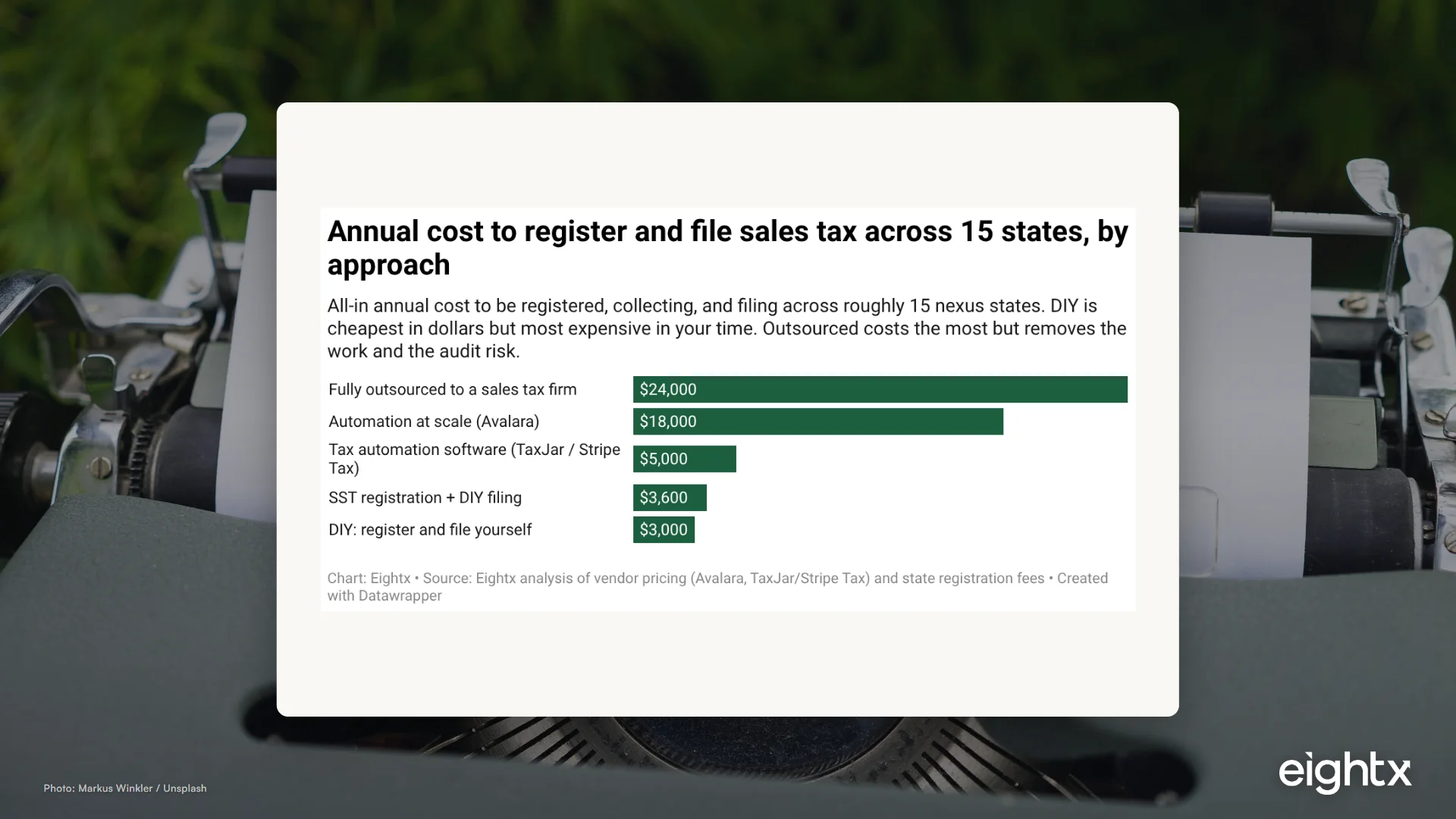
Here is the honest cost picture across roughly 15 nexus states.
Read it as a trade between dollars and your time and risk. DIY is cheapest in cash and most expensive in hours and missed-deadline risk. Outsourced costs the most but the work and the audit exposure leave your desk. The numbers below are Eightx directional estimates for a brand registering and filing across roughly 15 states, not vendor list prices; see the methodology note for how they are built and why you should treat them as ranges.
The bands, lowest to highest:
- DIY. You register and file every return yourself. Lowest cash cost, but you are paying in owner-hours and missed-deadline risk. Fine at low state counts; brutal once you are past 10 states on mixed frequencies.
- SST plus DIY filing. SST registration is free, and Certified Service Providers can lower the per-return cost in member states. Roughly DIY economics with less per-state setup friction.
- Automation software. TaxJar or Stripe Tax with AutoFile. The default for most DTC brands under about $5M, and a real step up in cost from pure DIY for the time it saves.
- Automation at scale (Avalara). Meaningfully more once you have B2B, exemption certificates, or 20-plus states. You are buying CertCapture and audit-grade reporting, not a better calculator.
- Fully outsourced. A sales tax firm runs registration and filing end to end, the highest cash cost of the four. Worth it when finance is thin and the cost of a missed return or a botched audit dwarfs the fee.
Cost sensitivity here is real, and founders feel it. We have had operators paying around $2,000 a month for sales tax help where the honest answer was "that sounds like a lot, and if the software does most of the work we can babysit it inside what we already do for you." The right number depends on state count and channel mix, not a sticker price.
Step five: do not register late, the back-tax trap is the real risk
This is the one that actually costs money. States generally expect you to register before your next taxable sale once you cross nexus. The moment you keep selling without registering, every sale becomes a liability: you owe the tax whether or not you collected it from the customer, plus penalties and interest.
Until you register, the lookback is effectively open, and a state that finds you can assess back taxes plus penalties and interest. The fix, if you are already behind, is a voluntary disclosure agreement (VDA) filed before the state contacts you. A VDA typically caps the lookback period and waives penalties, which is usually far cheaper than a penalty assessment if the state catches you first. The math strongly favors going to the state before it comes to you, especially if a raise or exit is on the calendar; back-tax exposure is one of the top sales-tax surprises in M&A diligence.
If the exposure is large, sequence the conversation carefully. We have done this more than once, and the order matters: talk to a lawyer before the accounting firm, because you have privilege, and the research the firm produces can be covered by that privilege if the lawyer engages them. Do not put your worst-case numbers in an unprivileged email first.
Once your registrations are in place, the storefront-side collection setup is the next job. This whole post is US-only; selling into Canada or the EU brings GST, PST, and VAT, and international is its own beast.
What to do about it
- Run a real nexus analysis first. Map in-state revenue, transaction counts, and FBA or 3PL inventory locations against each state's 2026 threshold. Register only where you have actually crossed.
- Register through SST in one pass. Use SSTRS to cover the 23 member states in a single free application before you touch any individual state portal.
- Register directly in the big non-SST states. California, Texas, Florida, New York. Budget half an hour each.
- Register before you collect, and do it the week you cross. Do not let uncollected sales pile up into a back-tax liability.
- Address any past gap with a VDA, not a forward-only registration. If you crossed nexus months or years ago, file a voluntary disclosure agreement before registering to cap the lookback.
- Pick your approach by state count and channel mix, not revenue alone. DIY or TaxJar under $5M and clean DTC; Avalara or outsourced once you have B2B, exemption certificates, or 20-plus states.
Methodology
Cost figures are directional ranges for a brand at roughly $5M to $15M of revenue registering and filing across about 15 nexus states. They are Eightx's own estimates, ordered lowest to highest by approach, and should be read as ranges rather than precise quotes. The public benchmarks behind the general "compliance gets expensive once you are multi-state" point are triangulated from older and broader surveys (Avalara's 2021 cost-of-compliance survey, which benchmarked an emerging small business at about 131 hours per month on sales tax once multi-state, the NetChoice cost-of-collection study, and a SaaS-focused Anrok benchmark), not a single current ecommerce-only dataset, which is another reason to treat the dollar figures as directional. Registration process and the SST member count (23 states) come from the Streamlined Sales Tax Governing Board. Filing frequency rules come from TaxCloud's 2026 filing frequency guide; each state sets its own thresholds, so confirm the current rule on the relevant department of revenue page. None of this is legal advice; confirm each state's current rules before you register.
Frequently Asked Questions
how do i register for sales tax in multiple states at once?
Use the Streamlined Sales Tax Registration System (SSTRS), which registers you across the 23 SST member states in one free application. For non-member states like California, Texas, and Florida, you register directly with each state's department of revenue. Most operators do SST first, then knock out the direct-registration states one at a time.
how much does it cost to register for a sales tax permit?
The permit itself is cheap: many states charge nothing, and where a state does charge, the fee is nominal and one-time. SST registration is free across its 23 member states. The real cost is not the permit, it is the ongoing filing. Once you are multi-state, compliance work scales fast, so plan around the filing burden rather than the registration fee.
what is the streamlined sales tax registration system?
SSTRS is a single online application that registers you for sales tax across the 23 Streamlined Sales Tax member states at once, for free. It also gives you access to Certified Service Providers (CSPs), third parties that can calculate, file, and remit on your behalf in member states, sometimes at state-subsidized rates. It does not cover non-member states, so you still register directly in places like California and Texas.
how do states decide my sales tax filing frequency?
States assign frequency based on your tax liability or sales volume, usually reviewing your prior or estimated activity. Small sellers file annually or quarterly; once your liability climbs, the state bumps you to monthly. Once you are remitting real volume, a lot of states put you on monthly. Very high-volume sellers can also be put on prepayment schedules in some states, where you remit before the period closes.
what happens if i register for sales tax late after crossing nexus?
You walk into the back-tax trap. Until you register, the state's lookback is effectively open, and they can assess back taxes plus penalties and interest. The fix when you are already late is a voluntary disclosure agreement filed before the state contacts you, which typically caps the lookback period and waives penalties. Registering forward-only without addressing the gap leaves the old exposure live. For larger exposure, talk to a lawyer before the accounting firm so the analysis stays privileged.
should i register for sales tax myself or use software?
Under about $5M with a clean DTC plus marketplace mix, DIY registration plus a tool like TaxJar or Stripe Tax with AutoFile is usually the cheapest sensible path. Past $5M to $10M, or with B2B and exemption certificates, Avalara or a fully outsourced firm earns its higher cost by removing audit and diligence risk. Pick based on state count and channel complexity, not just revenue.